Table of contents

An HVAC contractor's lifecycle value is built from three job-level habits, not a subscription metric: does the customer call back, do they renew the maintenance agreement, and do they send a referral. ServiceTitan, Housecall Pro and a 300-firm ACCA benchmarking study are the named sources behind the numbers on this page.
Key Takeaways
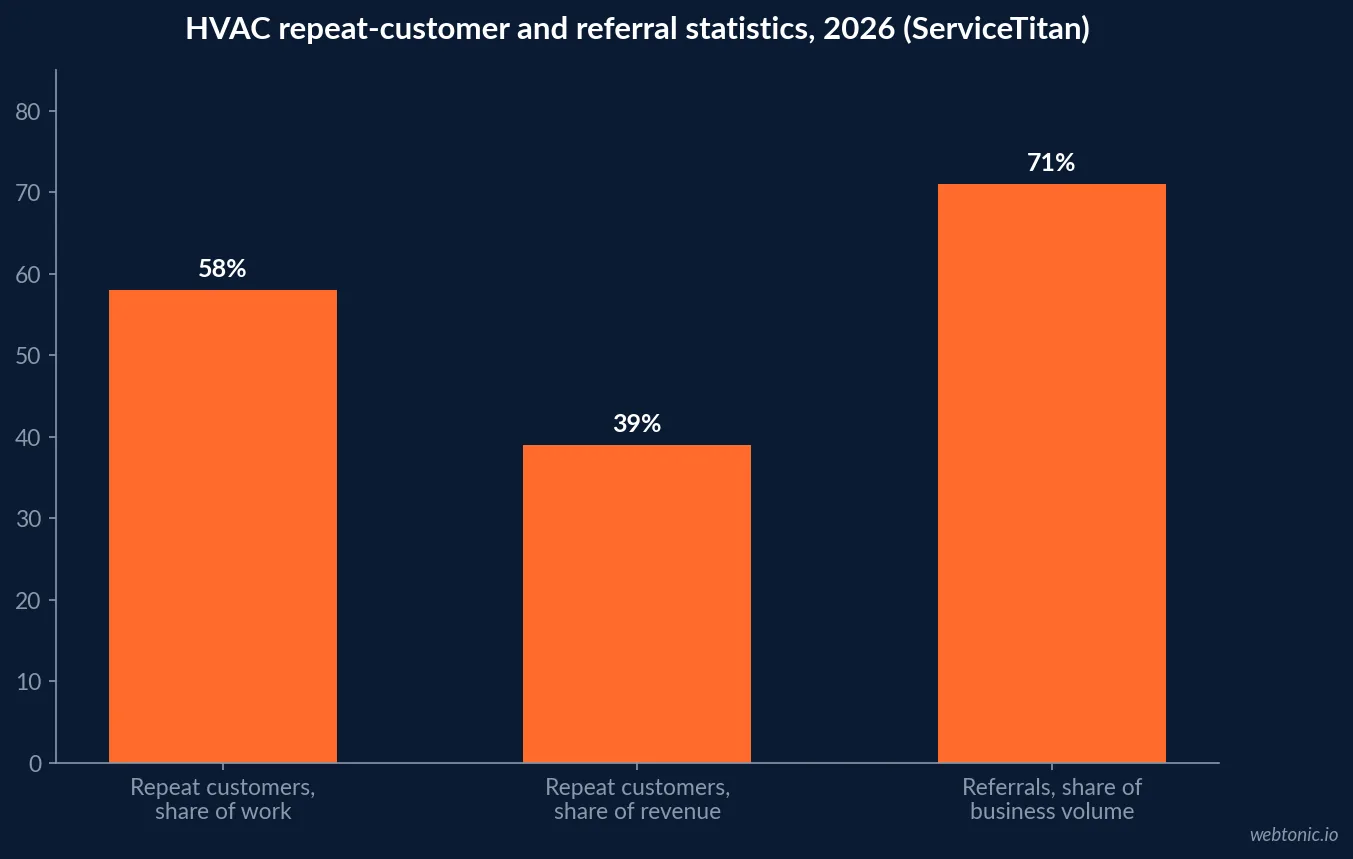
- Repeat customers drove 58% of completed work and 39% of annual revenue across residential contractors, per ServiceTitan's 2023 survey (2022 data) of 1,000-plus firms.
- Word-of-mouth referrals account for 71% of residential contractor business volume in the same survey.
- A healthy maintenance agreement program clears an 86% annual renewal rate, per the industry KPI cited by Contracting Business.
- ACCA's 2016 benchmarking guide surveyed more than 300 contracting firms on agreement sales, renewals and cost - still the only named agreement census.
- Repairs made up about 88% of HVAC jobs on Housecall Pro's platform in the period measured for its 2026 report.
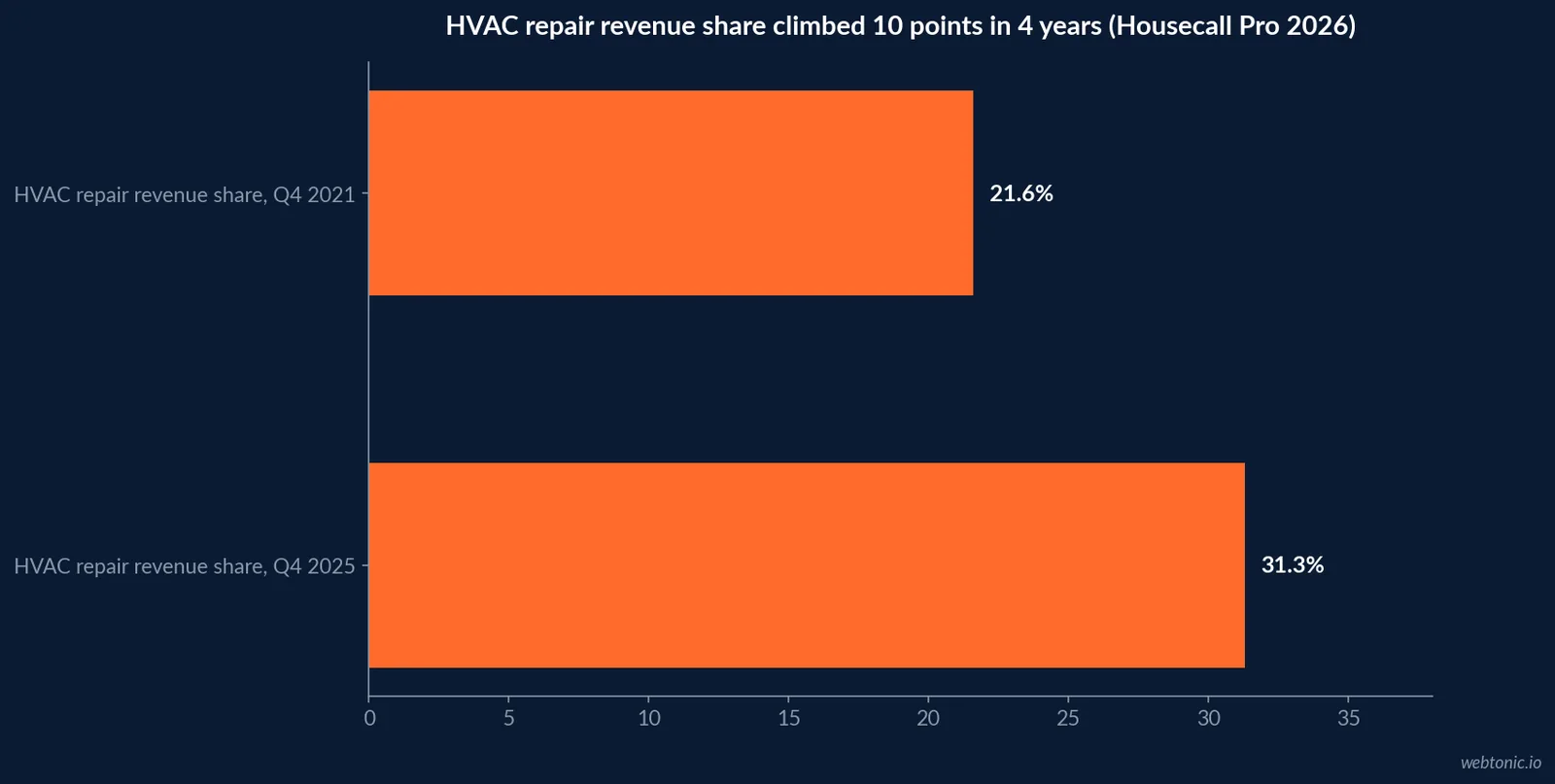
- HVAC repair's share of category revenue rose from 21.6% in Q4 2021 to 31.3% in Q4 2025, a nearly 10-percentage-point shift toward repair.
- 79% of homeowners plan to repair or replace at least one home system in 2026, per Housecall Pro's State of Home Service Spending report.
- A 5-percentage-point increase in retention lifts profit by 25% to 95%, per Bain & Company's Reichheld research.
- 58% of homeowner service calls start from an active failure, and only 47% from routine maintenance, per Housecall Pro's homeowner survey.
- Multi-system homeowners plan 70% routine upkeep and 26% full system replacement work in 2026.
- 72% of homeowners plan to stay in their current home, extending the window a maintenance-agreement relationship can compound in.
- A weak agreement program renewing well under the 86% KPI loses most of its compounding value inside two renewal cycles.
- ACCA's guide breaks agreement performance out by firm revenue band, so a shop can benchmark against similarly sized peers, not the whole market.
- Referral volume and agreement renewal are additive, not substitutes - the 71% referral figure and the 39% repeat-revenue figure come from the same survey population.
- Housecall Pro's data ties revenue trend directly to repair share, not replacement volume, which is the number a retention program should watch quarterly.
- $3,000-plus in planned 2025 home-project spend was reported by 59% of homeowners surveyed, a spending floor a maintenance-agreement pitch can reference.
- None of these figures require subscription billing software - they come from job history and lead-source fields most field-service platforms already log.
- The KPI gap between an 86% renewal target and a typical unmanaged book is the single biggest lever in HVAC lifecycle marketing.
Benchmarks at a glance
| Lifecycle metric | Reported figure | Source | What it measures |
|---|---|---|---|
| Repeat-customer share of work | 58% | ServiceTitan Residential Service Contractor Market Report (2022 data) | Jobs from existing customers |
| Repeat-customer share of revenue | 39% | ServiceTitan Residential Service Contractor Market Report (2022 data) | Dollars from existing customers |
| Referral share of business volume | 71% | ServiceTitan Residential Service Contractor Market Report (2022 data) | New volume from word of mouth |
| Maintenance agreement renewal KPI | 86%+ | Contracting Business (HVAC trade press) | Annual agreement renewal target |
| HVAC repair share of jobs | ~88% | Housecall Pro 2026 State of Home Service Spending | Repair vs. full replacement |
Repeat business and referrals are the HVAC lifecycle
ServiceTitan's Residential Service Contractor Market Report, built from a survey of more than 1,000 residential contractors, found repeat customers accounted for 58% of completed work and 39% of annual revenue in the survey year, and that word-of-mouth referrals made up 71% of business volume. That is the closest thing to an HVAC-specific lifetime-value baseline available today - built from field-service jobs, not a subscription ledger.
The two figures are additive: a customer who renews a maintenance agreement is also the customer most likely to refer a neighbor, because they have already had two or three good experiences with the same technician.
Maintenance agreements: the renewal number that matters
The industry key-performance-indicator cited by Contracting Business sets an 86% annual renewal rate as the floor a healthy residential maintenance-agreement program should clear, with the rate expected to climb every additional year a shop runs the program. ACCA's 2016 Residential Service Agreements: A Benchmarking Guide, built from a survey of more than 300 contracting firms, remains the only named industry census of agreement sales, renewal attempts and plan cost structure - a decade old, but still the reference point contractors cite because nothing newer has replaced it.
| Agreement metric | Benchmark | Source | Year of data |
|---|---|---|---|
| Annual renewal rate floor | 86%+ | Contracting Business HVAC KPI | 2016 |
| Firms surveyed for agreement census | 300+ | ACCA Residential Service Agreements guide | 2016 (2015 data) |
| Survey scope | Number of agreements, sales, renewals, cost, discounts, marketing cost | ACCA | 2016 |
| Report cost to non-members | USD 499 (USD 299 members) | ACCA | 2016 |
The shift from replacement to repair changes the lifecycle math
Housecall Pro's 2026 State of Home Service Spending report, based on platform data plus a survey of 1,100-plus U.S. homeowners, found repairs made up roughly 88% of HVAC jobs in the quarter measured, and that HVAC repair's share of category revenue rose from 21.6% in Q4 2021 to 31.3% in Q4 2025. A repair-led book is a retention-led book: the same customer is calling back rather than a new customer shopping for a full system swap.
The same report found 79% of homeowners plan to repair or replace at least one home system in 2026, with the leading trigger being an active failure (58%), followed by a smaller issue getting worse (51%) and routine maintenance (47%). Only 38% cite a planned upgrade - most HVAC calls are still reactive, which is exactly where a maintenance-agreement relationship earns its keep by getting the call before a competitor does.
Why the old retention math still holds
Frederick Reichheld's research, publicized through Bain & Company and still hosted on bain.com, found that a 5-percentage-point increase in customer retention increases profits by 25% to 95%. The research is decades old and not HVAC-specific, but the underlying mechanism - acquisition cost is front-loaded, and profit compounds in later-year visits - maps cleanly onto a trade where the first service call rarely breaks even and the third or fourth call is where the margin lives.
| Homeowner spending signal (2026) | Share | Source |
|---|---|---|
| Plan to repair/replace a home system | 79% | Housecall Pro State of Home Service Spending |
| Plan to stay in current home | 72% | Housecall Pro State of Home Service Spending |
| Spent more than USD 3,000 on home projects in 2025 | 59% | Housecall Pro State of Home Service Spending |
| Service trigger: active failure | 58% | Housecall Pro State of Home Service Spending |
| Service trigger: routine maintenance | 47% | Housecall Pro State of Home Service Spending |
Building an agreement-renewal scorecard
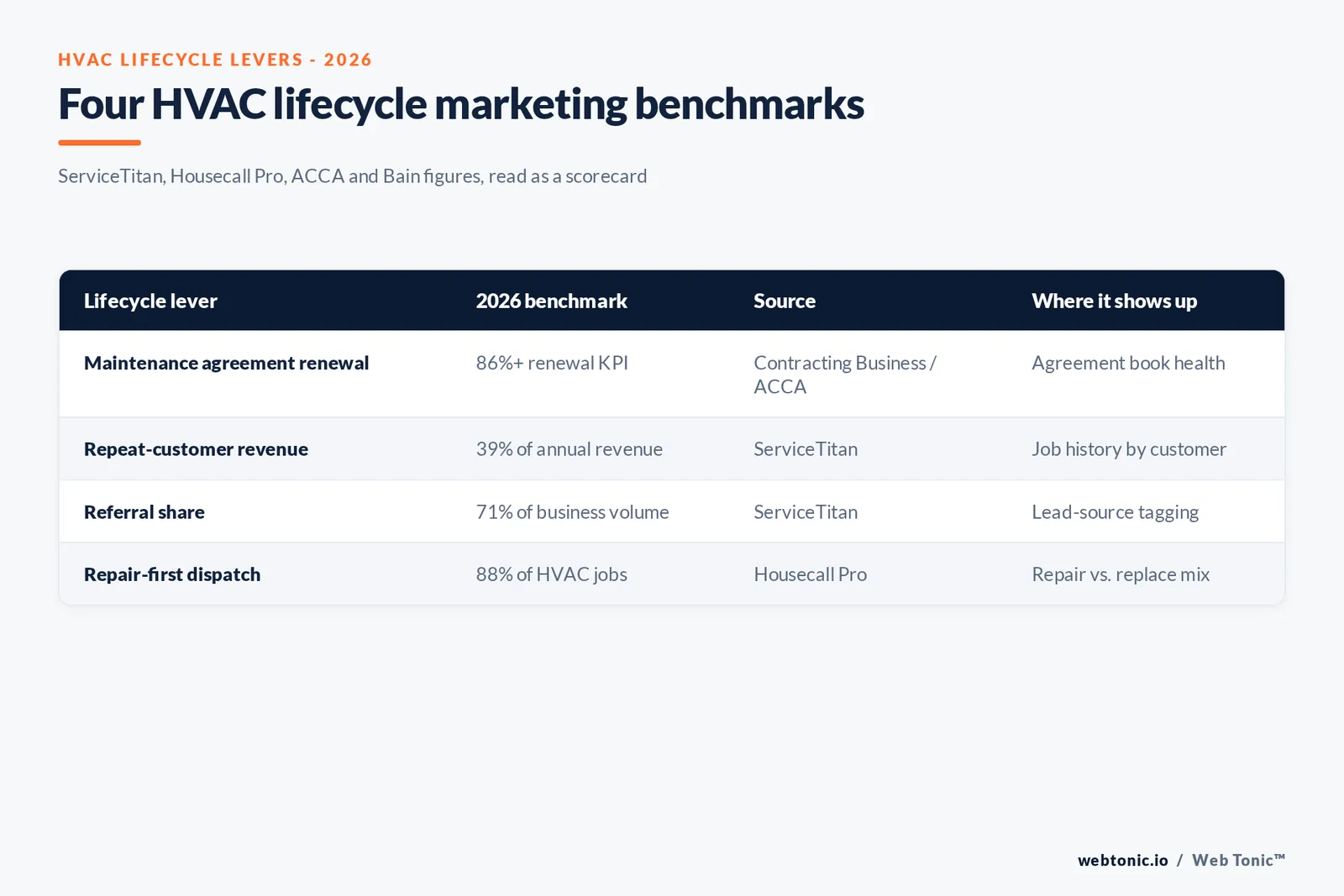
The four numbers above give a residential HVAC shop a scorecard without a subscription platform: agreement renewal rate against the 86% KPI, repeat-customer revenue share against ServiceTitan's 39% figure, referral share against its 71% figure, and repair-job share as a proxy for how retention-dependent the current book already is. A shop tracking below the 86% renewal floor is leaking the exact customers that Reichheld's research says are the most profitable ones to keep.
Where marketing spend should follow the data
Every source on this page points the same direction: the largest lifecycle lever for a residential HVAC business is the maintenance agreement, because it is the one relationship that converts a reactive 58%-of-calls failure event into a scheduled visit. A retention program built around CRM-driven follow-up and review requests after every visit compounds the referral share ServiceTitan measured at 71%, without needing a new billing system to prove it is working.
| Lifecycle lever | Benchmark it moves | Primary source |
|---|---|---|
| Maintenance agreement renewal outreach | 86%+ renewal KPI | Contracting Business / ACCA |
| Post-visit review and referral ask | 71% referral share | ServiceTitan |
| Repeat-customer follow-up cadence | 39% repeat revenue share | ServiceTitan |
| Repair-first dispatch triage | 88% repair job share | Housecall Pro |
| Retention-focused CRM segmentation | 25-95% profit lift per 5-point retention gain | Bain / Reichheld |
What a benchmarking exercise looks like in practice
ACCA's guide breaks agreement performance out by firm revenue band precisely because a 10-truck shop and a 2-truck shop should not be judged against the same renewal curve. A contractor running below the 86% KPI floor is not automatically failing - it may be running against a peer group with structurally lower agreement pricing - but the direction of travel matters more than the absolute number: a renewal rate that climbs year over year is the sign a program is compounding the way Reichheld's research predicts it should.
The same logic applies to referral share. ServiceTitan's 71% figure is a population average across residential contractors, not a target every individual shop must hit, but a shop sitting well below it is very likely under-asking for reviews and referrals at the point of service, the single cheapest lever on this entire page to test.
| Quick self-audit question | Benchmark to compare against | Data source |
|---|---|---|
| What share of last year's revenue came from repeat customers? | 39% | ServiceTitan |
| What share of new customers named a referral as their source? | 71% | ServiceTitan |
| What is the current maintenance-agreement renewal rate? | 86%+ | Contracting Business / ACCA |
| What share of HVAC jobs were repairs vs. full replacements? | ~88% | Housecall Pro |
| Has retention improved or declined over the last 2 renewal cycles? | Directional, not absolute | Bain / Reichheld |
A partner running the reporting layer behind this scorecard can pull all five answers from existing field-service job history without new billing software, and a marketing team can then build the follow-up cadence around whichever benchmark shows the widest gap.
Frequently Asked Questions
What share of HVAC revenue comes from repeat customers?
ServiceTitan's 2023 Residential Service Contractor Market Report (2022 data), a survey of more than 1,000 residential contractors, found repeat customers accounted for 58% of completed work and 39% of annual revenue in the most recent survey year, with word-of-mouth referrals contributing 71% of business volume. That is the lifecycle number to plan a retention budget against, not a SaaS net-revenue-retention figure - HVAC contractors sell jobs, not subscriptions.
Do maintenance agreements actually renew at a high rate?
Contracting Business, an HVAC trade publication, cites an industry key-performance-indicator of at least an 86% annual renewal rate for residential maintenance agreements as the bar a healthy program should clear, with the benchmark rising each year a contractor runs one. ACCA's 2016 Residential Service Agreements: A Benchmarking Guide, built from a survey of more than 300 contracting firms, remains the only named industry study of agreement sales, renewals and cost structure - dated, but still the closest thing HVAC has to a maintenance-plan census.
Is HVAC work shifting toward repair over full replacement?
Yes. Housecall Pro's 2026 State of Home Service Spending report shows repairs made up roughly 88% of HVAC jobs on its platform in the most recent quarter measured, and HVAC repair's share of category revenue rose from 21.6% in Q4 2021 to 31.3% in Q4 2025 - a repair-led shift that raises the value of a maintenance-agreement customer who calls back instead of shopping around.
Does the old '5% retention lifts profit' rule still apply to HVAC?
The underlying research is Bain & Company's Frederick Reichheld, publicized in the 1990s and still hosted by Bain: a 5-percentage-point increase in customer retention increases profits by 25% to 95%, because acquisition cost is front-loaded and the profit shows up in later-year visits. It is old research and cross-industry, but the mechanism - a maintenance-agreement customer costs nothing to re-acquire - maps directly onto HVAC's repeat-and-referral economics.
What should an HVAC contractor track instead of a churn rate?
Three numbers from the sources above: agreement renewal rate against the 86% KPI benchmark, repeat-customer share of revenue against ServiceTitan's 39% industry figure, and referral share of new volume against its 71% figure. None of those requires a subscription-billing platform - they come out of whatever field service software already logs job history and lead source.
Sources
ServiceTitan - Residential Service Contractor Market Report (2023, 2022 data)
Contracting Business - HVAC Maintenance Agreements by the Numbers
ACCA - 2016 Residential Service Agreements: A Benchmarking Guide
Housecall Pro - 2026 State of Home Service Spending Report
Bain & Company - Loyalty Rules (Reichheld retention-profit research)