
Table of contents
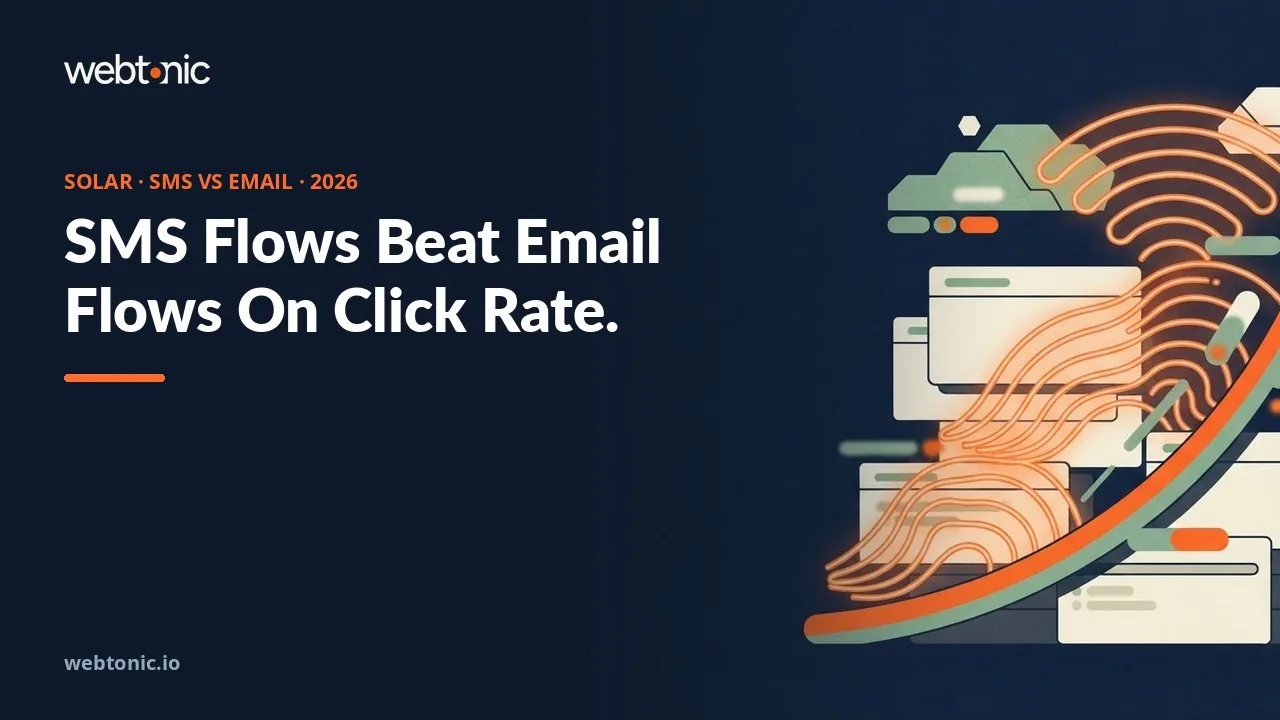
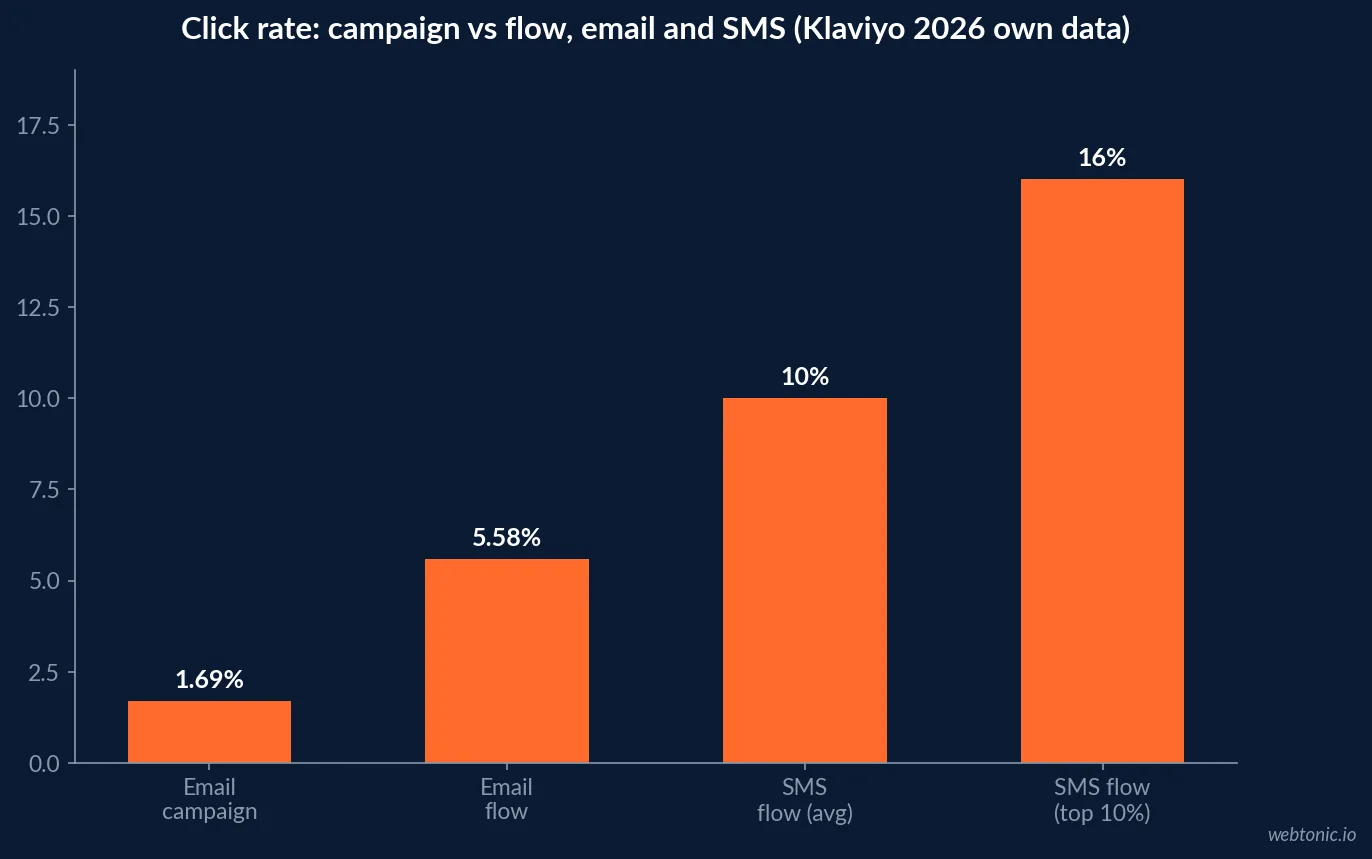
Klaviyo's own 2026 data, built from 183,000 customers, shows SMS flows landing close to a 10% click rate against a 1.69% click rate for broadcast email campaigns in the same dataset. Neither figure is solar-specific, but the same vendor measured both channels the same way, which is the fairest side-by-side available without commissioning new research.
Key Takeaways
- SMS flow click rates average close to 10%, with top performers above 16%.
- Email flow click rates average 5.58%, over 3 times the 1.69% campaign rate.
- SMS flows draw 45.2% of SMS revenue from just 7.6% of sends.
- Email flows draw 41% of email revenue from just 5.3% of sends.
- 64.4% of SMS flow revenue comes from new recipients, against 20% for campaigns.
- Twilio's own long-code SMS price is USD 0.0083 per segment.
- Twilio's MMS price is USD 0.022 outbound on the same long-code number.
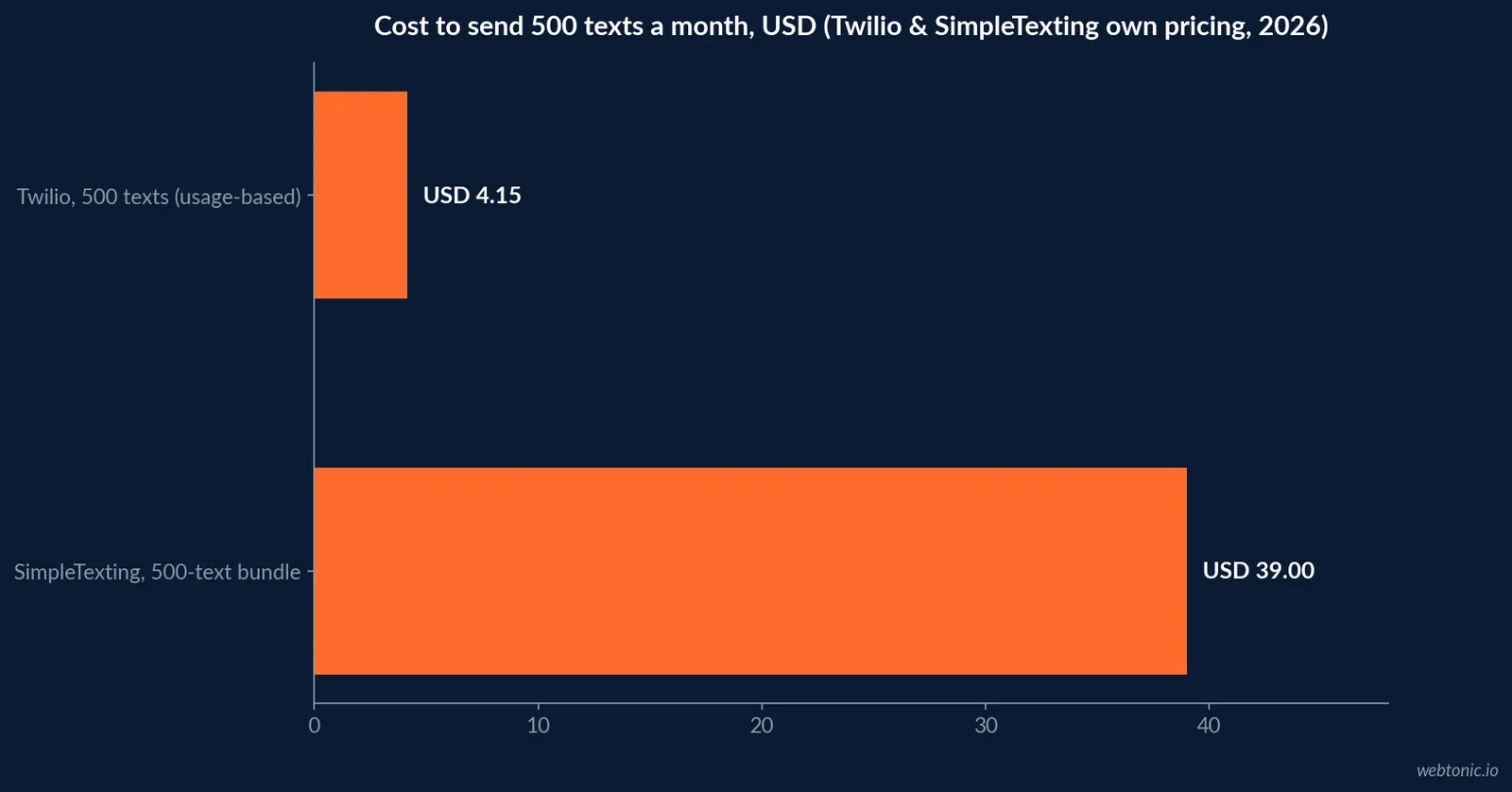
- SimpleTexting estimates about USD 39 a month for a 500-text monthly plan.
- That plan carries a USD 4 one-time carrier registration fee.
- EZ Texting charges 1 credit per SMS and 3 credits per MMS.
- EZ Texting does not charge for inbound replies at all.
- The FCC's one-to-one consent rule was vacated on January 24, 2025.
- It is not back in force - base TCPA consent rules still apply.
- Quiet hours run 8am to 9pm local time under 47 CFR 64.1200.
- Top 10% of SMS flows post revenue per recipient above USD 5.
- Top 10% of email flows post revenue per recipient up to USD 7.79.
The side-by-side, from one vendor's own data
Comparing SMS and email fairly means comparing them inside the same measurement system. Klaviyo's own 2026 SMS benchmarks and its own 2026 email benchmarks are both built from the same base of over 183,000 customers - mostly e-commerce, not solar, so read the gap between channels as the signal, not either raw number as a solar target.
| Metric (2026, Klaviyo's own data) | SMS | What the gap says | |
|---|---|---|---|
| Flow click rate | 5.58% | ~10% (avg) | SMS wins on triggered messages |
| Campaign (broadcast) click rate | 1.69% | Not separately published | Broadcast underperforms triggered, either channel |
| Top-10% flow click rate | Over 10% | Over 16% | Segmentation compounds in both channels |
| Share of sends that are flows | 5.3% | 7.6% | Both channels lean on automation for volume |
| Share of channel revenue from flows | 41% | 45.2% | Automation carries outsized revenue share |
| New-recipient share of flow revenue | 48% | 64.4% | SMS flows skew even more toward first-touch |
What install-day logistics actually favor
The revenue-source split points to a practical rule rather than a channel preference: SMS flows draw 64.4% of their revenue from new recipients against just 20% for SMS campaigns, and email flows draw 48% from new recipients against 16% for campaigns. A one-time, time-boxed message - an install-day reminder, a permit-inspection window, a "your system is now live" text - fits the flow pattern in either channel far better than a recurring newsletter does. That argues for SMS on same-week logistics and email on anything with a document attached, like a warranty PDF or a financing agreement.
| Solar use case | Better fit | Why | Compliance note |
|---|---|---|---|
| Install-day / crew arrival reminder | SMS | Time-boxed, high open urgency | Needs prior consent, not just a phone number on file |
| Permit or inspection scheduling | SMS | Short, single fact to deliver | Quiet-hours window still applies |
| Warranty documents / contracts | Attachments, longer read | CAN-SPAM unsubscribe link required | |
| Post-install review request | Either | Both show strong flow performance | STOP keyword must be honored either way |
| Seasonal maintenance offer | Lower urgency, more context needed | Marketing consent, not just transactional |
What sending it actually costs
Twilio's own US pricing page lists long-code SMS at USD 0.0083 per segment, both outbound and inbound, with MMS at USD 0.022 outbound and USD 0.0165 inbound, on a pay-as-you-go basis with no monthly minimum. SimpleTexting's own pricing calculator estimates roughly USD 39 a month for a bundled 500-text plan (or USD 398.40 billed yearly), plus a USD 4 one-time carrier registration fee and extra credits at 5.5 cents each, with a local number adding USD 10 a month and each extra user seat USD 20 a month. EZ Texting's own pricing FAQ states an SMS costs 1 credit and an MMS costs 3 credits, that it does not charge for inbound messages, and that its Launch plan carries a USD 5 a month telecom fee that is waived on its Boost, Scale and Enterprise tiers.
| Provider (own pricing page, 2026) | Unit cost | Monthly bundle | Note |
|---|---|---|---|
| Twilio (pay-as-you-go) | USD 0.0083 / SMS segment | None - usage-based | No monthly minimum, own number required |
| Twilio MMS | USD 0.022 outbound | None - usage-based | USD 0.0165 inbound on long code |
| SimpleTexting | 5.5c per overage credit | ~USD 39 / 500 texts | Plus USD 4 one-time registration |
| EZ Texting | 1 credit / SMS, 3 / MMS | Varies by plan (Launch-Enterprise) | Inbound replies are free |
| EZ Texting Launch telecom fee | USD 5 / month flat | Waived on higher tiers | Covers mandatory carrier fees |
What is actually still required before you text anyone
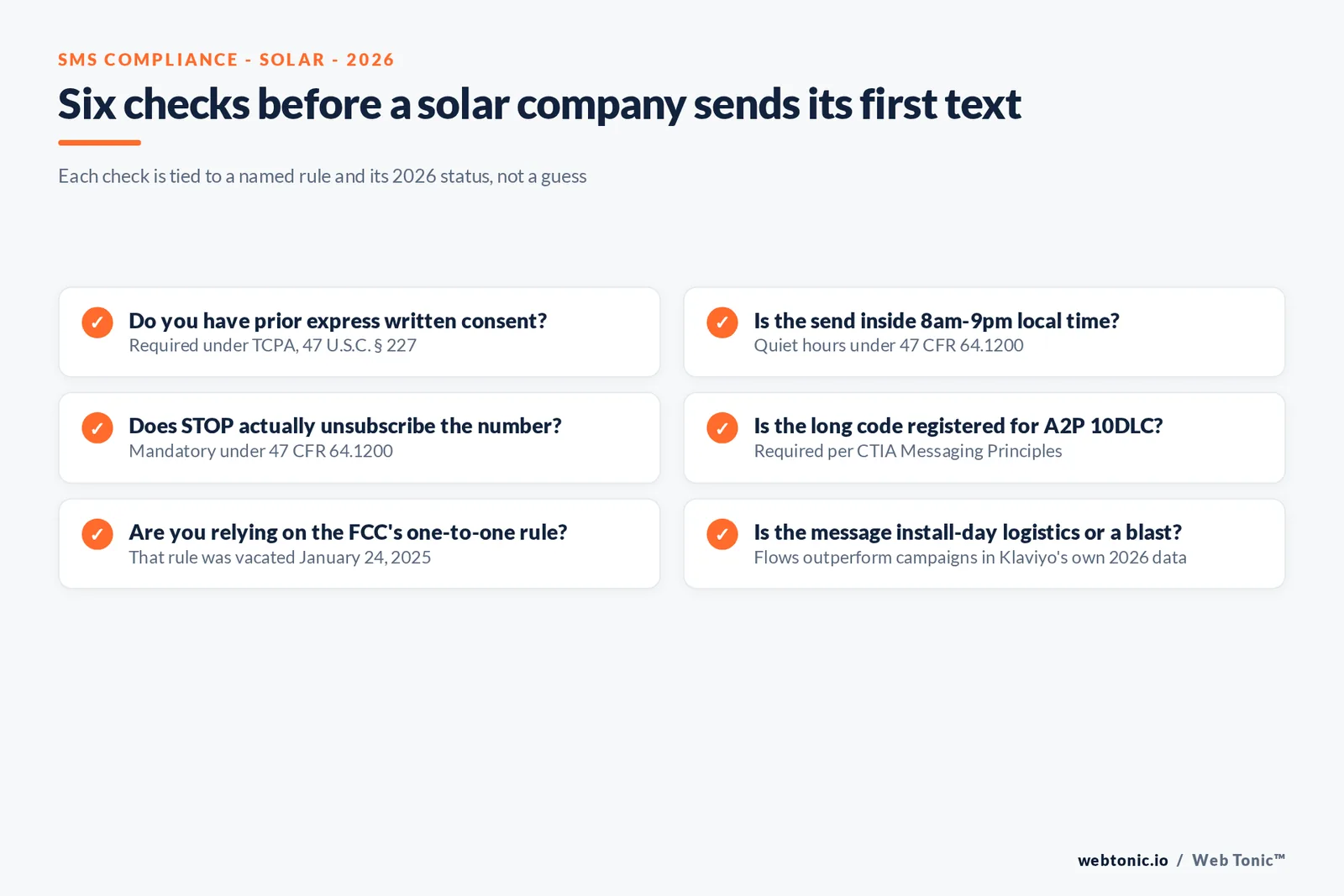
The Telephone Consumer Protection Act, 47 U.S.C. § 227, requires prior express written consent for marketing text messages, and its implementing rules at 47 CFR 64.1200 set the quiet-hours window and the requirement to honor a STOP request. In 2023 the FCC adopted a further rule requiring that consent be tied to one specific seller before that seller could rely on it - the "one-to-one consent" requirement, detailed in the FCC's own 2023 order. The Eleventh Circuit vacated that specific requirement on January 24, 2025 in Insurance Marketing Coalition v. FCC. It has not been reinstated - but the base consent, quiet-hours and opt-out rules under 64.1200 were untouched by that ruling and remain fully in force.
| Rule | What it requires | Status in 2026 | Source |
|---|---|---|---|
| TCPA prior express written consent | Marketing texts need documented consent | In force | 47 U.S.C. § 227, Cornell LII |
| Quiet hours | No marketing texts outside 8am-9pm local | In force | 47 CFR 64.1200, ecfr.gov |
| STOP / opt-out honoring | Must stop on request, immediately | In force | 47 CFR 64.1200, ecfr.gov |
| FCC one-to-one consent (2023 rule) | Consent tied to one named seller only | Vacated Jan 24, 2025 | 11th Cir., Insurance Marketing Coalition v. FCC |
| A2P 10DLC / CTIA messaging principles | Brand + campaign registration for long-code volume | In force | CTIA Messaging Principles |
Number type changes the per-segment price too
Twilio's own pricing page breaks its long-code rate down further by number type. On a standard 10-digit long code, SMS is USD 0.0083 per segment both directions and MMS is USD 0.022 outbound. On a toll-free number, Twilio's own page lists the same USD 0.0083 SMS rate but a slightly lower USD 0.02 MMS inbound rate. On a short code - a 5 to 6-digit number built for high-throughput two-way messaging - the listed SMS rate is the same USD 0.0083 per segment, though short codes carry separate lease and setup costs Twilio prices separately from per-message rates.
| Number type (Twilio's own pricing) | SMS per segment | MMS outbound | Typical use |
|---|---|---|---|
| Long code (10-digit) | USD 0.0083 | USD 0.022 | Two-way conversational texting |
| Toll-free | USD 0.0083 | USD 0.022 | Higher-throughput business messaging |
| Short code (5-6 digit) | USD 0.0083 | Not separately broken out | High-volume campaigns, separate lease cost |
What A2P 10DLC registration actually costs
Long-code business messaging at volume requires brand and campaign registration through The Campaign Registry, and its own fee schedule states the numbers plainly. The Campaign Registry's own fee guide lists brand registration for a PRIVATE_PROFIT entity - what most solar installers would register as - at a USD 4.50 one-time fee, and a standard Marketing use-case campaign at USD 10.00 a month, billed per campaign. An Agents and Franchises use case, relevant for a multi-location dealer network, is priced separately at USD 30.00 a month.
| A2P 10DLC fee (The Campaign Registry, 2026) | Price | Frequency | Applies to |
|---|---|---|---|
| Brand registration (private company) | USD 4.50 | One-time | Every registered sender brand |
| Marketing campaign use case | USD 10.00 | Monthly, per campaign | Standard promotional texting |
| Agents and Franchises use case | USD 30.00 | Monthly, per campaign | Multi-location dealer networks |
| Sole Proprietor brand registration | USD 4.00 | One-time | Single-owner installers |
Reading the revenue-per-recipient gap correctly
Klaviyo's own 2026 data separates flows from campaigns on revenue per recipient (RPR), not just click rate, which matters more for a business measuring texts against install volume rather than raw engagement. SMS flows post roughly 8 times the RPR of SMS campaigns, and the top 10% of SMS flows exceed USD 5 in RPR. On the email side, flows post nearly 18 times the RPR of campaigns, with the top 10% reaching USD 7.79. The pattern is consistent across both channels: a message tied to one real event outperforms a recurring send by an order of magnitude, not a small margin.
What happens to credits you do not use
Seasonal solar campaigns rarely text at a flat monthly rate - a launch month or storm-season inspection push can spike volume well above a quiet month. EZ Texting's own pricing FAQ states that on its current monthly plans, unused credits roll over for one additional billing cycle as long as the subscription stays active, meaning credits stay usable for up to two months from the date they were issued. Annual plans work differently: credits are issued upfront and expire twelve months after purchase, with no monthly rollover to track.
Why click rate is not the only number that matters here
A reminder text is judged differently than a promotional blast - a customer who never clicks but shows up on install day counts as a success even with a 0% click rate. Klaviyo's own data measures revenue per recipient precisely because click rate alone would undercount exactly this kind of message. For a solar company, the equivalent internal metric is show-rate on the appointment the text was sent about, not the click itself - a number worth tracking in your own CRM rather than importing from any vendor's benchmark page.
What this means for a solar company's texting plan
Consent and registration are the fixed costs; per-message price is the variable one, and it is small next to either. At Twilio's own USD 0.0083 per segment, texting 500 install-day reminders costs about USD 4.15 in pure usage - the real budget line is the compliance and platform work behind it, not the segment price. That is also why a bundled tool like SimpleTexting, at roughly USD 39 for the same volume, is often the more defensible buy for a business that cannot staff its own compliance review: the extra cost buys registration guidance the raw API does not.
For a build that keeps consent records, quiet hours and STOP handling correct from day one, our growth marketing practice can wire the workflow into your CRM; see also our marketing automation statistics hub for the workflow side of this same stack, or talk to us about a compliance review before you send your first campaign.
Frequently Asked Questions
Does SMS or email get a faster response for a solar install reminder?
Klaviyo's own 2026 benchmark data (183,000 customers) shows behavior-triggered SMS flows averaging close to a 10% click rate, with the top 10% of flows exceeding 16%. Its own email-flow figure is lower at 5.58%, itself already more than 3 times the 1.69% click rate of a broadcast email campaign. Neither figure is solar-specific - Klaviyo's base skews e-commerce - but the gap between a triggered message and a broadcast one is the more reliable pattern than either channel's raw number.
What does it actually cost to text a customer list?
Twilio's own US pricing page lists long-code SMS at USD 0.0083 per segment, both outbound and inbound (2026). SimpleTexting's own pricing tool estimates roughly USD 39 a month for a 500-text plan, billed monthly, plus a USD 4 one-time carrier registration fee, with overage credits at 5.5 cents each. EZ Texting's own FAQ states an SMS costs 1 credit and an MMS costs 3 credits, and that it does not charge for inbound messages at all - unlike some competitors.
Is the FCC's one-to-one consent rule still in force?
No. The rule the FCC adopted in its 2023 order required consent to be tied to a single identified seller before that seller's marketing texts could be sent. The Eleventh Circuit vacated that requirement on January 24, 2025 in Insurance Marketing Coalition v. FCC. It is not back in force. The base TCPA consent, quiet-hours and revocation rules under 47 CFR 64.1200 were not affected and still apply.
What still has to be true before a solar company can text a lead?
Prior express written consent for marketing messages under the Telephone Consumer Protection Act (47 U.S.C. § 227), no messages outside the recipient's local 8am-9pm window under 47 CFR 64.1200, an honored STOP keyword, and - for long-code business messaging at volume - A2P 10DLC brand and campaign registration per CTIA's own Messaging Principles and Best Practices. None of that changed when the one-to-one rule was vacated.
Should install-day reminders go by SMS or email?
Klaviyo's own data shows SMS flows draw 64.4% of their revenue from new (first-time) recipients versus 20% for SMS campaigns, and email flows draw 48% from new recipients versus 16% for campaigns - in both channels, a triggered, one-time message built around a real event (like an install date) meaningfully outperforms a broadcast blast. That pattern favors SMS for time-sensitive logistics and email for longer, document-heavy follow-up like warranty paperwork.
Sources
Klaviyo - 2026 SMS marketing benchmarks
Klaviyo - 2026 email marketing benchmarks
Twilio - US SMS and MMS pricing
SimpleTexting - Pricing
EZ Texting - Pricing FAQ
Cornell LII - 47 U.S.C. § 227 (TCPA)
eCFR - 47 CFR 64.1200
FCC - 2023 one-to-one consent order
US Court of Appeals, 11th Circuit - Insurance Marketing Coalition v. FCC
The Campaign Registry - TCR fees and pricing guide