Table of contents
A backlink is a link from another website pointing to yours, and Google still treats it as a vote of confidence: when a respected site links to your page, that's read as evidence your content deserves attention. Decades into the algorithm's life, backlinks remain one of the strongest ranking signals Google has, and the data on this hasn't softened much. Referring domain count is the single highest-correlating ranking factor Ahrefs tracks, ahead of nearly everything else measurable about a page.
The problem is that most sites never build any. Getting backlinks isn't complicated in concept, but it takes a deliberate, ongoing process. "Publish great content and wait" stopped working years ago.
Key takeaways
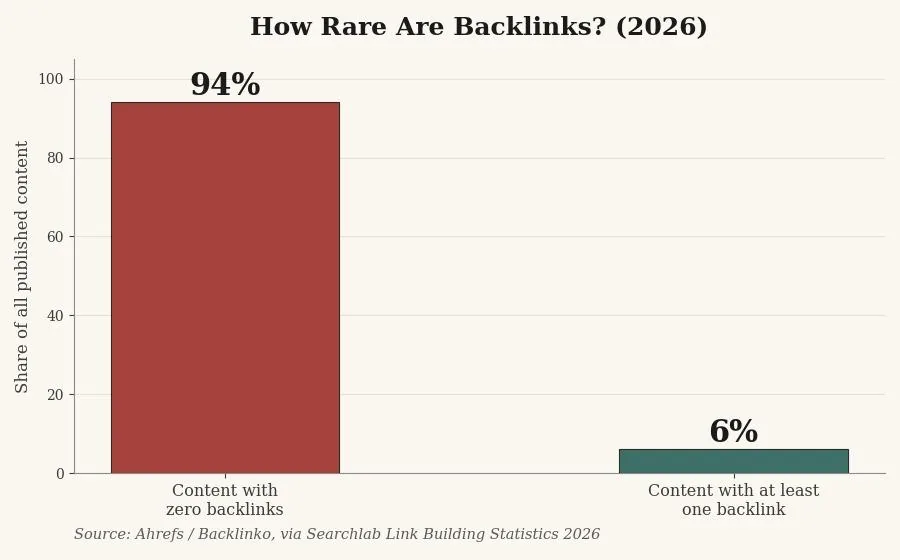
- 94% of all published content has zero external backlinks, and only 6% earns even a single link. If you're not actively building links, you're statistically invisible.
- The #1 Google result has 3.8x more backlinks than positions 2-10, based on Backlinko's analysis of 11.8 million search results.
- Digital PR has overtaken guest posting as the top-performing tactic in 2026, named by 34% of SEOs versus 18% for guest posting.
- Every 10-point increase in Domain Rating corresponds to about a 15% better ability to rank for competitive keywords.
- Link costs run wide in 2026: guest posts average $364-$461 per link before agency markup, digital PR links average $1,250-$1,500 per link, and 64% of SEOs spend $3,000 or more per month on link building.
- 91% of SEOs set a minimum Domain Rating before accepting a link, and 52% require DR 50 or higher, so link quality standards keep rising every year.
Why backlinks still matter in 2026
Domain Authority and Domain Rating aren't things Google actually reads. They're third-party metrics built by Moz and Ahrefs that estimate a site's link-based trust. But they correlate with rankings because both are downstream of the same thing: the strength and quantity of a site's backlink profile. Google's own 2024 API leak confirmed an internal "siteAuthority" signal exists, so while the specific DA or DR number means nothing to Google directly, the underlying trust it's measuring absolutely does.
That rarity is exactly why link building works as a competitive lever. If 94% of content never earns a single backlink, the sites that do build them systematically are competing against almost nobody. Backlinks now also feed AI visibility: research compiled by QuickSEO finds editorial brand mentions correlate about three times more strongly with AI citation than raw backlink counts, so a solid link profile increasingly helps a brand get cited by ChatGPT and Perplexity, not just ranked by Google.
How Google evaluates link quality
Not every link is worth the same. Google (and the tools that estimate its behavior) weighs a few factors above all else:
- Authority of the linking domain. A single link from a highly trusted, high-traffic site can outweigh dozens of links from weak ones.
- Relevance. A link from a site actually covering your topic sends a clearer signal than a link from an unrelated high-authority domain.
- Editorial context. A link a writer chose to include because it adds value ranks completely differently than a link inserted purely for SEO.
- Link diversity. The number of distinct referring domains linking to a page correlates with rankings more strongly than the raw number of links.
- Dofollow vs. nofollow. Nofollow links don't pass direct link equity, but 78.8% of SEOs believe they still influence rankings indirectly through brand signals and referral trust.
Step-by-step: how to actually get backlinks
Step 1: Build something worth linking to
Before any outreach happens, there needs to be a reason for someone to link. Original research, proprietary data, free tools, and genuinely comprehensive guides (the kind that cover a topic more thoroughly than anything else ranking) are what's known as linkable assets. Long-form content over 3,000 words earns 77.2% more backlinks than short-form articles, according to Single Grain's compilation of Backlinko's research, largely because it has more substance worth citing.
Step 2: Run digital PR campaigns
Digital PR means pitching a newsworthy angle, original data, or expert commentary to journalists and editors in exchange for an editorial mention and link. It's now the top-performing tactic in the industry, and for good reason: these links are hard to replicate and carry real trust with both Google and AI search tools. A typical digital PR campaign costs $5,000 to $10,000; at the $1,250-$1,500-per-link rate this works out to, that's about 3 to 8 earned links per campaign for a business running a standalone project. (Larger, ongoing digital PR retainers report much higher link counts — Reporter Outreach's 2026 digital PR data puts the average full campaign at 42 referring domains — but that reflects a bigger, sustained program rather than a single $5,000-$10,000 engagement.)
Step 3: Respond to journalist queries (HARO-style)
Services that connect journalists with expert sources (in the same spirit as the original HARO) send queries from publications multiple times a day. Responding within six hours meaningfully improves the odds of being quoted and linked, including in high-authority outlets like Forbes, Entrepreneur, and Inc, per Outreach Desk's 2026 HARO link building guide. Realistically, expect to land one placement for every 15 to 20 quality responses sent, at a time cost of around $150-$250 per link.
Step 4: Use guest posting strategically
Guest posting means writing an original article for another site in exchange for a link back. It's no longer the cheap tactic it once was: average guest post costs run $364 to $461 per link before agency markup, and only 1.37% of guest post opportunities actually meet real quality standards, per BuzzStream's 2026 link building pricing research. Vetting matters more than volume here.
Step 5: Try niche edits and link insertions
Instead of creating new content, a niche edit (or link insertion) adds your link into an existing, already-ranking article on someone else's site. These typically cost less than guest posts, averaging $141-$225 per link, and go live faster since no new content needs to be written or approved. The tradeoff is that high-quality, high-traffic sites rarely offer this option.
Step 6: Find and fix broken link opportunities
Broken link building means finding dead links on relevant sites and suggesting your own content as a replacement. It's slower and more manual than the tactics above, but it costs little beyond outreach time and works well for sites that already have strong linkable content in place.
Which tactic actually wins?
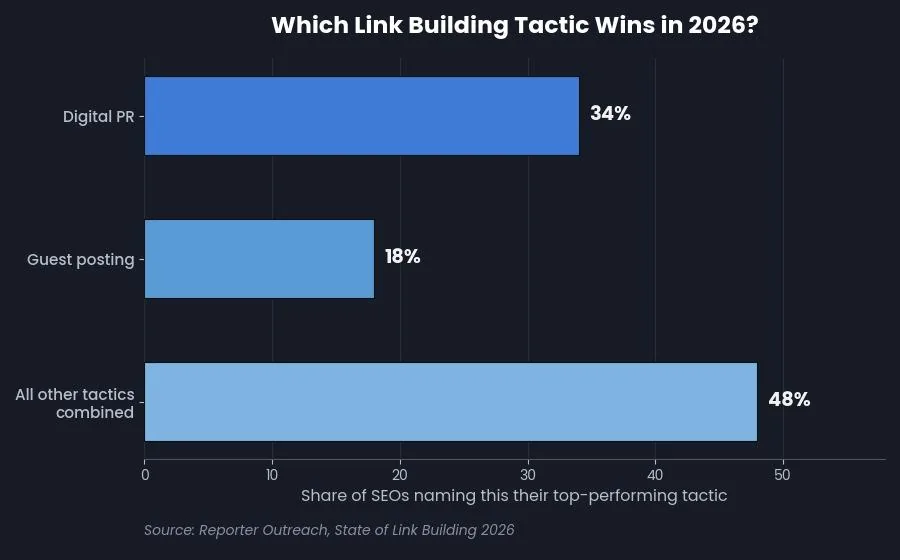
Digital PR has now clearly overtaken guest posting as the tactic SEOs credit most for real results, per Reporter Outreach's State of Link Building 2026 survey. Guest posting isn't dead: it's still used by 42.4% of SEOs, more than any single alternative. But it's no longer viewed as the top performer it once was. The shift tracks with rising publisher fees and stricter editorial standards making cheap, high-volume guest posting less viable than it was even two years ago.
Comparing link building tactics
| Tactic | Typical cost (USD) | Time to results | Best for |
|---|---|---|---|
| Digital PR | $1,250-$1,500 per link (campaigns run $5,000-$10,000) | 4-8 weeks per campaign | High-authority, hard-to-replicate editorial links |
| Guest posting | $364-$461 per link (before markup; $700-$1,000 retail) | 2-6 weeks per placement | Topically relevant, scalable placements |
| Niche edits / link insertions | $141-$225 per link | Days | Fast placement on already-ranking pages |
| Journalist requests (HARO-style) | $150-$250 per link (time cost) | Ongoing; ~1 per 15-20 responses | Earned editorial mentions, AI-citation trust signals |
| Broken link building | Outreach time only | Weeks, ongoing | Sites with existing strong content to offer as a replacement |
Costs reflect 2026 U.S. market benchmarks (BuzzStream, Adsy, RankZ); individual niches and site quality will shift these ranges.
What backlinks actually cost in 2026
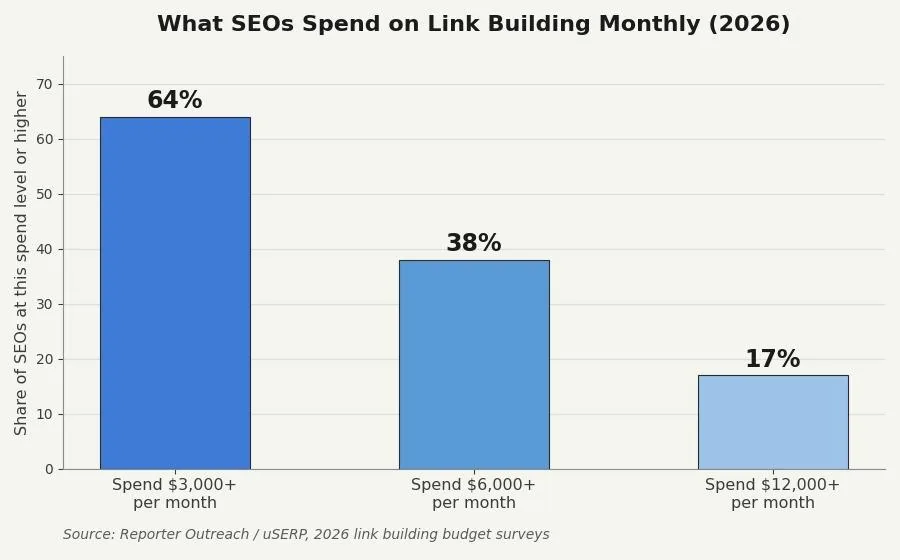
Budgets scale with ambition. For a small or mid-market business targeting mid-quality links (DR 40-60), a realistic 12-month budget lands around $3,000-$6,000 for 10-15 links, plus $500-$2,000 for tools and reporting. Businesses spending under $1,000/month are, in most competitive niches, effectively chasing shortcuts that either do nothing or actively harm rankings. On the agency side, managed link building retainers typically start around $1,750/month for 5 links and scale to $5,000+/month for 15-20 links, usually with a three-to-six-month minimum commitment.
Link building tool
Monthly link building budget calculator
Pick a tactic mix and a target link count to see a realistic monthly budget range.
Estimated monthly budget
--
vs. industry benchmark
--
How to vet a link building provider
91% of SEOs set a minimum Domain Rating before accepting a link, and 52% require DR 50 or higher, so any provider unwilling to disclose the sites in their network is a red flag on its own. A few other things worth checking before paying for links:
- They can show real organic traffic on prospective sites, not just a DR or DA number
- Links are topically relevant to your industry, not just high-authority in general
- They disclose whether placements are editorial (a writer chose to include you) or paid
- Pricing sits inside the ranges above rather than suspiciously below them, since below-market pricing usually means PBNs, link farms, or thin AI content
- They can explain how a placement contributes to AI-citation visibility, not just classic rankings
Common link building mistakes
- Chasing DR/DA instead of relevance. A DR 50-60 site in your exact niche often outperforms a DR 70+ general-interest site, because contextual relevance carries real weight.
- Buying links in bulk from marketplaces. Shared link inventory used across many agencies creates a detectable footprint that Google's spam systems are built to catch.
- Ignoring anchor text diversity. Over-optimized, repetitive anchor text is one of the clearest signals of manipulated link building.
- Treating link building as a one-time project. Top-ranking pages gain new backlinks continuously; a page that stops earning links eventually loses ground to one that doesn't.
- Skipping the vetting step to save time. Only 1.37% of guest post opportunities meet real quality standards; skipping vetting means paying full price for links likely to do nothing.
Frequently asked questions
How many backlinks do I need to rank?
There's no fixed number. Check the referring domains of the pages currently ranking for your target keyword and aim to match or exceed that median with links of comparable or better quality.
Are backlinks still a Google ranking factor in 2026?
Yes. Google still uses links as a trust signal, and referring domain count remains the strongest correlating ranking factor Ahrefs tracks. Link quality now matters more than raw quantity.
How much should I budget for link building?
Most growing businesses need $3,000-$6,500/month to build meaningful link velocity in competitive niches. Spending under $1,000/month rarely moves rankings in any competitive market.
Is guest posting dead?
No, but it's no longer the top-performing tactic. Digital PR has overtaken it, though guest posting remains the most widely used method at 42.4% adoption, mainly because it's more predictable and scalable than PR-dependent tactics.
Do nofollow links help SEO?
Not for direct link equity, since Google treats nofollow as a hint rather than a full endorsement. But 78.8% of SEOs believe they still contribute indirectly, through referral traffic, brand visibility, and the trust signals that feed AI citation.
Building the authority that actually gets you found
Backlinks aren't a checkbox you complete once. They're a continuous signal Google, and increasingly AI search tools, use to decide whether a site deserves trust and traffic. The sites winning at this in 2026 treat it as ongoing infrastructure: real linkable assets, consistent digital PR and outreach, and rigorous vetting of every placement that comes in, rather than a one-time sprint before a launch.
Do that consistently, and the compounding effect is real. Top-ranking pages get more backlinks, and they get them faster, which is exactly the gap that separates page one from everyone else.
More from Web Tonic: growth marketing services, data & analytics, performance creative.
Sources: quickseo.ai · singlegrain.com · reporteroutreach.com · outreachdesk.com · buzzstream.com