Table of contents
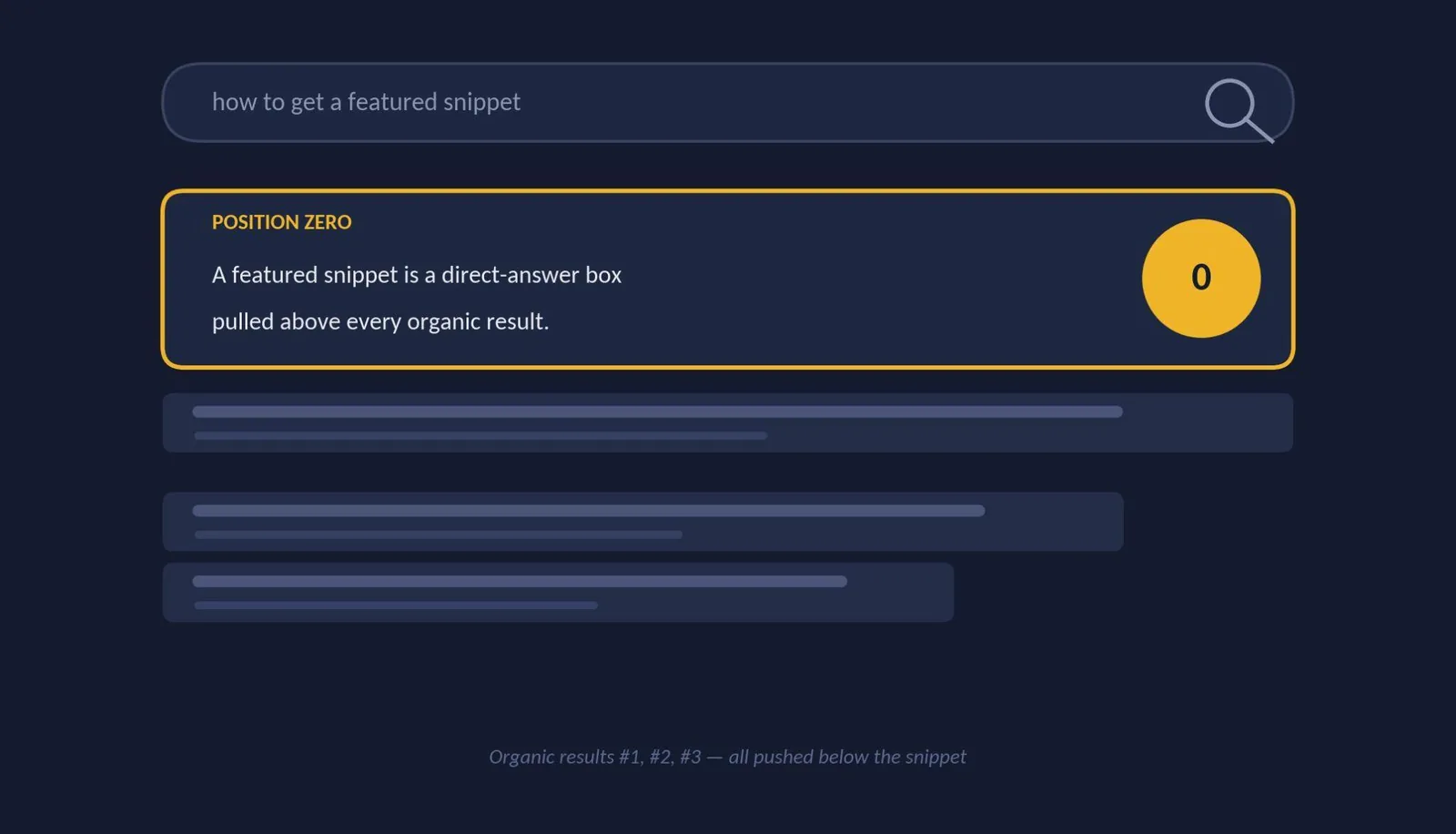
On a Google search engine results page, one box sits above everything else: not an ad, not the #1 organic listing, but the featured snippet — a chunk of content pulled directly from a ranking page and displayed as a direct answer to the searcher's question. SEOs call it position zero, and it's one of the few places on a search engine results page where a smaller site can out-rank a much bigger competitor, even on a single long-tail keyword.
What follows is what a featured snippet actually is, the four snippet formats Google pulls from, and the exact content structure that wins each one. If you've been chasing keywords without thinking about format, this is where search engine optimization stops being just a rankings game.
Key Takeaways
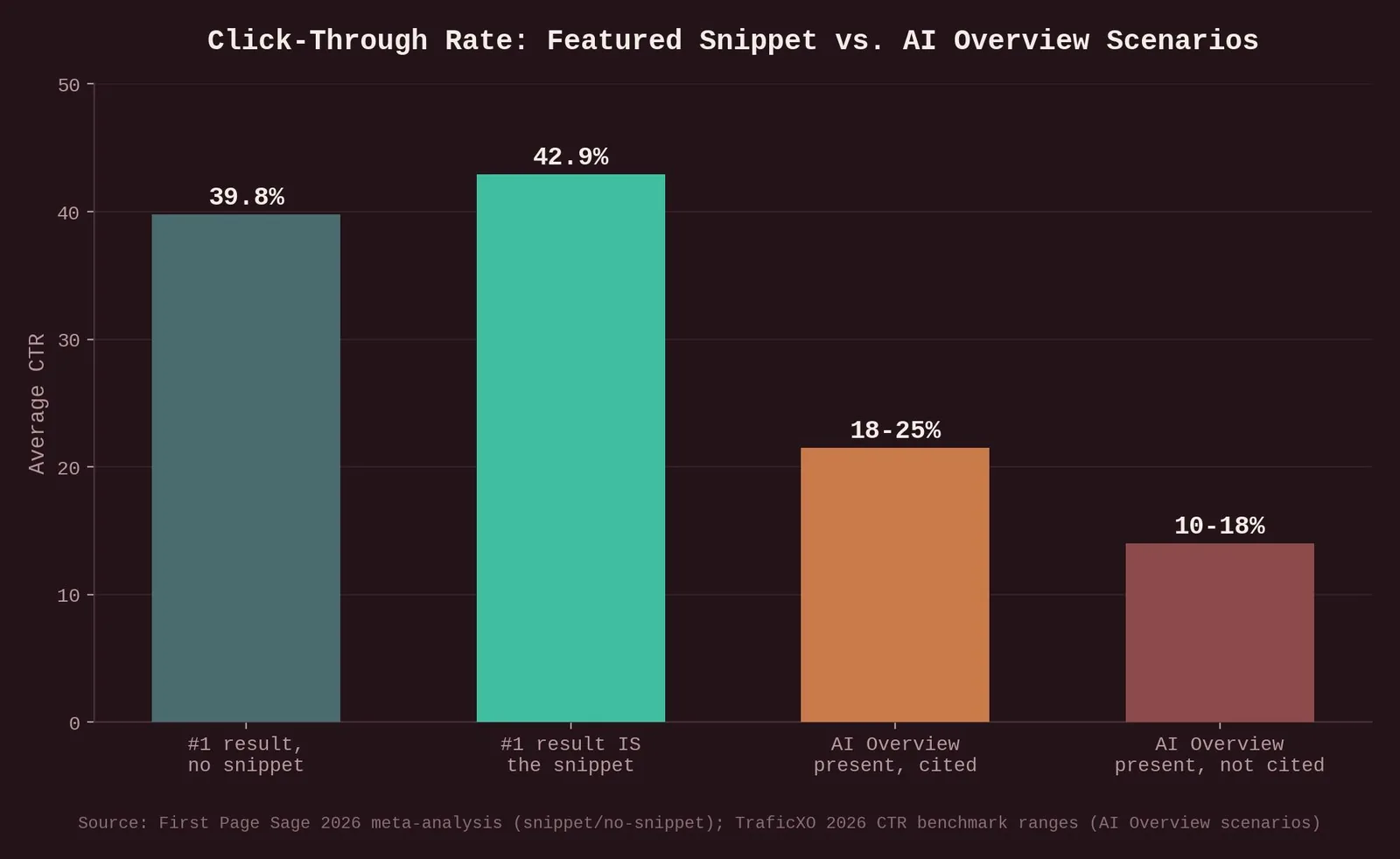
- A featured snippet earns roughly 42.9% average CTR when it replaces the #1 organic result, per First Page Sage's 2026 CTR benchmark report, compared to 39.8% for a plain #1 listing with no snippet.
- Paragraph snippets make up about 70% of all featured snippets, followed by list snippets (~19%), table snippets (~8%), and video snippets (~3%).
- You don't need to rank #1 to win the snippet — roughly 30% of featured snippets come from pages ranking anywhere between position 2 and 10.
- Paragraph answers should land between 40 and 60 words, positioned immediately after a heading that mirrors the search query.
- List snippets run roughly 5 to 8 items before Google truncates or collapses the rest behind a "more items" link.
- Table snippets require real HTML <table> markup. Google does not extract comparison data from styled divs or image-based tables.
- Featured snippets and AI Overviews rarely appear on the same SERP in 2026, so check which one your target query actually triggers before you optimize.
What Is a Featured Snippet?
A featured snippet is a highlighted answer box that Google displays above the first organic result, pulled directly from a page that already ranks on page one. Think of it as the closest thing in modern SEO to owning a billboard above everyone else's storefront. The content — a paragraph, a list, a table, or a video — comes from an existing page. Google isn't writing anything new; it's extracting and reformatting content that's already structured the right way.
Reference-style pages tend to hold a disproportionate share of definition snippets for exactly this reason. A page like Wikipedia, with its consistent "term, then immediate definition" structure, is practically pre-formatted for extraction. That's a useful benchmark: if your paragraph doesn't read like a dictionary entry, it's probably not snippet-ready yet.
A snippet win shows up instantly, right there on the Google SERP — a different kind of visibility than a Google Analytics conversion or a Google Search Console ranking improvement, and one that costs nothing beyond structuring your content correctly for the user asking the question.
The Four Types of Featured Snippets
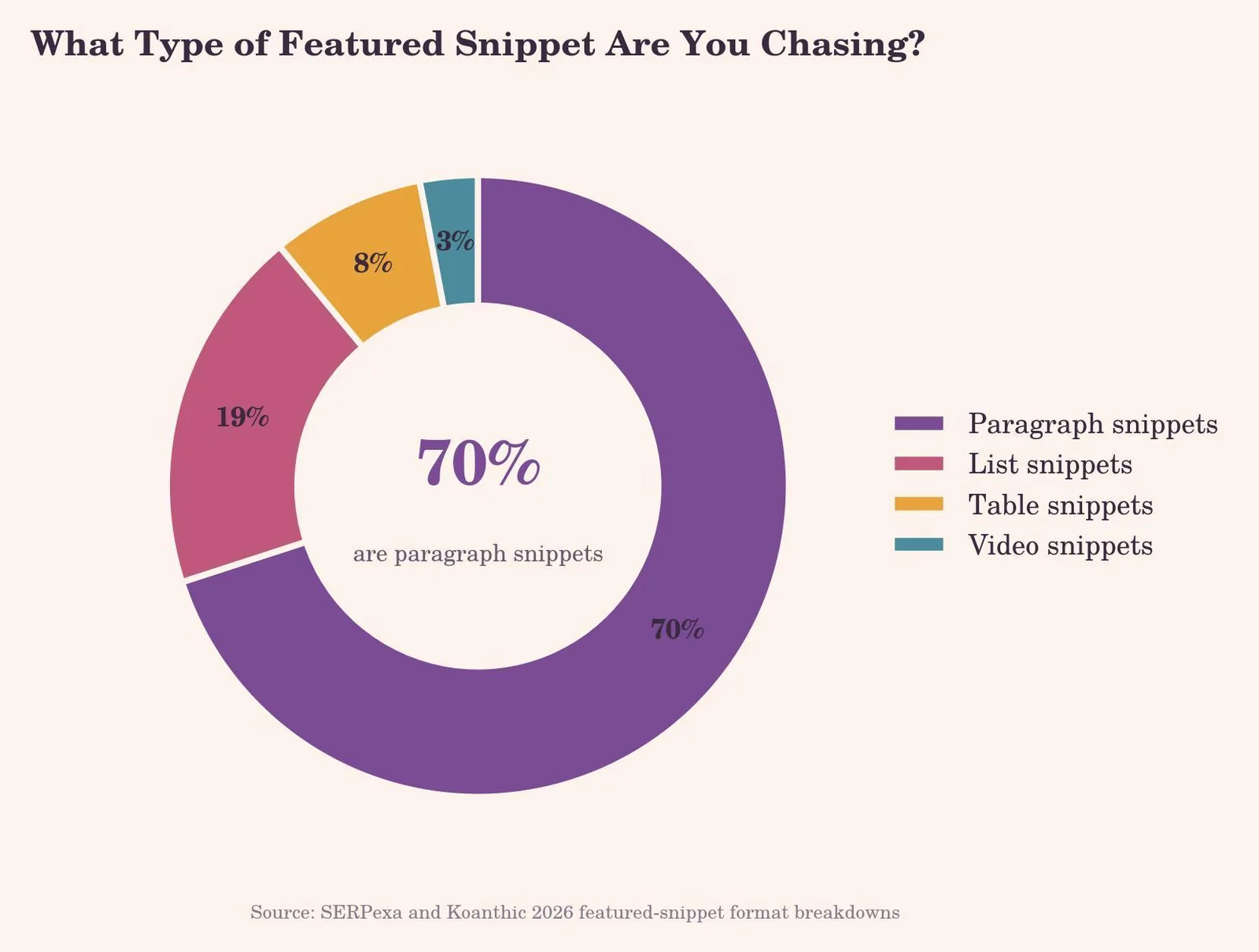
Google pulls featured snippets from four distinct formats, and each one needs a different structure on the page, according to a 2026 breakdown by SERPexa:
- Paragraph snippets (~70% of all snippets) — triggered by definition queries ("what is X"), explanation queries ("why does X happen"), and simple factual questions. These are the most common snippet type by a wide margin.
- List snippets (~19%) — triggered by process queries ("how to X") and ranking queries ("best X for Y"). Google displays these as ordered or unordered lists depending on whether the underlying content is sequential.
- Table snippets (~8%) — triggered by comparison queries ("X vs Y," "difference between X and Y") and spec-heavy questions. These need actual table markup, not a styled list or image.
- Video snippets (~3%) — triggered by tutorial and physical-task queries ("how to tie a bow tie"). Google pulls a thumbnail and timestamp from a YouTube video, so this format depends on having video content at all.
Knowing which format a query triggers before you write is the single biggest lever in featured snippet optimization. A beautifully formatted list won't win anything for a query that Google wants answered as a paragraph.
How to Optimize for Each Snippet Type
For paragraph snippets: use the exact search query, or a close variant, as your H2. Answer it in the first sentence, in 40 to 60 words total. Skip the throat-clearing (no "in this article, we'll explore"). Google's extraction favors a direct, complete answer sitting immediately under the matching heading, according to Digital Applied's 2026 featured snippet guide.
For list snippets: follow the question heading with a real HTML ordered or unordered list, not a numbered paragraph. Keep the list to roughly five to eight items — sources vary on the exact cutoff, but longer lists reliably get truncated or collapsed behind a "more items" link, so sequence your most important steps first. If a step needs elaboration, put that explanation in a paragraph below the list, not inside the list item itself.
For table snippets: build an actual <table> element with <thead>, <tbody>, and proper
For video snippets: pair a keyword-rich title and description with clear timestamps for key moments, and publish a full transcript on the page itself. This format leans heavily on YouTube hosting, since that's where Google pulls the thumbnail from.
You Don't Need to Rank #1 First
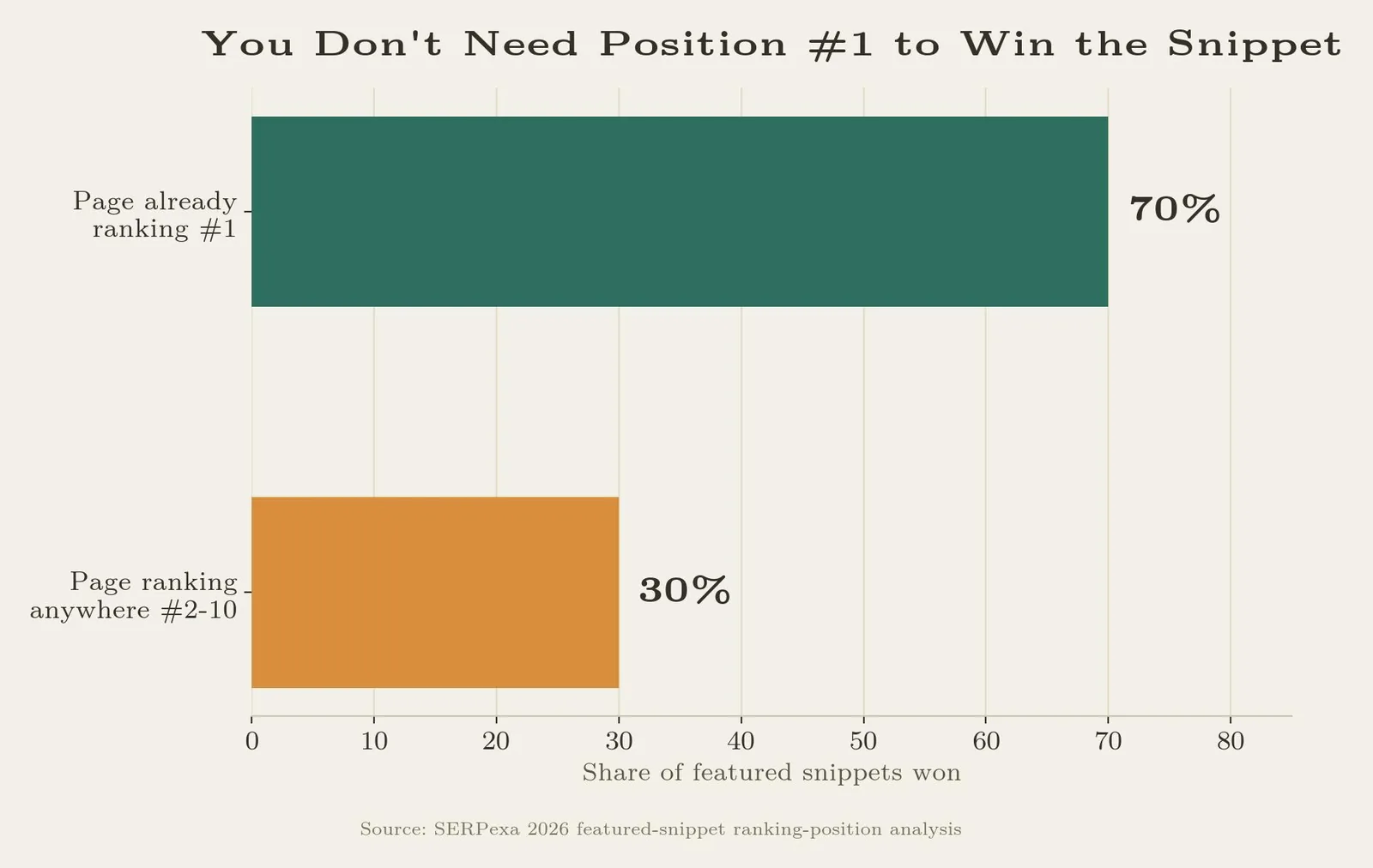
Here's the part most people get wrong: winning a featured snippet doesn't require the top organic spot. Research shows roughly 30% of snippets come from pages ranking in positions 2 through 10. A page sitting in position four or six can still capture the snippet box if its content is structured more precisely for extraction than whatever the current #1 has.
That changes how you should prioritize. Instead of only targeting keywords you already dominate, find the queries where you rank anywhere on page one and check whether the current snippet holder has a weak structure — a paragraph that's too long, a list buried in prose, a comparison with no real table. Those are your highest-probability targets, often easier wins than trying to out-rank an established page #1 outright.
Finding Snippet Opportunities
A keyword research tool like Ahrefs can flag which of your page-one queries currently show a snippet and who holds it, turning this from guesswork into a prioritized list. While you're there, don't ignore the People Also Ask (PAA) box that usually sits just below the snippet. Each question inside it is effectively its own miniature snippet opportunity, and answering several on the same page is one of the more efficient ways to compound your snippet footprint.
Worth knowing before you spend a lot of time chasing a "trick": John Mueller and Gary Illyes are the Google Search Relations team members who most often field public questions about how snippets get selected, and their answers on specifics have shifted over the years — schema's role in snippet selection, for instance, has been described differently by each of them at different points. Neither has ever pointed to one guaranteed shortcut. The throughline across a decade of public commentary is still clean, well-structured content, not a markup trick.
Featured Snippets vs. AI Overviews
Featured snippets and AI Overviews are not the same feature, and in 2026 they mostly don't compete for the same queries:
| Factor | Featured Snippet | AI Overview |
|---|---|---|
| Source | A single web page, extracted directly | Multiple sources, synthesized by Gemini |
| Attribution | One clear URL and title displayed | Several sources cited, less prominent per link |
| Typical trigger | Definitions, how-tos, comparisons | Complex, multi-faceted, or exploratory queries |
| Average CTR when present | ~42.9% for the page holding the snippet | ~18-25% if cited, ~10-18% if not cited |
| Content format needed | Paragraph, list, table, or video | Comprehensive, well-sourced, clearly structured |
| Co-occurrence | Rarely appears alongside an AI Overview on the same SERP | Same |
A caveat worth flagging: the AI Overview citation ranges above come from secondary aggregator benchmarks (TraficXO's 2026 compilation), not a single controlled study like the First Page Sage figures. Different sources in this space report absolute CTR numbers that vary by an order of magnitude depending on methodology, so treat these as directional rather than precise.
The practical upshot: check whether your target query currently shows a snippet or an AI Overview before you optimize. If it's AI Overviews, the goal shifts from winning the snippet box to earning a citation inside the overview. The underlying content structure that wins one tends to help with the other, since both systems favor content that answers the question cleanly for the user in the first few sentences.
Common Mistakes When Targeting Featured Snippets
Writing a strong answer buried in paragraph three instead of paragraph one is the most common miss. Google's extraction systems favor content sitting immediately under the matching heading, so burying the answer under three paragraphs of preamble drops your odds significantly, even if the content itself is accurate.
Formatting a list as bolded text inside a single paragraph instead of using real
- or
- tags costs you the list snippet entirely. Google's systems parse HTML structure, not visual styling that merely resembles a list.
Building comparison tables as styled <div> grids rather than semantic <table> markup means the content simply isn't eligible for a table snippet, regardless of how clean the design looks to a human reader.
And targeting a query that already shows an AI Overview with traditional snippet tactics wastes effort. Check which feature actually appears for your target query before optimizing, and you'll save yourself from polishing content for a box Google isn't going to show.
Try It Yourself: Snippet Format Picker
Not sure which format your target query needs? Pick the query type below and get the exact structure to build.
Snippet Format Picker
What kind of question are you answering?
Pick the query type closest to yours and get the exact format Google expects.
Target format
Frequently Asked Questions
Do I need to rank #1 to get a featured snippet? No. Roughly 30% of featured snippets come from pages ranking anywhere between position 2 and 10, not just the top spot.
How long should a featured snippet answer be? For paragraph snippets, 40 to 60 words. Shorter answers often look incomplete to Google's extraction system; longer ones get truncated with an ellipsis.
Can featured snippets and AI Overviews appear together? Rarely. In 2026, Google typically shows one or the other for a given query, not both.
Do featured snippets help with voice search? Yes. Voice assistants pull heavily from featured-snippet-style direct answers, since the format is already built for a short, spoken response.
Does winning a featured snippet guarantee more traffic? Not always. Snippets can produce zero-click searches where users get their answer without visiting your site. But they still build brand visibility and authority signals, and pages holding both a snippet and a top-five ranking often see a net traffic gain regardless.
Turning Position Zero Into a Repeatable Habit
Winning a featured snippet isn't about writing better content in the abstract. It's about matching a very specific structure to a very specific query type. Start with the keywords where you already rank on page one, check which snippet format the query actually wants, and reformat the content to match precisely: direct answers under matching headings, real lists, real tables. Do that consistently and position zero stops being a lucky break — it becomes a predictable outcome of how you structure content in the first place.
More from Web Tonic: growth marketing services, data & analytics.
Sources: firstpagesage.com · en.wikipedia.org · serpexa.com · digitalapplied.com · nightwatch.io · ahrefs.com · traficxo.com