



Table of contents
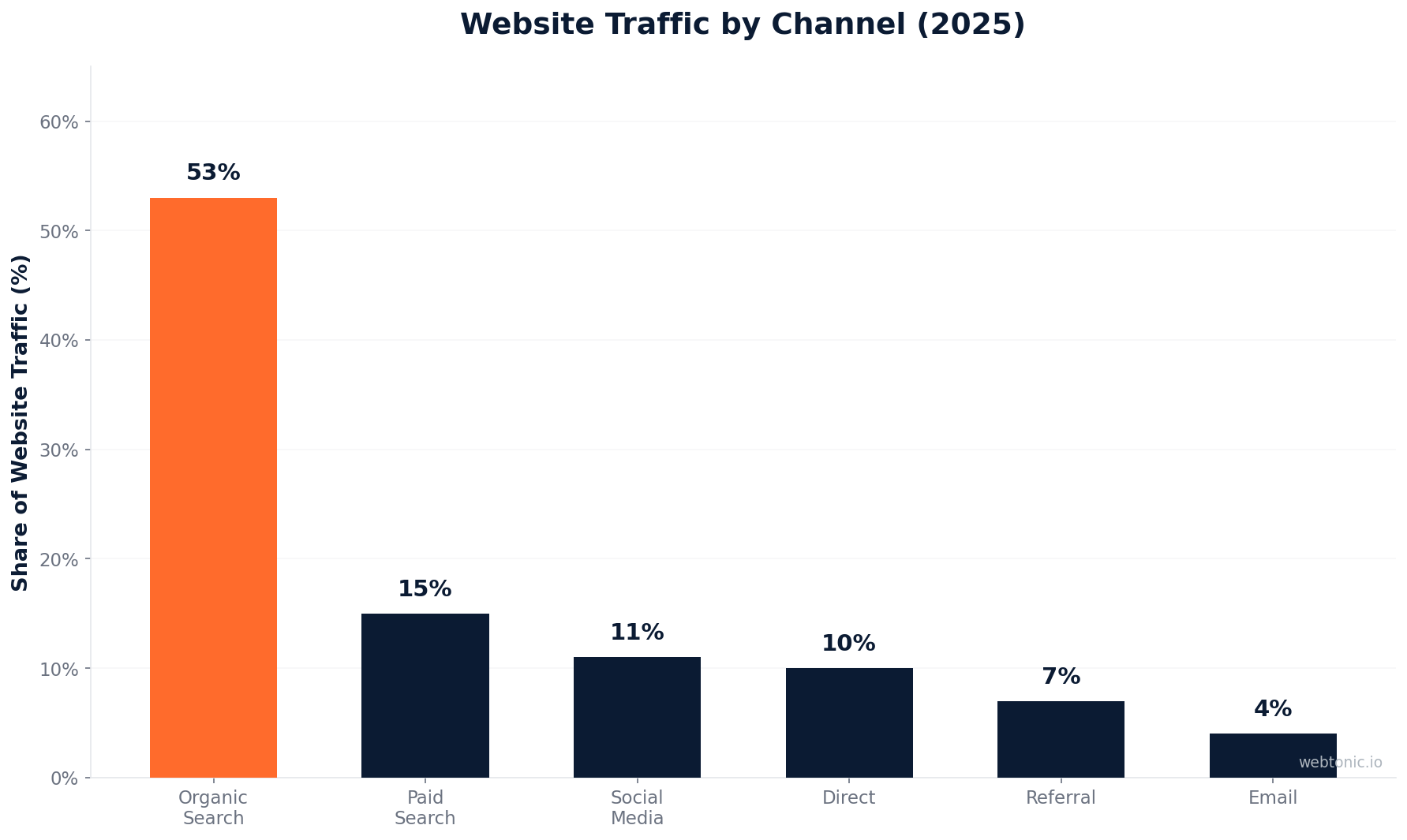
SEO (search engine optimization) is the practice of improving your website to rank higher in search results and attract organic traffic. Organic search drives 53 % of all website traffic in 2025, yet the playbook has shifted with AI Overviews and evolving ranking signals.
Key Takeaways
- Organic search accounts for 53 % of all website traffic, more than paid ads, social media, and email combined (BrightEdge).
- Google's organic CTR for position #1 dropped from 28 % to 19 % (a 32 % decline) (GrowthSRC study) between 2024 and 2025, largely due to AI Overviews now appearing on 86 % of keyword queries.
- SEO leads close at a 14.6 % rate, compared to just 1.7 % for outbound leads, making organic traffic one of the highest-converting channels.
- Pages meeting all three Core Web Vitals thresholds are 24 % less likely to be abandoned by visitors before the page finishes loading.
- Websites that publish 16+ blog posts per month get 3.5× more traffic than those publishing 0–4 posts (HubSpot).
What Is SEO and Why Does It Matter?
Search engine optimization is the practice of making your website easier for search engines to crawl, index, and rank — while simultaneously making it more useful, faster, and more trustworthy for human visitors. When done well, SEO positions your pages in front of people actively searching for what you offer, at the exact moment they need it.
The business case is straightforward: 68 % of all online experiences begin with a search engine. Unlike paid advertising, where traffic stops the moment you pause your budget, organic rankings compound over time. A page that ranks on the first page of Google today can continue driving traffic for months or years with minimal ongoing investment.
SEO breaks down into three pillars that work together:
- On-page SEO — Optimizing individual pages (content, title tags, headings, internal links) so search engines understand what the page is about and how relevant it is to a given query.
- Off-page SEO — Building authority through backlinks, brand mentions, and external signals that tell Google your site is trustworthy.
- Technical SEO — Ensuring your website is fast, mobile-friendly, crawlable, and properly indexed so search engines can access and render every important page.
How Search Engines Work
Before you can optimize for search engines, you need to understand how they discover and rank content. Google's process follows three stages:
| Stage | What Happens | Why It Matters for SEO |
|---|---|---|
| Crawling | Googlebot follows links across the web and discovers new or updated pages. | If your pages are blocked by robots.txt, orphaned (no internal links pointing to them), or behind JavaScript that Googlebot cannot render, they will never be indexed. |
| Indexing | Google analyzes the page content, images, and metadata, then stores it in its index — a massive database of web pages. | Duplicate content, thin pages, or missing canonical tags can prevent indexing or cause the wrong version of a page to appear in results. |
| Ranking | When a user searches, Google's algorithm selects the most relevant, authoritative results from its index and ranks them. | Rankings depend on hundreds of factors including relevance, content quality, backlinks, user experience signals, and E-E-A-T (Experience, Expertise, Authoritativeness, Trustworthiness). |
Understanding these stages helps you diagnose problems. If a page is not ranking, the first question is whether it has been crawled and indexed — you can verify this in Google Search Console.
Step 1 — Keyword Research
Every SEO strategy starts with finding the right keywords — the search terms your target audience actually types into Google. Effective keyword research balances three factors: search volume (how many people search for it monthly), keyword difficulty (how hard it is to rank), and search intent (what the user expects to find).
Types of Search Intent
- Informational — The user wants to learn something ("how to do SEO," "what is keyword research").
- Navigational — The user wants a specific website ("Google Search Console login").
- Commercial — The user is comparing options ("best SEO tools 2025," "Ahrefs vs Semrush").
- Transactional — The user is ready to act ("buy Ahrefs subscription," "hire SEO agency").
Best Free and Paid Keyword Research Tools
| Tool | Cost | Best Feature | Best For |
|---|---|---|---|
| Google Search Console | Free | Shows real queries your site already ranks for | Finding quick-win optimization opportunities |
| Google Keyword Planner | Free (with Google Ads account) | Volume ranges and seasonal trends from Google's own data | Validating search demand for new topics |
| Ahrefs Keywords Explorer | From $129/mo | Click-through rate estimates and parent topic grouping | Professional keyword research at scale |
| Semrush Keyword Magic Tool | From $139.95/mo | Intent labels and keyword clustering | Teams running both SEO and PPC |
| AnswerThePublic | Free (limited) | Visualizes question-based queries | Finding long-tail content ideas |
Pro tip: Start by exporting your Google Search Console data. Filter for queries where your site ranks in positions 5–15 with a high impression count — these are your "striking distance" keywords that can be pushed to page one with targeted optimization.

Step 2 — On-Page SEO
On-page SEO is where you have the most direct control. It covers everything you do on the page itself to signal relevance and quality to search engines. Here is a checklist of the elements that matter most:
Title Tags
Your title tag is the single most impactful on-page element. It appears as the clickable headline in search results and directly influences both rankings and click-through rate. Keep it under 60 characters, place your primary keyword near the beginning, and make it compelling enough that a searcher chooses your result over the nine others on the page.
Meta Descriptions
While meta descriptions do not directly affect rankings, they significantly impact CTR. Write a concise summary (120–158 characters) that includes your target keyword, communicates a clear benefit, and ends with a subtle call to action.
Heading Structure
Use a single H1 tag for your page title, then organize content with H2 and H3 subheadings. This creates a logical hierarchy that helps both readers and search engines understand your content structure. Include keyword variations naturally in your headings — forced keyword stuffing in headers is a ranking signal Google actively penalizes.
Content Optimization
Google's Helpful Content System rewards content that demonstrates first-hand experience and genuine expertise. When writing for SEO:
- Answer the search query within the first 100 words (answer-first structure).
- Cover the topic comprehensively — aim for depth, not word count.
- Use your target keyword and related terms naturally throughout the text.
- Include original data, examples, or expert perspectives that competitors lack.
- Add internal links to related pages on your site (this distributes link equity and helps Google discover your other content).
Step 3 — Technical SEO
Technical SEO ensures your website is accessible, fast, and properly structured for search engine crawlers. Even the best content will not rank if Google cannot crawl or render it. Here are the technical fundamentals every site needs:
Core Web Vitals
Google uses three Core Web Vitals as ranking signals, and they measure real user experience:
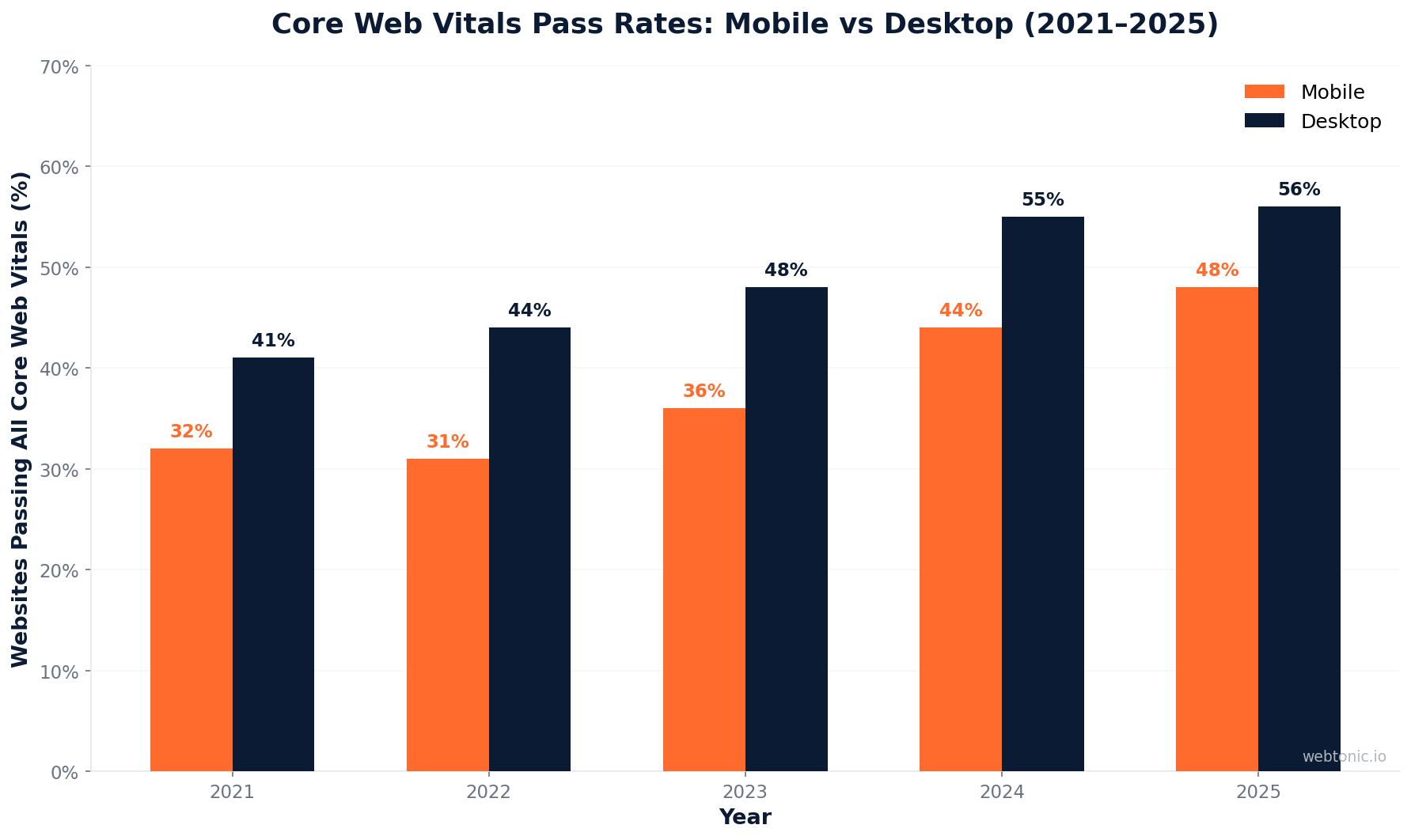
- Largest Contentful Paint (LCP) — Main content loads within 2.5 seconds. As of 2025, 48 % of mobile websites pass this threshold (HTTP Archive).
- Interaction to Next Paint (INP) — The page responds to user interactions within 200 milliseconds.
- Cumulative Layout Shift (CLS) — Visual elements remain stable during loading, with a score of ≤ 0.1.
Check your site's performance in Google PageSpeed Insights — it shows both lab data and real-user field data from the Chrome UX Report.
Mobile-Friendliness
Google uses mobile-first indexing, meaning it primarily crawls and ranks the mobile version of your site. If your site is not responsive or has content hidden behind tabs on mobile, that content may not be indexed. Over 60 % of all Google searches now happen on mobile devices.
Site Architecture and Internal Linking
A clean site architecture ensures every important page is reachable within 3 clicks from the homepage. Use a flat URL structure, logical categories, and a comprehensive internal linking strategy that connects related pages with descriptive anchor text.
HTTPS and Security
HTTPS has been a confirmed ranking signal since 2014. If your site still runs on HTTP, migrating to HTTPS is one of the fastest technical wins you can make. Beyond rankings, browsers now display "Not Secure" warnings for HTTP sites, which erodes user trust and increases bounce rates.
Step 4 — Link Building and Off-Page SEO
Backlinks remain one of the strongest ranking signals in Google's algorithm. A backlink is a link from another website to yours — think of it as a vote of confidence. However, not all backlinks carry equal weight. A single link from a high-authority, topically relevant site is worth more than dozens of links from low-quality directories.
Proven Link Building Strategies
- Create linkable assets — Original research, industry studies, data visualizations, and comprehensive guides naturally attract links because other content creators cite them as sources.
- Guest posting — Write expert articles for reputable publications in your industry. Focus on sites with real editorial standards, not link farms.
- Digital PR — Pitch newsworthy data, trends, or expert commentary to journalists. Tools like HARO (Help a Reporter Out) and Qwoted connect you with reporters seeking sources. A comprehensive link building guide covers these tactics in detail.
- Broken link building — Find broken links on relevant websites using tools like Ahrefs, then offer your content as a replacement resource.
- Unlinked brand mentions — Monitor mentions of your brand that do not include a link, then reach out and politely request the publisher add one.
In 2025, E-E-A-T signals (Experience, Expertise, Authoritativeness, Trustworthiness) are increasingly important for off-page SEO. Google evaluates not just links, but also author entities, brand mentions, and reviews to assess overall authority.
Step 5 — Content Strategy for SEO
Content is the vehicle that carries your keywords, answers user questions, and earns backlinks. A strong content strategy maps content to every stage of the buyer's journey:
| Funnel Stage | Content Type | Keyword Intent | Example |
|---|---|---|---|
| Awareness | Blog posts, how-to guides, infographics | Informational | "how to do SEO" |
| Consideration | Comparison pages, case studies, tool reviews | Commercial | "best SEO tools 2025" |
| Decision | Service pages, pricing pages, testimonials | Transactional | "hire SEO agency" |
Content freshness matters. Google rewards pages that are regularly updated with current data and examples. Set a quarterly review cadence to refresh your top-performing pages — update statistics, add new sections, and remove outdated information.
Step 6 — Local SEO
If your business serves a specific geographic area, local SEO is non-negotiable. 46 % of all Google searches have local intent, and 76 % of people who search for something nearby on their phone visit a business within a day.
Local SEO Checklist
- Claim and optimize your Google Business Profile — Fill out every field, add photos weekly, and respond to all reviews (positive and negative).
- NAP consistency — Ensure your business Name, Address, and Phone number are identical across your website, Google Business Profile, and every directory listing.
- Local keywords — Target "[service] + [city]" keywords on dedicated location pages.
- Reviews — 88 % of consumers trust online reviews as much as personal recommendations. Actively request reviews from satisfied customers.
- Local citations — Get listed in relevant local directories (Yelp, BBB, industry-specific directories).

SEO in the Age of AI Overviews
The biggest shift in SEO since 2024 is Google's AI Overviews — AI-generated answers that appear at the top of search results, often before any organic links. As of 2025, AI Overviews trigger on 86 % of tracked keywords, and they have caused a 32 % drop in organic CTR for position #1.
To maintain visibility in this new landscape:
- Structure content for citation. AI Overviews pull from pages with clear, factual statements. Use short paragraphs, numbered lists, and direct answers that an AI system can easily extract and attribute.
- Build entity authority. Google's AI systems reference brands and authors they trust. Consistent publishing, expert bylines, and cross-platform presence (LinkedIn, industry forums, podcasts) build the entity signals AI relies on.
- Target long-tail queries. AI Overviews are most disruptive on broad, informational queries. Specific, niche queries (e.g., "how to fix crawl budget waste on a Shopify store") still drive direct clicks because AI cannot fully address the nuance.
- Diversify traffic sources. SEO should not be your only channel. Integrate organic search with paid media, email marketing, and social distribution to reduce dependency on any single source.
Common SEO Mistakes to Avoid
- Keyword stuffing — Repeating keywords unnaturally makes content unreadable and triggers Google's spam filters. Write for humans first, search engines second.
- Ignoring search intent — A product page will never rank for an informational query. Match your content format to what the SERP already rewards.
- Neglecting technical foundations — No amount of content or links can overcome a slow, broken, or unindexable website.
- Buying low-quality backlinks — Google's SpamBrain algorithm detects link schemes with increasing accuracy. Purchased links from PBNs (private blog networks) can result in a manual penalty.
- Set-and-forget content — SEO is not a one-time project. Content decays, competitors improve, and algorithms evolve. Build ongoing optimization into your workflow.
Related reading
- SEO Audit: What It Is and How to Do It (Step-by-Step Guide)
- Faceted Navigation SEO: What It Is & How to Use It
- SEO for HVAC: A Practical Growth Playbook
- GEO & AEO services at Web Tonic
FAQ
How long does SEO take to show results?
Most websites begin seeing measurable improvements in organic traffic within 3 to 6 months of consistent SEO work. Competitive keywords in established industries can take 6 to 12 months or longer. The timeline depends on your site's current authority, the competitiveness of your target keywords, and the quality of your optimization efforts.
Can I do SEO myself without hiring an agency?
Yes. Small businesses and solopreneurs can execute effective SEO with free tools like Google Search Console, Google Analytics, and AnswerThePublic. The fundamentals — keyword research, on-page optimization, content creation, and technical housekeeping — are learnable skills. An agency becomes valuable when you need to scale, compete in highly competitive markets, or lack the time to execute consistently.
Is SEO dead in 2025 because of AI?
SEO is not dead — it is evolving. While AI Overviews have reduced click-through rates on some queries, organic search still drives 53 % of all website traffic. The websites that adapt — by building authority, optimizing for AI citation, and focusing on high-intent queries — continue to grow their organic traffic. The strategy has changed; the channel has not disappeared.
How much does SEO cost?
SEO costs vary widely. DIY SEO using free tools costs only your time. Freelance SEO consultants typically charge $75–$200/hour, while agency retainers range from $1,500 to $10,000+/month depending on scope, competitiveness, and market. The right investment depends on your revenue goals, competitive landscape, and current organic baseline.
What is the most important SEO ranking factor?
There is no single "most important" factor — Google uses hundreds of ranking signals. However, three consistently dominate: content quality and relevance (does the page thoroughly answer the query?), backlinks (do other authoritative sites vouch for this content?), and user experience (is the page fast, mobile-friendly, and easy to navigate?). Getting all three right is what separates page-one results from the rest.
Sources
BrightEdge — Organic Search Still Largest Channel
GrowthSRC — Google Organic CTR 2025 Study of 200K Keywords
HTTP Archive — 2025 Web Almanac Performance Chapter
HubSpot — Marketing Statistics
Google — Search Central Documentation
ClickMinded — SEO Strategy Guide 2026


