Table of contents
A shopper filters a shoe category by brand, size, and color, and without anyone noticing, that single click just created a brand-new URL. Multiply that across every filter combination on the site and a content management system with a few thousand real products can generate hundreds of thousands, sometimes millions, of crawlable pages that say almost nothing new.
Faceted navigation SEO is the discipline of keeping that filter system useful for shoppers without letting it quietly destroy how search engines crawl and rank the rest of the site. This guide covers exactly how the problem happens and how to fix it.
Key Takeaways
- Google's Gary Illyes attributed 50 percent of reported crawling issues directly to faceted navigation, with another 25 percent tied to action parameters like sorting and session IDs.
- A single category with 5 brands, 8 sizes, 6 colors, 3 price ranges, and 4 types can generate 2,880 URLs on its own, and across 50 categories that becomes roughly 144,000 crawlable URLs.
- Google's own Gary Illyes has stated that roughly 60 percent of the internet is duplicate content, and faceted navigation is the dominant technical driver of that duplication on ecommerce sites.
- One Ahrefs audit found a 39:1 ratio of non-indexable to indexable URLs on a site with unmanaged faceted navigation, meaning 39 pages were crawled and discarded for every one page actually worth keeping.
- Google's own guidance is to block low-value facet URLs in robots.txt rather than noindex them, since a noindexed page still consumes crawl budget every time it's requested.
- Every facet combination should be run through the same decision: index it, canonicalize it, make it AJAX-only, or block it, there's no fifth option that avoids the tradeoff.
What Is Faceted Navigation?
Faceted navigation is the filter-and-sort system on category pages that lets shoppers narrow results by attributes like brand, size, color, and price. Nearly every major retailer uses some version of it. Amazon's filters let shoppers narrow by brand and price. Nike and Adidas both let shoppers filter by size, color, and category on their own site. ASOS runs the same pattern at a larger scale, with dozens of overlapping filters across a catalog spanning multiple brands and categories. Unmanaged faceted navigation, sometimes called faceted search, does the most damage on exactly this kind of large, multi-attribute catalog. In Australia, Google-indexed retailers like The Iconic, Kmart, and Myer all rely on the same pattern, and stores built on WooCommerce or similar platforms generate it through filter plugins by default.
The user experience benefit is real. Nobody wants to scroll through thousands of unfiltered results. The problem is what happens underneath: each filter combination can generate its own unique URL, and search engines treat those URLs as separate pages to evaluate, even when the actual content barely changes from one filter combination to the next.
Google's Own Numbers on Crawling Issues
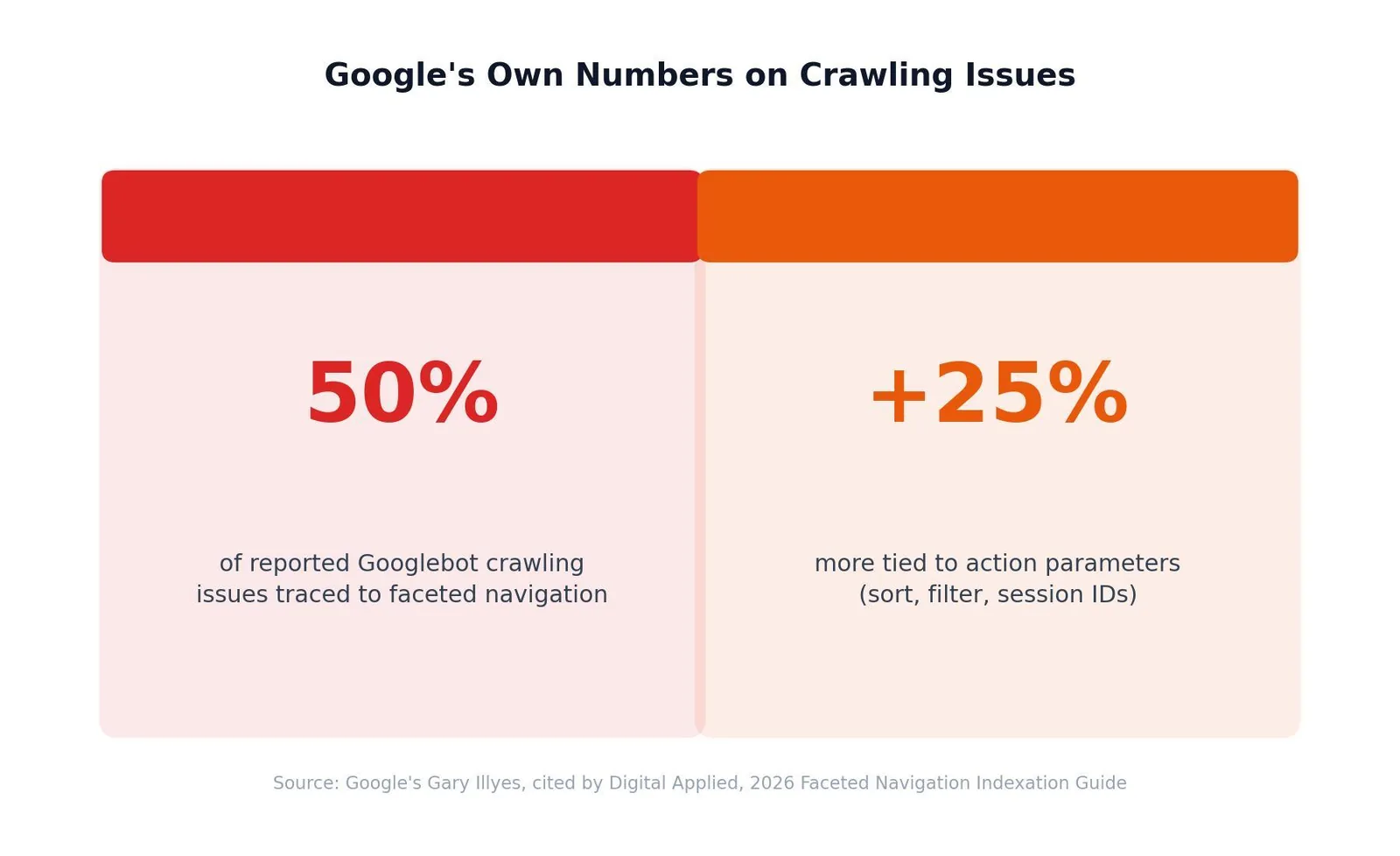
This isn't a theoretical problem. On Google's Search Off the Record podcast, Gary Illyes attributed 50 percent of all reported Googlebot crawling issues directly to faceted navigation. Action parameters, things like sort order, session tracking, and pagination, account for another 25 percent, putting URL parameter problems at the center of roughly three-quarters of all reported crawling complaints.
How One Category Page Becomes 144,000 URLs
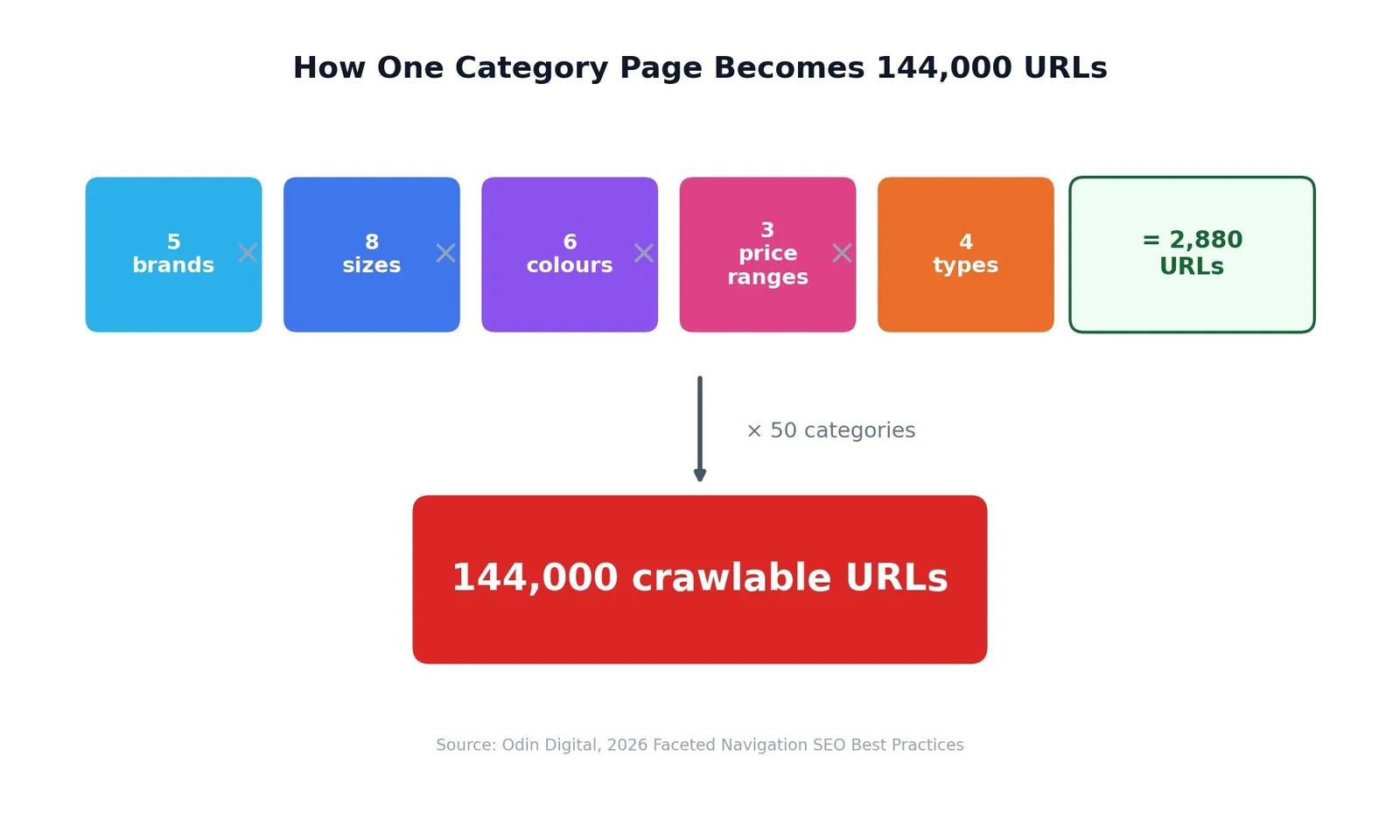
The scale of the problem is easy to underestimate until you do the math. According to Odin Digital's 2026 faceted navigation SEO guide, a single category with 5 brands, 8 sizes, 6 colors, 3 price ranges, and 4 types produces 2,880 possible URL combinations from that one category alone. Multiply that across 50 categories and a site can generate roughly 144,000 crawlable URLs, most carrying near-identical or duplicate content.
A 39:1 Crawl Waste Ratio, In One Ahrefs Audit
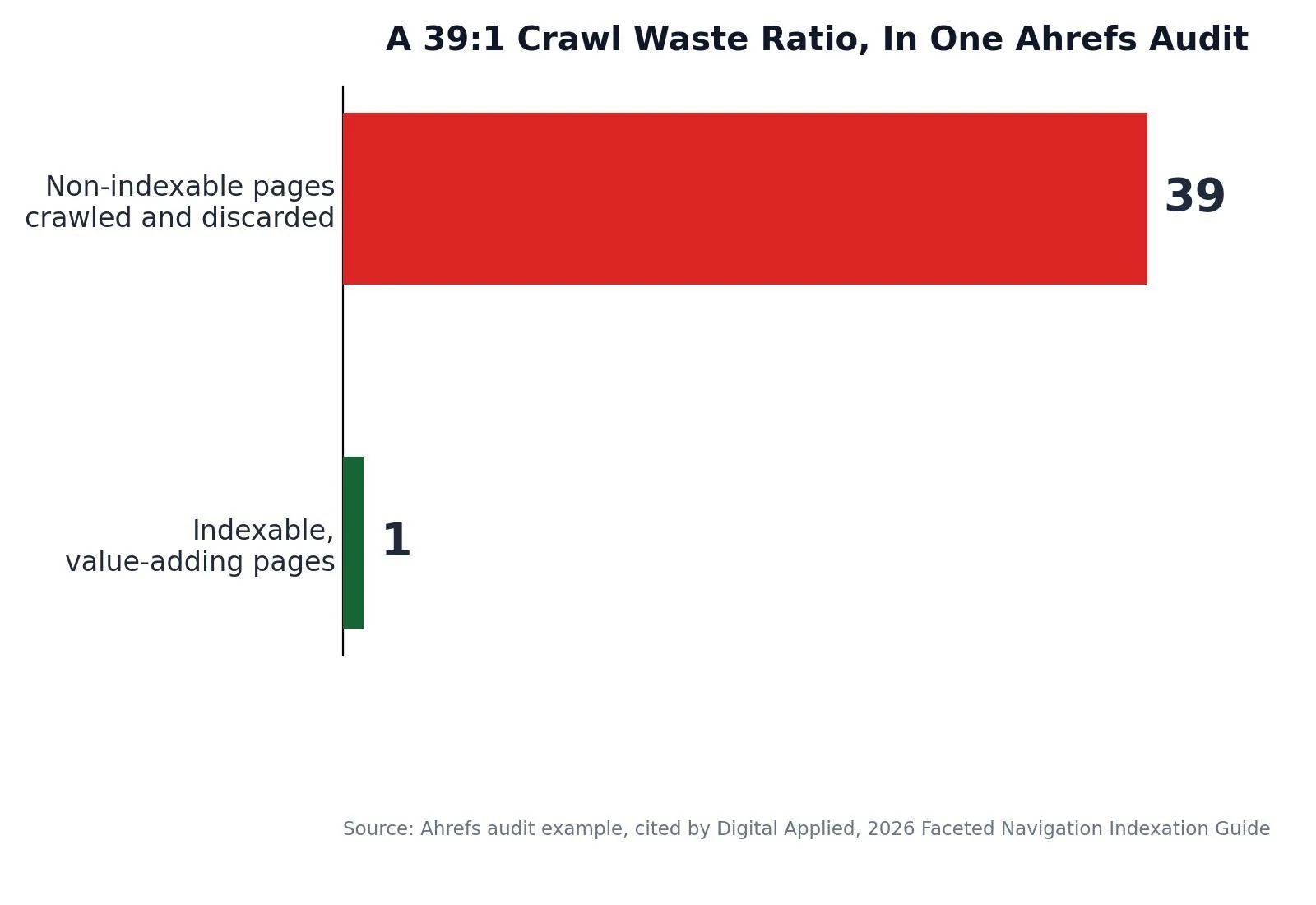
That combinatorial explosion translates directly into wasted crawl activity. Google's own Gary Illyes has stated that roughly 60 percent of the internet is duplicate content, with faceted navigation as the dominant technical driver of that duplication on ecommerce catalogs. In one illustrative Ahrefs audit, a site produced a 39:1 ratio of non-indexable to indexable URLs, meaning search engines crawled and discarded 39 pages for every single page that actually earned a place in the index.
Faceted Navigation Control Methods Compared
| Method | Blocks Crawling? | Passes Link Equity? | Best For |
|---|---|---|---|
| Robots.txt Disallow | Yes, prevents crawling entirely | No | Facets with no search demand and no SEO value |
| Meta noindex | No, page is still crawled | Yes, but diluted | Facets that need to stay accessible to logged-in users or bots for other reasons |
| Rel=canonical | No, page is still crawled | Yes, consolidates to target | Facets similar enough to a parent category to merge ranking signals |
| AJAX / JS-rendered filters | Yes, no new URL is created | Not applicable | Low-value filters needed only for on-site UX, not search |
Google's own guidance favors robots.txt over noindex for genuinely low-value facet URLs specifically because a noindex tag still requires Google Search Console and Googlebot to fetch the page before honoring the tag. A robots.txt block prevents that fetch from happening at all. GSC's Crawl Stats report is the fastest way to confirm which of these methods is actually needed before implementing any of them.
The Faceted Navigation Decision Tree
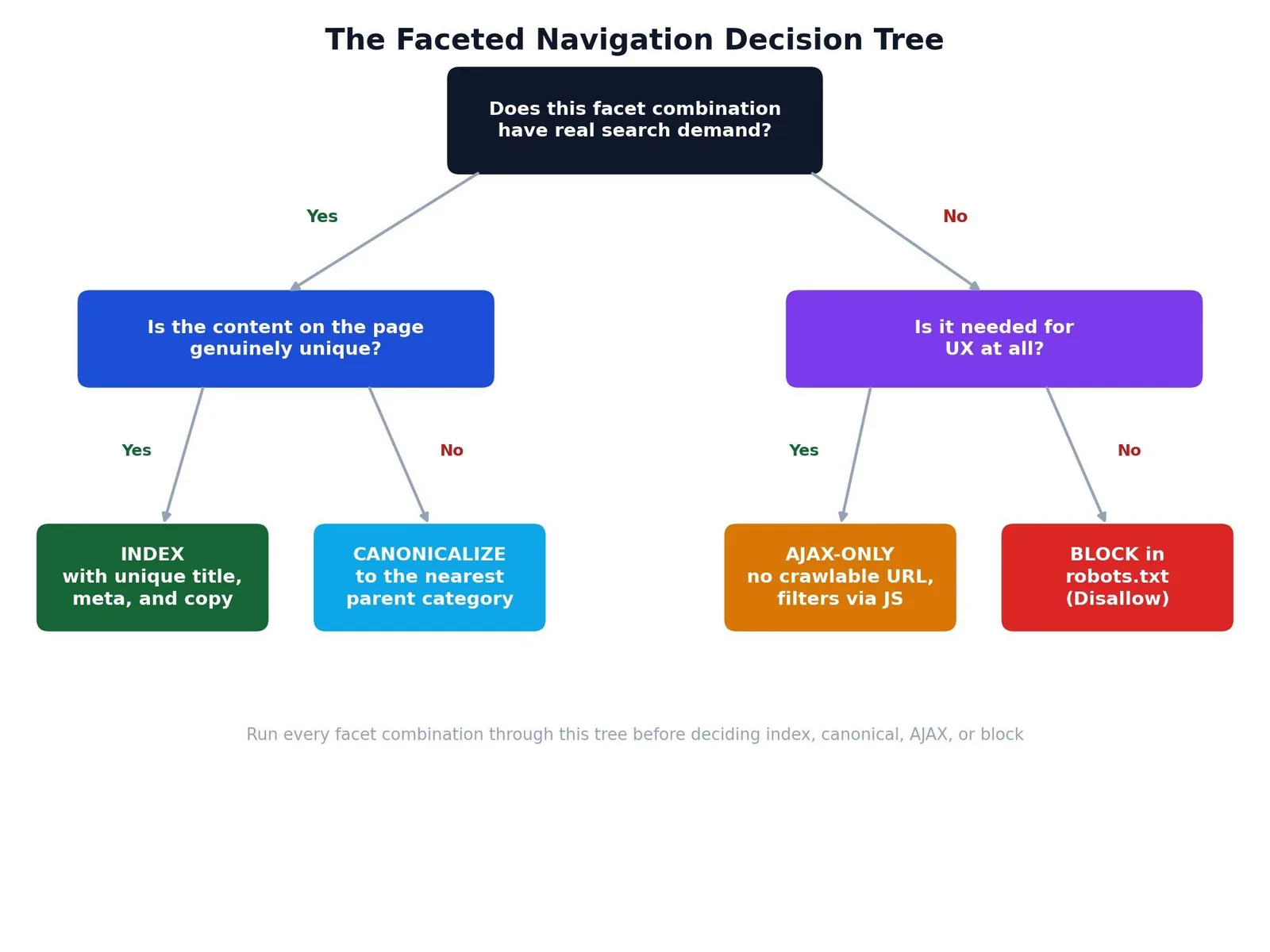
Google's own guidance favors robots.txt over noindex for genuinely low-value facet URLs specifically because a noindex tag still requires Googlebot to fetch the page before honoring the tag. A robots.txt block prevents that fetch from happening at all. GSC's Crawl Stats report is the fastest way to confirm which of these methods is actually needed before implementing any of them.
Technical SEO tool
What should you do with this facet?
Answer both questions to get a recommendation.
How to Fix Faceted Navigation SEO Issues
Step 1: Audit current crawl behavior in Search Console
Pull the Crawl Stats report in Google Search Console and check what share of requests hit parameterized URLs versus real category and product pages. A single Crawl Stats report tells you exactly how much crawl budget is being lost before you fix anything, which makes this the fastest technical SEO win available on the list.
Step 2: Identify which facets have genuine search demand
Not every filter deserves to rank. Check actual search volume for specific facet combinations before deciding anything else, a facet nobody searches for has no reason to stay indexable.
Step 3: Apply canonical tags to consolidate duplicate variations
For facets that are close enough to a parent category, rel=canonical tags consolidate link equity onto one strong page instead of spreading it thin across dozens of near-identical faceted URLs.
Step 4: Block low-value combinations in robots.txt
For facet combinations with no search demand and no real value, a robots.txt Disallow rule (using a clear user agent and disallow pattern) is more effective than noindex, since it stops the crawl before it starts.
Step 5: Convert pure-UX filters to AJAX
Filters that exist only to make browsing easier, with no organic search value, should update results without generating a new URL at all. This keeps the user experience intact while removing the SEO downside entirely.
Step 6: Monitor Google Analytics and Search Console after changes
Track Google Analytics and Google Search Console data after implementing changes. CTR, indexed page count, and crawl stats should all move in the right direction within a few weeks if the fix actually worked.
Common Faceted Navigation SEO Mistakes
The most common one is leaving every filter combination fully crawlable and indexable by default, which is exactly how a catalog of a few thousand SKUs ends up with hundreds of thousands of indexed pages.
Noindex gets used as the default control method far more often than robots.txt, wasting crawl budget on pages that still get fetched and evaluated before the noindex tag is even read.
A URL sometimes gets blocked in robots.txt while internal links keep pointing to it anyway, which sends search engines conflicting signals: internal links suggest a page matters while the block says otherwise.
And facet-generated duplicate content gets ignored until rankings visibly drop far too often, letting the problem compound for months before anyone notices the underlying cause.
Frequently Asked Questions
Does faceted navigation always hurt SEO?
No. Faceted navigation itself is neutral, even beneficial for user experience and long tail search discovery. The SEO damage comes specifically from unmanaged faceted navigation that generates crawlable, duplicate, low-value URLs without any control strategy behind it.
Should I use noindex or robots.txt to control faceted URLs?
Robots.txt is generally preferred for facets with no SEO or UX value, since it prevents the crawl entirely. Noindex still requires a fetch before Google respects the tag, which continues to consume crawl budget. Reserve noindex for cases where the page needs to stay accessible for other reasons.
Does faceted navigation affect AI search and AEO the same way it affects Google?
The underlying problem is similar: AI crawlers building answer engine optimization visibility still have to crawl a site before citing it, and a bloated, duplicate-heavy URL structure wastes their limited crawl activity the same way it wastes Googlebot's.
How much does it cost to fix faceted navigation issues on a large site?
It depends heavily on catalog size, platform, and how deeply the issue has already spread, so there's no single number that applies broadly. Get a quote specific to your site's scale before committing budget, and treat any figure quoted in USD as a starting point for negotiation.
The Bottom Line on Faceted Navigation SEO
Faceted navigation isn't the enemy, unmanaged faceted navigation is. The same filters that make a category page genuinely useful to shoppers can quietly generate hundreds of thousands of near-duplicate URLs that search engines crawl, evaluate, and discard, taking crawl budget away from the pages that actually deserve to rank.
Start with a Crawl Stats audit this week. If parameterized URLs make up a large share of requests, that's the clearest sign this problem is already costing you visibility. Following Google's own best practices, blocking low-value facets before worrying about anything else and indexing only what genuinely earns it, consistently beats leaving the decision to chance.
More from Web Tonic: growth marketing services, data & analytics.
Sources: searchengineland.com · odindigital.com.au · ahrefs.com · developers.google.com