Table of contents
Facebook still reaches more American adults than any network except YouTube, and a small business can work it on $10 a day. This is the operating manual: what to post, what to pay for, and what to measure.
Key Takeaways
- 71% of US adults use Facebook, so for most local businesses it is the widest single audience available.
- Meta's ad reach on Facebook is about 2.28 billion people — 41.1% of everyone online.
- Budget bands, not budgets: $10–$20/day tests an offer, $30–$60/day feeds one local service area, $100+/day supports multiple offers.
- Organic reach is a distribution tax, not a strategy — plan for 1–4% of followers seeing a post and treat paid as the reach engine.
- 3 assets carry everything: a complete Page, one recognisable offer, and 4–6 creatives in rotation.
- Average Facebook ads conversion rate sits near 8.8% for lead-gen forms, far above typical website form rates.
- Measure 5 numbers weekly: cost per result, click-through rate, frequency, lead-to-appointment rate, and cost per booked job.
What Facebook is actually good at for a small business
Facebook does 4 jobs well and 2 jobs badly. Getting the split right saves months. It is exceptional at cheap local reach, at retargeting people who already know you, at collecting leads inside the app, and at social proof through reviews and recommendations. It is weak at capturing high-intent demand the moment someone is ready to buy — that is search — and weak at long consideration cycles where nobody is browsing a feed while shortlisting vendors. Pew Research Center puts Facebook at 71% of US adults, which is why the reach argument holds even as attention shifts elsewhere.
| Job to be done | Facebook fit | What it costs you | Better alternative if it fails |
|---|---|---|---|
| Cheap local awareness | Excellent | $5–$15 per 1,000 local impressions | Local print or radio |
| Lead capture | Excellent with instant forms | $8–$60 per lead by industry | Google Ads search |
| Retargeting site visitors | Excellent above ~1,000 monthly visitors | $3–$10 per 1,000 impressions | Email sequences |
| Social proof | Strong via Recommendations | Time only | Google Business Profile reviews |
| Capturing ready-to-buy intent | Weak | Wasted spend on browsers | Search ads and local SEO |
| Long B2B consideration cycles | Weak alone | Leads that never book | LinkedIn plus email nurture |
Set the Facebook business account up once, properly
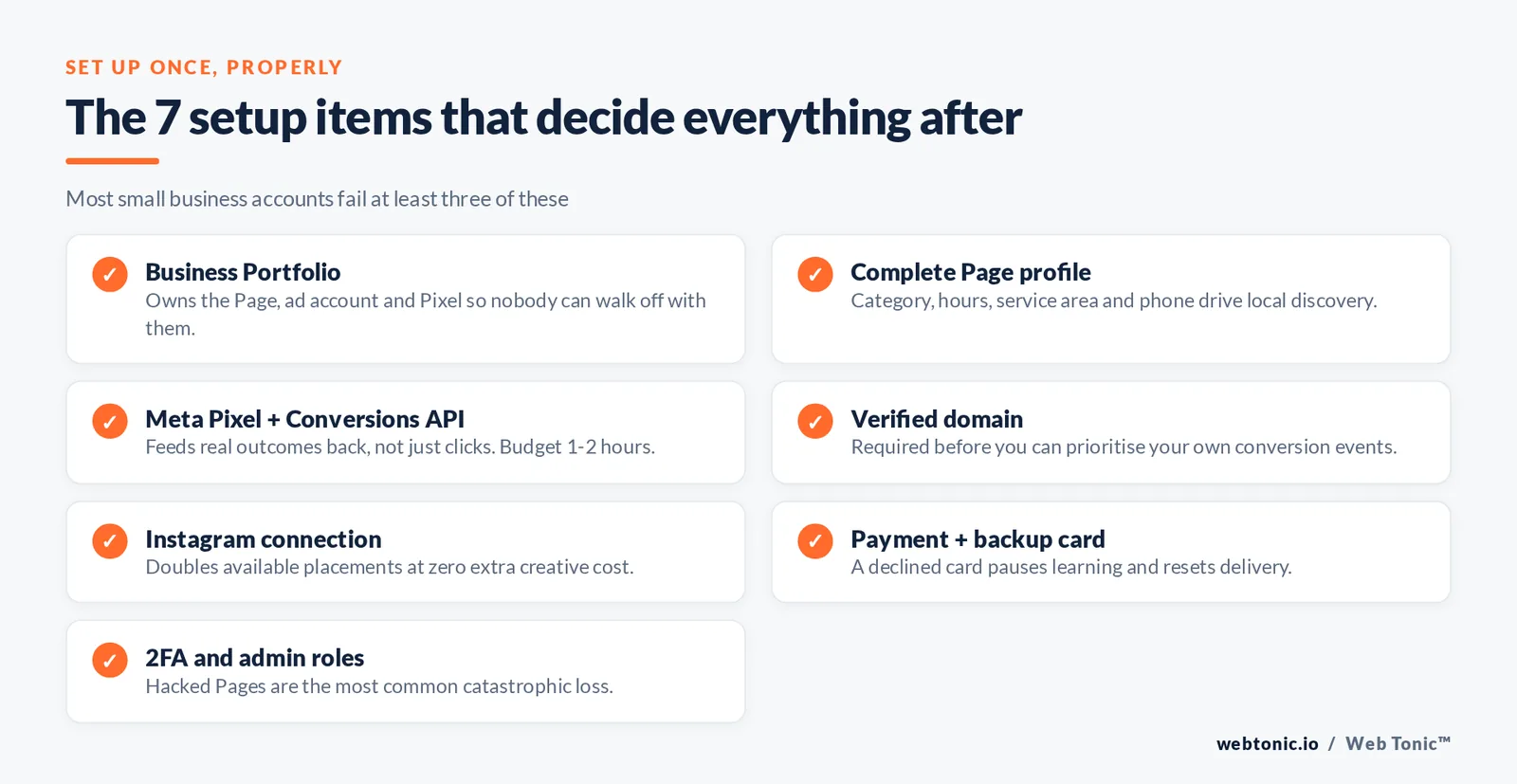
7 setup items decide whether everything after this works. Most small business accounts we audit fail on at least 3 of them, and every failure quietly caps performance. Work the list in order — the Meta Pixel and the conversions setup matter more than the cover photo, even though the cover photo gets all the attention.
| Setup item | Why it matters | Common mistake | Time |
|---|---|---|---|
| Business Portfolio (Business Manager) | Owns the Page, ad account and Pixel so a departing employee cannot take them | Running ads from a personal profile | 20 min |
| Complete Page profile | Category, hours, service area and phone drive local discovery | No service area, no hours | 30 min |
| Meta Pixel plus Conversions API | Feeds the ad system real outcomes rather than clicks | Pixel installed, no events mapped | 1–2 hrs |
| Verified domain | Required to prioritise your own conversion events | Skipped entirely | 15 min |
| Instagram connection | Doubles placements at no extra creative cost | Unlinked accounts | 10 min |
| Payment plus billing threshold | A declined card pauses learning and resets delivery | One card, no backup | 10 min |
| Two-factor and admin roles | Hacked Pages are the most common catastrophic loss | Single admin, no 2FA | 10 min |
Meta's own developer documentation on server-side events is the reference for the Pixel-plus-API pairing; if you would rather not touch code, our data intelligence team wires it as a fixed-scope project.
Organic content: what small businesses should actually post
Plan for 1–4% organic reach and post 3–5 times a week. Organic Facebook is no longer a distribution channel for cold audiences; it is a credibility layer that people check after an ad, a referral or a search. That changes what belongs on the Page. Proof content outperforms promotional content, and content filmed on a phone outperforms designed graphics because it looks like it came from a person. Hootsuite's Facebook marketing guide and Sprout Social's strategy breakdown both land on the same conclusion from independent data sets.
| Post type | What it does | Cadence | Effort |
|---|---|---|---|
| Finished-work photos | Proves capability better than any claim | 2× per week | Low |
| Short vertical video (15–30s) | Earns the most reach of any format | 1–2× per week | Medium |
| Customer review screenshots | Converts warm visitors reading the Page | 1× per week | Low |
| Behind the scenes / team | Builds the familiarity that makes ads cheaper | 2× per month | Low |
| Practical how-to posts | Gets saved and shared; seeds authority | 2× per month | Medium |
| Offers and promotions | Works only on an already-warm audience | 1× per month | Low |
| Local community and events | Triggers comments from real neighbours | 1–2× per month | Low |
Facebook ads on a small business budget
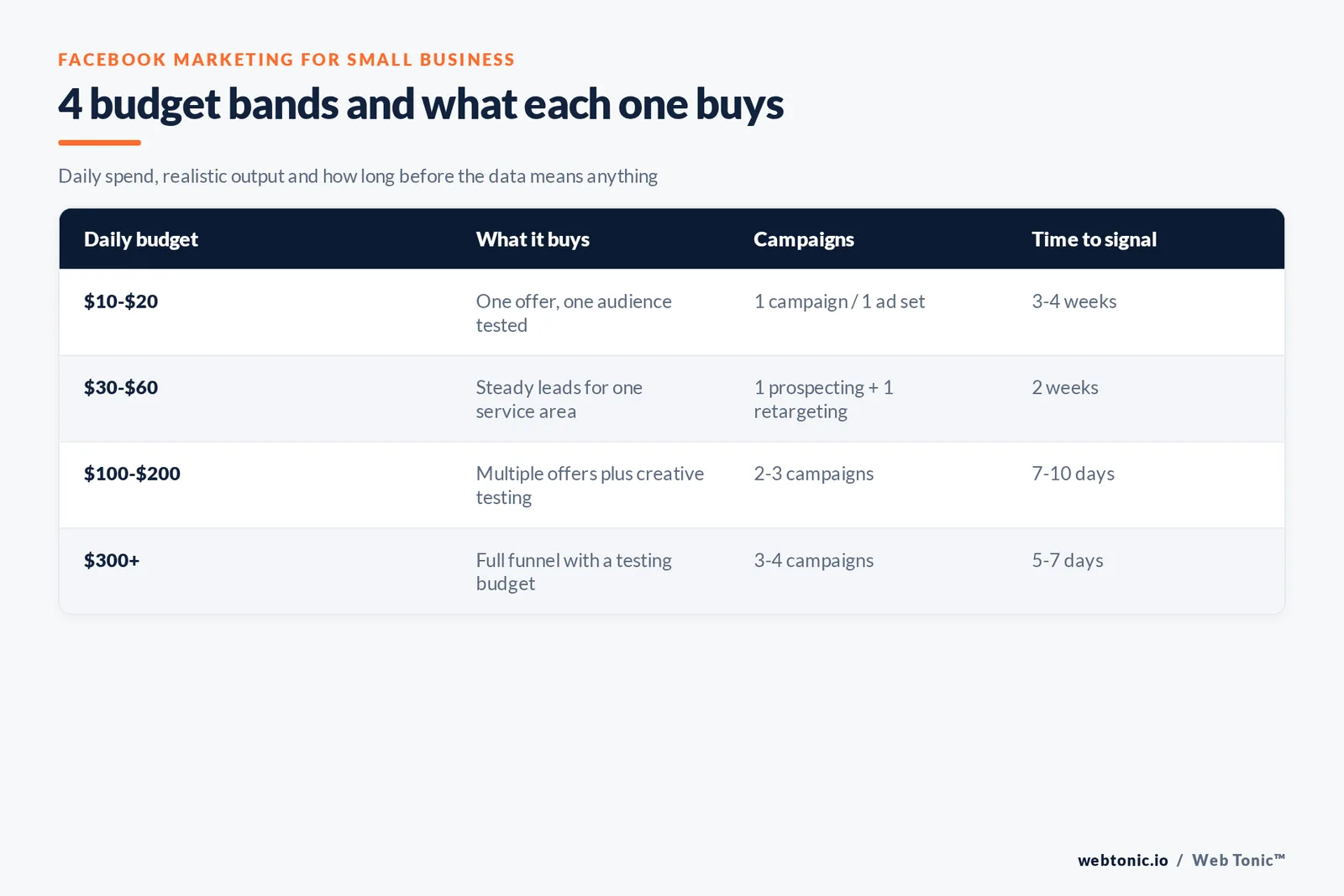
3 budget bands cover almost every independent operator. The mistake is not spending too little — it is splitting too little across too many campaigns, so nothing ever accumulates the 50 weekly conversions that stabilise delivery. One campaign, one audience, four creatives beats five campaigns every time at these levels.
| Daily budget | What it realistically buys | Campaign count | Expected timeline to signal |
|---|---|---|---|
| $10–$20 | One offer tested against one audience | 1 campaign, 1 ad set | 3–4 weeks |
| $30–$60 | Steady lead flow for one local service area | 1 prospecting, 1 retargeting | 2 weeks |
| $100–$200 | Multiple offers plus real creative testing | 2–3 campaigns | 7–10 days |
| $300+ | Full-funnel with dedicated testing budget | 3–4 campaigns | 5–7 days |
Rule 1 — never run more ad sets than you have $10/day each to feed. WordStream's Facebook advertising benchmarks put the average cost per lead near $27.66 across industries, with the cheapest verticals under $1 and the most expensive above $50 — so a $20/day budget generating fewer than 15 leads a month is normal, not broken.
Choosing the campaign objective and the audience
4 objectives cover 95% of paid activity at this scale. Everything else is a distraction at this spend level. Pick by what you can measure, not by what sounds ambitious: if you cannot see the outcome in your CRM or your inbox, you cannot optimise toward it.
| Objective | Use when | Optimise for | Typical trap |
|---|---|---|---|
| Leads (instant form) | You sell a service and can call fast | Leads, then qualified leads via offline events | Cheap leads nobody follows up within 5 minutes |
| Sales | You have checkout events firing | Purchase | Optimising Add-to-Cart forever |
| Engagement (messages) | Customers prefer to chat, e.g. restaurants and salons | Conversations started | Nobody staffs the inbox |
| Awareness | Launching a location or event | Reach with a frequency cap | Used as the default because it looks cheap |
| Audience type | How to build it | Minimum size | When it wins |
|---|---|---|---|
| Local broad | Radius or city, age range, no interests | 50,000+ | Default for local services in 2026 |
| Advantage+ audience | Suggestions plus your conversion data | Any | Once 50+ conversions exist |
| Customer list | Upload hashed emails and phones | 300+ matched | Repeat purchase and win-back |
| Lookalike 1% | Seed from best customers, not all leads | 1,000-record seed | Scaling past $100/day |
| Website retargeting | Pixel visitors, 30–90 days | 1,000+ | Always, if traffic allows |
| Video viewers | 75% viewers of your best video | 2,000+ | Low-traffic sites with strong content |
Limit 3: no more than 3 audiences at once below $100/day. Overlap between local audiences drives your own costs up in the auction, and our growth marketing team sees this on roughly half of the accounts we inherit.
Creative that works when you are not a brand
4–6 live creatives, refreshed when frequency passes 2.5. Small businesses win on specificity and proof, not production value. A phone photo of a real job with a plain-language offer regularly beats an agency-produced video, because it matches what the feed already looks like. Nielsen Norman Group's research on video usability is a useful discipline check: people skip anything that takes too long to declare its point.
| Creative angle | Format | Why it works | Best for |
|---|---|---|---|
| Before and after | Single image or 2-card carousel | Shows the outcome in under a second | Trades, dental, fitness, cleaning |
| Owner to camera | 15–25s vertical video | Trust transfers from a face, not a logo | Local services, professional services |
| Named offer | Bold text image | Removes ambiguity about price and next step | Promotions, first-visit offers |
| Customer review as the ad | Screenshot plus caption | Third-party voice beats first-party claims | Anything with strong reviews |
| Process explainer | Carousel, 4–5 cards | Reduces fear of the unknown | High-ticket or invasive services |
| Team or "we're hiring" | Photo | Cheapest reach; doubles as recruitment | Growing local businesses |
If a review or a customer photo appears in an ad, the FTC's endorsement guides apply — get permission, do not edit the substance of a testimonial, and disclose any incentive. Trap 2 — using stock photos of people who are obviously not your customers is the fastest way to burn credibility on a local Page.
Facebook marketing by business type
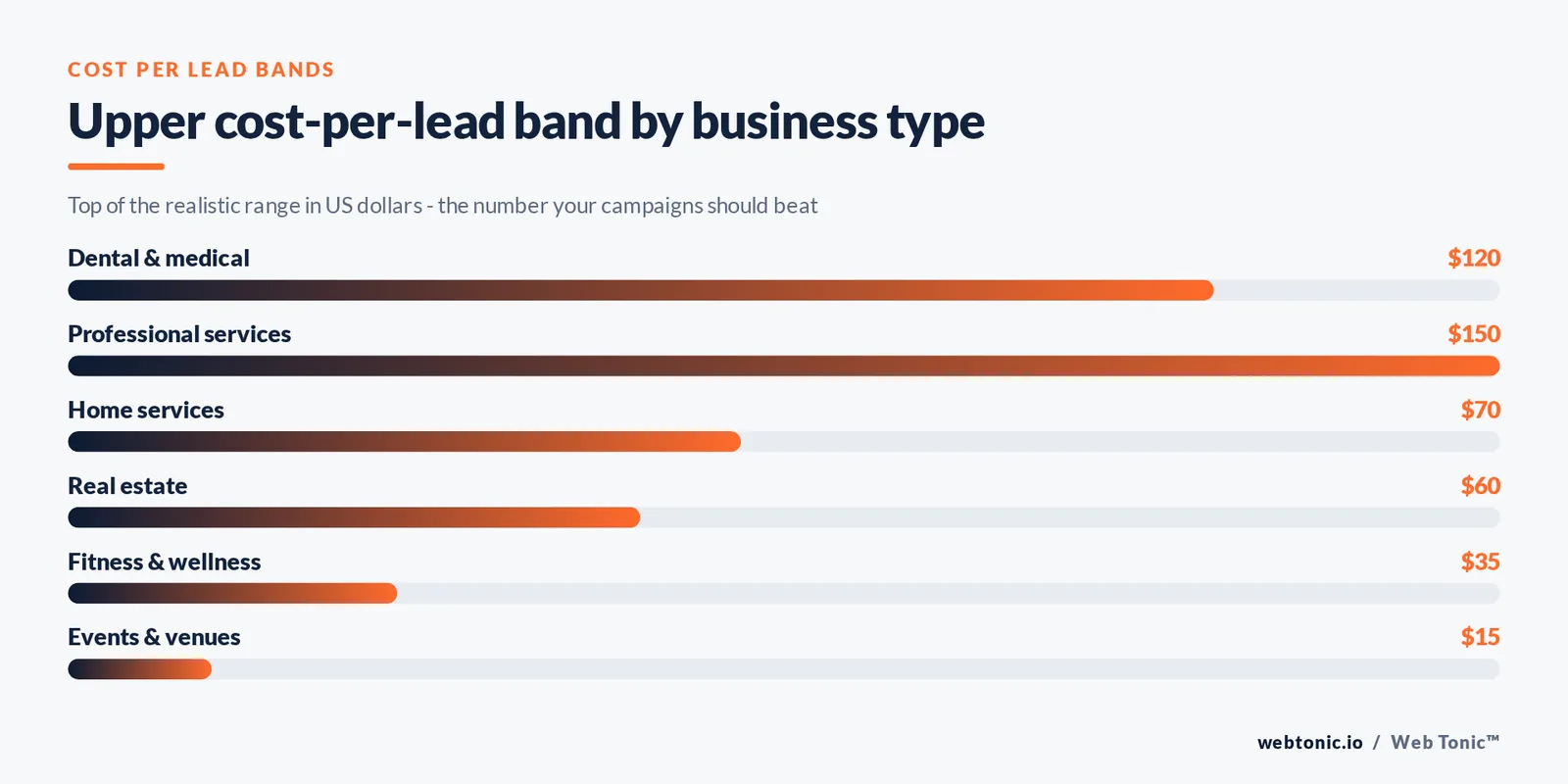
The same platform, 8 different playbooks. What changes is the offer and the measurement point, not the mechanics. Cost figures below reflect the ranges reported in Socialinsider's Facebook benchmark study and industry lead-cost data; treat them as bands to beat, not promises.
| Business type | Primary play | Measure this | Realistic cost per enquiry |
|---|---|---|---|
| Home services / trades | Local lead form plus before/after creative | Cost per booked job | $20–$70 |
| Restaurants and cafés | Reach plus messages within 3–5 km | Redeemed offers | $2–$8 per offer claim |
| Fitness and wellness | Trial offer with instant form | Trial-to-member rate | $10–$35 |
| Dental and medical | New-patient offer, strict compliance copy | Cost per new patient | $35–$120 |
| Ecommerce under $500k | Catalogue retargeting plus one prospecting ad set | Blended ROAS | n/a — track ROAS |
| Professional services (B2B local) | Lead magnet plus nurture email | Cost per consultation held | $40–$150 |
| Real estate | Listing carousels plus saved-search leads | Cost per qualified enquiry | $15–$60 |
| Events and venues | Event response plus 7-day countdown retargeting | Cost per ticket | $3–$15 |
Facebook Groups, reviews and the free surface area
3 free surfaces still move revenue. Groups, Recommendations and Marketplace are the parts of Facebook that do not cost media budget, and small businesses under-use all three. The US Small Business Administration's marketing guidance makes the same point about earned channels: they are slow, and they are durable.
| Free surface | How to use it | Realistic payoff | Effort per week |
|---|---|---|---|
| Local community Groups | Answer questions in your expertise, never pitch | 2–8 referrals a month in an active town Group | 30–45 min |
| Your own customer Group | Support, tips, early access for buyers | Higher retention and repeat purchase | 1 hr |
| Page Recommendations | Ask every happy customer by text with the direct link | Lifts ad conversion rates measurably | 15 min |
| Marketplace listings | Only for physical goods and rentals | Free high-intent enquiries | 20 min |
| Events | Every class, sale, open house | Cheap reach through interested-friend notifications | 15 min |
Measurement: 5 numbers, one weekly review
Fact 3 — most owner-run accounts are judged on the wrong metric. Page likes and post reach tell you nothing about revenue. The review below takes 20 minutes a week and is the difference between a channel you can scale and a channel you argue about. Metricool's cross-platform study is a useful outside benchmark for engagement, but the numbers that matter are yours.
| Metric | Where it lives | Healthy range | What to do when it breaks |
|---|---|---|---|
| Cost per result | Ads Manager | Below your allowable CPA | Change the offer before the targeting |
| Click-through rate (link) | Ads Manager | 0.9%–2.5% | New creative, new hook |
| Frequency | Ads Manager, 7-day view | Under 2.5 for prospecting | Refresh creative or widen the radius |
| Lead-to-appointment rate | Your CRM or inbox | 25%–50% | Fix speed to lead, add a qualifying question |
| Cost per booked job or sale | CRM plus spend | Under 20% of average order value | Pause, do not tune; the offer is wrong |
Send offline conversions back to Meta so the system optimises toward booked jobs rather than form fills — that single change is often worth more than every creative test combined. Meta's FY2025 results show ad impressions up 12% and average price per ad up 9% year over year, which is exactly why signal quality now beats bid tinkering.
7 traps that waste paid budgets
Every one of these appears in more than half of the accounts we audit. Fixing them costs nothing and usually recovers 20–40% of wasted spend.
| Trap | What it looks like | Fix |
|---|---|---|
| Trap 1 — Boosting posts | Engagement optimisation with no conversion event | Run the same creative as a proper campaign |
| Trap 2 — Editing live ads | Delivery resets every few days | Duplicate instead of edit; leave 7 days untouched |
| Trap 3 — Interest stacking | 14 interests in a 40,000-person town | Broad local targeting, let the creative filter |
| Trap 4 — No follow-up system | Leads called 2 days later | Auto-text in 60 seconds, call in 5 minutes |
| Trap 5 — Single creative | CTR halves in week 3 | Keep 4–6 in rotation, replace the worst monthly |
| Trap 6 — Sending traffic to the homepage | Clicks with no conversions | One offer, one page, one action |
| Trap 7 — Judging week 1 | Killing an ad set after 8 clicks | Decide at 50 conversions or 14 days |
6 strategies to increase results without increasing budget
6 strategies that cost nothing but attention. Before you increase spend, make sure the free levers are pulled — these are the changes that make an existing budget go further, and each one is effective for a different constraint. Start with whichever row matches the problem your company has this month, create the asset once, and let your existing customers and users share it for you.
| Strategy | What to create | How it helps | Most effective for |
|---|---|---|---|
| Recycle your best organic post as an ad | Nothing new — promote the existing post ID | Keeps accumulated likes, comments and shares as social proof | Companies with an active Page |
| Ask customers to share, do not buy reach | A short thank-you message with a direct share link | Friends of customers are the cheapest users to reach | Service businesses with repeat clients |
| Start an email-to-audience loop | A customer list upload refreshed monthly | Improves match rates and unlocks better lookalikes | Any company with 300+ customer records |
| Create one product-focused carousel | 4–5 cards of your best-selling products or services | Lets the system pick the winning product per user | Retail, ecommerce, multi-service firms |
| Answer questions in local Groups | Two genuinely helpful replies per week | Builds the recognition that lowers ad costs later | Trades and local professionals |
| Fix speed to lead before adding budget | A 60-second auto-text and a call script | Can increase booked jobs 20–40% at the same spend | Every firm running instant forms |
A 30-day starting plan
Week by week, 30 days from zero to a measurable channel. This assumes $20–$40/day and about 3 hours a week of owner time.
| Week | Do this | Spend | Success signal |
|---|---|---|---|
| Week 1 | Business Portfolio, Page cleanup, Pixel plus events, domain verification | $0 | Events firing in Events Manager |
| Week 2 | Shoot 6 creatives, write one named offer, build the local audience | $0 | 4–6 assets ready, landing page live |
| Week 3 | Launch 1 lead campaign, 1 ad set, 4 ads; set up 60-second lead texting | $20–$40/day | First 10 leads, CTR above 0.9% |
| Week 4 | Add retargeting, kill the worst 2 ads, report the 5 metrics | $20–$40/day | Known cost per lead and per booked job |
For a deeper look at the creative side, our breakdown of the Web Tonic blog covers ad-format specifics, and if you want the build handled, performance creative and a scoping conversation are the two fastest routes. Rounding out the picture: DataReportal's Facebook statistics track how the platform's reachable audience is shifting, and Facebook's own history is a decent primer on why its advertising system is shaped the way it is.
FAQ
How much should a small business spend on Facebook marketing per month?
Plan on $300 to $1,200 a month in media for a single local offer. Below roughly $10 a day, a campaign takes so long to accumulate conversions that you cannot tell a bad ad from bad luck. Above $100 a day you can afford genuine creative testing alongside a working campaign. Organic posting costs only time — budget 2 to 3 hours a week.
Is Facebook still worth it for small businesses in 2026?
Yes, for local reach and lead capture. About 71% of US adults still use Facebook, and Meta's reachable ad audience on the platform sits near 2.28 billion people worldwide. The channel has changed rather than declined: organic reach is small, paid delivery is automated, and the winners are businesses with good offers and honest creative rather than clever targeting.
Should I use boosted posts or Ads Manager?
Ads Manager, in nearly every case. A boosted post optimises for cheap engagement and gives you almost no control over the conversion event, placement or audience exclusion. If a post performs organically, take that same creative into a proper campaign with a leads or sales objective. Boosting is only reasonable for filling an event or amplifying a genuine piece of community news.
How many times a week should a small business post on Facebook?
Three to five times a week is enough. Consistency matters more than volume because the Page functions as proof rather than as a reach channel. A practical mix is two finished-work photos, one or two short vertical videos, and one review or community post. If posting five times means posting filler, post three good things instead.
What is the fastest way to get leads from Facebook?
An instant lead form on a named offer, aimed at a broad local audience, with automated follow-up inside 60 seconds. Instant forms convert far better than sending cold traffic to a website because they remove the page load and the typing. The constraint is almost never volume — it is follow-up speed, which is why speed-to-lead automation should be built before the first campaign goes live.
Sources
Pew Research Center — Social Media Fact Sheet · DataReportal — Essential Facebook Statistics · Meta Platforms — Fourth Quarter and Full Year 2025 Results · WordStream — Facebook Advertising Benchmarks · Socialinsider — Facebook Benchmarks Study · Sprout Social — Facebook Marketing Strategy · Hootsuite Blog — Facebook Marketing Tips · Metricool — Social Media Study · US Small Business Administration — Marketing and Sales Guide · Federal Trade Commission — Endorsement Guides FAQ · Nielsen Norman Group — Video Usability