Table of contents
There is no universal ideal blog post length. The right word count is set by the search intent you are answering and by what already ranks — most commercial blog posts land between 1,200 and 2,500 words, while news updates work at 400.
Key Takeaways
- Google publishes no minimum word count; its guidance asks for helpful, people-first content, not length.
- Derive the target from the SERP: take the top 5 ranking pages, note their word counts, and aim inside that band rather than above it.
- Practical bands: 400–700 words for news, 800–1,200 for a single how-to, 1,500–2,500 for a commercial guide, 3,000+ for a pillar page.
- Nielsen Norman Group's reading studies found roughly 79% of users scan rather than read, and that visitors consume only about 20–28% of the words on a page.
- Orbit Media's survey of 808 content marketers found just 21% report strong results — and about half publish only 2–4 posts a month, so each one has to earn its length.
- Long form content wins when it consolidates a topic; it loses when it pads a question that deserves 300 words.
This page gives you a repeatable way to decide how long a blog post should be before you write it, the word count bands we use across client programmes at Web Tonic's growth marketing team, and the formatting that makes longer posts readable. If you want the writing process itself, read how to write a blog post; for the strategy behind pillar content, see long form content.
What Google actually says about blog post length
Google has never published a word count target. Its helpful content guidance asks whether a page provides original information, substantial value and evidence of first-hand expertise — questions about substance, not volume. Search engines reward the page that resolves the query most completely, and completeness sometimes takes 500 words and sometimes 3,000.
Two mechanics matter more than length. First, snippets: Google generates the description shown in results from page content, so your snippet and title should answer the query in the first paragraph, whatever the total word count. Second, scanning behaviour. Nielsen Norman Group's classic finding that users scan rather than read means a 2,500-word article that hides its answer in paragraph nine performs worse than an 800-word article that leads with it.
The practical translation: write to satisfy the query, then check length. Never open a document with a word count quota and reverse-engineer the content to fill it — that is how thin, padded long blog posts get made.
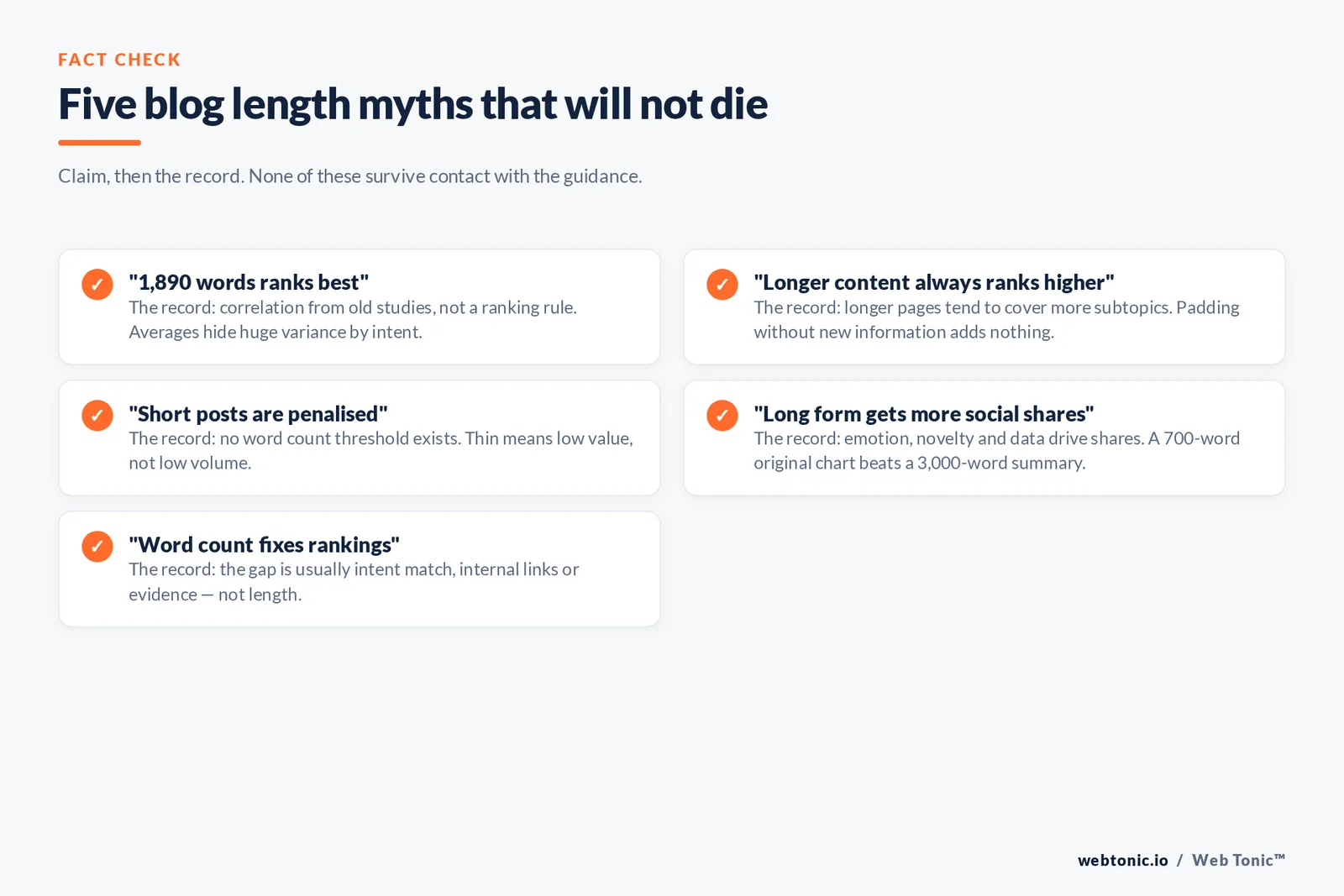
| Length myth | What people believe | What holds up |
|---|---|---|
| "1,890 words ranks best" | A single average word count is the target for every post | Correlation from old studies, not a ranking rule. Averages hide huge variance by intent |
| "Longer content always ranks higher" | More words means more keywords and more authority | Longer pages tend to cover more subtopics; padding without new information adds nothing |
| "Short posts are penalised" | Under 500 words gets filtered out | No word count threshold exists. Thin means low value, not low volume |
| "Long form content gets more social shares" | Word count drives sharing | Emotion, novelty and data drive social shares. A 700-word original chart outperforms a 3,000-word summary |
| "Word count fixes rankings" | Adding 1,000 words revives a stalled post | Usually the gap is intent match, internal links or evidence — not length |
Ideal blog post length by content type
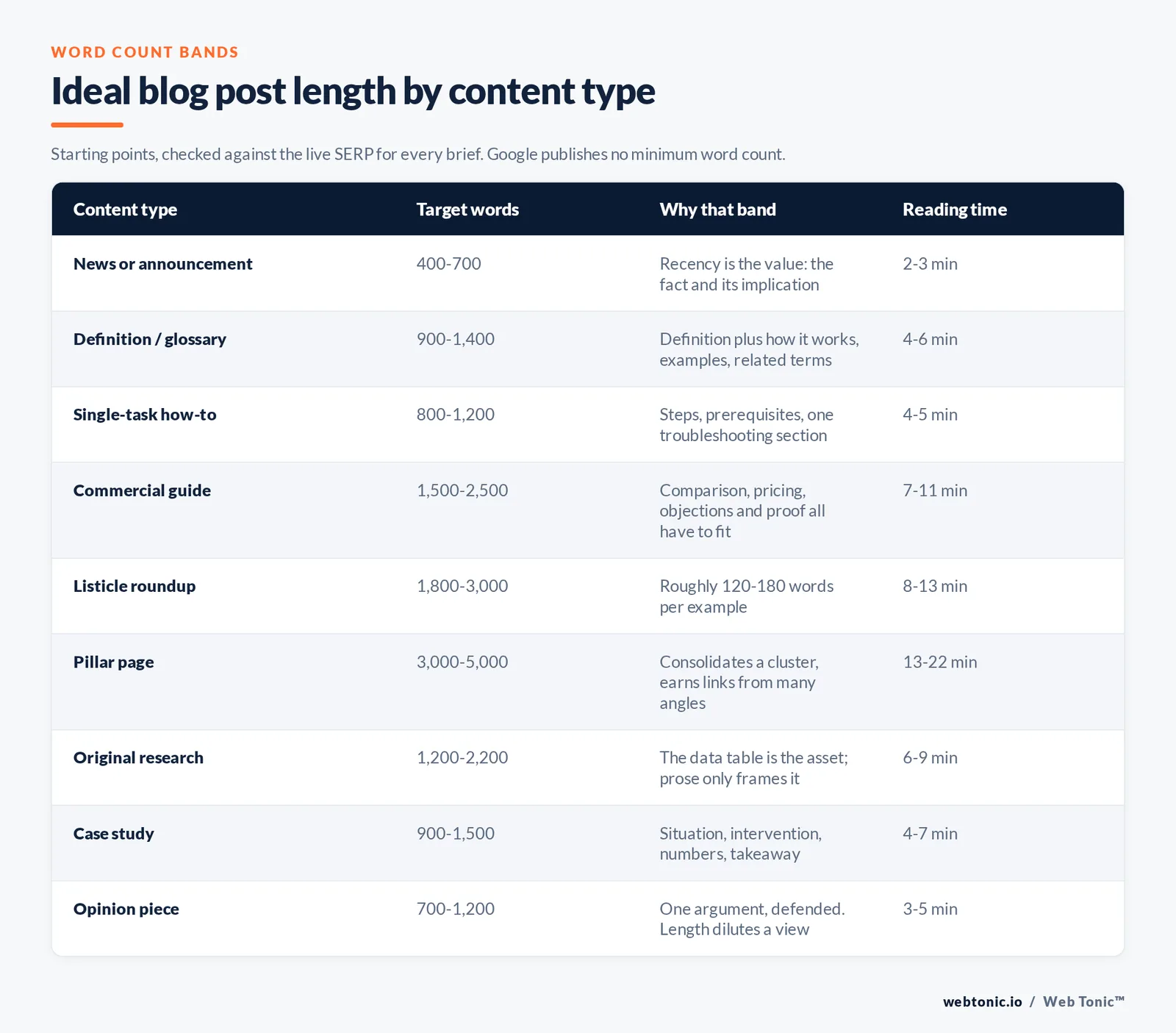
These are the bands our editors work to. They are starting points, checked against the live SERP for every brief. The rule behind them: length should scale with the number of decisions a reader has to make before they act.
| Content type | Target word count | Why that band | Reading time |
|---|---|---|---|
| News or announcement | 400–700 | Recency is the value; readers want the fact and the implication | 2–3 min |
| Definition / glossary post | 900–1,400 | A tight definition plus how it works, examples and related terms | 4–6 min |
| Single-task how-to | 800–1,200 | Steps, prerequisites and one troubleshooting section | 4–5 min |
| Commercial guide (buying intent) | 1,500–2,500 | Comparison, pricing, objections and proof all have to fit | 7–11 min |
| Listicle / examples roundup | 1,800–3,000 | Length is a function of item count: roughly 120–180 words per example | 8–13 min |
| Pillar page / complete guide | 3,000–5,000 | Consolidates a cluster and earns links from many angles | 13–22 min |
| Original research / statistics post | 1,200–2,200 | The data table is the asset; prose only frames it | 6–9 min |
| Case study | 900–1,500 | Situation, intervention, numbers, takeaway — nothing else | 4–7 min |
| Opinion / thought leadership | 700–1,200 | One argument, defended. Length dilutes a point of view | 3–5 min |
How to set the word count from the SERP in 10 minutes
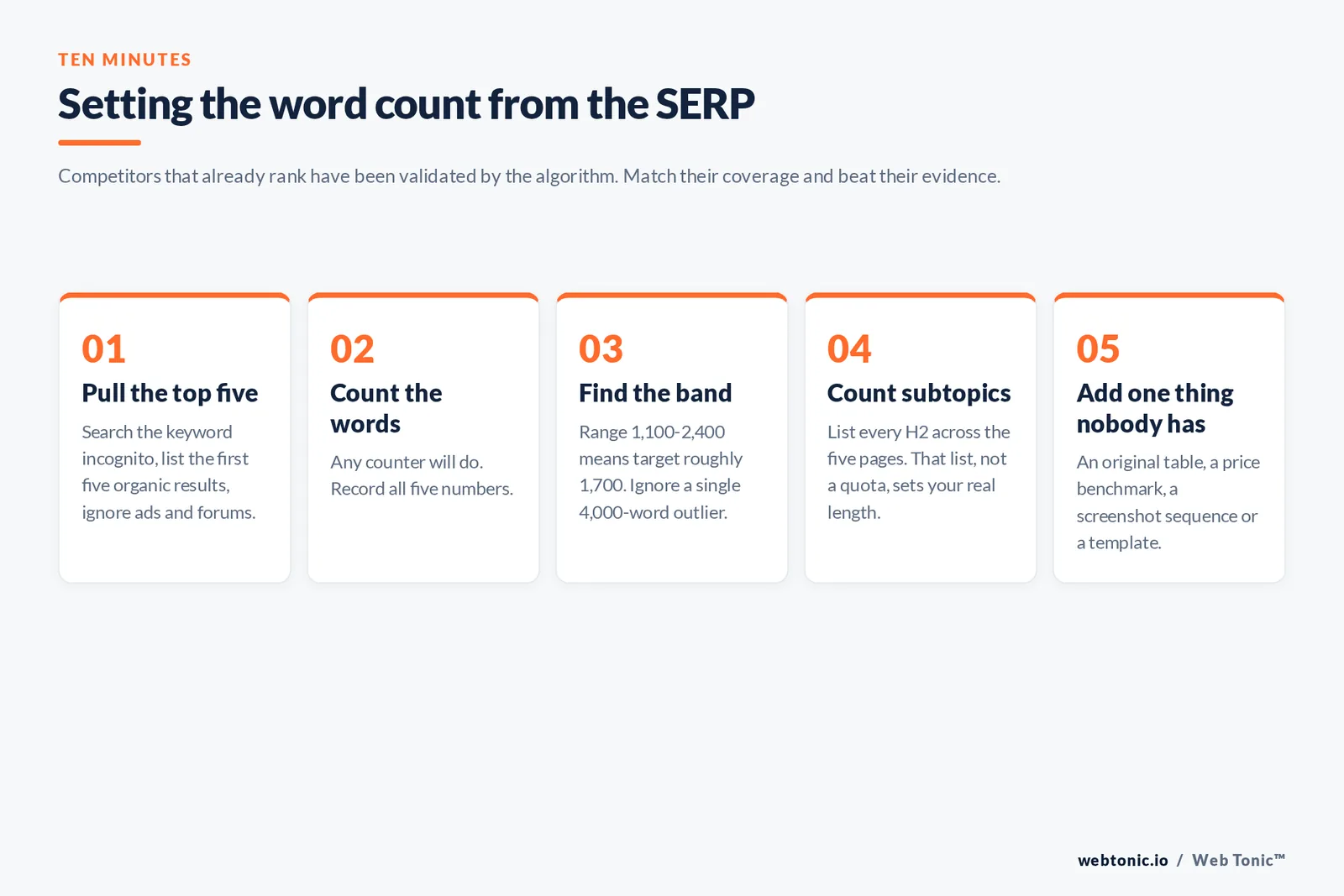
The fastest way to answer "how long should a blog post be" for a specific keyword is to let the search engines show you. Competitors that already rank have been validated by the algorithm; your job is to match their coverage and beat their evidence.
- Step 1 — pull the top 5. Search your target keyword in an incognito window and list the first five organic results, ignoring ads and forums.
- Step 2 — count the words. Use any word count extension or paste the body into a counter. Record all five numbers.
- Step 3 — find the band, not the average. If the range is 1,100–2,400 words, target the middle at roughly 1,700 words. If four results sit near 900 and one is 4,000, ignore the outlier.
- Step 4 — count subtopics, not just words. List every H2 across the five pages. Your post needs to cover the recurring ones; that H2 list, not a quota, determines your real length.
- Step 5 — add one thing nobody has. An original table, a price benchmark, a screenshot sequence or a template. This is what makes the page worth ranking above the incumbents.
Tool-based briefs from Ahrefs, Semrush and Yoast all recommend the same competitive check before drafting rather than a fixed length.
Blog post length by search intent
Intent predicts length better than industry does. A dentist writing "tooth extraction aftercare" and a SaaS company writing "SOC 2 checklist" both need instructions and both land near 1,000 words. The same two brands writing a comparison page both need 2,000.
| Search intent | Example query | Length | Must-have elements |
|---|---|---|---|
| Informational (quick answer) | "what is a meta description" | 600–1,000 | Definition in the first 50 words, one example, one limit or spec |
| Informational (deep) | "content marketing strategy" | 2,000–3,500 | Framework, stage-by-stage table, measurement section |
| Commercial investigation | "best email marketing tools" | 2,000–3,000 | Comparison table, pricing, verdict per use case |
| Transactional | "seo agency pricing" | 1,200–1,800 | Real price ranges, what drives cost, next step CTA |
| Navigational / branded | "[tool] integrations" | 400–800 | List, screenshots, links to docs |
| Local intent | "roof repair cost in Dubai" | 900–1,500 | Local price data, regulations, service area detail |
What long form content is actually good at
Length is a means, not a goal. Longer blog posts earn their place when they do one of four jobs, and each job has a natural length ceiling.
- Job 1 — consolidation. Merging five thin posts into one 3,000-word guide removes internal competition and concentrates links on a single URL.
- Job 2 — link acquisition. Reference pages with original data attract citations. Orbit Media found 25% of marketers who publish original research report strong results, against 21% overall.
- Job 3 — objection handling. High-ticket services need the pricing, risk and process sections that push a page past 2,000 words.
- Job 4 — topical depth signals. Covering every recurring subtopic in a cluster demonstrates coverage no 600-word post can.
Note the counterweight in that same survey: only 37% of bloggers cite external sources, and respondents reported organic clicks falling 10–20% while AI assistant traffic contributes around 1% of visits. In that environment, adding words to an uncited page is the least effective move available. Adding evidence is the most effective one.
| Goal | Short post (under 1,000) | Long form blog post (2,500+) |
|---|---|---|
| Rank for a long-tail question | Strong — fast to publish, tightly matched | Weak — dilutes the answer |
| Rank for a head term | Weak — cannot match SERP coverage | Strong — room for every subtopic |
| Earn backlinks | Possible with one original stat | Strong when built on research |
| Drive social shares | Strong — scannable and quotable | Mixed — needs an excerptable hook |
| Convert to a lead | Good for late-stage queries | Good when objections are handled inline |
| Publishing velocity | 8–12 posts a month is realistic | 2–4 posts a month, matching the survey median |
Formatting: how to make any length readable
If readers scan, structure carries the load. Nielsen Norman Group's inverted pyramid recommendation — conclusion first, detail after — is what lets a long article survive a scanner. And since Statcounter puts mobile at roughly 52.6% of web traffic, every length decision is really a mobile decision.
| Element | Standard we hold | Effect on a long post |
|---|---|---|
| Paragraph length | Max 3 sentences, about 60 words | Prevents the wall-of-text bounce on mobile |
| Subheadings | One H2 or H3 every 250–350 words | Gives scanners entry points and builds the outline |
| Bullet points | 2–4 lists per 1,500 words, 3–7 items each | Compresses enumerations that would bloat word count |
| Tables | At least 2 tables per guide | Replaces 400 words of comparison prose |
| Images | 1 visual every 500–800 words | Resets attention and supports dwell time |
| Answer position | Within the first 60 words | Wins featured snippets and AI answer citations |
| Key takeaways box | 5–7 bolded lines above the fold | Serves the 79% who scan without reading |
Length, publishing cadence and budget
The real constraint is rarely the ideal blog post length — it is how much writing capacity you have per month. Orbit Media's survey of 808 content marketers is a useful reality check: about half publish 2–4 posts monthly, and the share of marketers using no AI tools at all collapsed from 65% to 5% in 24 months, which changed drafting speed far more than it changed quality standards. Decide your mix deliberately.
| Monthly capacity | Recommended mix | Total words | Best for |
|---|---|---|---|
| 2 posts | 1 pillar (3,000) + 1 how-to (1,000) | ~4,000 | New blogs building topical foundations |
| 4 posts | 1 pillar + 2 commercial guides + 1 short answer | ~8,000 | Service businesses chasing qualified leads |
| 8 posts | 2 guides + 4 how-tos + 2 news | ~12,000 | Competitive niches needing coverage speed |
| 16 posts | 3 pillars + 8 mid-length + 5 short | ~26,000 | Programmatic and ecommerce content at scale |
| Refresh-only month | Expand 4 existing posts by 400–800 words each | ~2,400 new | Blogs with 50+ posts and decaying rankings |
Five traps that make word count the wrong conversation
- Trap 1 — padding to a quota. Filler intros and restated definitions inflate word count and depress time on page. Cut the first 100 words of most drafts.
- Trap 2 — cannibalisation. Three 1,200-word posts on near-identical queries compete with each other. Merge them into one 2,500-word page and redirect.
- Trap 3 — ignoring the update cycle. A 3,000-word guide is a maintenance commitment. Budget 2 refreshes a year or don't publish it.
- Trap 4 — measuring the wrong thing. Track assisted conversions and rankings per URL, not average word count. Benchmarks from HubSpot's statistics library and Content Marketing Institute are directional, not targets.
- Trap 5 — one length for every channel. The blog post is the source; the newsletter, the LinkedIn version and the video script are different lengths of the same argument.
If you'd rather have this decided per keyword by an editor who checks the SERP first, our team does exactly that — see Web Tonic's services or talk to us. More writing playbooks live on the Web Tonic blog.
Length for social shares, email and repurposing
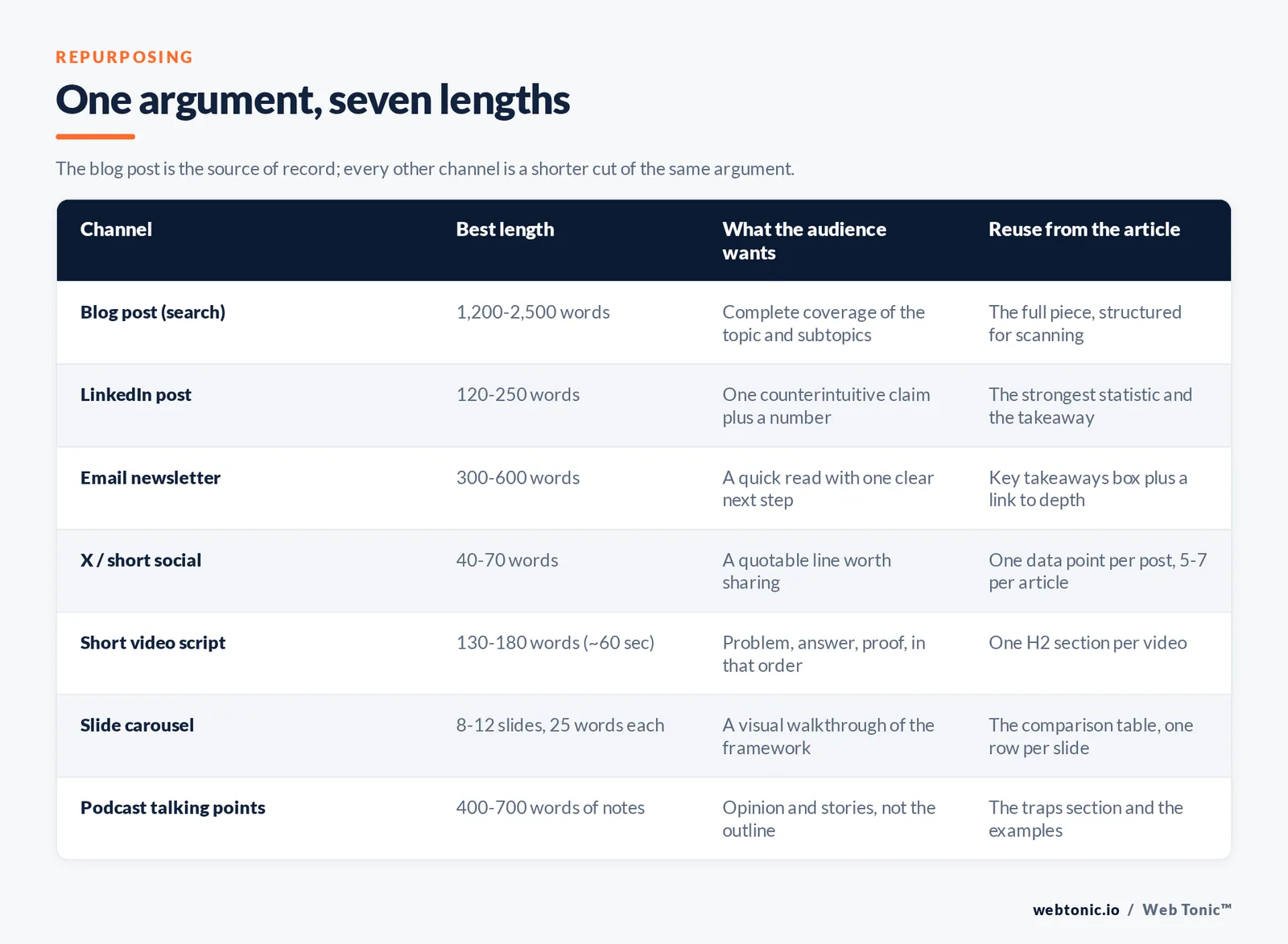
One article rarely serves every channel. A long form blog post is the source of record; the versions that earn social shares are shorter cuts of the same argument, written for readers who found you somewhere other than search engines. Deciding the word count for each derivative up front is what stops a good topic from being published once and forgotten.
| Channel | Best length | What the audience wants | Reuse from the article |
|---|---|---|---|
| Blog post (search) | 1,200–2,500 words | Complete coverage of the topic and its subtopics | The full piece, structured for scanning |
| LinkedIn post | 120–250 words | One counterintuitive claim plus a number | The strongest statistic and the takeaway line |
| Email newsletter | 300–600 words | A quick read with one clear next step | Key takeaways box plus a link to the depth |
| X / short social | 40–70 words | A quotable line worth sharing | One data point per post, 5–7 posts per article |
| Short video script | 130–180 words (about 60 seconds) | Problem, answer, proof, in that order | One H2 section per video |
| Slide carousel | 8–12 slides, 25 words each | A visual walkthrough of the framework | The comparison table, one row per slide |
| Podcast talking points | 400–700 words of notes | Opinion and stories, not the outline | The traps section and the examples |
Two things follow from this table. First, shorter blog posts are not lesser content — they are the correct format for some audiences and some channels. Second, social shares reward extraction, not length: the best-performing post on a channel is usually a single number lifted out of a longer article, which is why publishing without at least one original data point wastes most of the distribution potential.
Auditing existing articles: expand, trim or merge
Most blogs do not have a "how long should a new post be" problem. They have 60 published articles of mixed depth, uneven traffic and overlapping topics. Run this audit quarterly: pull every URL with its word count, ranking position, sessions and conversions, then classify each one.
| Symptom | What it usually means | Action | Target change |
|---|---|---|---|
| Ranks 5–15, short vs the top 5 | Coverage depth gap on recurring subtopics | Expand with the missing H2s and a data table | Add 500–900 words |
| Ranks top 3, high bounce | Answer buried; readers scan and leave | Move the answer up, add a takeaways box | Trim 200–400 words |
| 3,000+ words, no traffic | Wrong intent or no demand for the topic | Re-target to a keyword with real volume, or unpublish | Rewrite, not extend |
| Two articles ranking for one query | Cannibalisation between near-identical posts | Merge into the stronger URL and 301 the weaker one | 1 page of 2,200–2,800 words |
| Traffic falling year on year | Stale data and outdated examples | Refresh statistics, sources and screenshots | Same length, new evidence |
| Good traffic, no conversions | Top-of-funnel topic with no relevant next step | Add an internal link path to a service page | Add 150–250 words |
| Under 400 words, thin | Placeholder content published to hit a cadence | Consolidate several into one useful guide | Merge 3 posts into 1 |
The audit reframes the question usefully. Instead of asking how long a blog post should be in the abstract, you are asking which of your existing pages is the wrong length for the job it is doing — and that question has a measurable answer for every URL on the site.
FAQ
How long should a blog post be for SEO?
Long enough to cover every subtopic the top-ranking pages cover, which usually means 1,200–2,500 words for competitive commercial keywords and 600–1,000 for specific questions. Google publishes no minimum word count, so pull the top five results, note the range, and target the middle of that band with better evidence than the incumbents.
Is a 500-word blog post too short?
Not if 500 words fully answer the query. Short posts work well for news, product updates, single definitions and narrow long-tail questions. They fail when the query implies comparison, pricing or a multi-step process, because the SERP will be full of pages that cover those and yours will look incomplete.
Do longer blog posts get more social shares?
Word count is a weak predictor of social shares. What travels is an original statistic, a strong opinion, a useful template or a surprising chart. A 700-word post built around one proprietary number is shared more than a 3,000-word summary of things readers already knew.
What is the average blog post length?
Industry surveys typically place the average blog post between roughly 1,000 and 1,400 words, but the average is not a target: it blends news posts, definitions and pillar guides that each have very different correct lengths. Use intent-based bands instead of a single average word count.
Should I make an old blog post longer to improve rankings?
Only if the audit shows missing subtopics. More often the fix is better intent match, a clearer answer in the first paragraph, internal links from related posts, updated data and stronger sources. Adding 800 words of restated material to a stalled page rarely moves it.
Sources
Orbit Media 12th Annual Blogger Survey (808 respondents) · Google Search Central, Creating helpful, reliable, people-first content and Snippet documentation · Nielsen Norman Group, How Users Read on the Web and Inverted Pyramid · Ahrefs, Semrush and Yoast content briefing guidance · HubSpot Marketing Statistics library · Content Marketing Institute research articles · Statcounter GlobalStats desktop vs mobile platform share. All sources accessed August 2026.