Table of contents

Long-form content is any piece deep enough to answer a question completely rather than partially — in practice 1,500+ words of text, 10+ minutes of video, or a 30-minute-plus podcast. Length is the symptom, not the goal.
What follows is where long-form earns its cost, where short-form beats it outright, and what the published data actually supports.
Key Takeaways
- Long-form starts at roughly 1,500 words for text and 10 minutes for video, but the useful definition is completeness, not a word count.
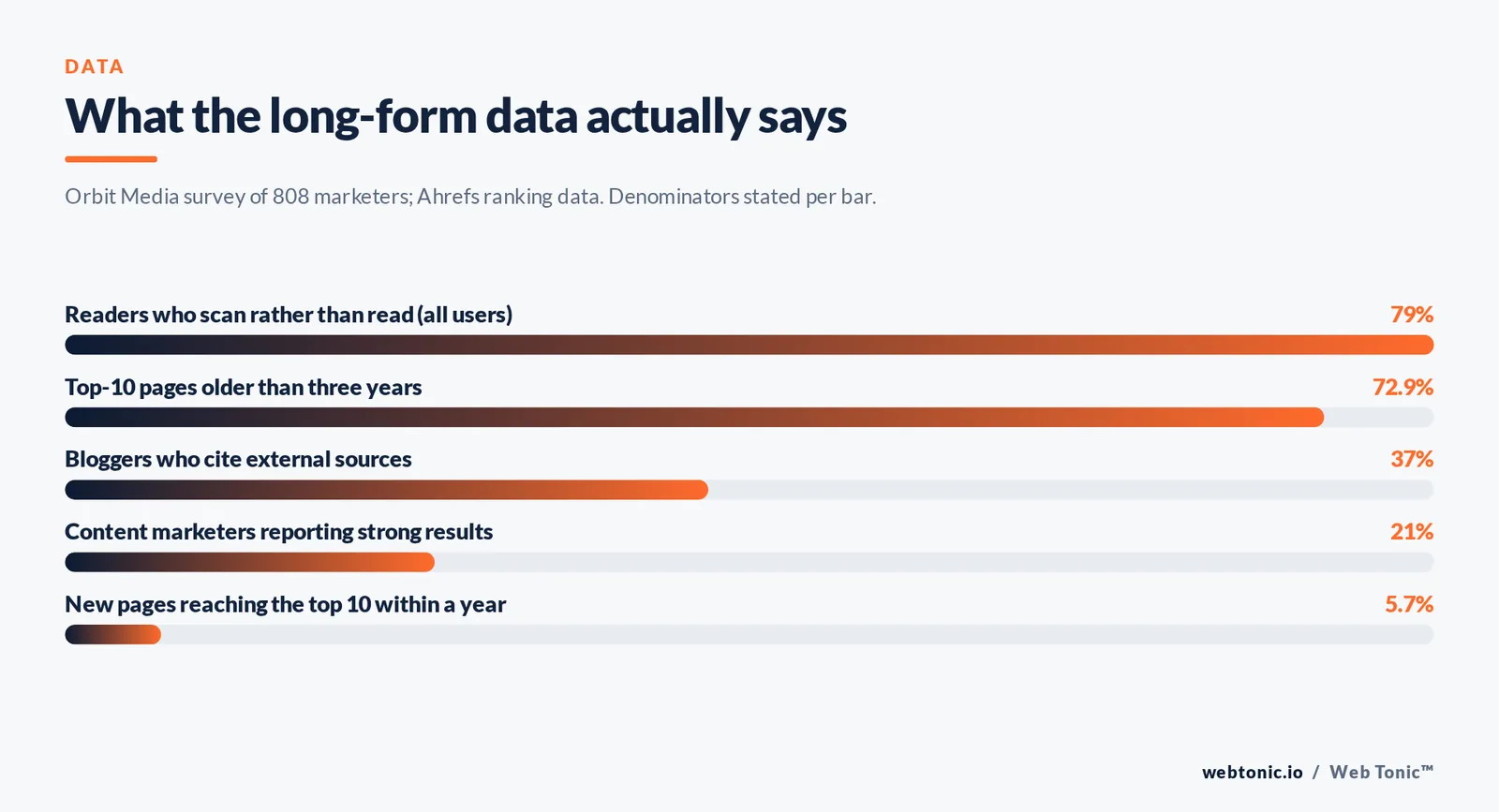
- Word count does not cause rankings. Ahrefs found no correlation between readability scores and position, and 72.9% of top-10 pages are more than three years old — age and links do more work than length.
- Only 21% of content marketers report strong results from blogging, while about half publish just 2–4 posts a month, per Orbit Media's survey of 808 marketers.
- Original research is the highest-yield long-form format: nearly half of surveyed marketers publish it, and 25% of those report strong results.
- Only 37% of bloggers cite external sources — the cheapest way to make a long piece more credible than its competition.
- 79% of readers scan rather than read, and only 16% read word by word, so structure carries more weight than prose in a 3,000-word piece.
- Long-form is a compounding asset with a slow start: only 5.7% of new pages reach the top 10 within a year.
- The economics are simple. One 2,500-word researched piece costs roughly what 8–10 short posts cost, so it has to earn its place on rankings, links or sales conversations — not on volume.
What counts as long-form, by format
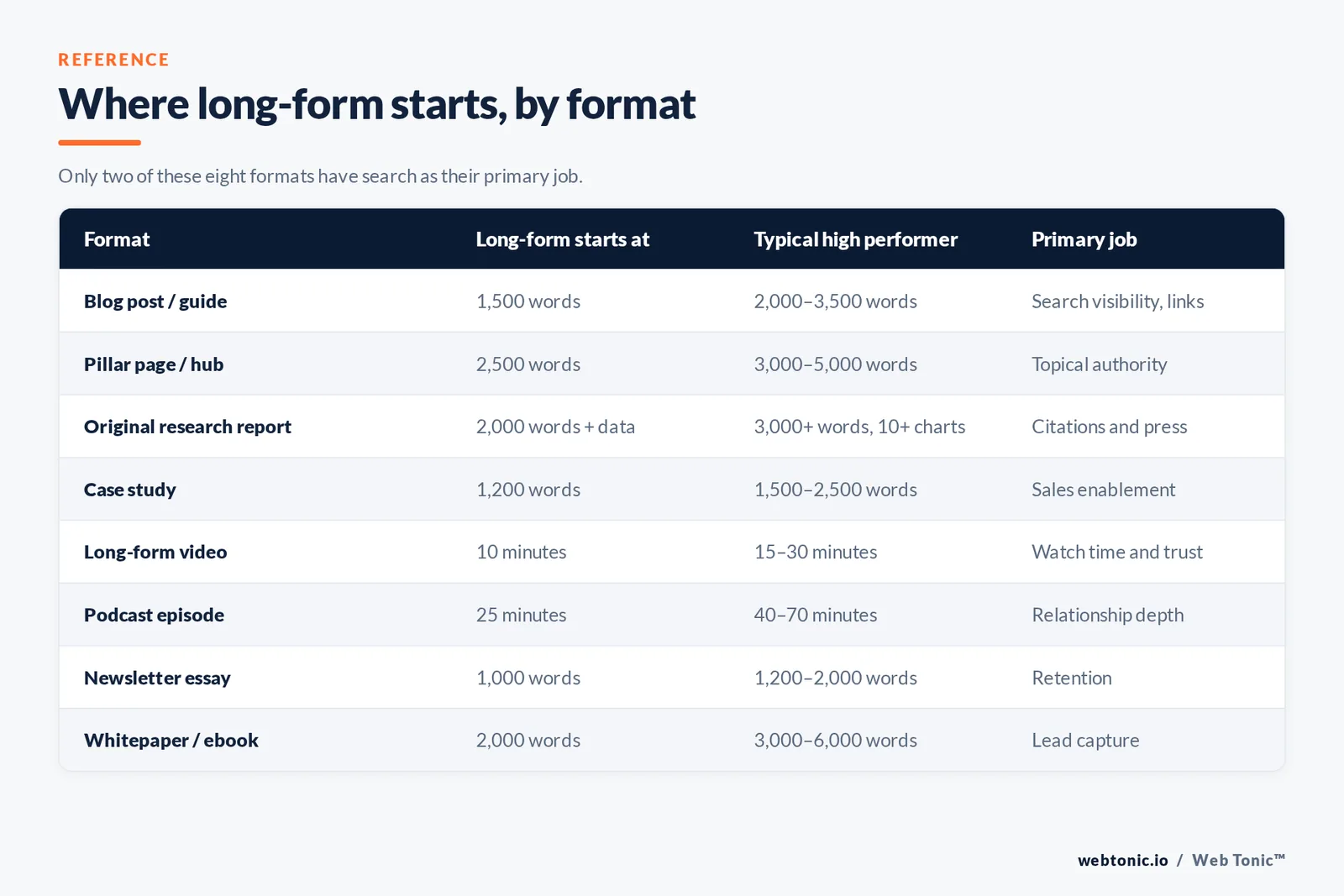
The thresholds differ per medium, and mixing them up is why "long-form" gets argued about in strategy meetings.
| Format | Long-form starts at | Typical high performer | Primary job |
|---|---|---|---|
| Blog post / guide | 1,500 words | 2,000–3,500 words | Search visibility and link acquisition |
| Pillar page / hub | 2,500 words | 3,000–5,000 words | Topical authority across a cluster |
| Original research report | 2,000 words plus data | 3,000+ words, 10+ charts | Citations, press coverage, links |
| Case study | 1,200 words | 1,500–2,500 words | Sales enablement, late-funnel proof |
| Long-form video | 10 minutes | 15–30 minutes | Watch time, subscriber depth, trust |
| Podcast episode | 25 minutes | 40–70 minutes | Relationship depth and repurposing fuel |
| Newsletter essay | 1,000 words | 1,200–2,000 words | Retention and direct audience ownership |
| Whitepaper / ebook | 2,000 words | 3,000–6,000 words | Lead capture in considered purchases |
Notice that only two of those eight formats have search as their primary job. Long-form content is treated as an SEO tactic far more often than the format list justifies — podcasts and long video earn their keep on trust and repurposing, not rankings. Google's own helpful content guidance never mentions a length target; it asks whether the page leaves the reader feeling they have learned enough about a topic.
Long-form vs short-form: the decision table
Both formats work. They answer different questions, and the mistake is using one where the other belongs.
| Situation | Choose | Because |
|---|---|---|
| The query needs a full method, not a fact | Long-form | Partial answers lose to complete ones on complex intents |
| The query has one factual answer | Short-form | Padding a 200-word answer to 2,000 words hurts it |
| You need links and citations | Long-form with original data | People cite datasets and frameworks, not opinions |
| You need reach this week | Short-form video | Distribution is algorithmic and immediate |
| Sales needs proof for a specific objection | Long-form case study | Detail is the point; a clip cannot carry it |
| You are testing whether a topic resonates | Short-form first | Cheap signal before an expensive production |
| The topic is regulated or technical | Long-form | Caveats and sourcing need room |
| Budget covers one piece a month | Long-form | A thin monthly post competes with nothing |
The healthiest pattern is a pairing: one long-form asset per month, cut into 8–12 short-form pieces that all point back to it. Short-form buys attention; long-form converts it and keeps earning after the feed forgets. Both sides of that engine sit inside content and growth strategy rather than in a publishing calendar.
Word count by intent — what the target should actually be
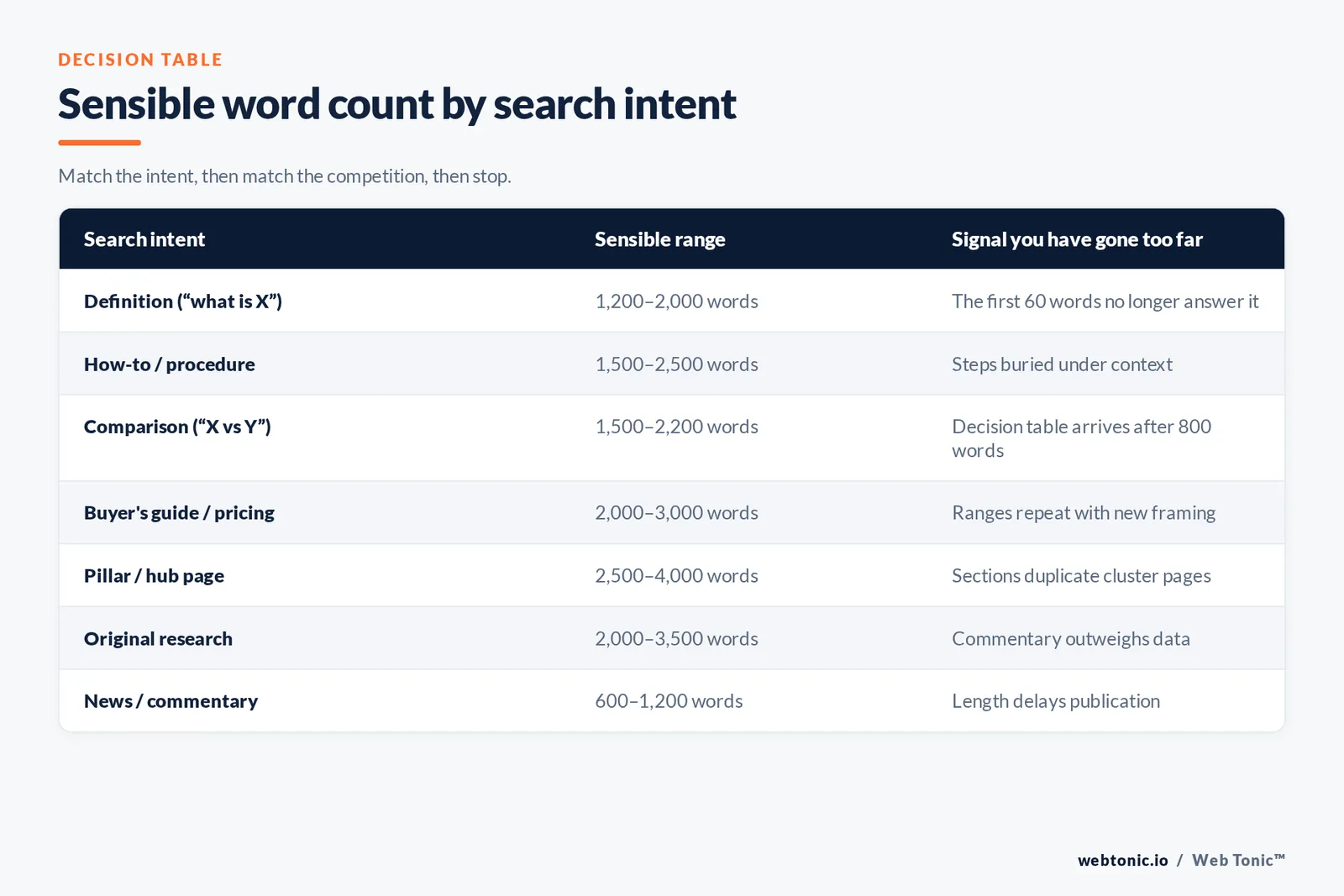
Rule 1 — match the intent, then match the competition, then stop. There is no ranking bonus for the extra 600 words nobody reads.
| Search intent | Sensible range | Signal that you have gone too far |
|---|---|---|
| Definition ("what is X") | 1,200–2,000 words | The first 60 words no longer answer the question |
| How-to / procedure | 1,500–2,500 words | Steps are buried under context |
| Comparison ("X vs Y") | 1,500–2,200 words | The decision table arrives after 800 words |
| Buyer's guide / pricing | 2,000–3,000 words | Ranges repeat with different framing |
| Pillar / hub page | 2,500–4,000 words | Sections duplicate the cluster pages they link to |
| Original research | 2,000–3,500 words | Commentary outweighs data |
| News / commentary | 600–1,200 words | Length delays publication past relevance |
Limit 2: 94.74% of keywords get ten or fewer searches a month, so a 4,000-word piece aimed at a single low-volume term will never repay itself. Aggregate demand across a cluster before committing to depth — Ahrefs' compilation of SEO statistics also notes that an average top-ranking page also ranks in the top 10 for about 1,000 other keywords, which is the real argument for depth.
Types of long-form content, with examples that work
Named examples beat abstractions. These are the shapes long-form actually takes.
| Type | Recognisable example | Why it works |
|---|---|---|
| Immersive narrative journalism | The New York Times' "Snow Fall", its account of the Tunnel Creek avalanche | Multimedia scrolling made a 17,000-word story finishable; it won a 2013 Pulitzer |
| Long-form profile | Esquire's "Frank Sinatra Has a Cold" by Gay Talese, 1966 | Observation replaced access — still taught as the template for the form |
| Essay collection / column | Joan Didion's magazine essays; The Atlantic's monthly features | A consistent voice makes the length the attraction rather than the cost |
| Definitive practitioner guide | Ahrefs' and Yoast's blog-writing guides | Complete method plus screenshots earns links from people who follow it |
| Original research report | Orbit Media's annual blogger survey, now in its 12th year | A dataset nobody else has gets cited for years |
| Benchmark study | Platform engagement and CTR studies across millions of posts | Numbers become the reference point competitors have to argue with |
| Long-form podcast | Interview shows distributed on Spotify and Apple Podcasts | One hour of tape yields a month of clips, quotes and a newsletter |
| Documentary-length video | Netflix-style brand documentaries and 20-minute YouTube explainers | Watch time compounds recommendation, and depth reads as credibility |
| Teardown / case study | Detailed before-and-after account of one client engagement | Specificity closes deals that generic capability pages cannot |
| Practitioner thought leadership | Writers like Ann Handley and Neil Patel publishing method openly | A named point of view is the one thing generative tools cannot copy |
The Atlantic and its peers keep proving the demand side of this: readers will spend 25 minutes on a piece when the piece deserves it. The commercial version of that lesson is that long-form fails from thinness, not from length. Content Marketing Institute and MIT Sloan Management Review both publish long, argued pieces on this cadence rather than daily volume.
What long-form actually costs
Depth is a budget decision. These are realistic production ranges for agency- or in-house-quality work.
| Asset | Hours to produce | Typical cost band | Biggest hidden cost |
|---|---|---|---|
| 1,200-word informational post | 4–7 | $300–$800 | Editing and fact-checking |
| 2,500-word researched guide | 10–18 | $900–$2,500 | Source verification and custom graphics |
| Original research report | 40–80 | $5,000–$20,000 | Survey panel or data acquisition |
| Written case study | 8–14 | $700–$2,000 | Client approval cycles |
| 20-minute video | 25–60 | $2,500–$15,000 | Scripting and post-production |
| Weekly long-form podcast | 6–10 per episode | $400–$1,500 per episode | Guest booking and consistency |
Step 3 — price the piece against the alternative use of the money, not against a per-word rate. A $2,000 guide that earns links and appears in sales calls for three years is cheap; the same $2,000 spent on eight thin posts that never rank is not. Orbit Media's blogging survey of 808 marketers is blunt about the split: only 21% report strong results, and the practices separating them are original research and citing sources — both of which cost hours rather than words.
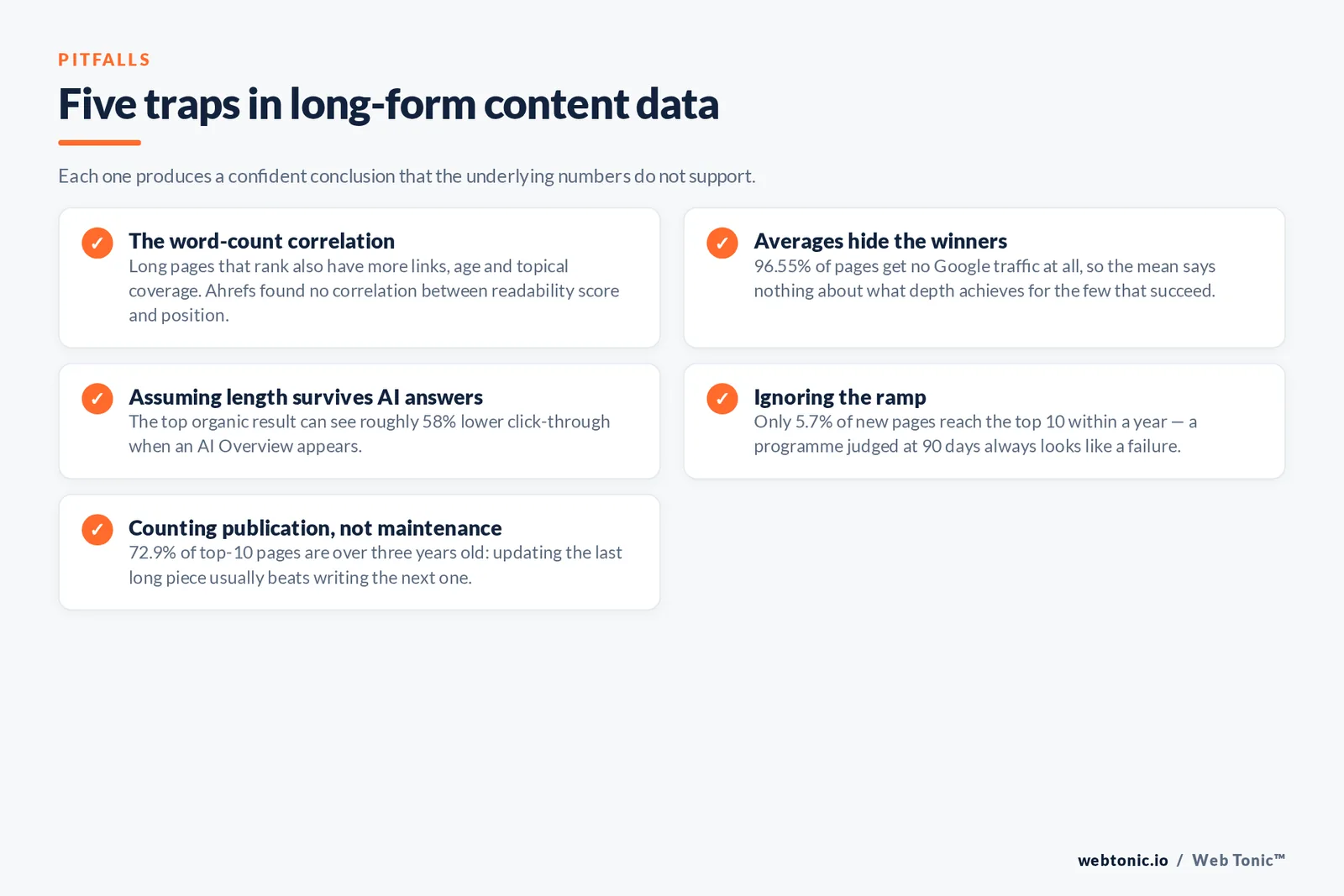
Five traps in long-form data
Trap 1 — the word-count correlation. Studies showing long pages rank well are measuring pages that also have more links, more age and better topical coverage. Ahrefs found no correlation between Flesch readability and ranking position, which is the same class of claim.
Trap 2 — averages hide the winners. When 96.55% of pages get no Google traffic at all, the mean tells you nothing about what depth achieves for the small set that succeeds.
Trap 3 — assuming length survives AI answers. The top organic result can see roughly 58% lower click-through when an AI Overview appears. Long-form still gets read — but increasingly by a model that summarises it.
Trap 4 — ignoring the ramp. Only 5.7% of new pages reach the top 10 within a year, so a long-form programme judged at 90 days will always look like a failure.
Trap 5 — counting publication instead of maintenance. Because 72.9% of top-10 pages are over three years old, updating the last long piece usually beats writing the next one.
Structuring long-form so it gets finished
Depth only pays if the reader reaches the depth. Nielsen Norman Group's testing found 79% of users always scan a new page and only 16% read word by word; a concise rewrite of the same content tested 58% more usable, and a scannable version 47% more.
| Element | Target | Why it matters at length |
|---|---|---|
| Answer-first intro | Under 60 words | Scanners decide in seconds whether to continue |
| Section headings | Every 250–350 words | Headings are the navigation for a scanning reader |
| Tables and lists | At least one per 800 words | Comparisons are read; the same content as prose is skipped |
| Bolded specifics | A figure or name per section | Gives the eye anchors on a long scroll |
| Visual per major section | 1 chart or image | Breaks the wall and carries data faster than a sentence |
| External citations | 8–12 per 2,500 words | Only 37% of bloggers cite sources — it is a cheap differentiator |
| Explicit FAQ block | 4–6 questions | Captures adjacent queries the body cannot phrase naturally |
The inverted-pyramid pattern — conclusion first, detail after — is the structure that makes long-form survive scanning, and NN/g's guidance on it pairs with their research on how people read on the web. Practical templates for the same idea are documented by Semrush and Yoast. Getting the page itself fast and readable is a build question as much as an editorial one, which is where site and template work comes in.
Long-form in an AI-search world
The distribution has changed more than the format has. Click-through on the first organic result sits near 39.8% in First Page Sage's CTR study, but the presence of an AI answer above it changes the arithmetic. Orbit Media's respondents reported organic clicks down 10–20% with large-language-model referrals adding only about 1% net new traffic so far.
Three consequences follow, and none of them argue for shorter content:
- 1. Citable structure beats keyword density. Models quote defined claims, tables and numbers. A long piece organised into extractable facts gets cited; the same content as unbroken prose does not.
- 2. First-party data becomes the moat. A survey, a benchmark from your own accounts or a documented teardown cannot be synthesised from other pages.
- 3. Fewer, better assets. If a summary satisfies the shallow query, the remaining click goes to the piece with something the summary lacked — depth, proof or a named practitioner view.
Measuring a long-form programme
Judge long-form on a longer clock and on different metrics than short-form.
| Metric | Read it at | Healthy signal |
|---|---|---|
| Referring domains per asset | 6 months | Research pieces attracting links without outreach |
| Keywords ranked per page | 6–12 months | Hundreds of terms, not one head term |
| Assisted pipeline | Quarterly | Sales reusing the asset in live deals |
| Scroll and read depth | 30 days | Majority reaching the halfway heading |
| Repurposing yield | 30 days | 8–12 derivative pieces per long asset |
| Update lift | 60 days post-refresh | Refresh beating a new piece on traffic per hour spent |
If the first four rows are flat after two quarters, the problem is usually distribution or topic selection rather than length. That diagnosis is exactly what our measurement work is for, and you can bring us a live example if you want it checked against your own data.
FAQ
How long should long-form content be?
For text, 1,500 words is the practical floor and 2,000–3,500 is where most successful guides land. Pillar pages run to 4,000. For video, 10 minutes is the threshold and 15–30 minutes is where watch-time-driven formats perform. Choose the range from the intent, then stop when the question is fully answered.
Does long-form content rank better than short-form?
Not because of length. Longer pages tend to cover more subtopics and attract more links, which is what drives the ranking. Ahrefs' own long-form content analysis reaches the same conclusion, and 72.9% of top-10 pages are over three years old. Depth helps when the query needs depth; on a single-fact query it hurts.
What are the best types of long-form content?
Original research reports, definitive practitioner guides, detailed case studies, long-form interview podcasts and 15-to-30-minute video explainers. Research is the strongest bet on citations: nearly half of surveyed marketers publish it and a quarter of those report strong results.
How do I repurpose long-form content?
Plan the cuts before production. One 2,500-word guide or one hour of tape should yield 8–12 short-form pieces: clips, carousels, a newsletter section, two or three quote graphics and an internal sales one-pager. Publish the long asset first so every derivative has somewhere to send people.
Is long-form content still worth it with AI summaries in search?
Yes, but for different reasons. Shallow informational pages lose most to AI answers; pieces with original data, named expertise and extractable structure are what both readers and models cite. The winning shape is fewer, deeper assets that contain something a summary cannot manufacture.
Sources: Orbit Media 12th annual blogger survey (orbitmedia.com) · Ahrefs SEO statistics compilation and long-form content guide (ahrefs.com) · Google Search Central helpful content guidance (developers.google.com) · Nielsen Norman Group, "How Users Read on the Web" and inverted-pyramid writing (nngroup.com) · First Page Sage Google CTR by ranking position · Semrush and Yoast blog-writing guides · Content Marketing Institute · MIT Sloan Management Review marketing topic · The Atlantic.