Table of contents
Key Takeaways
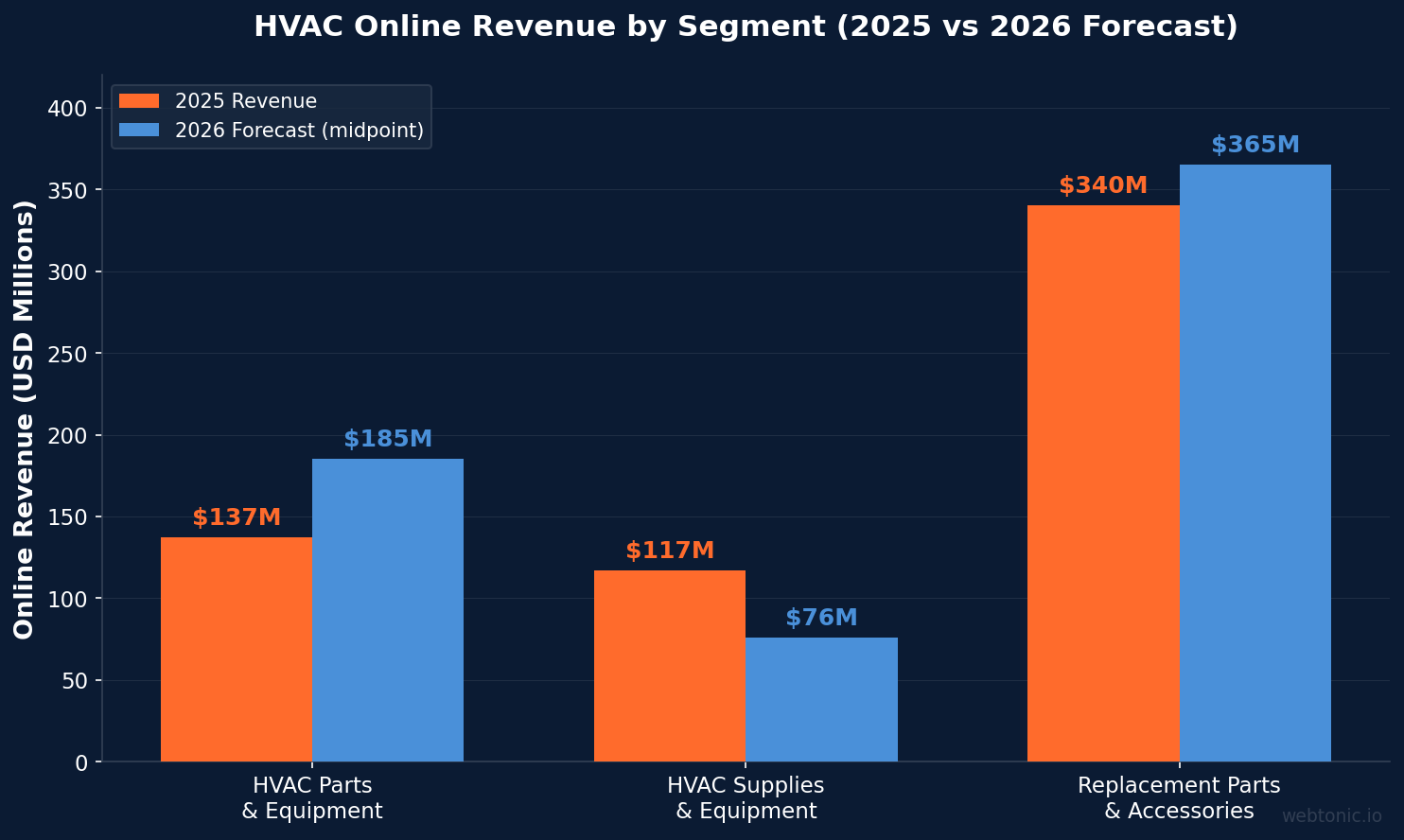
- HVAC parts and equipment generated $137M in aggregate online sales in 2025, with revenue forecast to grow 20–50% in 2026 after a down year (Grips Intelligence).
- Only 7.9% of HVAC distributor sales happen through e-commerce on average, while top-performing HARDI distributors consistently clear 10% or more — the gap is the opportunity (Flxpoint).
- There are 7,700+ live Shopify stores in the HVAC and Climate Control category, with 45+ actively tracked brands generating 6.4M total monthly traffic (Brandsearch).
- HVAC parts e-commerce conversion rates average 1.5–2.0%, with average order values of $100–$200 across tracked retailers (Grips Intelligence).
- Home improvement and hardware e-commerce has a 48% repeat purchase rate — 68% higher than the cross-industry average of 28.5% (WisePIM).
- 91% of B2B buyers would switch suppliers for a better online buying experience, and 44% of HVAC distributors have zero e-commerce revenue (Flxpoint).
HVAC E-Commerce Benchmarks at a Glance
| Metric | HVAC / Home Improvement | E-Commerce Average |
|---|---|---|
| Online parts revenue (2025) | $137M (parts), $117M (supplies) | — |
| Revenue growth forecast (2026) | +20–50% (parts) | +8.11% overall |
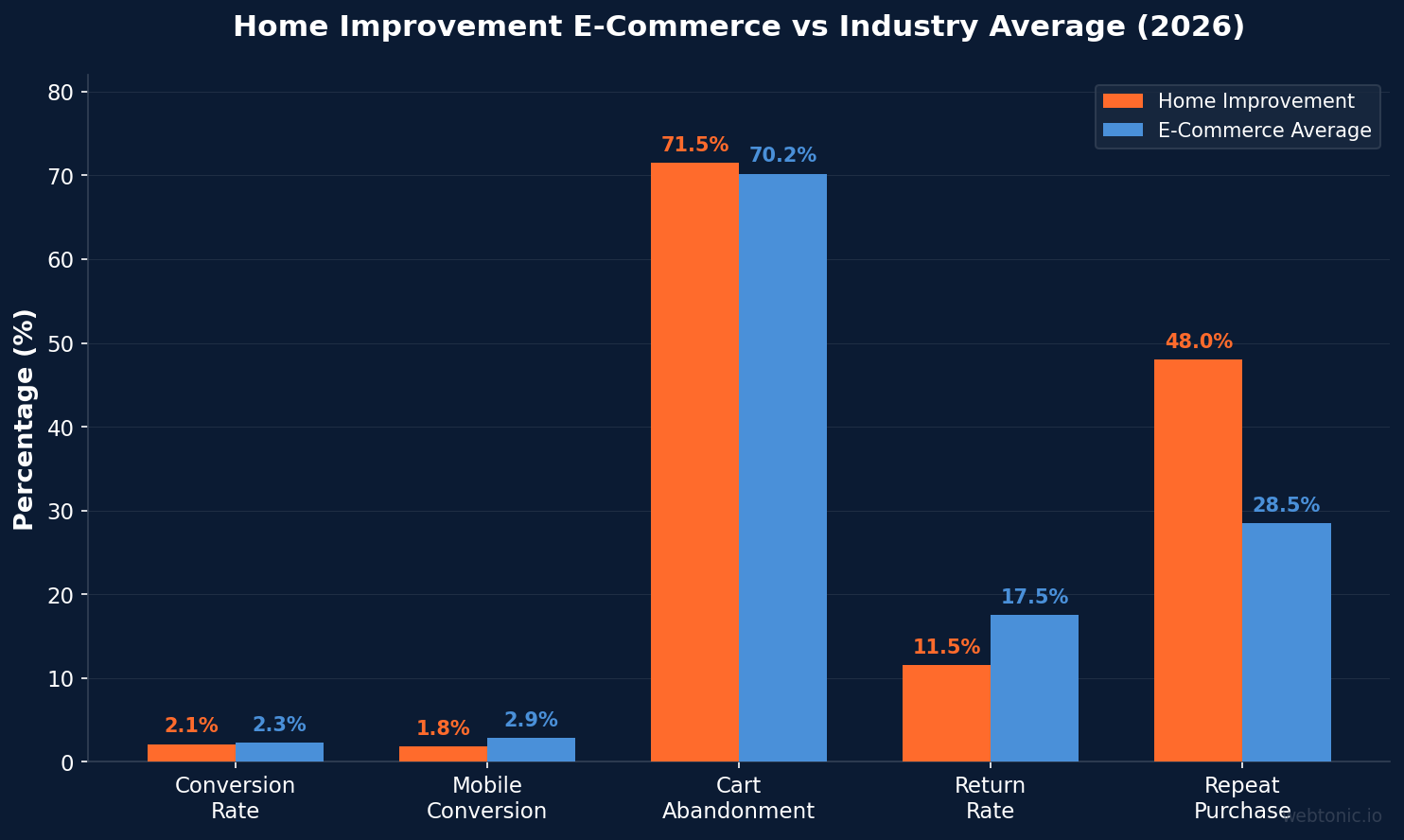
| Conversion rate | 1.5–2.0% (HVAC parts) / 2.1% (home improvement) | 2.3% |
| Average order value | $100–$200 (parts) / $135 (home improvement) | $143 |
| Cart abandonment rate | 71.5% | 70.19% |
| Return rate | 11.5% | 17.5% |
| Repeat purchase rate | 48% | 28.5% |
| Mobile conversion rate | 1.8% | 2.85% |
HVAC Online Parts Revenue and Market Size
The HVAC e-commerce market is in a turnaround phase after a challenging 2024. Grips Intelligence reports that HVAC parts and equipment generated $137M in aggregate online sales across tracked retailers in 2025, down 20–50% from the prior year. However, 2026 revenue is forecast to grow by 20–50%, suggesting the contraction was cyclical rather than structural.
A separate segment — HVAC supplies and equipment — generated $117M in online sales in 2025, also down 20–50% year-over-year, though this category's 2026 outlook is less optimistic with a projected 20–50% further decline (Grips Intelligence). The divergence between parts (rebounding) and supplies (continued decline) reflects different buyer behaviors: parts are urgent replacement purchases, while supplies are discretionary capital expenditures that contractors defer during uncertain periods.
The broader context is a massive industry. The U.S. home services market is $842B in 2026, projected to reach $989B by 2031 at a 3.27% CAGR, with HVAC services alone crossing $180B in 2025 (Elev8 Operations). Even a small shift from offline to online purchasing represents billions in addressable e-commerce revenue.
Shopify Adoption in the HVAC Category
Shopify has become the dominant platform for HVAC e-commerce stores. Brandsearch tracks 7,700+ live Shopify stores in the HVAC and Climate Control category, with 45+ actively tracked brands. These stores generate 6.4M total monthly traffic with an average of 143K visits per store and 65 products per store.
The top performers are significant businesses. One tracked HVAC Shopify store generates approximately $8.0M per month with 909K monthly traffic (Brandsearch data, March 2026). Another runs at $4.2M per month. These numbers demonstrate that Shopify can handle the complexity and volume of B2B HVAC parts commerce, not just consumer-grade sales.
However, most HVAC distributors remain offline. Flxpoint's 2026 HVAC Industry Report, tracking 14 major distributors, found that 44% of HVAC distributors have zero e-commerce revenue. Their contractors are purchasing somewhere — they are just purchasing from competitors who invested in digital ordering. The total tracked HVAC e-commerce market across 14 domains is $142M, and market traffic declined 17.8% overall, but the gap between winners and losers is widening.
Conversion Rates and Order Values
HVAC e-commerce conversion metrics sit slightly below the cross-industry average, reflecting the technical nature of the purchase. HVAC parts and equipment conversion rates average 1.5–2.0% with average order values of $100–$200, according to Grips Intelligence. Some individual retailers outperform: hvacairfilters.com achieves a 2.50–3.00% conversion rate with a $225–$250 AOV across 5,543 monthly sessions.
The broader home improvement and hardware category benchmarked by WisePIM shows a 2.1% overall conversion rate (vs. 2.3% e-commerce average) and a $135 AOV (vs. $143 average). The most striking metric: mobile conversion in home improvement is just 1.8% — 37% lower than the e-commerce average of 2.85%. This reflects the technical complexity of HVAC part selection, where contractors often need to verify model numbers, compatibility, and specifications before purchasing.
Cart abandonment in home improvement runs at 71.5%, roughly on par with the 70.19% e-commerce average. But the return rate of 11.5% is 34% lower than the 17.5% cross-industry average, meaning that when HVAC buyers do complete a purchase, they are more likely to keep it — likely because they have already confirmed the part fits their system.
The Repeat Purchase Advantage
The single most valuable metric in HVAC e-commerce is repeat purchasing. Home improvement and hardware has a 48% repeat purchase rate — 68% higher than the 28.5% e-commerce average (WisePIM). For HVAC specifically, this makes sense: contractors buy from the same suppliers repeatedly, technicians reorder the same filters, capacitors, and refrigerants, and homeowners on maintenance plans return for seasonal supplies.
This repeat rate transforms the unit economics. Even though the $135 AOV in home improvement trails the $143 e-commerce average, the higher repurchase frequency means customer lifetime value significantly exceeds what the first-order metrics suggest. A growth-focused HVAC e-commerce operation should invest heavily in post-purchase email sequences, reorder reminders, and loyalty programs — the data says nearly half of buyers will return.
The U.S. leads Shopify adoption in the Home and Garden sector with 286,120 stores (42.39% of global total), followed by the UK at 82,600 stores (12.24%) and Australia at 44,810 (6.64%), per AfterShip. This geographic concentration means HVAC Shopify competitors are primarily domestic, and local market intelligence matters more than global competitive analysis.
Platform Performance and Operational Gaps
The operational divide between winning and losing HVAC distributors is stark. Flxpoint's research found that the distributor that grew 55% in HVAC revenue (Parts Town) did so by integrating 89 suppliers automatically — no new headcount required. Their catalog became accurate, orders routed automatically, and oversells on peak-season SKUs dropped to near zero. The revenue growth followed the operational improvement.
67% of B2B buyers have already switched suppliers because of a poor digital experience, and 91% would switch for a better online buying experience (Flxpoint). In a fragmented industry where 78% of HVAC contractors employ fewer than 10 people (Elev8 Operations), these small operators increasingly expect the same frictionless ordering they get from Amazon and consumer platforms.
The winners share common traits: real-time inventory syncing from every supplier, automatic order routing based on live stock, fast onboarding of new SKUs (including A2L refrigerant catalog updates), and contractor-facing interfaces that eliminate the need to call before ordering. The losers are still managing inventory in spreadsheets, creating POs manually, and overselling during peak season.
HVAC E-Commerce Best Practices From the Data
- Optimize for mobile conversion — the 37% gap between home improvement mobile conversion (1.8%) and the e-commerce average (2.85%) represents the biggest quick-win opportunity. Simplify part search, auto-populate model numbers, and reduce checkout friction.
- Invest in repeat-purchase infrastructure — with a 48% repeat rate, every dollar spent on email automation, reorder reminders, and email marketing strategy generates outsized returns.
- Automate supplier integrations — the 55% revenue growth at Parts Town came from operational automation, not marketing spend. Real-time inventory accuracy is a competitive moat in HVAC e-commerce.
- Target a 2.5%+ conversion rate — top HVAC e-commerce sites like hvacairfilters.com achieve 2.5–3.0%. If you are at the category average of 1.5–2.0%, focus on product detail pages, trust signals, and compatibility verification tools.
- Build for contractors, not consumers — HVAC e-commerce buyers are predominantly professionals who need bulk ordering, net-30 terms, saved reorder lists, and product content that speaks to specs rather than lifestyle benefits.
- Leverage the low return rate — at 11.5% returns vs. the 17.5% average, HVAC parts buyers know what they need. Use this margin advantage to offer more competitive pricing or free shipping thresholds.
Shopify vs. Alternative Platforms for HVAC
| Platform Factor | Shopify | WooCommerce | B2B-Specific (NetSuite / Flxpoint) |
|---|---|---|---|
| HVAC store count | 7,700+ | Significant (untracked) | 14 tracked distributors |
| Setup complexity | Low–Medium | Medium–High | High |
| B2B features (net terms, bulk) | Via apps | Via plugins | Native |
| Supplier integration | Limited native | Plugin-dependent | 89+ integrations (Parts Town) |
| Best for | DTC parts retailers | Flexible custom builds | Multi-supplier distributors |
HVAC E-Commerce Growth Drivers and Market Trends
Several structural forces are pushing HVAC businesses toward e-commerce adoption. The broader home and garden e-commerce sector has 675,000+ Shopify stores globally, with the United States accounting for 286,120 of them (42.39%), according to AfterShip's 2026 data. The HVAC niche within this sector is growing faster than the parent category because of two convergent trends: contractor workforce demographics and supply chain digitization.
78% of HVAC contractors employ fewer than 10 people (Elev8 Operations), which means these businesses lack dedicated purchasing departments. A solo technician replacing a capacitor at 9 PM needs to order the part from a phone, not wait until Monday to call a distributor. The HVAC contractors who can buy parts the way they buy everything else — on their phone, delivered next day — are migrating to online suppliers permanently.
The A2L refrigerant transition is accelerating this shift. New EPA regulations require updated refrigerant-compatible equipment, and distributors who can update their catalog rapidly gain a competitive advantage. Flxpoint documented how automated catalog management lets winning distributors add new A2L-compatible SKUs within days, while manual operators take weeks — losing orders to competitors in the interim.
Overall e-commerce traffic in the HVAC distribution sector declined 17.8% (Flxpoint), but that decline is not evenly distributed. The "game changer" quadrant — distributors with automated supplier operations and strong digital presence — grew by 55%, while the rest contracted. This polarization suggests the market is consolidating around digitally mature operators, creating a window of opportunity for mid-tier businesses willing to invest in their e-commerce infrastructure now.
Related reading
- Heating & Ventilation WordPress Statistics: Key Data for 2026
- Webflow Performance in Heating & Ventilation: 35+ Stats for 2026
- HVAC Landing Page & CRO Statistics: Benchmarks and Conversion Data (2026)
- Custom Web Development services at Web Tonic
Frequently Asked Questions
How big is the HVAC e-commerce market?
HVAC parts and equipment e-commerce generated $137M across tracked online retailers in 2025, with a separate supplies segment at $117M (Grips Intelligence). The broader HVAC services market is $180B+, meaning online penetration is still below 1% — a massive growth runway for digital-first HVAC businesses.
What is a good conversion rate for an HVAC Shopify store?
The HVAC parts category averages 1.5–2.0% conversion, while top performers reach 2.5–3.0% (Grips Intelligence). The broader home improvement category benchmarks at 2.1%. Anything above 2.5% puts an HVAC store in the upper tier.
Why is mobile conversion so low for HVAC e-commerce?
Home improvement mobile conversion is 1.8% — 37% below the e-commerce average of 2.85% (WisePIM). HVAC parts purchasing requires model number verification, compatibility checking, and spec comparison that are harder on small screens. Stores that add model-number search, part-finder tools, and mobile-optimized spec tables close this gap.
Is Shopify suitable for B2B HVAC parts sales?
Yes, but with caveats. 7,700+ HVAC Shopify stores prove the platform works for this category, with top stores doing $8M+ per month (Brandsearch). However, B2B features like net-30 terms, bulk pricing, and multi-supplier inventory management typically require apps or middleware. Enterprise distributors with 89+ supplier integrations often outgrow Shopify's native capabilities.
What repeat purchase rate should HVAC stores target?
Home improvement e-commerce averages a 48% repeat purchase rate — well above the 28.5% cross-industry average (WisePIM). HVAC stores should target at least 40% and invest in post-purchase automation to reach the category benchmark. The high repeat rate reflects HVAC's consumable and maintenance-driven purchasing patterns.
Sources
https://gripsintelligence.com/insights/industries/business-industrial/hvac-parts-and-equipment
https://gripsintelligence.com/insights/industries/business-industrial/hvac-supplies-and-equipment
https://brandsearch.co/niches/hvac-climate-control
https://flxpoint.com/hvac-supply
https://flxpoint.com/blog/best-hvac-ecommerce-platforms-for-b2b-distributors
https://wisepim.com/ecommerce-industry-insights/home-improvement
https://www.aftership.com/ecommerce/statistics/stores/home-garden
https://www.elev8operations.com/guides/contractor-marketing-statistics-2026