Table of contents

Behavioral health carries the highest patient acquisition cost of any medical specialty tracked in 2026, and none of the major benchmark publishers break out a mental-health- specific landing page conversion rate. This page prices the intake page against the adjacent data that does exist - healthcare and wellness conversion benchmarks, the specialty economics of behavioral health, and the national treatment gap that sets how much friction an intake funnel can afford to carry.
Key Takeaways
- 22.9% of US adults (60.1 million people) received mental health treatment in 2024.
- 52.1% of adults with any mental illness got treatment, leaving close to half untreated.
- 46% of psychologists still have no openings for new patients per APA's 2025 survey.
- 87% of psychologists can now see new patients within three months, a improvement since 2021.
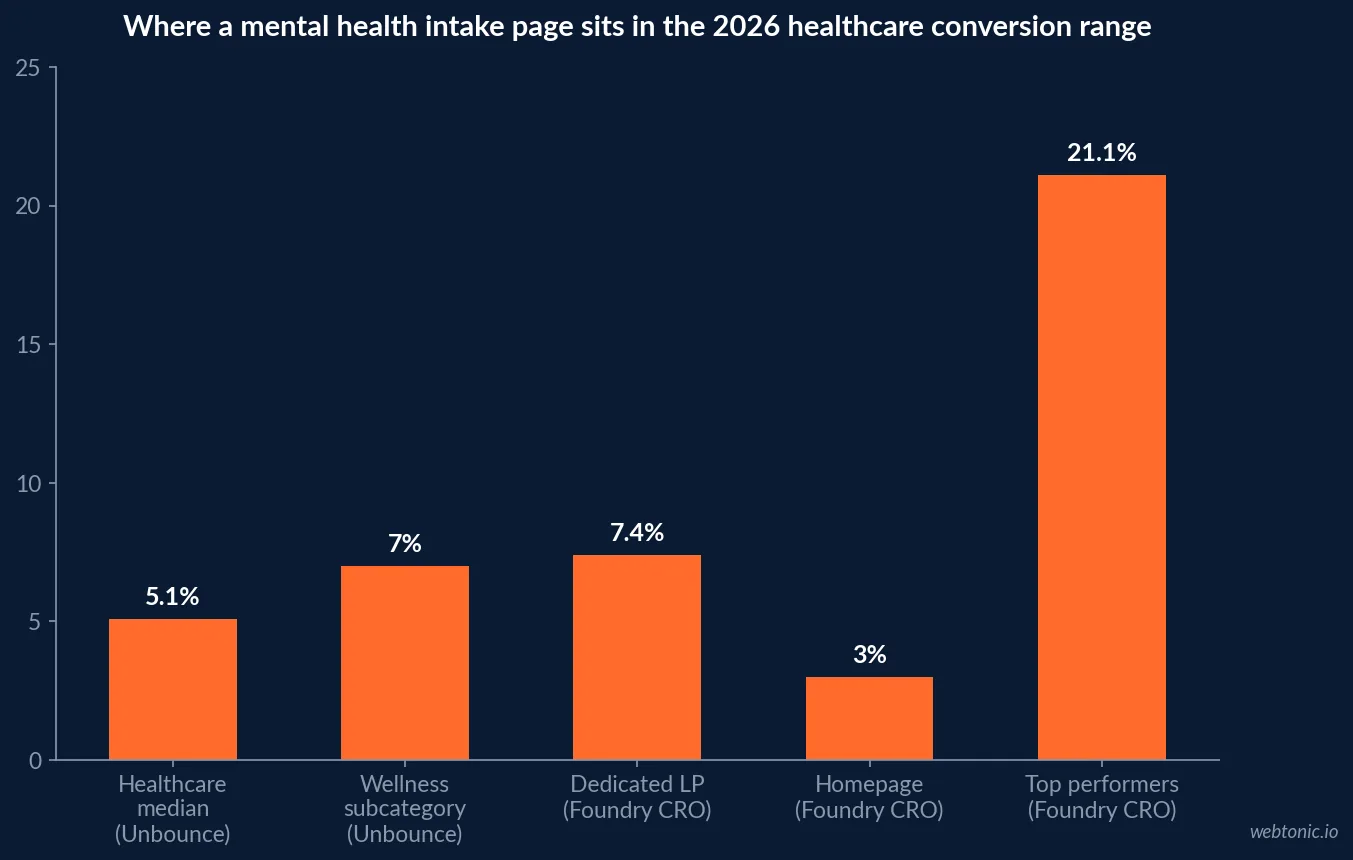
- Healthcare and wellness pages convert at a 5.1% median per Unbounce.
- The wellness subcategory beats that median by 38%, to roughly 7.0%.
- Healthcare search ads convert at 8.09% on average per LocaliQ.
- Dedicated landing pages convert at 7.4% versus 3% for homepages.
- Top healthcare landing pages reach 21.1% conversion, a 4x spread from the median.
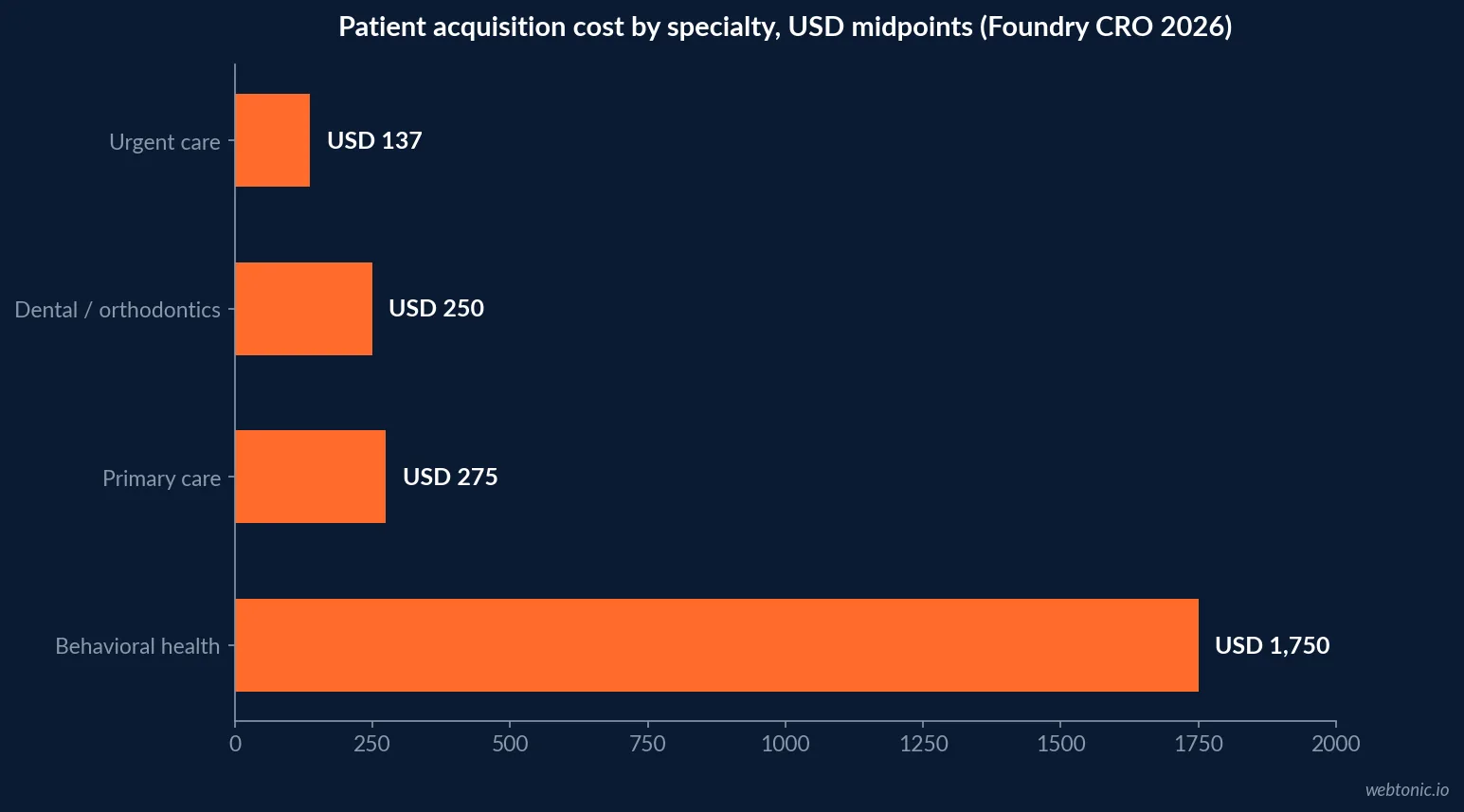
- Behavioral health patient acquisition cost runs USD 1,000 to 2,500, the highest of 12 tracked specialties.
- Behavioral health cost per click is just USD 3.46, the lowest in the same table.
- Behavioral health cost per lead rose 146% year over year.
- Pages at a 5th to 7th grade reading level convert at a 10.8% median.
- Cutting form fields from 11 to 4 produced 120% more conversions.
- Click-to-call converts at 25% to 40% against 2% for web forms.
- 88% of healthcare appointments are still booked by phone.
- Behavioral health LTV runs USD 5,000 to 15,000, against a 2:1 to 6:1 LTV:CAC ratio.
- Organic SEO delivers a USD 40 to 90 cost per lead with a 14.6% close rate.
Why "healthcare average" does not apply to a mental health intake page
Foundry CRO's 2026 Specialty Economics Matrix, built from LocaliQ, Unbounce, Demandforce and MGMA data across 12 medical specialties, makes the point bluntly: patient acquisition cost ranges from USD 155 for pediatrics to USD 2,500 for behavioral health, a 16x spread inside one industry label. Landing page conversion rate spans from 4.3% for dental to 25.33% for dermatology. A page built to a blended "healthcare" benchmark is being built to a number that describes almost no one.
Behavioral health sits at the expensive, high-retention end of that spread: cheap clicks, expensive leads, and a funnel that has to work harder than most because the buyer is not comparing prices, they are deciding whether to reach out at all.
| Specialty | Avg CPC | Patient acquisition cost | Patient LTV | LTV:CAC |
|---|---|---|---|---|
| Behavioral health | USD 3.46 | USD 1,000-2,500 | USD 5,000-15,000 | 2:1-6:1 |
| Primary care | USD 3-8 | USD 150-400 | ~USD 3,000 | 7.5:1-20:1 |
| Dental / orthodontics | USD 7.85-8.76 | USD 100-400 | USD 4,000-8,000 | 10:1-40:1 |
| Urgent care | USD 4-15 | USD 75-200 | Low (episodic) | 2:1-5:1 |
| Physical therapy | USD 5-12 | USD 200-400 | USD 2,000-4,000 | 5:1-20:1 |
Source: Foundry CRO 2026 Specialty Economics Matrix.
The demand side: a treatment gap the page is competing to close
The 2024 National Survey on Drug Use and Health, run by SAMHSA, found 22.9% of adults (60.1 million people) received mental health treatment in the past year. Narrow that to people who actually have a diagnosable condition and the picture tightens: of 61.5 million adults with any mental illness, 52.1% (32.0 million) received treatment - which means close to half of a clinically diagnosable population did not reach care in 2024.
That gap is not only a demand problem. The APA's 2025 Practitioner Pulse Survey found 46% of psychologists still have no openings for new patients, though that figure has trended downward since 2021 and 87% can now see new patients within three months. The 2024 survey found 61% of psychologists did not maintain a waitlist at all, and among those who did, 56% reported new-patient waits under one month while 17% reported waits of four months or longer.
| Access metric (APA Practitioner Pulse) | 2024 | 2025 |
|---|---|---|
| Psychologists with no new-patient openings | More than half report no openings | 46% |
| Psychologists able to see new patients within 3 months | Not directly comparable | 87% |
| Psychologists with no waitlist | 61% | Trending, not re-asked identically |
| Waitlisted patients waiting under 1 month | 56% | - |
| Waitlisted patients waiting 4+ months | 17% | - |
A page competing for a market where nearly half the diagnosable population is unserved, and where almost half of providers still have no capacity, cannot afford the friction a commodity healthcare category can tolerate. Every extra form field is a chance for someone who was already ambivalent about reaching out to close the tab.
What actually moves the conversion rate
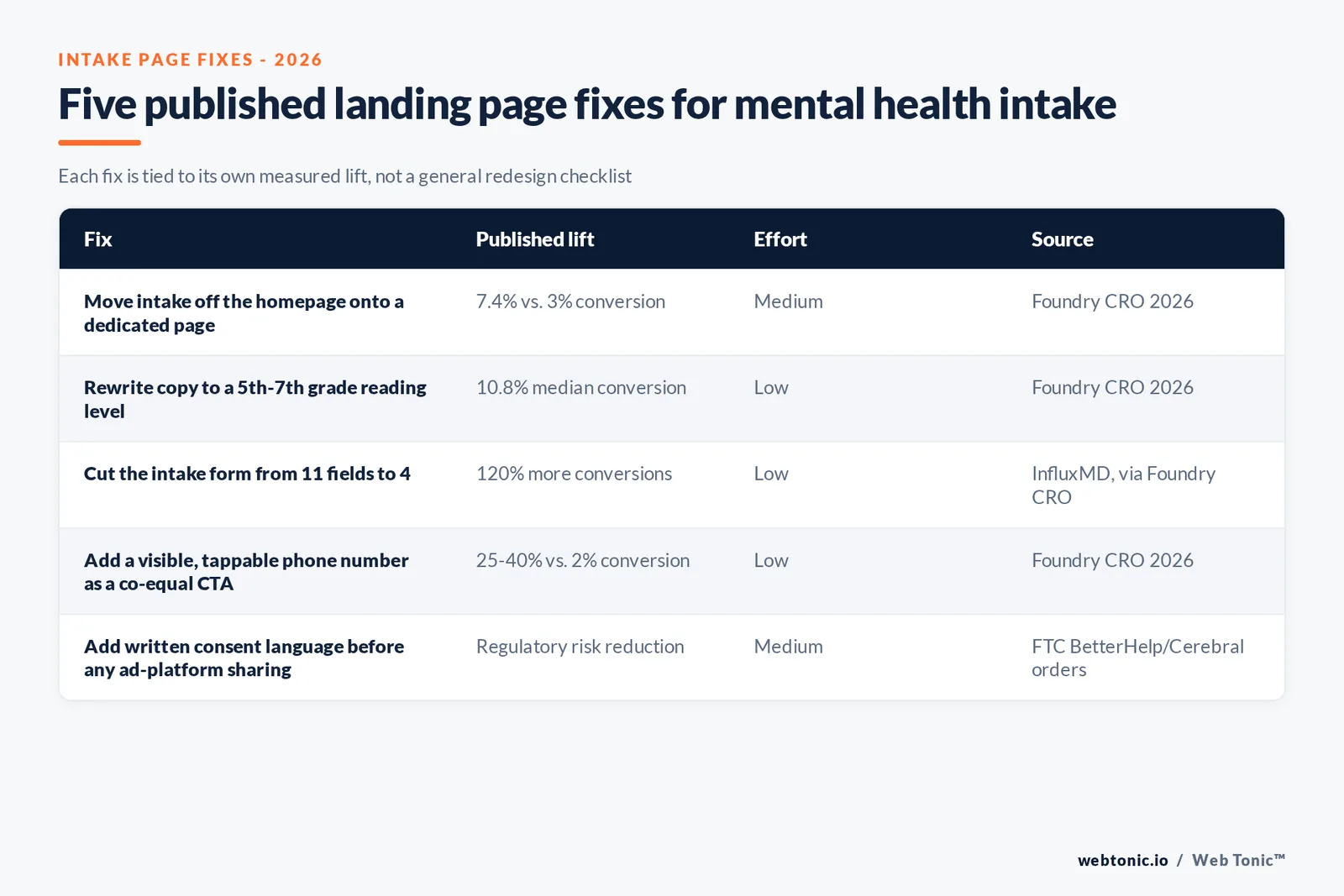
Two published levers show up consistently in the 2026 data, and neither is the hero image. Foundry CRO reports pages written at a 5th to 7th grade reading level converting at a 10.8% median, well above the 5.1% healthcare baseline. And it notes that dedicated landing pages convert at 7.4% against 3% for homepages - the single biggest structural lever before any copy or design work begins.
| Lever | Published effect | Source |
|---|---|---|
| Dedicated landing page vs. homepage | 7.4% vs. 3% conversion | Foundry CRO 2026 |
| 5th-7th grade reading level copy | 10.8% median conversion | Foundry CRO 2026 |
| Form fields cut from 11 to 4 | 120% more conversions | InfluxMD, via Foundry CRO |
| Click-to-call vs. web form | 25-40% vs. 2% conversion | Foundry CRO 2026 |
| Organic SEO vs. paid search lead | USD 40-90 CPL, 14.6% close rate, vs. USD 120-200+ | Foundry CRO 2026 |
Phone still wins the last step
Foundry CRO's data puts a number on something most intake teams already suspect: 88% of healthcare appointments are still booked by phone, and click-to-call converts at 25% to 40% against 2% for web forms. A mental health landing page built as a form-only funnel is optimizing for the smaller of the two paths. The forms still matter for after-hours and asynchronous intake, but a visible, tappable phone number is not a secondary CTA on this category - it may be the primary one.
The general-search cross-check
Two cross-industry sources back the healthcare-specific numbers rather than contradicting them. LocaliQ's healthcare search advertising benchmarks put the average conversion rate for healthcare search ads at 8.09%, above the 5.1% Unbounce median because it measures paid search traffic specifically rather than all traffic to a page. WordStream's 2026 Google Ads benchmarks guide puts the all-industry average Google Ads conversion rate at 8.18% - a genuinely cross-industry figure, not a healthcare number, included here only to show that healthcare search traffic is not unusually hard to convert once it clicks. The bottleneck this page is built around is the intake step after the click, not the click itself.
| Benchmark | Figure | Scope | Source |
|---|---|---|---|
| Healthcare & wellness landing page median | 5.1% | All traffic, industry-wide | Unbounce 2024 |
| Wellness subcategory median | ~7.0%, +38% vs. median | All traffic, wellness pages | Unbounce 2024 |
| Healthcare search ads average | 8.09% | Paid search traffic only | LocaliQ 2026 |
| All-industry Google Ads average | 8.18% | Cross-industry, not healthcare-specific | WordStream 2026 |
| Top healthcare landing pages | 21.1% | Best-performing pages, all specialties | Foundry CRO 2026 |
The disclosure question the fixes above raise
Every lever above pushes toward collecting a name, a reason for reaching out, and contact details faster. That data is more sensitive here than on almost any other landing page category, and two federal actions set the boundary. The FTC's 2023 order against BetterHelp required a USD 7.8 million payment over sharing consumers' health data, including answers to personal health questions collected on the site, with Facebook and other platforms for ad targeting. The 2024 order against Cerebral covered similar ground - tracking tools that disclosed sensitive personal health information to ad and analytics platforms - and cost the company more than USD 7 million.
Read together with HIPAA's Title 45 regulations, the practical rule for an intake page is simple: whatever a visitor discloses to get a call back should not silently become an ad audience. That single design decision now carries regulatory weight that a generic healthcare landing page does not.
Where the traffic should come from while the page is being fixed
Foundry CRO's channel-level data gives a second lever alongside the page itself: organic SEO delivers the lowest cost per lead in healthcare, at USD 40 to 90, with a 14.6% close rate, against USD 120 to 200-plus for paid search and roughly USD 41.60 for Meta/Facebook traffic at lower reported lead quality. None of that is mental-health-specific, but it explains why a practice fixing its intake page should not simultaneously be pouring paid budget at it - a broken funnel amplifies expensive traffic the same way it amplifies cheap traffic, just at a worse loss per click.
| Channel | Cost per lead | Reported close rate / quality note |
|---|---|---|
| Organic SEO | USD 40-90 | 14.6% close rate |
| Google Search Ads | USD 120-320 | Higher intent, higher cost |
| Meta / Facebook | ~USD 41.60 | Lower reported lead quality |
Source: Foundry CRO 2026 Specialty Economics Matrix, channel section.
How to prioritize the rebuild
Start with structure - move any intake copy off the homepage and onto a dedicated page, since that alone is worth the gap between 3% and 7.4% conversion. Rewrite for reading level next, since it is a copy edit, not a redesign, and carries a documented lift to 10.8%. Cut the form to what is operationally required to return a call, add a visible phone number as a co-equal CTA, and put a written consent line in front of anything collected before it reaches an ad platform. Our performance creative practice builds and tests that sequence, and our data and analytics team can confirm what your current funnel is actually leaking before you rebuild it.
If the paid side of the funnel needs its own audit first, see our breakdown of what Google Ads actually costs or our general conversion rate benchmarks for context outside this specialty, or talk to our team about a funnel audit before the next quarter's ad spend commits.
Frequently Asked Questions
What conversion rate should a mental health landing page target?
There is no published behavioral-health-specific benchmark, so the honest target is a range built from adjacent data. Unbounce puts the healthcare and wellness median at 5.1%, with the wellness subcategory beating that by 38% to roughly 7.0%. Foundry CRO's 2026 specialty data shows dedicated landing pages converting at 7.4% against 3% for homepages, and top healthcare performers reaching 21.1%. A mental health intake page built as a dedicated page, not a homepage section, should be judged against the 5% to 7% band first and the 21% ceiling second.
Why is mental health patient acquisition cost the highest in healthcare?
Foundry CRO's 2026 Specialty Economics Matrix puts behavioral health patient acquisition cost at USD 1,000 to 2,500, the highest of the 12 specialties it tracks, against USD 150 to 400 for primary care and USD 75 to 200 for urgent care. The click itself is cheap - behavioral health has the lowest average cost per click in the table at USD 3.46 - but cost per lead is rising 146% year over year as more providers compete for the same searches, and the intake funnel between click and booked session carries most of the cost that a CPC number hides.
Does shortening the intake form actually increase bookings?
The published lift is large enough to test. Foundry CRO cites InfluxMD's finding that cutting form fields from 11 to 4 produced 120% more conversions, consistent with broader form-conversion benchmarks. The same data set shows click-to-call converting at 25% to 40% against 2% for web forms, and notes that 88% of healthcare appointments are still booked by phone - a detail a form-only intake page misses entirely.
What does the national treatment gap have to do with landing page design?
It sets the size of the addressable audience your page is competing for. SAMHSA's 2024 National Survey on Drug Use and Health found 60.1 million adults, or 22.9% of all adults, received mental health treatment in the past year, and that among the 61.5 million adults with any mental illness, 52.1% (32.0 million) received treatment - meaning close to half did not. The APA's 2025 Practitioner Pulse Survey found 46% of psychologists still had no openings for new patients. A page competing for an under-served, capacity-constrained market has less room for friction than one selling into abundant supply.
Are patient testimonials safe to use on a mental health landing page?
Use them carefully and disclose. The FTC's 2023 action against BetterHelp turned partly on how personal health answers collected on an intake-style questionnaire were later used for ad targeting, and the 2024 Cerebral order covered similar disclosure of sensitive data to ad platforms through website tracking tools. Neither case was about testimonials themselves, but both show regulators reading intake-adjacent data flows closely in this category, which argues for explicit consent language and no re-use of quiz or intake answers in ad targeting or lookalike building.
Sources
SAMHSA - 2024 National Survey on Drug Use and Health, highlights
American Psychological Association - 2025 Practitioner Pulse Survey
American Psychological Association - 2024 Practitioner Pulse Survey
Foundry CRO - 2026 Healthcare Marketing Benchmarks by Specialty
Unbounce - Healthcare, Wellness & Medical Services Conversion Benchmark Report
LocaliQ - Healthcare Search Advertising Benchmarks
WordStream - 2026 Google Ads Benchmarks Guide
Federal Trade Commission - BetterHelp order, 2023
Federal Trade Commission - Cerebral order, 2024
eCFR - Title 45, Subtitle A, Subchapter C, Part 160 (HIPAA)