



Table of contents
Growth consulting is diagnosis and decision-making about where revenue comes from — offer, pricing, ideal customer profile and channel priorities. It is the work you buy when more spend is not the answer.
Key Takeaways
- A growth advisory engagement produces a revenue growth plan: a written diagnosis, a ranked set of moves, and the numbers each move is expected to change. It does not produce campaigns.
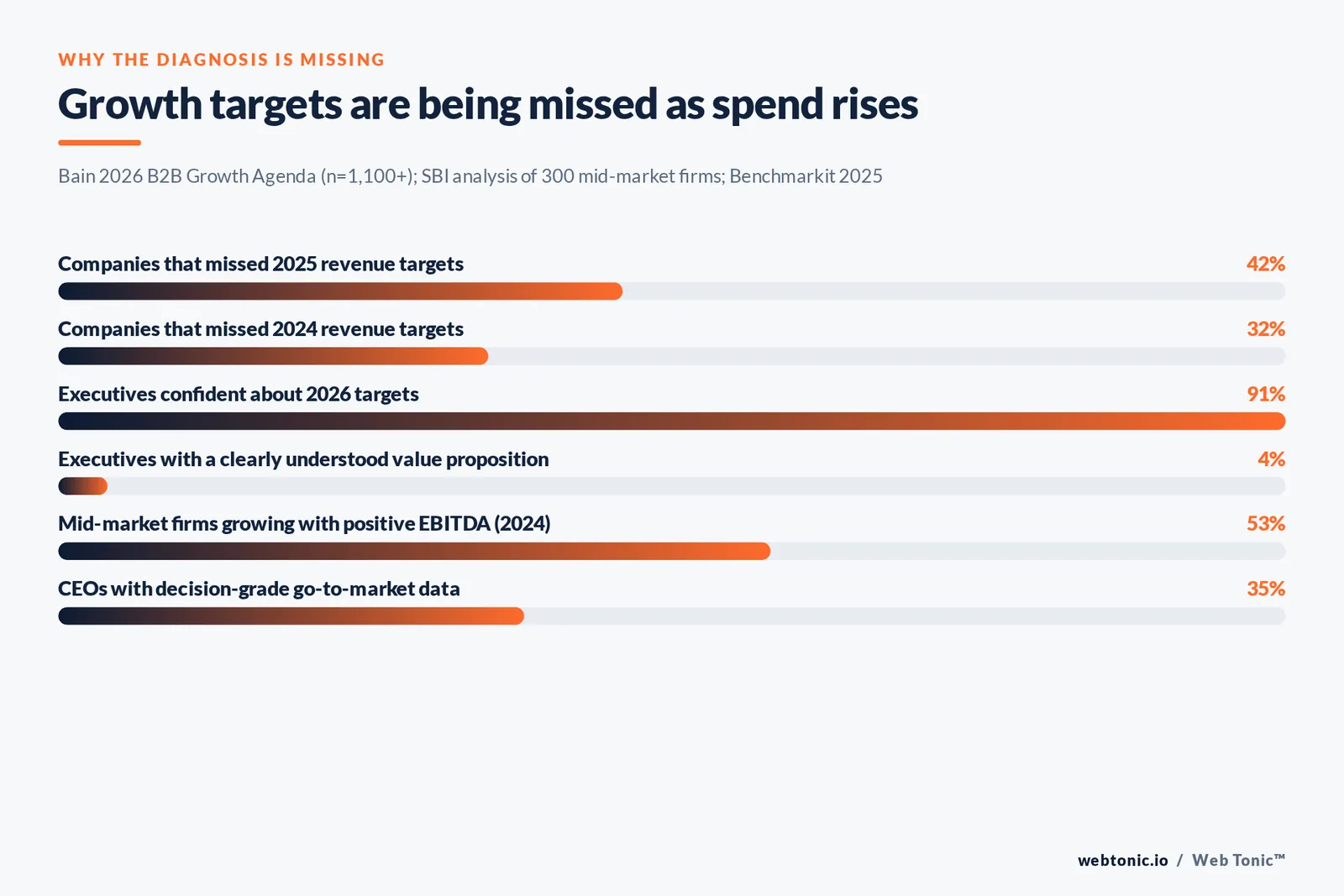
- The problem it treats is common. In Bain's 2026 survey of more than 1,100 senior executives, 42% missed their 2025 growth targets, up from 32% the year before.
- Only 4% of those executives said their company has a strong, consistently understood value proposition — and firms that do grew 19% in 2025 against 12% for those that do not.
- Efficiency, not ambition, is usually the binding constraint: median B2B SaaS now spends $2.00 of sales and marketing to buy $1.00 of new customer ARR, 14% worse year over year.
- The highest-leverage outputs are unglamorous: a documented ICP (worth a 68% win-rate lift in Demandbase's benchmark) and a defensible price (a 1% price move is worth 8.7% of operating profit).
- You need a growth strategy consultant when the diagnosis is missing. You need an agency or an in-house team when the diagnosis exists and execution is the gap.
What growth consulting actually is
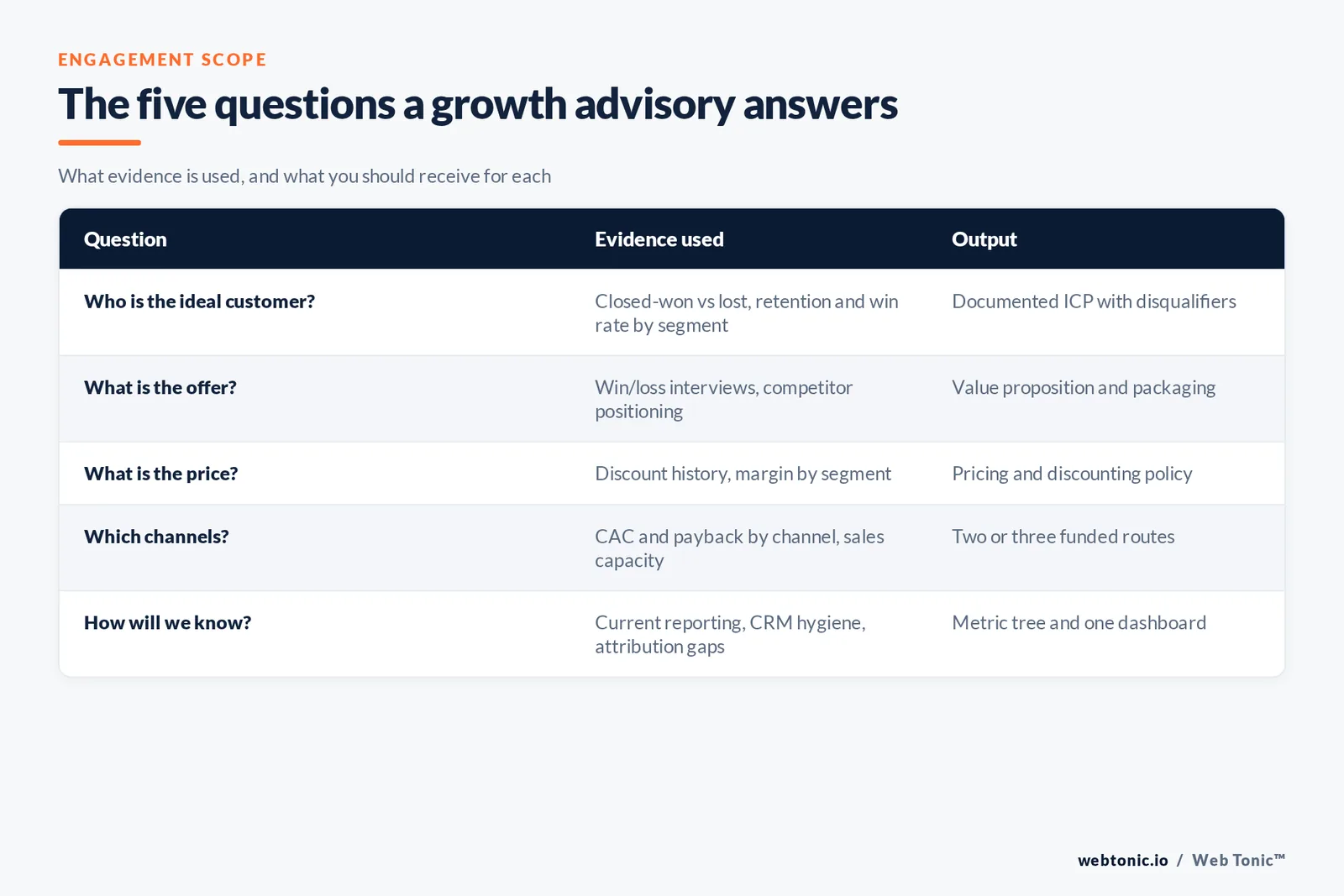
Growth consulting — sometimes sold as growth advisory, sometimes as a growth strategy consultant retainer — is a short, senior engagement that answers four questions with evidence: who should we sell to, what should we sell them, at what price, and through which two or three routes to market. Everything else is downstream.
It sits inside a large and still-expanding professional services market. VantaInsights, working from Census and BLS data, puts US management consulting at roughly $466.7 billion in 2026 across more than 188,000 establishments employing over 1.4 million people. Growth and commercial advisory is one slice of that, and it is the slice most often bought by companies between $2M and $200M in revenue, where the strategy function exists in someone's head rather than on paper.
The distinguishing feature is the deliverable. An agency's deliverable is work: campaigns, content, media, code. A growth advisory's deliverable is a decision set — the revenue growth plan — with the arithmetic attached. If an engagement ends without numbers you can argue with, you did not buy advisory work.
| Question the engagement answers | Typical evidence used | Output you should receive |
|---|---|---|
| Who is the ideal customer? | Closed-won vs closed-lost analysis, retention by segment, win rate by firmographic | A documented, tested ICP with disqualifiers |
| What is the offer? | Win/loss interviews, competitor positioning, product usage | A value proposition and packaging structure |
| What is the price? | Discount analysis, margin by segment, willingness-to-pay research | A pricing and discounting policy |
| Which channels? | CAC and payback by channel, pipeline coverage, sales capacity | Two or three prioritised routes with budgets |
| How will we know? | Current reporting, CRM hygiene, attribution gaps | A metric tree and one dashboard |
The evidence that this is a real problem
The case for a growth advisory is not that companies lack ambition. It is that ambition keeps outrunning the commercial system underneath it. Bain's 2026 B2B Growth Agenda, based on more than 1,100 senior executives across 18 industries, found 91% confident of hitting 2026 targets — while 42% of them had just missed 2025, against 32% missing in 2024. Confidence rose as accuracy fell.
Bain's diagnosis is blunt: only 4% of executives say their organisation has a strong, consistently understood value proposition, and nearly half cite product or service differentiation as their biggest challenge. Companies with a clear and consistent value proposition reported 19% revenue growth in 2025 versus 12% for those without one. That is a positioning problem, and no amount of media budget fixes it.
The cost side tells the same story. SBI's analysis of 300 mid-market firms found sales and marketing expenses ballooned 68% from 2020 to 2024 while the growth those dollars bought collapsed: expense growth fell from a median 30% in 2021 to 5% in 2024, and only 53% of companies managed any growth at all while holding positive EBITDA. The leaders in that sample earned $0.71 of growth per commercial dollar against $0.54 for the market — 31% more growth per dollar, achieved through disciplined choices rather than more spend.
In subscription businesses the same squeeze shows up as CAC. Benchmarkit's 2025 B2B SaaS report puts the median new-customer CAC ratio at $2.00 of sales and marketing spend per $1.00 of new ARR — a 14% deterioration in a single year — with the bottom quartile at $2.82. Median growth fell to 26% and net revenue retention to 101%. When acquisition gets that expensive, the decisions upstream of the campaign matter more than the campaign.
Six signals you need a growth strategy consultant
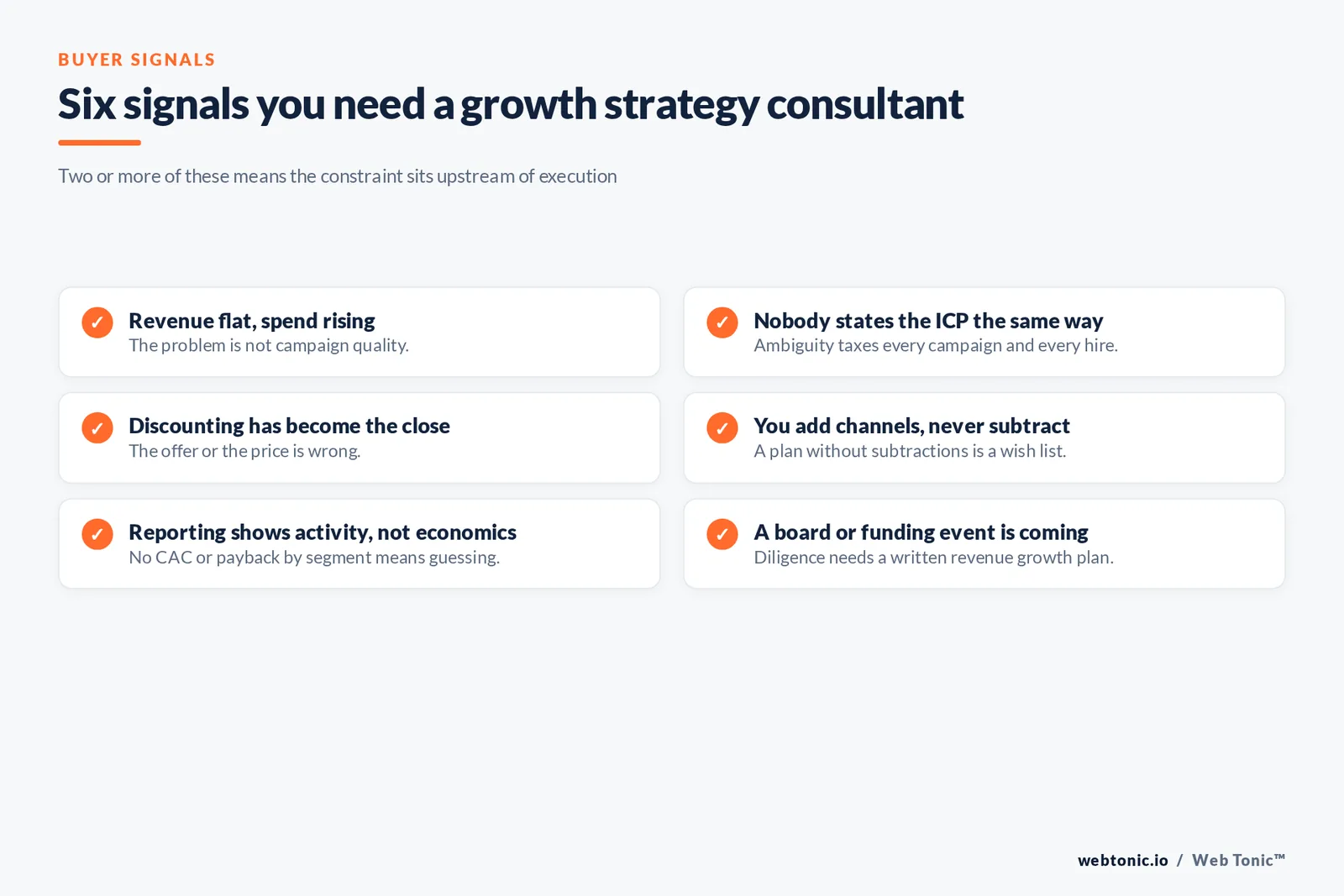
Most companies buy advisory too late, usually after a year of channel experiments. These are the honest triggers.
- Revenue is flat while spend is not. If marketing and sales cost more each quarter and pipeline does not move, the problem is upstream of execution.
- Nobody can state the ICP in one sentence. Or three people state it differently. Ambiguity here taxes every campaign, every sales call and every hire.
- Discounting has become the close. When deals only land with a concession, the offer or the price is wrong, not the sales team.
- You are adding channels, never subtracting. A plan with no subtractions is a wish list. Prioritisation is exactly what an outside operator is paid to force.
- Reporting shows activity, not economics. If you cannot produce CAC and payback by segment, no decision you make about budget is better than a guess.
- A funding event, exit or board is coming. Investor scrutiny needs a written revenue growth plan with defensible assumptions, and it needs it before the diligence call.
Egon Zehnder's survey of more than 500 senior revenue leaders, published by Harvard Business Review in February 2026, reached a similar conclusion about what separates compounding companies from stalled ones: it is the coherence of the growth agenda across leadership, not the volume of initiatives.
The two decisions that carry most of the value
Two outputs of a growth advisory tend to pay for the whole engagement on their own.
The ICP. The Starr Conspiracy's 2025 benchmark set compiles Demandbase's finding of a 68% higher account win rate at companies with a documented, validated ICP, from a survey of 600 B2B revenue leaders. The same set reports CAC payback of 14 months on ICP-fit accounts versus 26 months off-profile, sales cycles 1.7x faster on fit accounts, a median 31% of B2B SaaS pipeline sitting outside the ICP, and 42% of marketers admitting their ICP is more than 18 months old. Nothing in a media plan competes with fixing that.
The price. McKinsey's analysis of the 1,200 largest public companies, summarised in IndustryWeek, calculated that a 1% increase in price levels lifts profit by 8.7% on average — against 5.9% for a 1% cut in variable costs and 1.8% for fixed costs. Pricing is the single most powerful lever most mid-market companies have never systematically pulled.
| Lever | Documented effect | Source of the number | Time to see it |
|---|---|---|---|
| Documented ICP | 68% higher account win rate; 14-month vs 26-month CAC payback | Demandbase 2024 ABX benchmark (n=600) | One to two sales cycles |
| Clear value proposition | 19% vs 12% revenue growth in 2025 | Bain 2026 B2B Growth Agenda (n=1,100+) | Two to four quarters |
| Price and discount policy | 1% price move ≈ 8.7% operating profit | McKinsey, largest 1,200 public companies | Immediate on new deals |
| Channel prioritisation | $0.71 vs $0.54 growth per commercial dollar | SBI, 300 mid-market firms | One to three quarters |
| Commercial reporting | Only 35% of CEOs have the data for confident GTM calls | SBI mid-market analysis | 30 to 60 days |
What growth consulting is not
Three boundaries keep an engagement honest.
It is not execution. A growth advisory that quietly becomes campaign management is being paid senior rates for delivery work. Once the plan exists, execution belongs with a team — internal, agency, or both. Our own growth marketing and performance creative teams pick up exactly at that handover point, and the split is deliberate: the diagnosis and the delivery should be separable, and each should be judged on its own terms.
It is not a permanent leadership seat. If what you need is someone accountable for the marketing function week to week, that is a fractional CMO engagement, not advisory. Advisory ends with a plan; leadership stays for the plan's life.
It is not a reporting project. Building dashboards is necessary and rarely sufficient. The point of instrumentation is to make the next decision provable — that is why data intelligence work usually runs alongside the advisory rather than instead of it.
How a growth advisory engagement usually runs
Scope varies, but the shape is consistent: four to twelve weeks, senior time only, and a hard stop.
- Weeks 1–2 — evidence. Revenue by segment, win/loss data, channel economics, pricing and discount history, plus five to ten customer interviews. Access is the usual bottleneck; agree it in writing before day one.
- Weeks 3–5 — diagnosis. A written assessment naming the constraint. Good advisory names one binding constraint, not nine opportunities.
- Weeks 6–8 — the revenue growth plan. Ranked moves with expected effect, owner, cost and a date, plus what you will stop doing.
- Weeks 9–12 — handover. Metric tree, dashboard, and a 90-day execution sequence handed to whoever will run it.
Two practical rules make the difference. First, insist that every recommendation carries a number and a named owner; recommendations without either are opinions. Second, book the review. A plan reviewed at day 90 and day 180 survives; a plan filed after the final presentation does not.
Who should not buy it
Advisory is wasted in three situations. If your positioning and ICP are settled and converting, buy execution capacity instead. If revenue is under about $1M and the real question is whether anyone wants the product, that is product-market-fit work, not commercial strategy. And if leadership will not commit to acting on findings — including uncomfortable ones about pricing or a favourite channel — the engagement produces a document, not growth. Say so before the contract, not after.
Independent operators know this pattern well. In the 2026 Rate Report, consultants earning above $150,000 a year overwhelmingly structured work as retainers or monthly fees rather than hourly billing — the structures that keep an advisor accountable to outcomes over a defined period instead of to hours logged.

Related reading
- AI Marketing Advisory / AI Readiness: what it is and when you actually need one
- Marketing Team Structure & Hiring Advisory: what it is and when you actually need one
- Fractional CGO / Head of Growth: what it is and when you actually need one
- Marketing Strategy Consulting services at Web Tonic
Frequently Asked Questions
What is the difference between growth consulting and a marketing agency?
Growth consulting decides what to do and why; an agency executes it. Advisory ends with a revenue growth plan — ICP, offer, pricing, channel priorities and a metric tree. An agency turns those decisions into campaigns, creative and media. Buying execution before the diagnosis exists is the most common and most expensive sequencing error.
How long does a growth advisory engagement take?
Four to twelve weeks for the diagnosis and plan in most mid-market businesses, with a lighter monthly cadence afterwards if you want the plan governed. Anything advertised as a two-day workshop is a workshop; anything running past a quarter without a written plan has drifted.
How do I know if the problem is strategy or execution?
Test one question: can three people in your leadership team independently name the ideal customer, the value proposition and the two priority channels, and do their answers match? If not, it is a strategy problem. If they match and results are still weak, it is an execution or capacity problem.
What should a growth strategy consultant deliver?
A written diagnosis, a documented ICP with disqualifiers, a value proposition and packaging structure, a pricing and discount policy, two or three prioritised channels with budgets, a metric tree with one dashboard, and a 90-day sequence with named owners. Ask for the list before you sign.
Can a growth advisory work alongside our existing agency?
Yes, and it usually should. The advisory sets the targets and the guardrails; the agency executes against them. Make the reporting line explicit at the start so the agency is briefed by the plan rather than negotiating with it.
Where to take this next
If two or more of the six signals above describe your business, the next step is a diagnosis, not a campaign. Our growth advisory engagement is built around exactly the outputs listed here, and the wider services lineup exists to execute the plan once it is written. More analysis of the same problems sits on the blog, and if you want to test whether advisory is even the right purchase, talk to us and we will tell you plainly if it is not.
Sources
Bain & Company — 2026 B2B Growth Agenda survey
Harvard Business Review / Egon Zehnder — Why Some Companies Grow Rapidly While Others Stall
Benchmarkit — 2025 B2B SaaS Performance Metrics
The Starr Conspiracy — ICP Benchmarks for B2B GTM 2025
SBI Growth — While Growth Slows for Most, Leaders Take a Different Approach
IndustryWeek / McKinsey — The Payoff from Investing in Pricing Capabilities
VantaInsights — Consulting Industry Trends 2026
Sam Landenwitsch — The 2026 Rate Report


