



Table of contents
The build-or-buy question is really a sequencing question. Marketing strategy consulting answers what to do; an in-house hire owns doing it every day. Buying them in the wrong order is what wastes the money.
Key Takeaways
- A senior in-house hire is a fixed, long commitment: $140,000–$260,000 in base salary for a VP of Marketing in 2026, and $250,000–$320,000 all-in for year one once taxes, benefits and search fees are counted.
- Time is the hidden cost. Average time to fill a VP of Marketing role runs 60–90 days, plus another 30–60 days to full productivity — a quarter to two quarters before the first decision lands.
- Advisory is bought by the question, not by the year. Independent consulting rates cluster at a global median of $190/hour, with a North American median of $290/hour and marketing or growth specialists at $140–$325/hour.
- Hire in-house when the plan exists and the constraint is capacity. Buy a marketing strategy consultant when the plan does not exist, or when leadership disagrees about what it should be.
- The market rewards clarity, not headcount: firms with a clear, consistently understood value proposition grew 19% in 2025 against 12% for the rest, and only 4% of executives believe they have one.
- The strongest structure is usually sequential — a short advisory engagement to write the marketing plan, positioning and messaging, then a hire briefed against it.
Two different purchases, routinely confused
An in-house marketing leader buys you continuity, institutional knowledge and daily ownership. Marketing strategy consulting buys you a decision: who the customer is, what the offer and price should be, which two or three channels deserve the budget, and how success will be measured. The first is a permanent function. The second is a finite piece of thinking with a document at the end of it.
Companies conflate them because both are senior and both are expensive. The practical test is simple. If you can already write a one-page brief that says who you sell to, what you say to them, and where the budget goes — and your leadership team would sign it unchanged — you have a plan and need execution capacity. If you cannot, hiring someone to "own marketing" delegates a strategy problem to a person who will spend their first two quarters rediscovering it at full salary.
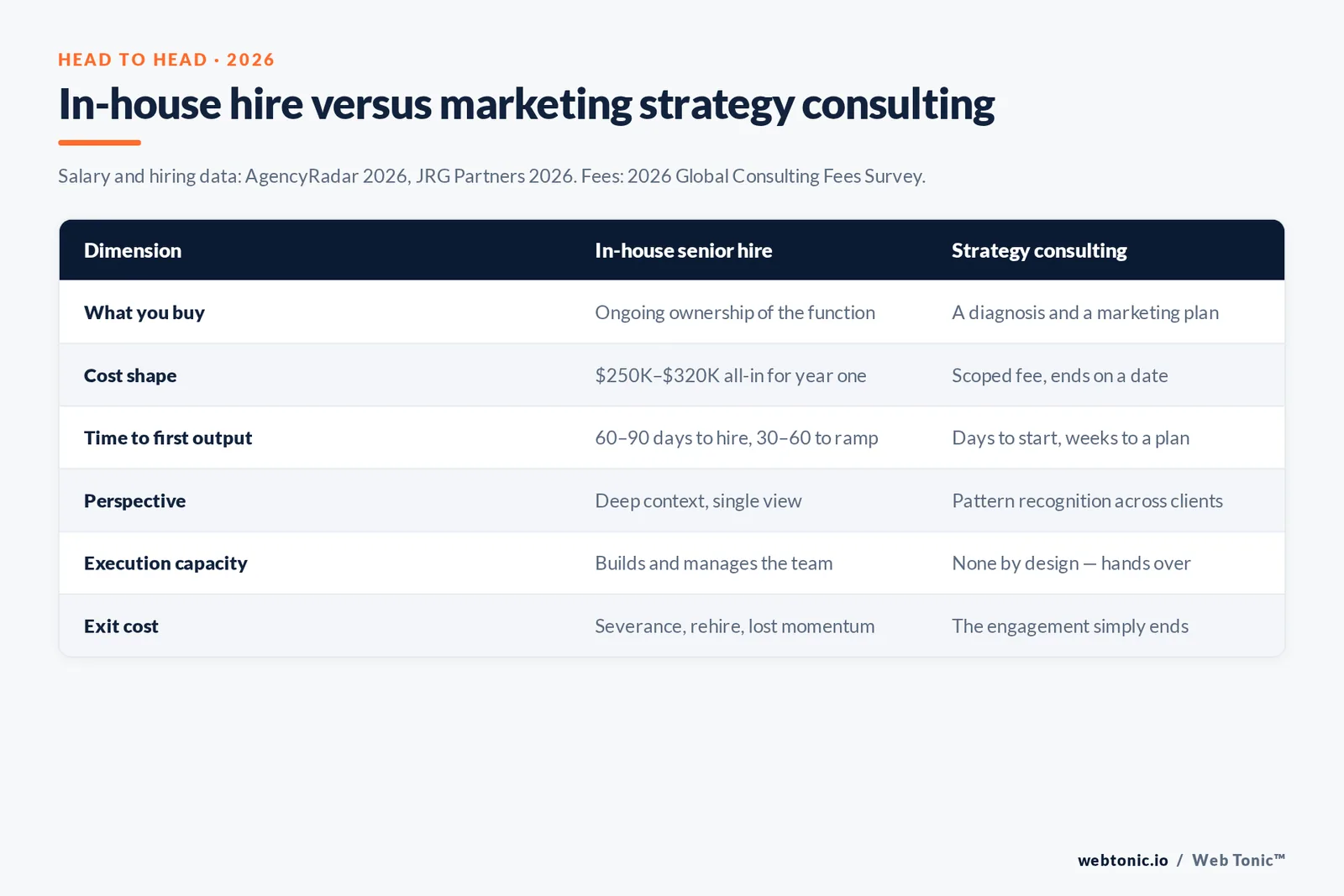
| Dimension | In-house senior hire | Marketing strategy consulting |
|---|---|---|
| What you are buying | Ongoing ownership of the function | A diagnosis and a marketing plan |
| Cost shape | Fixed annual cost, hard to reverse | Defined scope, ends on a date |
| Time to first output | 60–90 days to hire, 30–60 to ramp | Days to start, weeks to a written plan |
| Breadth of view | Deep context, single perspective | Cross-company pattern recognition |
| Execution capacity | Builds and manages the team | None by design — hands over |
| Exit cost | Severance, rehire, lost momentum | The engagement simply ends |
What the in-house route actually costs in 2026
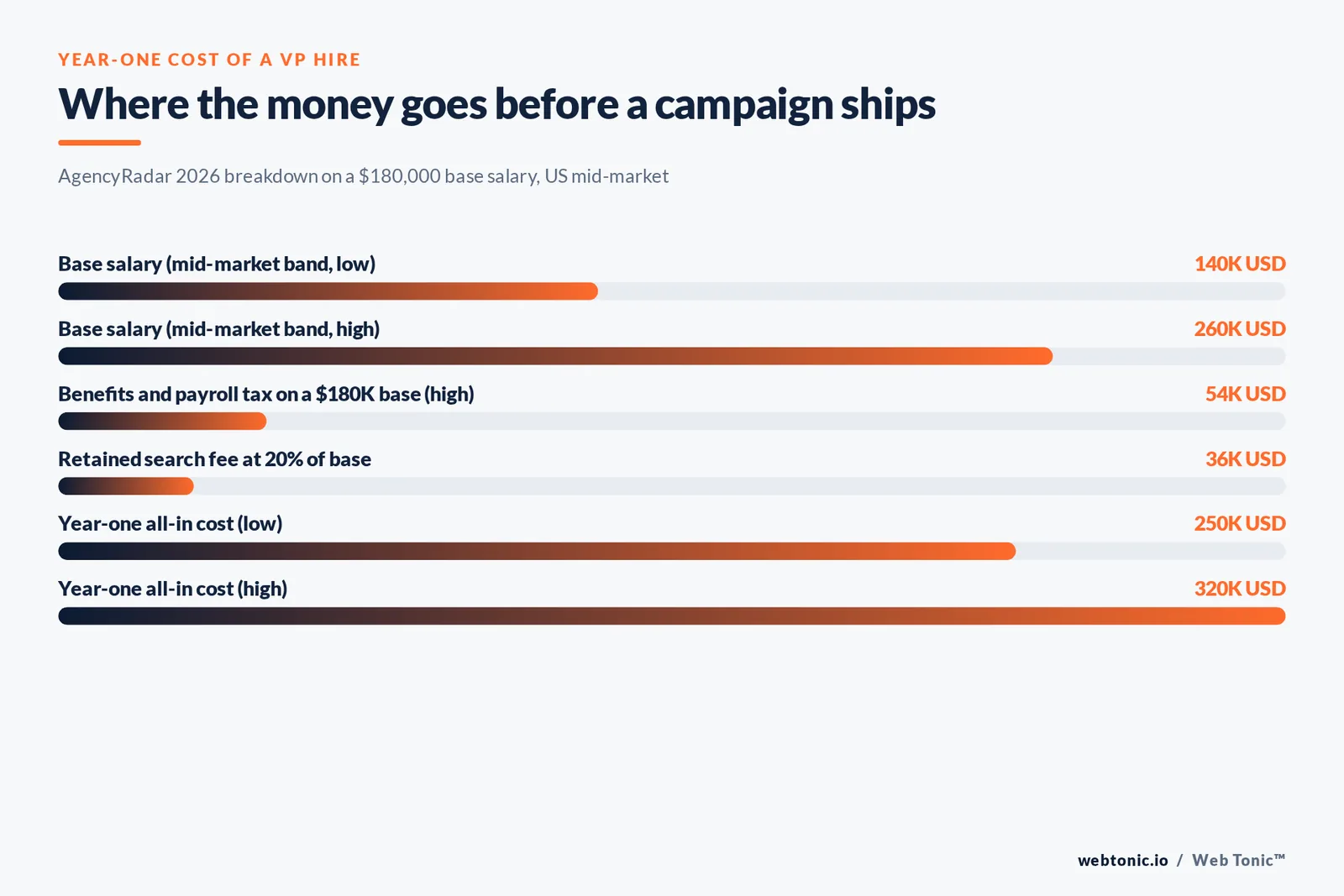
Base salary is the number people quote and the smallest part of the decision. AgencyRadar's 2026 cost breakdown puts VP of Marketing base pay at $140,000–$180,000 for companies of 50–500 employees, $160,000–$220,000 at Series A/B startups and $180,000–$260,000+ in the mid-market and above. Payroll taxes and benefits add 25–30% — roughly $45,000–$54,000 on a $180,000 base — and retained search typically costs 15–20% of first-year base, another $27,000–$36,000. Year one lands at $250,000–$320,000 before a single campaign ships.
JRG Partners' 2026 salary guide adds the variable layer: target bonuses generally run 20–40% of base, weighted higher where pipeline accountability is explicit, and total compensation scales steeply with company revenue. None of that is wasted money when the role is right. It is simply a commitment made before you know whether the marketing plan you are hiring against is the correct one.
Then there is the calendar. Sixty to ninety days to fill, thirty to sixty to ramp: a decision made in January produces its first considered strategy somewhere around May. If your board has asked for a positioning and messaging fix this quarter, the hire cannot deliver it.
What advisory costs, in third-party terms
Consulting fees are public enough to plan against. The 2026 Global Consulting Fees Survey reports a median fee of $190 per hour worldwide, $290 in North America and $200 across Western and Northern Europe, with North American responses spanning $125 to $2,500 an hour. It also found 54% of consultants raised fees in the last 24 months and 55% now price by project rather than by time.
Sengi's 2026 rate tables narrow it by discipline: marketing and growth consulting at $85–$140 junior, $140–$220 mid-level and $220–$325 senior, with management and strategy consulting reaching $275–$400 at the senior end. The 2026 Rate Report puts the median hourly equivalent at $188 with the middle half between $150 and $250, and shows retainer-based engagements averaging $222 against $179 for hourly billing.
Ranges that wide are not evasion; they reflect scope. A four-week diagnosis of one segment and a twelve-week rebuild of positioning, pricing and the channel plan are different purchases. Ask for scope in deliverables and dates, then compare like with like — and treat any published range, including these, as a starting point for a scoped quote rather than a price list.
The decision framework
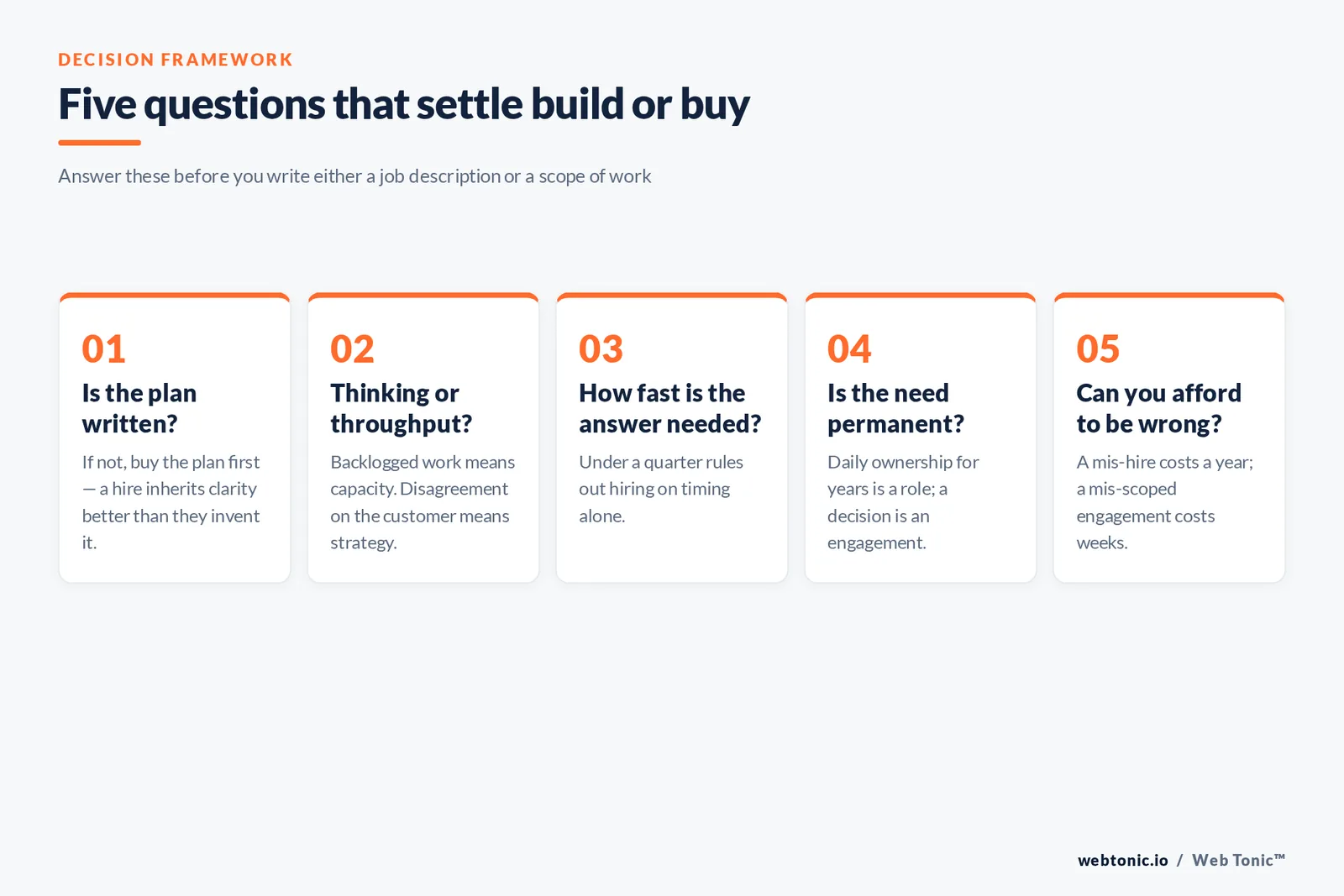
Five questions settle most build-or-buy debates faster than a spreadsheet.
- Is the plan written? If no, buy the plan first. A hire inherits clarity far better than they manufacture it.
- Is the constraint thinking or throughput? Backlogged campaigns and unshipped content mean capacity. Disagreement about the target customer means strategy.
- How fast does the answer need to exist? Under a quarter rules out hiring on timing alone.
- Is the requirement permanent? If the function needs daily ownership for years, that is a role. If it needs a decision and a governance rhythm, that is an engagement.
- Can you afford to be wrong? A mis-hire costs a year and the severance. A mis-scoped engagement costs weeks.
Bain's 2026 survey of more than 1,100 executives across 18 industries supplies the uncomfortable context for question one: 42% missed their 2025 revenue targets, up from 32% in 2024, while 91% remained confident about 2026. Only 4% said their value proposition was strong and consistently understood, and those that had one grew 19% versus 12%. Hiring a leader into that ambiguity does not resolve it.
| Your situation | Better first move | Why |
|---|---|---|
| No documented ICP or positioning | Advisory engagement | The hire would spend two quarters deriving it at full cost |
| Plan agreed, nothing shipping | In-house hire or delivery partner | Constraint is throughput, not clarity |
| Board or investor deadline this quarter | Advisory engagement | Hiring cycle alone consumes the deadline |
| Leadership disagrees on the strategy | Advisory engagement | An outside operator can force the choice a new employee cannot |
| Team over ~8 people, growing | In-house leader | Daily management and career development need an owner |
| One-off launch or repositioning | Advisory plus execution capacity | Finite work should not create permanent overhead |
What each option asks of your business
Cost is only half the comparison. The two routes make very different demands on the founder and the leadership team. An in-house hire needs a manager, a career path and a development plan; the role has to be defined well enough that a strong candidate can see where it goes in three years, and someone senior has to hold the weekly one-to-one. That is a real management commitment, and businesses that skip it lose good employees inside a year.
An advisory firm asks for something narrower but sharper: access, evidence, and a founder or executive sponsor who will spend two to four hours a week in the room and sign decisions. The advisor brings expertise across many clients and a comprehensive view of what has worked elsewhere; what they cannot bring is your institutional memory. Strategic planning done without your sales team's input produces a document that reads well and does not survive contact with the pipeline.
There is also a communication cost nobody prices. A new employee spends months learning who decides what. A consultant shortcuts that with a written scope naming decision owners in the first ten days — one reason engagements with a clear governance policy tend to finish on time while open-ended retainers drift into general help.
Why efficiency, not headcount, is the live problem
Adding senior salary to an inefficient commercial system usually buys more of the same. SBI's study of 300 mid-market companies found sales and marketing expenses up 68% between 2020 and 2024 while median expense growth collapsed from 30% in 2021 to 5% in 2024, and only 53% of firms grew at all while holding positive EBITDA. The leaders in that dataset generated $0.71 of growth per commercial dollar against $0.54 for the market, and 63% of them had redesigned their go-to-market approach. Notably, only 35% of CEOs said they had the data needed for confident go-to-market decisions.
Subscription businesses see the same pattern in acquisition costs. Benchmarkit's 2025 benchmarks record a median new-customer CAC ratio of $2.00 per $1.00 of new ARR, 14% worse year over year, with the fourth quartile at $2.82. A new VP inherits that ratio on day one. Whether they can change it depends almost entirely on whether the offer, price and target list are right — which is exactly what advisory work interrogates.
Questions to ask before you commit either way
Whichever route you focus on, a short due-diligence pass saves money. For a hire: what does the first-year scorecard say, who signs off the budget, and which projects will be judged at month six? For advisors: what comprehensive evidence base will they work from, which named advisor does the thinking rather than the pitch, and what does their reporting look like in month two?
Ask for a work sample in both cases. A candidate can walk you through a plan they built and what it produced; an advisory firm can show a redacted deliverable and the financial reasoning behind it. Expertise is easy to claim in a meeting and hard to fake against a real artifact. Confirm the engagement policy on data handling and digital access too — analytics, CRM and ad accounts are the assets you are opening up, and the answer should be documented before anyone signs.
The hybrid most companies should actually run
The two options are not rivals, and treating them as one decision produces bad outcomes in both directions. A sequence works better.
- Weeks 1–8: buy the diagnosis. A marketing strategy consultant produces the ICP, positioning and messaging, pricing guardrails, channel priorities and a metric tree.
- Weeks 6–12: write the role from the plan. The job description now describes a mandate rather than a wish. Interviews test for fit against real priorities.
- Months 3–6: hire and hand over. The new leader starts with a written plan, a dashboard and a shortlist of decisions already made — the ramp shortens materially.
- Ongoing: keep a review cadence. A quarterly outside review costs a fraction of a headcount and stops the plan quietly reverting to last year's split.
Where execution capacity is the gap in the meantime, that is a delivery question rather than a leadership one: our growth marketing and performance creative teams run the plan while the seat is being filled, and data intelligence builds the reporting the new leader will need on day one. If the requirement is genuinely a leader rather than a plan, a fractional CMO covers the seat without the permanent commitment.

Related reading
- Board Advisory / Investor-Ready Growth Plan: vs hiring in-house
- Marketing Team Structure & Hiring Advisory: vs hiring in-house
- Fractional CGO / Head of Growth: vs hiring in-house
- Marketing Strategy Consulting services at Web Tonic
Frequently Asked Questions
Is marketing strategy consulting cheaper than hiring in-house?
It is a different shape of cost rather than automatically cheaper. A senior in-house hire is a fixed annual commitment of roughly $250,000–$320,000 in year one at VP level, while advisory is scoped work with an end date, priced against published market rates of about $150–$325 an hour for marketing and growth specialists. For a finite question, advisory is almost always the smaller total cost; for permanent daily ownership, the hire is the correct spend.
Can a consultant replace a full-time marketing leader?
Not permanently. A consultant should not be managing your team's day-to-day workload or owning career development. If you need continuous leadership without a permanent hire, use a fractional executive arrangement rather than stretching an advisory scope into a shadow employment.
How long before an in-house hire pays for themselves?
Assume two to three quarters at minimum: 60–90 days to hire, 30–60 days to ramp, then at least one full sales cycle before their decisions show in revenue. Businesses with long enterprise cycles should extend every milestone accordingly.
What if we already have a marketing team but no strategy?
That is the clearest case for advisory. A team executing without an agreed marketing plan produces motion, not compounding results. Fix the plan, brief the team against it, and only then judge whether the capability gap is real.
How do we stop the plan from being ignored after the engagement ends?
Name an owner for every recommendation, put the metric tree into one dashboard leadership already looks at, and book the day-90 and day-180 reviews before the engagement closes. Plans die from missing calendar invites more often than from missing insight.
Where to take this next
If you cannot yet write the one-page brief, the hire can wait a few weeks and the plan cannot. Our growth advisory engagement exists to produce that brief, the full services lineup executes it, and further analysis lives on the blog. If you want a second opinion on whether to buy or build first, tell us the situation and we will give you a straight answer.
Sources
AgencyRadar — In-House Marketing Hire vs. Agency: The Real Cost Breakdown (2026)
JRG Partners — VP of Marketing Salary Guide 2026
Reinvention Academy — 2026 Global Consulting Fees Survey
Sengi — Freelance consultant rates 2026
Sam Landenwitsch — The 2026 Rate Report
Bain & Company — 2026 B2B Growth Agenda survey
SBI Growth — While Growth Slows for Most, Leaders Take a Different Approach
Benchmarkit — 2025 B2B SaaS Performance Metrics


