



Table of contents
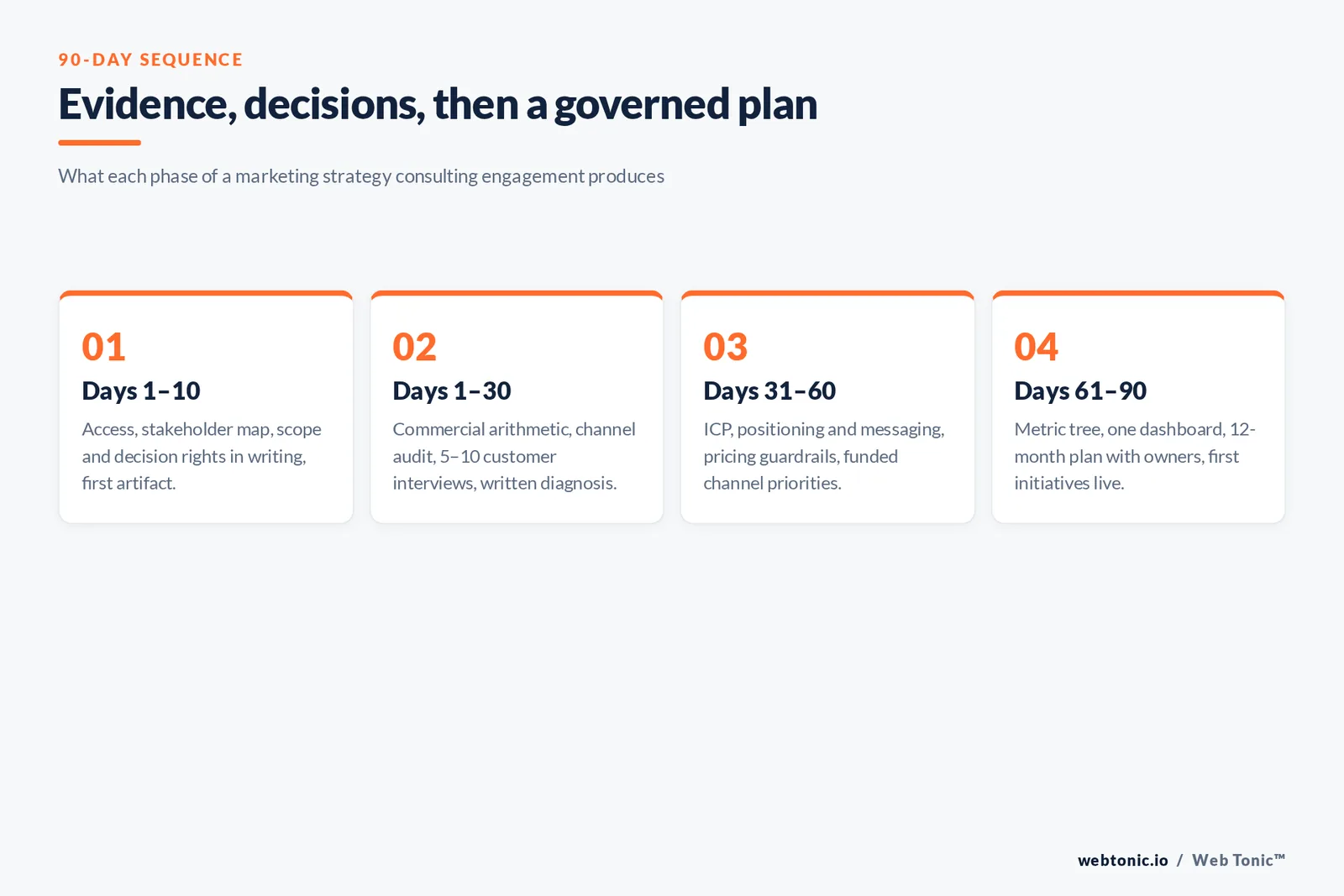
A marketing strategy consulting engagement is won or lost in its first quarter. The sequence that works: evidence in month one, decisions in month two, a governed marketing plan running in month three.
Key Takeaways
- Front-load access. Data-room and system access by day 3, stakeholder map and booked interviews by day 7, scope confirmed in writing by day 10 — the checkpoints that separate a launched engagement from a stalled one.
- The kickoff is a working session, not a formality: 60–90 minutes, three outputs — the goal, the cadence, the immediate next steps — written up within 24 hours.
- Month one is diagnosis. Expect 5–10 win/loss interviews, 12 months of channel economics, and a written assessment naming one binding constraint.
- Month two is decisions: ICP, positioning and messaging, pricing guardrails, and two or three prioritised channels with budgets attached.
- Month three proves it. One dashboard, a metric tree, and a 12-month marketing plan with owners and dates — plus the list of things you have stopped doing.
- Judge outcomes on a realistic clock: leading indicators inside the quarter, pipeline effect in months three to six, revenue effect after at least one full sales cycle.
Why the first 90 days carry the whole engagement
Advisory work has no ramp period. You are paying senior rates from week one, and the value is concentrated in a small number of decisions. That makes the first quarter a scheduling problem as much as an analytical one: the calendar has to be built backwards from the deliverables, or discovery expands to fill whatever time exists.
The context makes the urgency real. Bain's 2026 B2B Growth Agenda, surveying more than 1,100 executives across 18 industries, found 42% of companies missed their 2025 revenue targets against 32% the year before, while 91% remained confident about the year ahead. Only 4% reported a strong, consistently understood value proposition, and those that had one grew 19% versus 12%. A first quarter that does not close that gap has not earned its fee.
Days 1–10: the launch gate
Nothing derails a strategy engagement faster than waiting three weeks for CRM access. Treat the opening ten days as a gate with named owners, not as warm-up.
Stratenity's kickoff framework sets three checkpoints: system access, data rooms and a standing meeting rhythm by day 3; stakeholder map, interview list and the evidence base by day 7; confirmed scope, named decision owners and the operating cadence by day 10, reviewed alongside a first reviewable artifact before the engagement is declared launched. Strategy Case makes the same point from the delivery side: data requests should go out within the first three days, because data access is the single most common thing that stalls a project and it almost always takes longer than the client promises.
The kickoff itself should be short and structured. MyConsultBase's 2026 onboarding checklist recommends a 60–90 minute session producing three outputs — shared understanding of the goal, an agreed working cadence, clarity on immediate next steps — documented in writing within 24 hours, with constraints surfaced deliberately. Constraints raised at kickoff are negotiable; the same constraints discovered in week six are conflicts.
| Checkpoint | By when | Owner | Evidence it happened |
|---|---|---|---|
| Systems and data access | Day 3 | Client operations lead | Analytics, CRM, ad accounts and finance exports in hand |
| Stakeholder map and interviews booked | Day 7 | Engagement lead | Named list, calendar invites sent, sales and CS included |
| Scope and decision rights in writing | Day 10 | Executive sponsor | One page naming who signs off what |
| First reviewable artifact | Day 10 | Engagement lead | Current-state map circulated for comment |
| Cadence live | Day 10 | Both | Recurring weekly slot with the sponsor in the diary |
Days 1–30: evidence before opinions
Month one collects the facts that make month two's decisions arguable rather than aesthetic. Four workstreams cover it.
- Commercial arithmetic. Revenue and margin by segment, average deal value, win rate, sales-cycle length, and acquisition cost by channel over the last 12 months.
- Customer evidence. Five to ten structured interviews across recent wins, losses and churns. Positioning problems surface here long before they show in a dashboard.
- Channel and spend audit. What each channel produced, what it cost, and which numbers survive scrutiny. Most audits find at least one line nobody can defend.
- Data honesty check. Whether the CRM and analytics can answer the questions the plan will depend on. SBI found only 35% of CEOs have the data needed for confident go-to-market decisions.
The month-one deliverable is a written assessment naming one binding constraint. Not a list of nine opportunities — the constraint, with the numbers that prove it and an explicit statement of what would have to be true for it to be wrong.

Days 31–60: the four decisions
Month two turns evidence into commitments. Four of them carry nearly all the value.
- Ideal customer profile. Documented, with disqualifiers. Demandbase's benchmark of 600 revenue leaders found a 68% higher account win rate where a validated ICP exists, with CAC payback of 14 months on fit accounts versus 26 months off-profile, and 1.7x faster sales cycles. The same compilation reports a median 31% of B2B SaaS pipeline sitting outside the ICP and 42% of marketers admitting theirs is over 18 months old.
- Positioning and messaging. One articulation of the value proposition that sales, marketing and the founder all use unchanged. Given Bain's 4% figure, this is rarer than teams assume.
- Price and packaging guardrails. McKinsey's analysis of the 1,200 largest public companies, reported by IndustryWeek, found a 1% price improvement lifts profit 8.7% on average — more than a 1% cut in variable costs (5.9%) or fixed costs (1.8%).
- Channel priorities and budget. Two or three routes, funded properly, with the rest explicitly paused. A marketing plan with no subtractions is a wish list.
Each decision needs a named owner and a date. Without both, month three inherits an argument instead of a plan.
Days 61–90: instrument, launch, govern
The final month makes the plan operable by people who were not in the interviews.
- Metric tree and one dashboard. Revenue target decomposed into the four or five numbers that move it, in a single view leadership already opens.
- The 12-month plan. Initiatives with owners, dates, budgets and the expected effect on a named metric.
- First moves live. At least two prioritised initiatives shipped inside the quarter, so the plan is tested rather than admired.
- Governance. A monthly review against the metric tree, plus booked day-90 and day-180 checkpoints.
Efficiency should be an explicit target of that dashboard. Benchmarkit's 2025 benchmarks put the median new-customer CAC ratio at $2.00 of sales and marketing spend per $1.00 of new ARR, 14% worse year over year, with the bottom quartile at $2.82, median growth at 26% and net revenue retention at 101%. If the plan does not name which of those numbers it intends to move, it is not finished.
| Phase | Focus | Deliverable | Signal it is on track |
|---|---|---|---|
| Days 1–10 | Access, scope, cadence | Signed scope page, current-state map | Nobody is still chasing logins |
| Days 1–30 | Evidence and interviews | Written diagnosis naming one constraint | Leadership learns something it did not know |
| Days 31–60 | ICP, messaging, pricing, channels | Decision set with owners and budgets | Sales and marketing tell the same story |
| Days 61–90 | Instrumentation and launch | Metric tree, dashboard, 12-month plan | Two initiatives live and measured |
| Day 90+ | Governance | Monthly review, day-180 checkpoint | The plan is edited, not filed |
The relationships the first quarter has to build
A plan is only as durable as the working relationships behind it. Three matter early. The executive sponsor, who clears access and signs decisions. The sales or commercial manager, whose team supplies the evidence and later has to live with the ICP. And whoever owns the data, because every question the advisors ask will eventually land on their desk.
Practically, that means a standing weekly meeting with the sponsor from week one, a short monthly session with the wider leadership team, and named contacts for finance and operations. Meetings should have a written purpose: review evidence, make a decision, or unblock access. Recurring status meetings with no decision on the agenda are the first thing to cut when the calendar gets tight.
Communication style matters as much as cadence. Good advisors circulate work in progress early and invite disagreement while it is still cheap, rather than saving a polished reveal for month three. Board members and other stakeholders should see the direction of travel before the final document lands — a well-run engagement produces no surprises in its last week, only confirmation of choices the organisation has already had a chance to argue with.
Six red flags inside the first quarter
Catch these in month two and the engagement recovers cheaply.
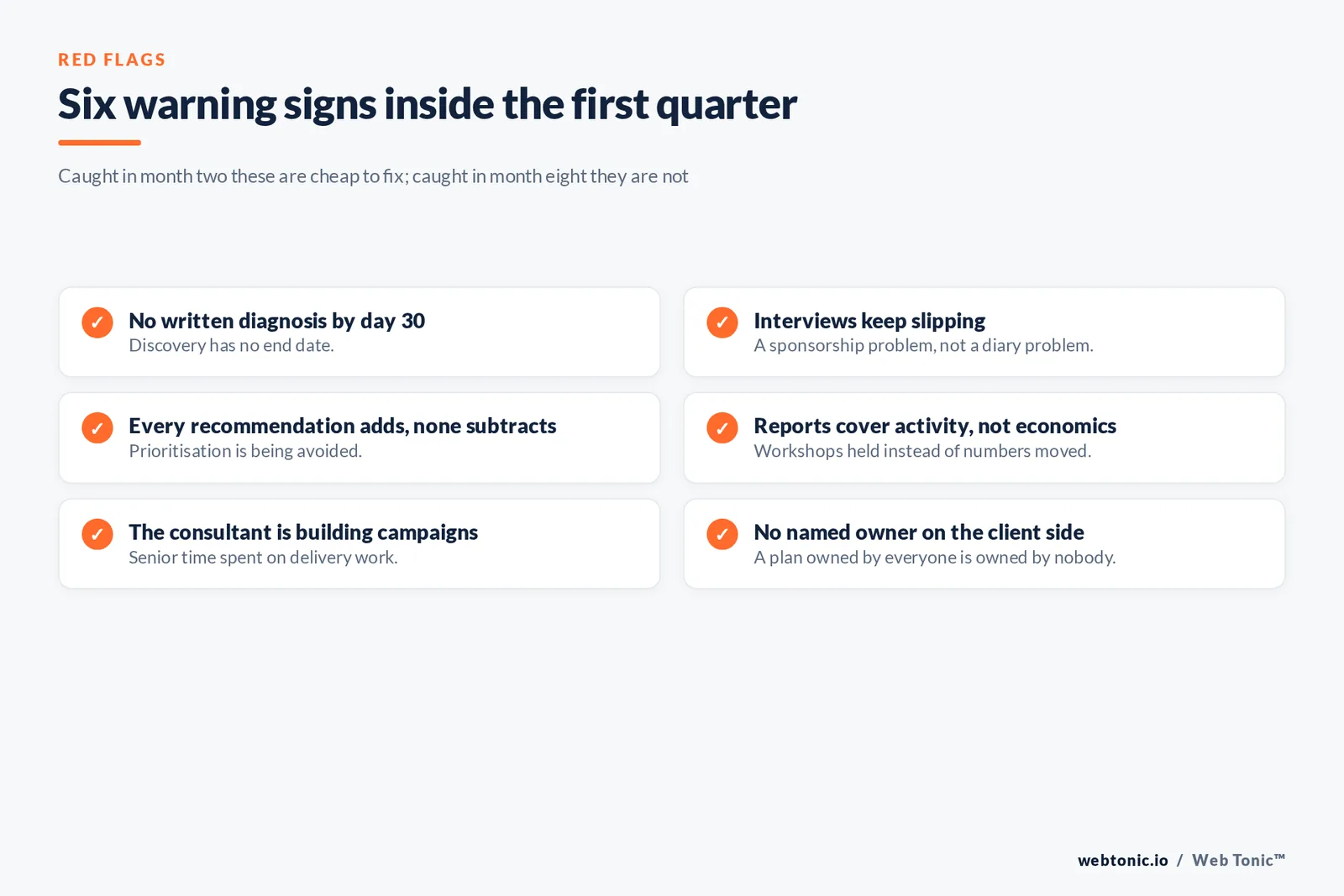
- No written diagnosis by day 30. Discovery without an end date will not find one on its own.
- Interviews keep slipping. Usually a sponsorship problem, not a diary problem. Escalate at day 7, not day 40.
- Every recommendation adds; none subtracts. Ask which two activities stop this quarter and who signs that off.
- Reporting on activity rather than economics. Decks about workshops held instead of numbers moved.
- The consultant is building campaigns. Senior advisory time spent on delivery work means the scope has drifted; add capacity and return the advisor to the plan.
- No named owner on the client side. Plans handed to "the team" belong to nobody by day 91.
None of these are exotic. They are what happens when the calendar is not enforced, which is why the day-10 gate matters more than any single analysis.
What happens after day 90
Advisory should end, or shrink deliberately. Three sensible landing points: hand the plan to an internal owner with a quarterly outside review; hand execution to a delivery team while governance stays monthly; or, if the real gap is continuous leadership, convert to a fractional CMO arrangement instead of stretching the advisory scope. Whichever route, the handover should include the metric tree, the dashboard and the written decision log — not just the final deck.
In practice most companies split it: the plan comes from growth advisory, execution goes to growth marketing and performance creative, and the measurement layer is built by data intelligence so the day-180 review argues about results rather than about whose number is right.

Related reading
- Board Advisory / Investor-Ready Growth Plan: the first 90 days
- EOS / Scorecard & KPI Advisory: the first 90 days
- Marketing Team Structure & Hiring Advisory: the first 90 days
- Marketing Strategy Consulting services at Web Tonic
Frequently Asked Questions
What should be delivered in the first 30 days of a marketing strategy consulting engagement?
A written diagnosis: the commercial arithmetic, the channel audit, findings from five to ten customer interviews, and one clearly named binding constraint. If month one ends with a status update rather than a document you can disagree with, the engagement is behind.
How much client time does the first quarter require?
Budget roughly two to four hours a week from the executive sponsor, plus interview time from sales and customer success in month one. Access and interviews are the two things only the client can unblock, and both belong in the first ten days.
When should we expect results?
Leading indicators — pipeline quality, win rate on ICP-fit accounts, cost per qualified opportunity — inside the quarter. Pipeline effect in months three to six. Revenue effect after at least one full sales cycle, which in enterprise businesses can push past month nine.
What if the diagnosis says something leadership does not want to hear?
That is usually the point of hiring outside help. Agree in advance who arbitrates disputed findings and what evidence would change the conclusion. Engagements fail more often from unresolvable disagreement about the diagnosis than from a weak plan.
Can the first 90 days run alongside our existing agency or team?
Yes, and it works best that way. Keep the delivery running against current priorities while the plan is written, then rebrief everyone against the new plan at day 90 so there is one set of targets rather than two.
Where to take this next
If you are scoping an engagement, use the checkpoint table above as an acceptance test before you sign. Our growth advisory engagement runs to this sequence, the wider services lineup executes the plan afterwards, more on the method sits on the blog, and if you would rather talk it through first, get in touch.
Sources
Stratenity — Engagement Kickoff Orbit framework
MyConsultBase — The Consulting Client Onboarding Checklist (2026)
Strategy Case — An Insider Consulting Project Kickoff Playbook
Bain & Company — 2026 B2B Growth Agenda survey
The Starr Conspiracy — ICP Benchmarks for B2B GTM 2025
IndustryWeek / McKinsey — The Payoff from Investing in Pricing Capabilities
Benchmarkit — 2025 B2B SaaS Performance Metrics
SBI Growth — While Growth Slows for Most, Leaders Take a Different Approach


