



Table of contents

Quick answer: Scope growth consulting around one constraint and one measurable outcome, then write five clauses: the constraint, the outcome with a baseline and date, decision rights, named exclusions, and an exit condition. Scope by constraint, never by channel list.
Last verified: 2026-09-04
Start with the constraint, not the deliverables
Most growth advisory proposals open with a list of workstreams: paid, SEO, lifecycle, CRO, analytics. It reads as thorough and it is usually the reason the engagement disappoints. A list of channels is not a diagnosis; it is a hedge against not having one.
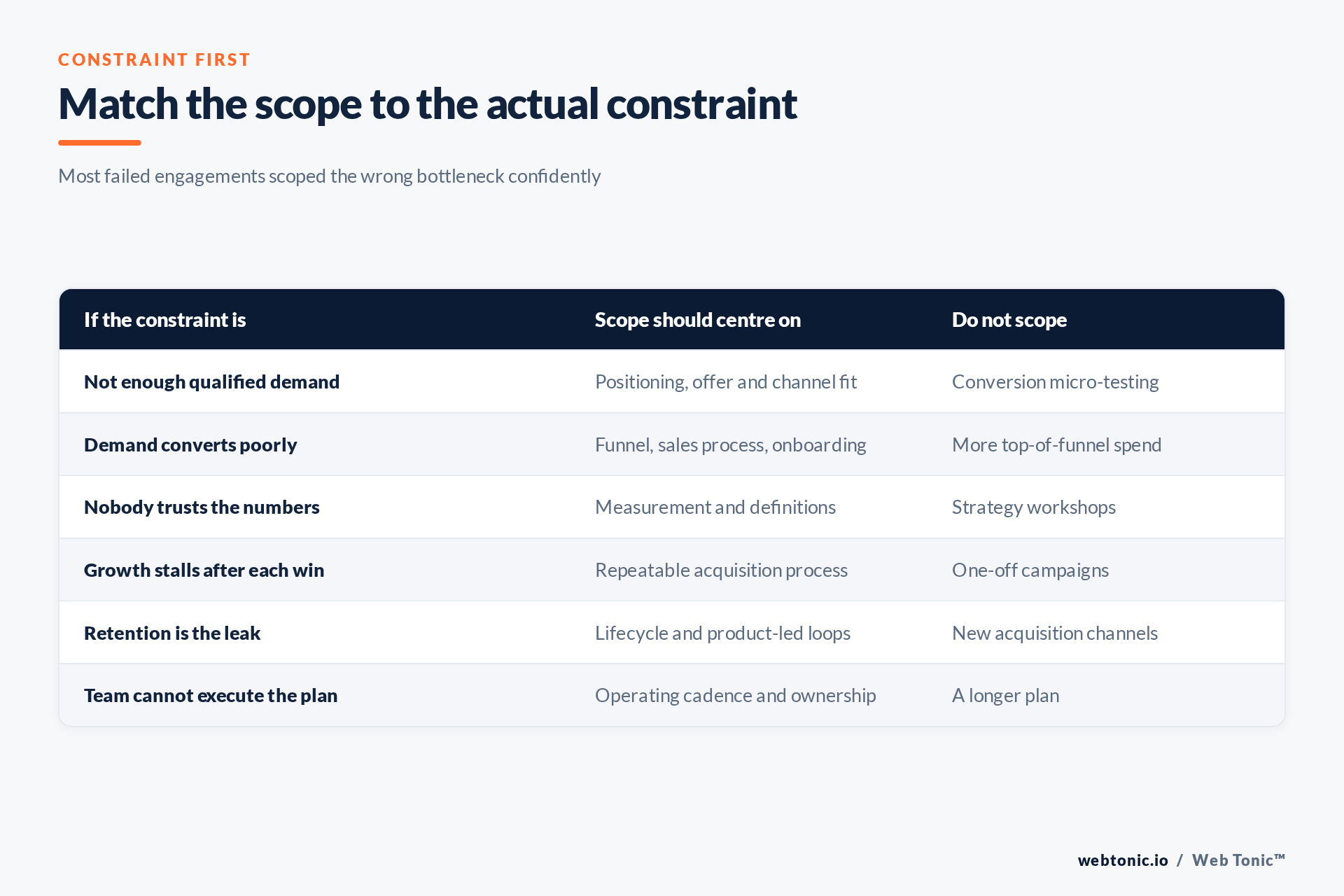
A scope that holds names the constraint first — the single thing currently limiting growth — and everything else follows from it. If qualified demand is the constraint, conversion-rate work is a distraction. If the funnel leaks, more spend at the top makes the leak more expensive. The discipline is the same one behind any theory-of-constraints approach: improvements away from the bottleneck do not move the system.
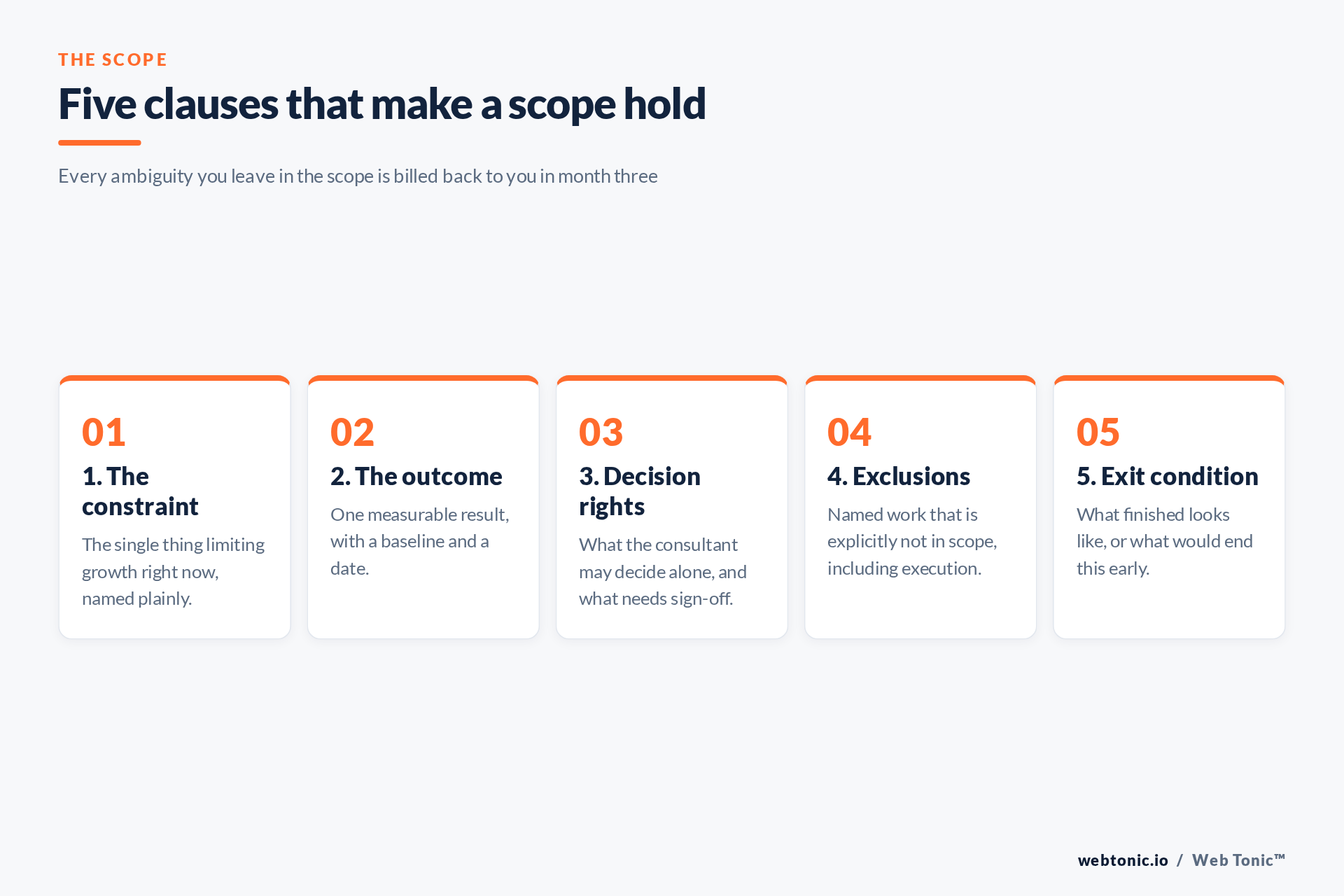
Clause one — name the constraint
Write it in one sentence a non-marketer would accept. "Qualified pipeline has been flat for three quarters while traffic grew 40%" is a constraint. "We need a growth strategy" is not.
Where the constraint is genuinely unknown, scope a short diagnostic phase as its own engagement with its own outcome — a written diagnosis — rather than pretending the full plan can be committed to blind. That phase is short by design, and it is the honest version of what a longer discovery is doing anyway.
Clause two — one outcome, with a baseline
A revenue growth plan needs a number to be judged against. Pick one primary outcome, record today's value, and date the target. Two outcomes is usually a sign the constraint was not settled; five is a wish list.
Choose an outcome the client's own systems already measure. Introducing a new metric and being assessed on it in the same quarter guarantees an argument about the measurement instead of the result. If the metric genuinely does not exist yet, building it belongs in the scope explicitly, and the definition should be written down before work starts, not after.
Clause three — decision rights
The most expensive ambiguity in advisory work is not scope of work, it is scope of authority. State what the growth strategy consultant may change alone — budget shifts under a threshold, creative direction, testing plans — and what requires sign-off, with a named person and a response window.
Without this, every decision becomes a meeting, and the engagement quietly converts into consensus-building. That is expensive at advisory rates and it produces the safest possible version of every choice.
Clause four — exclusions
Name what is not included, in the same document, in plain terms. Execution is the big one: advisory that gradually absorbs hands-on delivery has effectively repriced itself downward without anyone deciding to. A statement of work exists exactly for this.
Common exclusions worth stating: production of creative assets, day-to-day campaign management, hiring decisions, tool procurement, and anything requiring engineering time not already committed. Where execution is wanted, scope it separately with its own outcome — our growth marketing and performance creative pages describe the delivery side we keep deliberately distinct from advice.
Clause five — the exit condition
Say what finished looks like. Advisory engagements without an exit condition drift into indefinite retainers where neither side can say whether it worked. An exit condition can be an outcome ("qualified pipeline sustained above X for two quarters"), a handover ("the in-house lead is running the cadence"), or a date with an explicit review.
Include the early exit too. Both sides should be able to end an engagement that is not working without it being a dispute — a stated notice period and a review checkpoint at the end of the first quarter is usually enough.
| Scope shape | Best when | Risk |
|---|---|---|
| Diagnostic only | Constraint is unknown or disputed | Ends with a document nobody actions |
| Constraint-led project | Constraint is clear and bounded | Constraint moves mid-engagement |
| Quarterly advisory | Team can execute, needs judgement | Drifts into status meetings |
| Advisory plus delivery | No internal execution capacity | Advice gets absorbed by delivery |
On price, honestly
Published market observations put independent strategy consulting across an extremely wide band — commonly quoted day rates for senior independent consultants run from a few hundred to several thousand US dollars, and monthly advisory retainers are advertised across a similarly wide spread. Treat any single figure sceptically: the band reflects market, seniority and days committed more than method. Scope drives the number far more than the rate does, which is why the five clauses come before the commercial conversation. For a figure against your own constraint, read the rest of the library and then ask us for a scoped quote.
What goes wrong
The failure mode: the scope is written around channels, so the engagement is judged on channel activity. Six weeks in, the client asks why paid performance has not moved, when the agreed constraint was that the sales team could not follow up leads fast enough. Nobody is wrong; the scope simply never said what success was.
The second failure mode is a scope with an outcome but no decision rights. The consultant produces a correct plan that requires four approvals, three of which never arrive, and the quarter ends with a good document and no change. Advice that cannot be actioned inside the client's own governance is not a plan, it is an opinion.
The third is scoping the constraint you are best at solving. It is the most human error in this work and the hardest to see from inside. A second reader on the scope — someone with no stake in which workstream wins — catches it cheaply.
Related reading
- Fractional CGO / Head of Growth — How to Scope the Engagement
- Marketing Team Structure & Hiring Advisory — How to Scope the Engagement
- EOS / Scorecard & KPI Advisory — How to Scope the Engagement
- Marketing Strategy Consulting services at Web Tonic
Frequently Asked Questions
How long should a growth advisory engagement be?
Long enough for the outcome to move and short enough to judge: one to two quarters is typical, with a review checkpoint at the end of the first. Open-ended retainers should have an explicit exit condition.
Should the scope include execution?
Only if it is stated and priced as a separate line with its own outcome. Advisory that silently absorbs delivery loses both the strategic distance and the commercial logic.
What if the constraint changes mid-engagement?
Re-scope in writing rather than quietly redirecting the work. A one-page amendment naming the new constraint and outcome protects both sides and keeps the review honest.
Who should own the scope document?
The client's economic buyer, countersigned by the consultant. If the only person who has read it is the marketing manager, the sign-offs it depends on will not arrive.
Sources: Theory of constraints, Statement of work, KPI (Wikipedia); MIT Sloan Management Review; Harvard Business Review. Market rate ranges are third-party observations, not Web Tonic rates. Verified 2026-09-04.


