



Table of contents

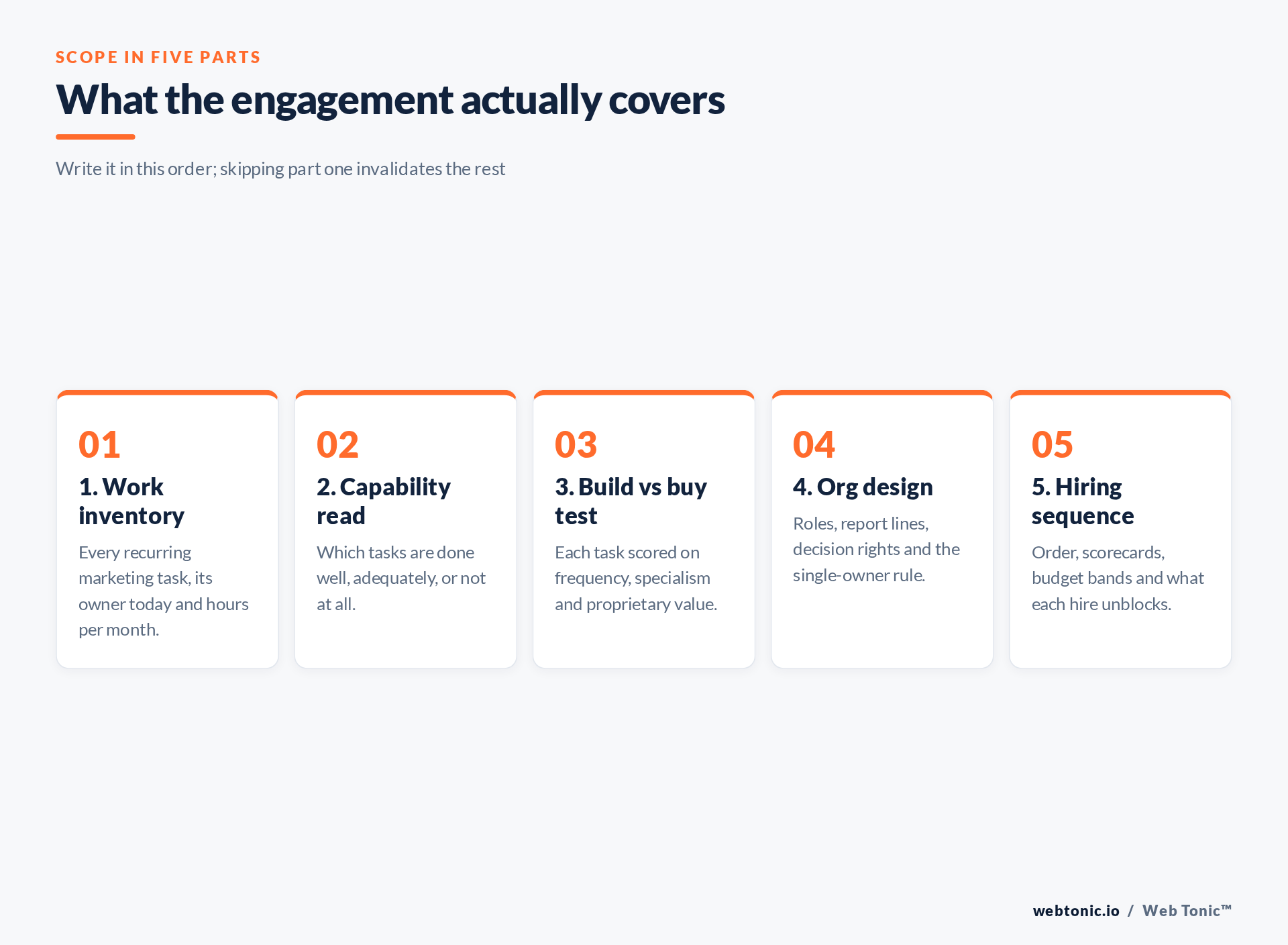
Quick answer: Scope a marketing team structure engagement in five parts: inventory every recurring task with hours, judge current capability, run each task through an in-house versus agency test, design roles and decision rights, then sequence the hires.
Last verified: 2026-09-09
Start from the work, not the org chart
Most structure conversations open with boxes and titles, which is why they end in a hiring plan the company cannot absorb. Start instead with an inventory: every recurring marketing task, who does it today, roughly how many hours a month it takes, and what breaks if it stops. Two or three days of interviews plus a look at the actual calendars produces a list that is usually longer than anyone expected and heavily concentrated in one or two people.
The inventory is the deliverable that makes everything else arguable in a good way. Once the hours are visible, "we need a growth marketer" becomes "eleven hours a month of paid media reporting sits with the founder", which is a very different problem with a very different fix. Formal marketing planning only becomes useful after this step.
Score capability honestly before deciding anything
Mark each task done well, done adequately, or not done. Evidence, not vibes: is there a measured result, a documented process, a person who could hand it over? Tasks marked "not done" split into two piles — genuinely unnecessary, and quietly load-bearing. The second pile is where most of the value in the engagement sits, because nobody has been accountable for it long enough to notice.
Watch for the two structural failures that appear in almost every audit. First, measurement with no owner, which means every number is contestable; remediation patterns live under conversion tracking and analytics. Second, a senior person doing junior work because delegating it would take a week they never have.
Run the in-house versus agency test per task
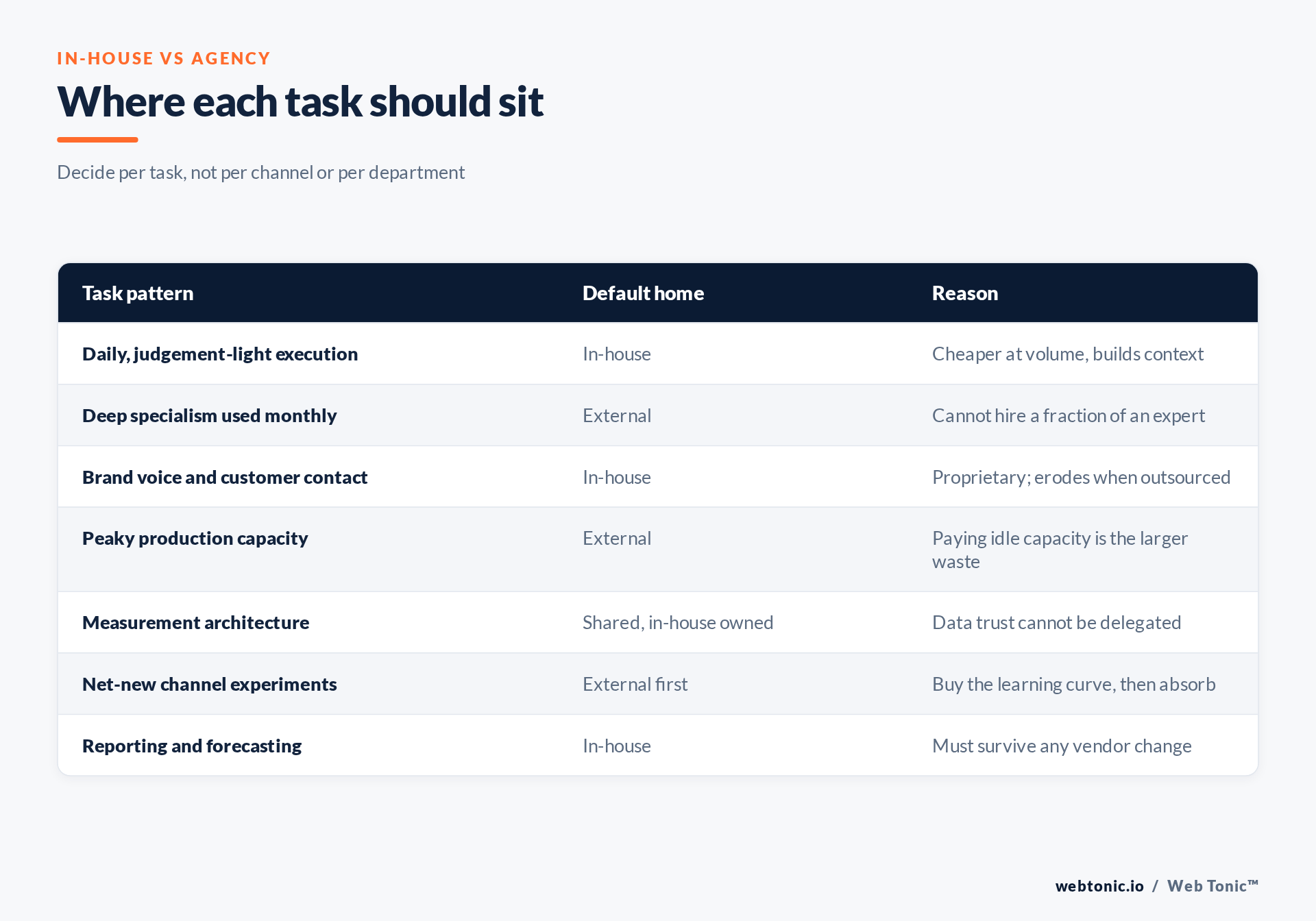
Do not decide by channel. Decide per task, on three questions: how often is it needed, how much scarce specialism does it require, and does doing it in-house build something proprietary. Daily judgement-light execution belongs inside. A specialism used a few days a month cannot be hired as a fraction of a person and belongs outside. Brand voice and direct customer contact belong inside, because customer understanding degrades fastest when it is outsourced.
Two rules keep the answer stable. Measurement architecture is always owned in-house even if built with help — the company must be able to change vendor without losing its numbers. And net-new channels are worth buying first: an external team has already paid the learning cost, and the work can be absorbed once it is routine. Where the work is a platform build rather than a channel, the same test applies to web development.
Design roles around outcomes and single owners
Each outcome gets exactly one owner. Shared ownership of a number is the most reliable way to make it nobody's problem, and it shows up later as two dashboards that disagree. Write, for every role: the outcome it owns, the decisions it can take alone, the decisions it must escalate, and the two or three measures it is judged on — framed as KPIs or, where the company runs them, OKRs.
Keep spans of control small and layers few. A marketing function of eight people does not need a middle tier; it needs clear decision rights and one person who can arbitrate priority conflicts. If the design requires a title nobody can define in a sentence, the design is wrong.
| Scope item | Deliverable | Typical duration |
|---|---|---|
| Work inventory | Task list with owners and monthly hours | 1 week |
| Capability read | Well / adequate / not done, with evidence | Same week |
| Build vs buy | Per-task decision with reasoning | 3 days |
| Org design | Roles, report lines, decision rights | 1 week |
| Hiring sequence | Order, scorecards, budget bands | 1 week |
| Handover | Written plan the CEO can execute alone | 2 days |
Sequence the hires and write the contract carefully
Order matters more than count. The first hire should unblock the largest concentration of hours held by the wrong person, and each subsequent hire should have a named thing it makes possible. Attach a scorecard to every role before posting it: the outcomes, the measures, and what "good" looks like at ninety days. Salary bands come from published survey data for the market, not from the last CV that landed.
Then write the engagement scope so it cannot drift. What is included, what is explicitly excluded, who provides which data, the decision rights of the adviser versus the company, and the end state. Use the discipline of a proper statement of work: named deliverables, named dates, named acceptance. Advisory engagements that end without a written plan the client can execute alone have not finished. Note also that hiring content carries legal constraints — the EEOC's list of prohibited employment practices is the reference to check job descriptions against before they go live.
What goes wrong
The failure mode: the engagement produces an aspirational org chart for a company twice the size, with six roles nobody has budget for. It gets admired, filed, and quietly ignored while the same two people keep doing everything. The fix is to design the structure that is affordable now and show the trigger — a revenue level, a volume level — at which each later role becomes justified.
Second failure mode: deciding in-house versus agency at the department level. "We're bringing marketing in-house" bundles a hundred tasks with different economics into a single wrong answer, and the specialisms are the ones that get lost. Decide per task, and expect a mixed answer. A marketing hiring plan built on a mixed model is normal, not indecisive.
Third: hiring before the measurement is owned. A new hire whose results cannot be measured is judged on effort within a quarter. More process notes in the help library; the delivery side sits under growth marketing.
Related reading
- EOS / Scorecard & KPI Advisory — How to Scope the Engagement
- AI Marketing Advisory / AI Readiness — How to Scope the Engagement
- Growth Consulting: How to Scope the Engagement
- Marketing Strategy Consulting services at Web Tonic
Frequently Asked Questions
How long does a marketing team structure engagement take?
Four to six weeks for a mid-sized function: a week of inventory and capability work, a week of build-versus-buy decisions, a week of org design and a week on the hiring sequence.
Should we decide in-house versus agency per channel?
No — per task. Frequency, depth of specialism and whether the work builds something proprietary decide it, and the honest answer is almost always a mix.
Who should be involved from the company side?
The CEO or whoever owns the budget, the most senior marketer, the finance lead for bands and payback, and the sales lead where pipeline handoff is in scope.
What should the engagement deliver?
A task inventory with hours, a per-task build-versus-buy decision, an org design with decision rights, and a sequenced hiring plan with scorecards and bands.
Sources: Marketing plan, Voice of the customer, KPI, OKR, Statement of work (Wikipedia); US EEOC prohibited practices; Harvard Law School Forum on Corporate Governance. Verified 2026-09-09.


