Table of contents
The useful Google Ads examples are not the prettiest ads — they are the ones whose structure you can copy. This page breaks down what a strong ad looks like in each of Google's ad formats, then shows the copy patterns and benchmarks behind them.
Key Takeaways
- 7 ad formats cover almost every Google Ads example you will see: responsive search, dynamic search, Shopping, responsive display, video, Demand Gen and Local Services.
- 15 headlines and 4 descriptions is the asset pool a responsive search ad can draw from, and Google's own guidance is to make them genuinely different rather than 15 near-duplicates.
- $5.42 average cost per click and a 6.64% average click-through rate across 23 categories (LocaliQ search advertising benchmarks) are the numbers any example should be judged against.
- $294.69 billion in advertising revenue reached Google in 2025 (Statista), which is why its ad formats keep multiplying.
- 90 characters per search description and 30 characters per headline force every example into a single claim per line.
- 5 seconds is all a skippable video ad owns before the skip button appears, which is why the best video examples open on the problem, not the logo.
The seven ad formats, and what a good example looks like in each
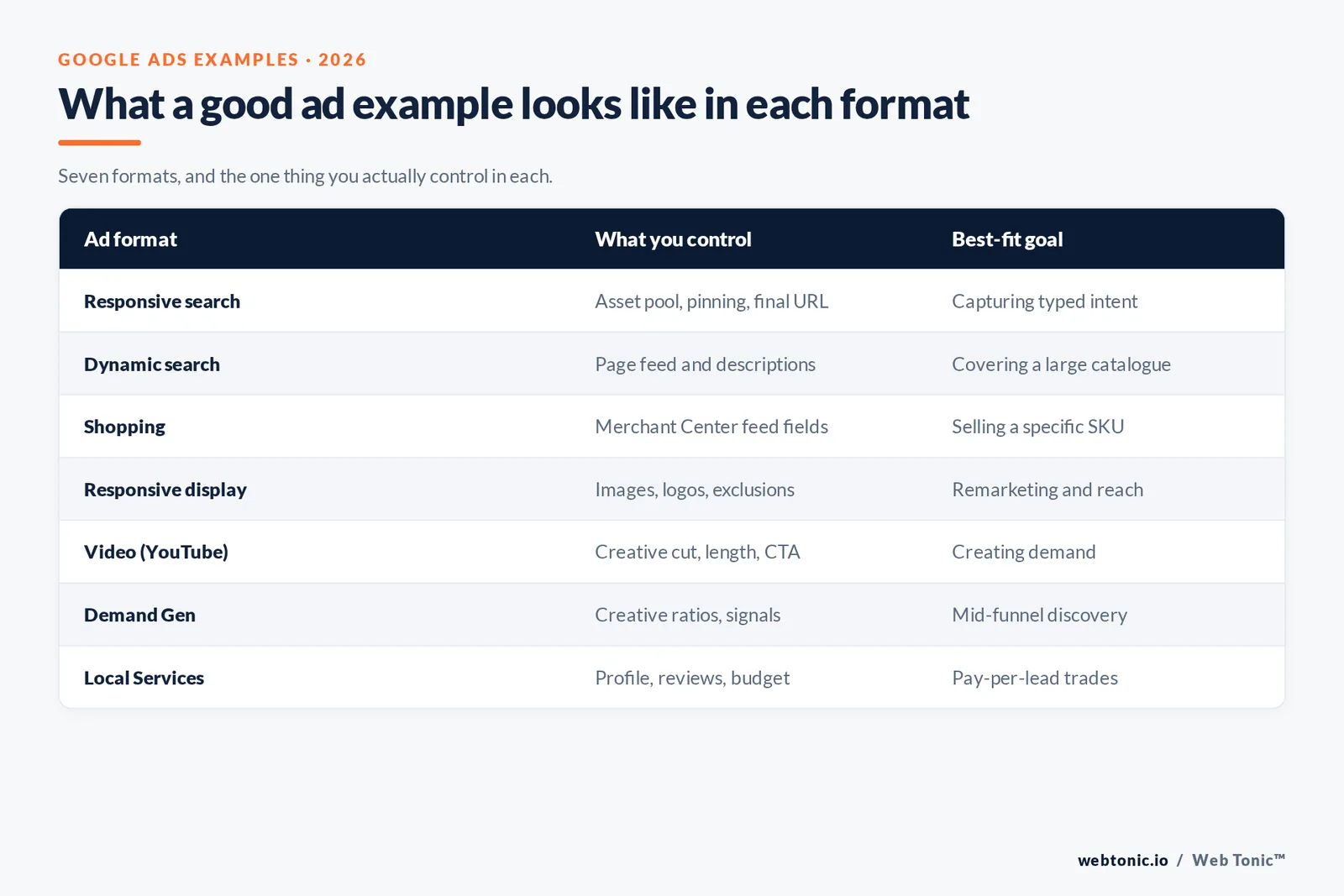
Every Google Ads example belongs to a format, and the format dictates what you are even allowed to control. In a search ad you control words; in a Shopping ad you control feed data; in a video ad you control the first frame. Google's text ad documentation and its video ad format reference are the two places where those limits are set out plainly.
| Ad format | What the example looks like on screen | What you actually control | Best-fit goal |
|---|---|---|---|
| Responsive search ad | 3 headlines, 2 descriptions, sitelinks, callouts | Asset pool, pinning, final URL | Capturing typed intent |
| Dynamic search ad | Auto-generated headline pulled from your page | Page feed, description, exclusions | Covering a large catalogue of pages |
| Shopping ad | Product image, price, title, merchant name | Merchant Center feed fields | Selling a specific SKU |
| Responsive display ad | Image plus short headline on partner sites | Images, logos, headlines, exclusions | Remarketing and cheap reach |
| Video ad | Skippable in-stream, in-feed, bumper or Shorts | Creative cut, length, CTA overlay | Creating demand and recall |
| Demand Gen ad | Feed-style image or vertical video in Discover, Gmail, YouTube | Creative ratios, audience signals | Mid-funnel discovery |
| Local Services ad | Business name, rating, phone, Google Screened badge | Profile, reviews, job types, budget | Pay-per-lead for licensed trades |
Rule 1 — judge an example against its own format. A display ad with a 0.5% click-through rate can be profitable; a brand search ad with the same rate is broken. Trap 1 — 1 benchmark applied across all formats is the fastest way to kill a campaign that was working.
Responsive search ad examples: the copy patterns that repeat
Search is still where most budget lands, and Statcounter's market share data explains why — Google handles close to nine in ten global search referrals. A responsive search ad assembles up to three headlines and two descriptions from your pool at auction time, so the job is to write assets that read well in any combination. Google's best practices for responsive search ads push the same point: distinct angles beat polished repetition.
Rule 2 — 30 characters per headline and 90 per description means one idea per asset. Rule 3 — 8 to 12 headlines covering at least four different angles (offer, proof, objection, location) is the practical target before you fill all 15 slots.
| Headline pattern | Example asset | Why it earns the click | Angle it covers |
|---|---|---|---|
| Keyword + qualifier | Emergency Plumber - 24/7 | Matches the query and answers availability in 5 words | Relevance |
| Price anchor | Plans From $29/Month | Filters out unqualified clicks you pay for anyway | Offer |
| Social proof | Trusted By 4,000+ Clinics | A verifiable number outperforms an adjective | Proof |
| Objection killer | No Contract, Cancel Anytime | Removes the reason people bounce off the page | Risk |
| Speed claim | Same-Day Install In Austin | Combines urgency with geography | Location |
| Comparison | Cheaper Than Legacy Suites | Frames the alternative instead of ignoring it | Positioning |
| Direct CTA | Get A Free Quote Today | Tells the searcher what happens next | Action |
| Dynamic insertion | {KeyWord:Running Shoes} Sale | Mirrors the query where inventory genuinely matches | Relevance |
That last pattern uses keyword insertion, which is powerful and dangerous in equal measure: it will happily insert a competitor's brand name if that term is in your ad group. Trap 2 — 0 review of what insertion actually produced is a compliance risk as much as a performance one, and the FTC's guidance on advertising disclosures is a good reminder that the words in a paid unit are your responsibility.
What the numbers say a "good" example is
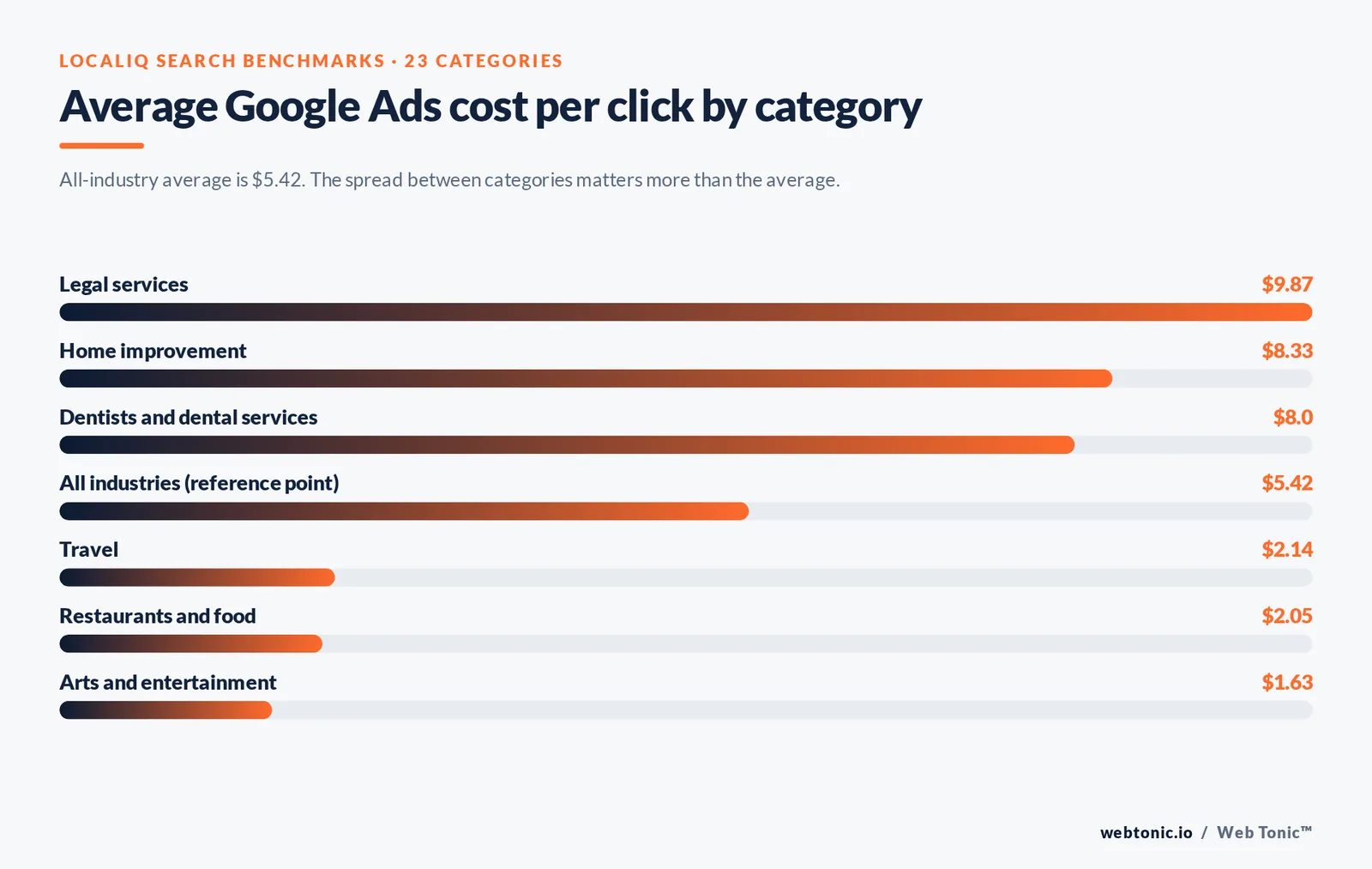
Benchmarks turn opinion into a decision. Across 23 categories, LocaliQ's search advertising benchmarks put the all-industry average cost per click at $5.42, click-through rate at 6.64%, conversion rate at 8.18% and cost per lead at $66.69. The spread between categories matters more than the average.
| Category | Average CPC | What that means for your ad copy | Copy priority |
|---|---|---|---|
| Legal services | $9.87 | Every click is expensive, so pre-qualify hard in the headline | Qualification |
| Home improvement | $8.33 | Service area and speed decide the click | Location and urgency |
| Dentists and dental services | $8.00 | Insurance and new-patient offers do the filtering | Offer clarity |
| All industries | $5.42 | The reference point for a first campaign | Balanced pool |
| Travel | $2.14 | Volume is cheap, so test more angles per ad group | Breadth |
| Restaurants and food | $2.05 | Proximity beats persuasion | Local signals |
| Arts and entertainment | $1.63 | Cheap clicks hide weak intent — watch conversion rate | Intent filtering |
Rule 4 — 8.18% conversion rate is the line where a landing page stops being the problem. If your ads beat the CTR benchmark but the conversion rate sits at 2%, the example you should be copying is a landing page, not an ad. That is usually where our performance creative team starts.
Shopping ad examples: the feed is the creative
A Shopping ad has no headline you can write. As Google's own breakdown of what makes up a Shopping ad shows, the unit is assembled from feed fields, so optimising a Shopping "example" means optimising the product data specification.
| Feed field | Weak example | Strong example | Why the strong version wins |
|---|---|---|---|
| Product title | Blue Jacket | Patagonia Torrentshell 3L Rain Jacket - Men's Blue, L | Brand, model, attribute and size all become matchable text |
| Main image | Lifestyle shot with 3 models | Single product on white, fills 80% of frame | Thumbnails are ~200px wide; clutter reads as noise |
| Price | Feed price out of sync | Price matches landing page to the cent | Mismatches cause disapprovals, not just distrust |
| GTIN | Missing | Valid 13-digit GTIN per variant | Unlocks comparison surfaces and better matching |
| Product type | 1 flat category | 4-level hierarchy you control | Lets you bid by category without restructuring |
| Custom labels | Unused | Margin band, season, bestseller flag | Turns 5,000 SKUs into 6 manageable groups |
Trap 3 — 1 word titles like "Sneakers" lose to competitors who describe the same product in 12 words. Rule 5 — 150 characters is the title limit, but the first 70 are what shoppers read.
Display, video and Demand Gen examples
The Google Display Network reaches sites and apps rather than searchers, so a display example is judged on cost per incremental visit, not click-through rate. Video ads live on YouTube in a fixed set of slots, and YouTube's advertising format reference lists what each one demands from the creative.
| Format | Length or size | Example that works | Metric to judge it on |
|---|---|---|---|
| Skippable in-stream | 15-60 seconds | Problem stated in the first 5 seconds, product at 8s | View-through rate and cost per view |
| Bumper | 6 seconds | One claim, one logo, no voiceover needed | Reach and frequency |
| In-feed video | Thumbnail plus title | Face-forward thumbnail with a 5-word question | Earned views |
| Shorts / vertical | 9:16, under 30s | Captioned demo shot on a phone | Cost per conversion |
| Responsive display | 1200x628 plus 1200x1200 | Product on brand colour, 4-word headline | Cost per incremental session |
| Demand Gen image | 3 ratios minimum | Editorial-style image that survives a Discover feed | Conversion rate by placement |
Rule 6 — 3 aspect ratios per Demand Gen campaign, because a single landscape asset simply will not serve in vertical inventory. Trap 4 — 0 placement exclusions on a new Display campaign is how mobile game apps absorb a test budget. Google's audience segment documentation is worth reading before you build these, because on non-search surfaces the audience is the targeting.
Ad extensions: the free real estate most examples waste
Assets shown alongside the ad text often decide the click, and they cost nothing to add. Google's guidance on reaching the top ad positions ties eligibility to Ad Rank, which is influenced by expected impact of these assets as well as by bid.
| Asset type | Example | Job it does | Minimum to add |
|---|---|---|---|
| Sitelinks | Pricing · Case Studies · Free Trial · Contact | Sends different intents to different pages | 4 links |
| Callouts | Free Shipping Over $50 | Adds non-clickable proof points | 4 callouts |
| Structured snippets | Services: Audit, Migration, Support | Lists coverage without burning a headline | 3 values |
| Call asset | Tap to call, 8am-8pm | Converts mobile intent instantly | 1 tracked number |
| Lead form | Get a quote in 30 seconds | Captures leads for slow mobile sites | 1 form, CRM-synced |
| Image asset | Square product shot beside the text ad | Lifts CTR on visual categories | 2 images |
| Price asset | 3 tiers from $29 to $199 | Pre-qualifies the click | 3 tiers |
Google Ads examples by business type and goal
The same ad copy example fails or works depending on who runs it. A local service business and an ecommerce brand are buying different things from the same auction: one wants a phone call inside its service radius, the other wants a specific product sold at a margin. Mapping the example to the business model first removes most of the guesswork about which formats and campaigns to build.
| Business type | Campaign example to build first | Example headline or asset | Metric that decides it |
|---|---|---|---|
| Local service business | Local Services Ads plus branded search | Licensed Roofers - Free Roof Check | Cost per booked job |
| Ecommerce store | Shopping ads, then Performance Max | Feed title with brand, model and size | Return on ad spend by product |
| B2B software | Search on problem keywords | Replace 3 Spreadsheets - Free Trial | Cost per qualified demo |
| Mobile app | App campaign with 4 video cuts | 15-second gameplay or feature demo | Cost per in-app event |
| New consumer brand | Video ads for brand awareness | 6-second bumper with 1 claim | Reach and lifted brand search volume |
| Clinic or practice | Search with call and location assets | Same-Week Appointments Near You | Cost per call over 60 seconds |
| Marketplace | Dynamic search ads over category pages | Auto-generated headline from the landing page | Cost per click against margin per order |
| Course or info product | Demand Gen with vertical video | Free lesson offer with social proof overlay | Cost per free signup |
Rule 8 — 1 primary conversion action per business, chosen before any ad is written, and every example judged against that action. Trap 5 — 4 goals at once in one account splits the conversion data so thinly that Smart Bidding never leaves its learning period.
Automated formats: Performance Max, dynamic search and Local Services examples
Three formats generate most of their own creative, which changes what an example even means. A Performance Max asset group is an example of an asset library rather than of a single ad: Google assembles text, image and video into search, Shopping, YouTube, Display, Discover and Gmail placements and reports on the outcome. Dynamic search ads write their own headline from the landing page content, so the page becomes the copy. Local Services Ads show your business name, review rating and a verification badge, and bill per lead rather than per click.
| Automated format | What you feed it | What users actually see | Most common failure |
|---|---|---|---|
| Performance Max | 5 headlines, 5 images, 1+ video, product feed, audience signals | A different assembly on each of 6+ surfaces | Brand traffic absorbed and reported as new demand |
| Dynamic search ads | A page feed and 2 descriptions | A headline lifted from your own page copy | Thin or outdated pages generating odd headlines |
| Local Services Ads | Licence, insurance, reviews, job types, weekly budget | Name, star rating, phone and Google Screened badge | Unreviewed leads billed at full price |
| Responsive display | 3+ images, 5 headlines, 1 logo | Auto-resized units across millions of sites and apps | No placement exclusions on app inventory |
| Demand Gen | Vertical, square and landscape creative | Feed-native units in Discover, Gmail and YouTube | A single landscape asset that cannot serve |
Rule 9 — 2 to 3 asset groups per Performance Max campaign, themed by product category or audience, rather than one group carrying everything. Rule 10 — 6 weeks before judging an automated format in an account below 30 conversions per month. Keeping a separate brand search campaign alive is the only reliable way to read whether automation found new customers or repackaged existing ones.
Five traps that make bad Google Ads examples look good
A screenshot in a listicle tells you nothing about whether the ad made money. Before you copy an example, check it against the mechanics — Quality Score components and conversion tracking setup explain most of the gap between a pretty ad and a profitable one.
| Trap | What it looks like | What it costs | Fix |
|---|---|---|---|
| Trap A: brand-only screenshots | A famous brand's search ad held up as a model | Brand CTR of 20%+ is unreachable for non-brand terms | Compare non-brand ads only |
| Trap B: no conversion tracking | Clicks reported, revenue not | 100% of optimisation runs on the wrong signal | Verify tags before scaling spend |
| Trap C: 15 identical headlines | A full asset pool with 1 real idea | Automation has nothing to test | 4+ distinct angles per ad |
| Trap D: page mismatch | Ad promises a price the page hides | Bounce rate up, Quality Score down | Mirror the ad's promise above the fold |
| Trap E: judged in week 1 | Pausing an ad after 40 clicks | Random noise read as a verdict | Wait for 100 clicks or 30 conversions |
How to build your own example set in 6 steps
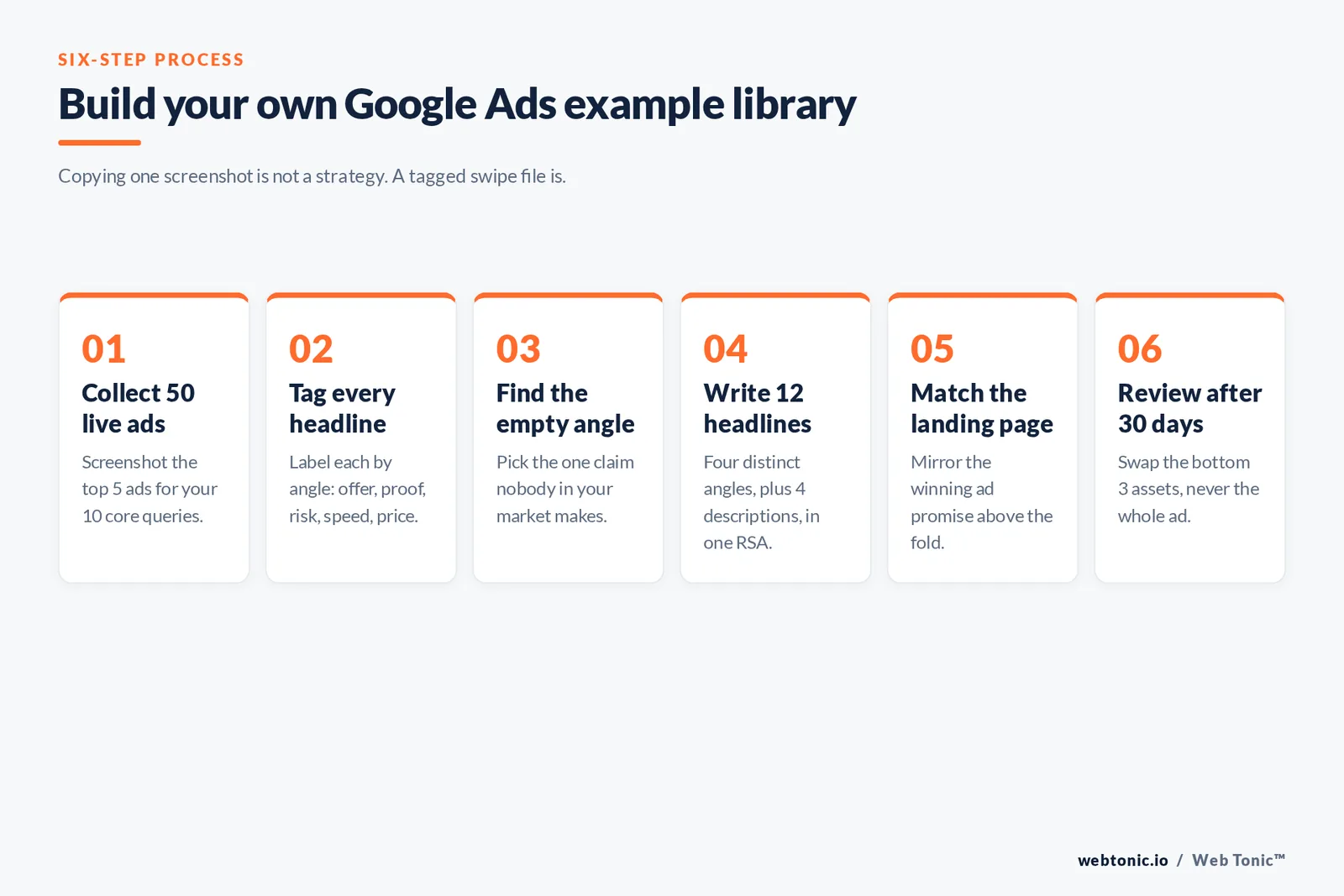
Copying a screenshot is not a strategy. Building a reusable pattern library is. Google's best practices hub and its cost and bidding overview are the reference points; the process below is what we run for clients inside growth marketing engagements.
| Step | Action | Output | Time |
|---|---|---|---|
| Step 1 | Screenshot the top 5 ads for your 10 core queries | A 50-ad swipe file | 2 hours |
| Step 2 | Tag every headline by angle: offer, proof, risk, speed, price | Angle frequency count | 1 hour |
| Step 3 | Find the angle nobody in your market uses | 1 differentiated claim | 30 minutes |
| Step 4 | Write 12 headlines and 4 descriptions across 4 angles | 1 complete RSA | 90 minutes |
| Step 5 | Match the landing page headline to the winning ad promise | Aligned page | 2 hours |
| Step 6 | Review asset ratings and search terms after 30 days | Replace the bottom 3 assets | 1 hour monthly |
Rule 7 — 30 days or 100 clicks before the first asset swap, and 3 assets replaced per round rather than a full rewrite, so you can still read what changed. Attribution questions that survive this loop usually belong with data intelligence rather than with copywriting. Think with Google's search strategy library is a decent source of category-level creative research once the basics are in place.

FAQ
What is the best example of a Google ad?
There is no single best example, because each format is judged differently. The most useful models are non-brand responsive search ads that beat the 6.64% average click-through rate while holding conversion rate near or above 8.18%. An ad that wins clicks and loses conversions is a bad example dressed up as a good one.
How many headlines should a Google search ad have?
A responsive search ad accepts up to 15 headlines and 4 descriptions. Aim for 8 to 12 headlines across at least four distinct angles before filling every slot, because near-duplicate assets give the system nothing to optimise between.
Where can I see real Google Ads examples for free?
The Google Ads Transparency Center shows ads currently running by advertiser, and a plain search for your core keywords shows the live auction. Both beat curated listicles, because you see the ads competitors are paying to keep running today rather than a screenshot from three years ago.
Do Google Shopping ads use ad copy?
No. Shopping ads are built from Merchant Center feed fields — title, image, price, availability — so improving a Shopping ad means editing the feed. The first 70 characters of the product title carry most of the weight.
How long before a new ad shows reliable results?
Give a new ad 30 days or roughly 100 clicks, whichever comes first, before drawing conclusions. Campaigns using automated bidding also need a learning window; below 30 conversions a month, weekly changes usually add noise rather than insight.
Sources
Google Ads Help — about text ads, responsive search ads best practices, video ad formats, Display Network, audience segments, Quality Score, conversion tracking, keyword insertion, top ad positions, Shopping ad composition, best practices hub · Google Merchant Center product data specification · YouTube Help advertising formats · LocaliQ search advertising benchmarks (23 categories) · Statcounter global search engine market share · Think with Google search strategy library · US Federal Trade Commission advertising disclosure guidance · Google Ads pricing overview. Figures checked August 2026.