Table of contents
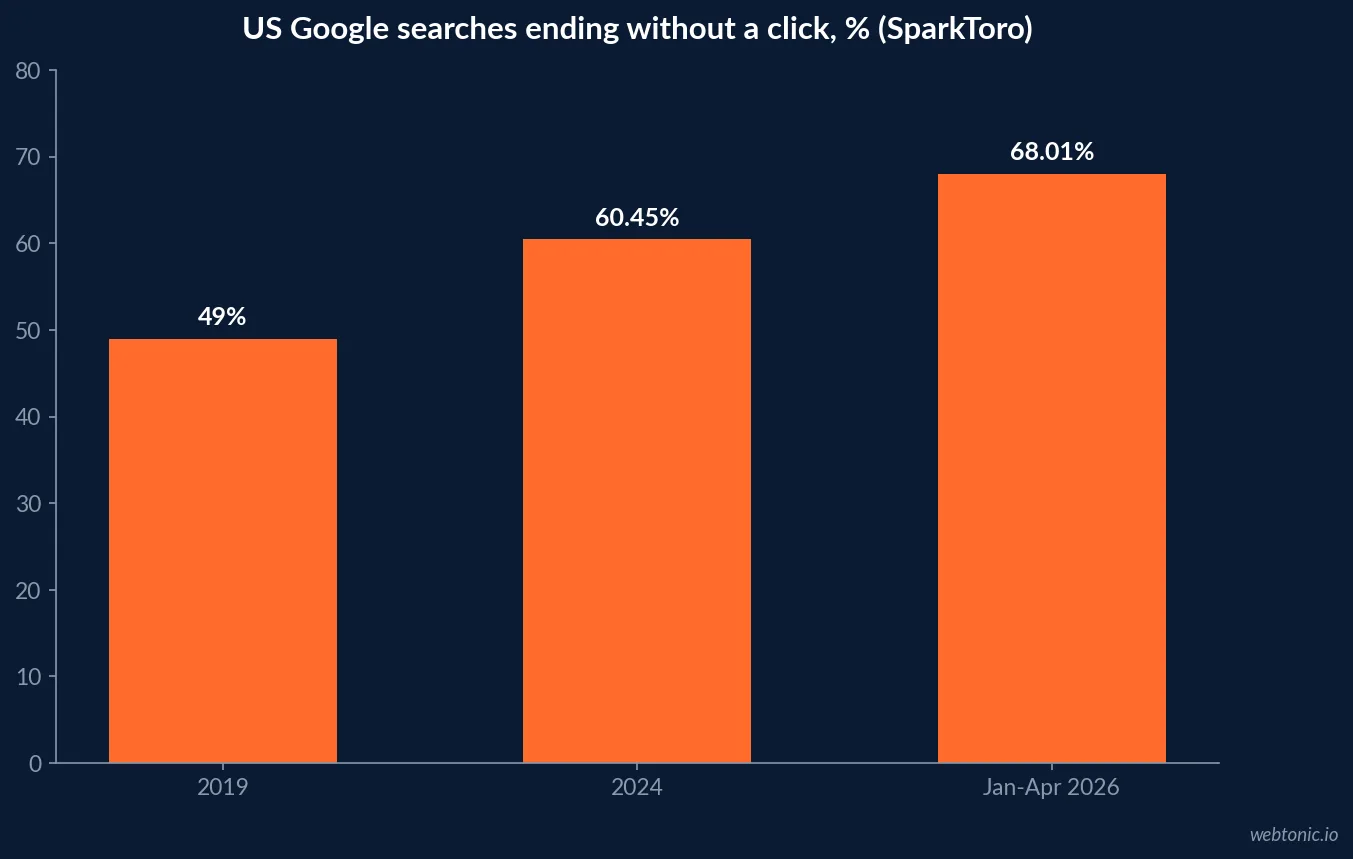
Between 2024 and 2026 the share of Google searches ending without a click rose from 60.45% to 68.01%, AI Overviews spread to roughly half of tracked queries, and the click loss they correlate with grew from 34.5% to 58%. This page tracks each shift with a before-and-after pair from the same issuer, starting with SparkToro's 2026 zero-click study.
Key Takeaways
- US zero-click Google searches: 60.45% in 2024, 68.01% in Jan-Apr 2026 (SparkToro).
- That is a rise of 7.5 percentage points in two years (2024 on the Datos panel, 2026 on Similarweb's, so read it as directional).
- AI Overview presence grew from about 30% to 48% of BrightEdge-tracked queries, a 58% increase.
- Only about 17% of sources cited in AI Overviews also rank in the organic top 10 (BrightEdge).
- Top-result CTR gap with an AI Overview: -34.5% in April 2025, about -58% on December 2025 data (Ahrefs).
- ChatGPT share of AI chatbot referrals fell from 84.21% to 76.85% between April 2025 and April 2026 (Statcounter).
- Gemini's referral share rose from 2.31% to 9% over the same twelve months.
- Google says AI Overviews has over 2.5 billion monthly active users (I/O 2026).
- Enterprises gave AEO 12% of digital budgets in 2025; 94% plan to increase in 2026 (Conductor).
The two-year scorecard
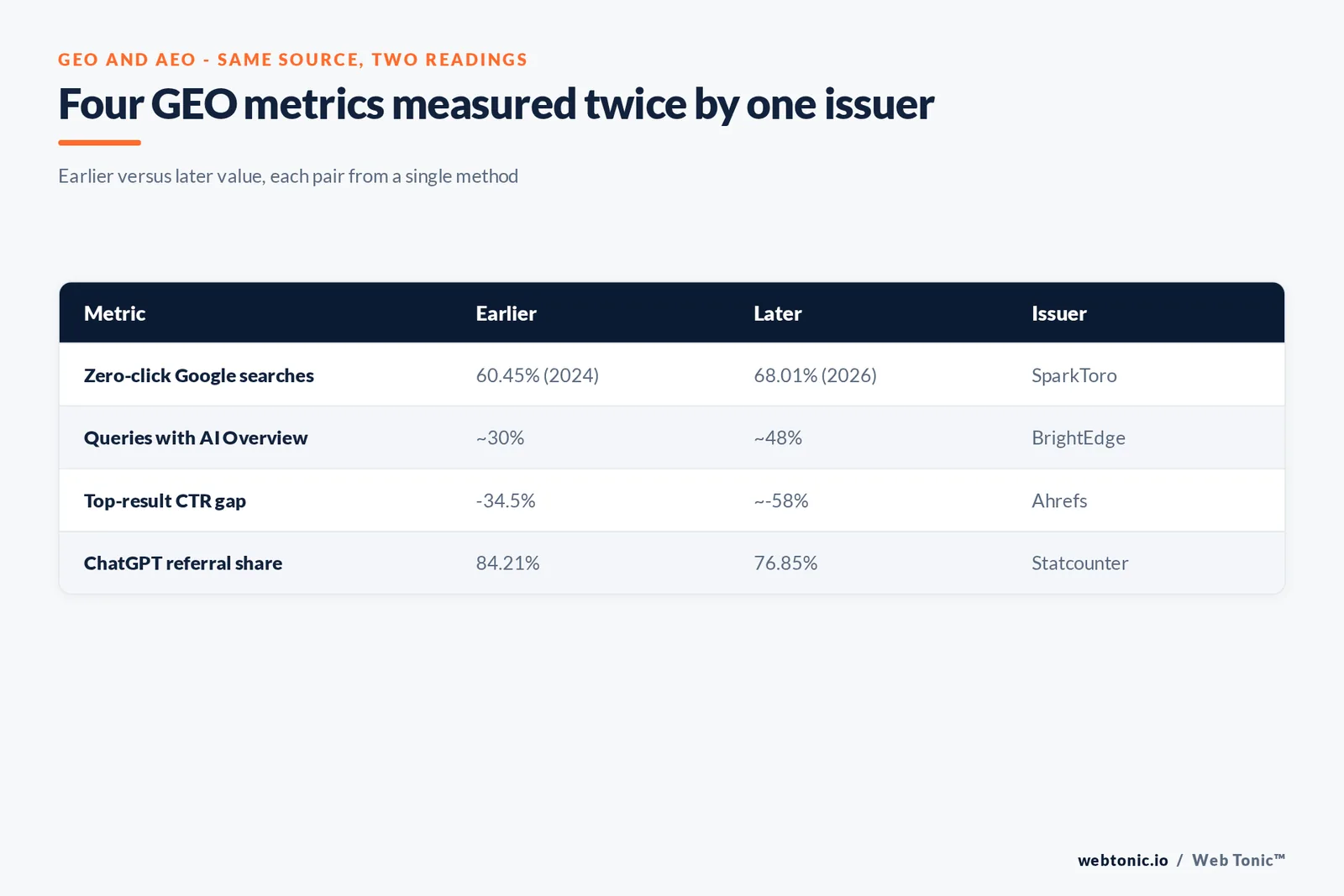
Every row below pairs an earlier and a later reading taken by the same organisation; where the underlying panel changed, the Issuer column says so. That matters: most GEO numbers circulating online compare one vendor's 2024 figure with another vendor's 2026 figure, which turns method differences into fake trends. If no same-source earlier value exists, the row says so.
| Metric | Earlier value | Later value | Change | Issuer |
|---|---|---|---|---|
| US Google searches ending without a click | 60.45% (2024) | 68.01% (Jan-Apr 2026) | +7.5 pts | SparkToro (Datos 2024 / Similarweb 2026 panels) |
| Queries showing an AI Overview | ~30% | ~48% | +58% | BrightEdge, one-year tracking |
| Top-result CTR gap with AI Overview | -34.5% (Apr 2025) | ~-58% (Dec 2025 data) | Gap widened | Ahrefs |
| ChatGPT share of AI chatbot referrals | 84.21% (Apr 2025) | 76.85% (Apr 2026) | -7.4 pts | Statcounter |
| Gemini share of AI chatbot referrals | 2.31% (Apr 2025) | 9% (Apr 2026) | +6.7 pts | Statcounter |
Zero-click: 49% in 2019, 68% in 2026
SparkToro first published zero-click research in 2019, when 49% of Google searches ended without a click. Its June 2026 update, built on Similarweb's mobile and desktop clickstream panel (its 2024 figure came from Datos), says that in the first four months of 2026 "a whopping 68.01% of Google searches ended without a click", against 60.45% in 2024. SparkToro describes that as 12.5% growth, or 7.5 percentage points, and "the fastest acceleration of this phenomenon in the last decade", which it attributes largely to AI Overviews, now found on 20%+ of all searches.
A caution on comparisons: SparkToro and Datos also published a separate 2024 study that reported 58.5% US zero-click. That earlier study was a different cut of Datos data, so it is not the baseline for the 2026 figure. Quote 60.45% to 68.01% as SparkToro's own pairing, read as directional because the two years come from different panels.
AI Overview footprint, then and now
BrightEdge tracked AI Overview presence across its query set for a full year and reports it grew from "roughly 30% to 48% of tracked queries over the past year - a 58% increase". When an overview appears it now averages over 1,200 pixels tall, enough to push organic results below the fold on a standard screen. The second half of the finding is the GEO one: only about 17% of sources cited in AIOs also rank in the organic top 10, which BrightEdge rephrases as 5 out of 6 citations coming from pages that are not on page one. The overlap varies from 24% in healthcare to 11% in finance.
Google's own scale figures moved in the same direction. At I/O 2026, Sundar Pichai said "AI Overviews now has over 2.5 billion monthly active users" and that AI Mode surpassed 1 billion monthly active users in about a year. Those are company-reported user counts, not query shares.
| Footprint measure | Value | Period | Issuer |
|---|---|---|---|
| AI Overview presence, start of tracking | ~30% of tracked queries | One year earlier | BrightEdge |
| AI Overview presence, latest | ~48% of tracked queries | One year later | BrightEdge |
| Citations also in organic top 10 | ~17% | Latest | BrightEdge |
| Citation overlap, healthcare vs finance | 24% vs 11% | Latest | BrightEdge |
| AI Overviews monthly active users | 2.5 billion-plus | May 2026 | |
| Searches with an AIO, 21.9M analyzed | 25.11% | 2025-2026 benchmark | Conductor |
The click-through penalty doubled in Ahrefs' re-run
Ahrefs analyzed 300,000 keywords in April 2025 and found that an AI Overview "correlated with a 34.5% lower average clickthrough rate (CTR) for the top-ranking page" compared with similar informational keywords without one. It then re-ran the study using data from December 2025: the presence of an AI Overview now correlates with roughly 58% lower position-one CTR, with actual CTR of about 1.57% against a forecast of about 3.73%. Both readings are correlations, not controlled experiments, but they come from the same method a few months apart.
Pew Research Center adds a user-level snapshot from March 2025: among 900 US adults who shared their browsing, people who saw an AI summary clicked a traditional result on 8% of visits versus 15% without one, and clicked a link inside the summary on 1% of visits. Around 18% of searches that month produced an AI summary. Pew has not yet published a same-panel follow-up, so there is no later Pew value to pair it with.
| Click measure | Earlier | Later | Basis |
|---|---|---|---|
| Top-result CTR gap, AIO vs none (Ahrefs) | -34.5% | ~-58% | 300,000 keywords; Apr 2025 vs Dec 2025 data |
| Position-one CTR with AIO (Ahrefs re-run) | Forecast ~3.73% | Actual ~1.57% | December 2025 data |
| Result clicks with vs without AI summary (Pew) | 15% without | 8% with | March 2025, 900 adults |
| Clicks on links inside the summary (Pew) | Not measured earlier | 1% | March 2025 |
| Session ended after search page (Pew) | 16% without summary | 26% with summary | March 2025 |
Chatbot referrals: one leader, a widening field
Statcounter measures which AI chatbots send visitors to websites. Its May 2026 release reports that ChatGPT's worldwide share fell to 76.85% in April 2026, the lowest on record and down from 84.21% a year earlier. Google Gemini reached 9%, up from 2.31% twelve months before, with Perplexity at 7.73%, Microsoft Copilot at 3.76% and Claude at 2.66%. On Statcounter's US view for September 2026, ChatGPT holds 75.17%, Gemini 13.26% and Copilot 6.64%.
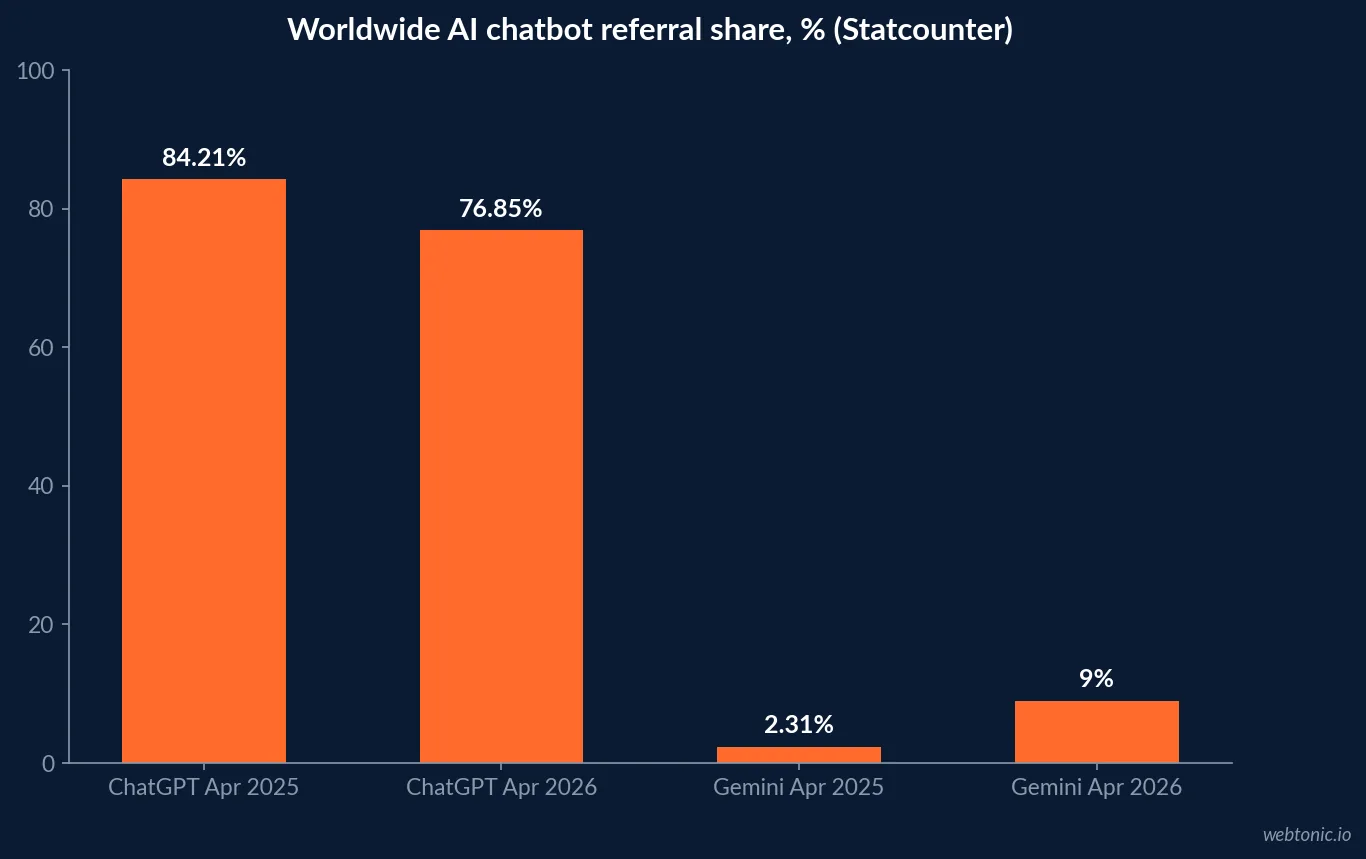
| Chatbot (worldwide referrals) | April 2025 | April 2026 | US, September 2026 |
|---|---|---|---|
| ChatGPT | 84.21% | 76.85% | 75.17% |
| Google Gemini | 2.31% | 9% | 13.26% |
| Perplexity | Not stated | 7.73% | 3.02% |
| Microsoft Copilot | Not stated | 3.76% | 6.64% |
| Claude | Not stated | 2.66% | 1.81% |
How much traffic AI actually sends
Growth rates sound dramatic because the base is small. Conductor's 2026 AEO/GEO benchmarks put AI referral traffic at 1.08% of all website traffic across ten industries, about one visit in a hundred. Information Technology led at 2.80% and Consumer Staples at 1.91%; Communication Services (0.25%) and Utilities (0.35%) were lowest. ChatGPT delivered 87.4% of AI referral traffic in that dataset, which is higher than Statcounter's share because the two count different things: Conductor counts sessions on its customers' sites, Statcounter counts referrals across its tracker network.
Conductor also reports that AI referral traffic increased every month in only 4 of the 10 industries between May and September 2025, so the curve is rising but not smooth.
Commercial queries joined the shift
In 2024 most AI Overview research focused on informational questions. Semrush examined more than 600,000 keywords from its US desktop database between November 2025 and April 2026 and found AI Overviews on commercial-intent results grew 71% on average, while transactional-intent appearances fell 5%. Finance showed the biggest commercial growth, up 231% in six months, and results showing both Google Ads and an AI Overview appeared roughly twice as often as a year earlier.
The research and guidance timeline
The term itself is recent. Aggarwal and colleagues introduced Generative Engine Optimization in a 2023 arXiv paper (later presented at KDD 2024), defining it as a framework to improve content visibility in generative engine responses and reporting that GEO "can boost visibility by up to 40%" on their GEO-bench query set. That is a lab benchmark, not a field traffic figure.
Google's position has stayed consistent. Search Central states there are "no additional requirements to appear in AI Overviews or AI Mode, nor other special optimizations necessary", and that sites do not need new machine readable files, AI text files or markup. In practice, 2024-2026 GEO work has meant classic SEO hygiene plus citation-worthy content, not a separate technical stack.
| Date | Milestone | Issuer |
|---|---|---|
| 2019 | 49% of Google searches end without a click | SparkToro |
| Nov 2023 (paper), KDD 2024 | GEO defined; up to 40% visibility lift on GEO-bench | Aggarwal et al., arXiv 2311.09735 |
| April 2025 | AIO correlates with 34.5% lower top-result CTR | Ahrefs |
| March 2025 | 8% vs 15% result clicks with and without AI summary | Pew Research Center |
| Feb 2026 | AIO CTR gap ~58% on December 2025 data | Ahrefs |
| May 2026 | AI Overviews 2.5 billion-plus monthly users | Google I/O |
| June 2026 | 68.01% zero-click for Jan-Apr 2026 | SparkToro |
Budgets caught up in 2025
Spending data has a shorter history. Conductor's State of AEO/GEO report surveyed enterprise CMOs, VPs and senior directors: enterprises allocated an average of 12% of their digital budgets to AEO in 2025, 56% made a significant or high AEO investment that year, 97% reported a positive impact and 94% plan to increase AEO investment in 2026. There is no same-survey 2024 figure, so this is a first reading rather than a trend line.
What the two-year data implies for planning
- Plan for 68% zero-click as the floor, not the ceiling: measure visibility, not only sessions.
- Track citations separately from rankings, since about 17% of AIO sources overlap the organic top 10.
- Diversify beyond ChatGPT: Gemini's referral share roughly quadrupled from 2.31% to 9% in a year.
- Keep AI referrals in context: 1.08% of traffic is small, so judge them on conversion quality.
- Skip special markup myths: Google says no AI-specific files are required.
Our earlier generative engine optimization statistics page covers the cross-industry snapshot; this page is its time-series companion. For search-side context see the international SEO statistics, and for measurement setup talk to our data intelligence team or growth marketing group.
Frequently Asked Questions
How much did zero-click search grow between 2024 and 2026?
In SparkToro's US clickstream data (Datos panel for 2024, Similarweb for 2026), zero-click Google searches went from 60.45% in 2024 to 68.01% in the first four months of 2026, a rise of 7.5 percentage points. SparkToro calls it the fastest acceleration of the trend in a decade. An earlier, separate SparkToro/Datos 2024 study reported 58.5%; it was a different cut of the data and should not be mixed with the 2026 pair.
Did AI Overviews take more clicks in 2026 than in 2025?
Ahrefs ran the same study twice. In April 2025 an AI Overview correlated with a 34.5% lower click-through rate for the top-ranking page; re-run on December 2025 data and published in February 2026, the gap was about 58%. Both are correlations measured on Ahrefs' own keyword sets.
Is ChatGPT still the main source of AI referral traffic?
Yes, but its lead is shrinking. Statcounter put ChatGPT at 76.85% of worldwide AI chatbot referrals in April 2026, down from 84.21% a year earlier, while Google Gemini rose from 2.31% to 9%. Conductor found ChatGPT delivered 87.4% of AI referral traffic across the ten industries it studied.
Does Google require special markup for AI Overviews?
No. Google Search Central states there are no additional requirements to appear in AI Overviews or AI Mode, nor other special optimizations necessary, and that you do not need new machine readable files, AI text files or markup. Standard SEO fundamentals still apply.
How large is the AI share of website traffic today?
Still small. Conductor's 2026 benchmarks put AI referrals at 1.08% of all website traffic across ten industries, about 1 in 100 visits, with Information Technology highest at 2.80%. Growth is the story, not the current size.
Sources
SparkToro, In 2026, Less than One Third of Google Searches Still Send a Click (June 2026)
BrightEdge, AI Overviews one-year presence, size and citing
Ahrefs, AI Overviews Reduce Clicks by 34.5% (April 2025)
Ahrefs, Update: AI Overviews Reduce Clicks by 58% (2026)
Pew Research Center, AI summaries and clicks (July 2025)
Statcounter press release, AI chatbot referrals (May 2026)
Statcounter, AI Chatbot Market Share, United States
Google, Sundar Pichai I/O 2026 remarks
Conductor, 2026 AEO/GEO Benchmarks Report
Conductor, State of AEO/GEO report
Semrush, AI Overviews commercial search study (2026)
Aggarwal et al., GEO: Generative Engine Optimization, arXiv 2311.09735
Google Search Central, AI features and your website