Table of contents

International SEO in 2026 rests on four measurable facts: Google is not the leading engine everywhere, English is only about half of the indexed web, most hreflang setups carry errors, and shoppers still prefer their own language. This hub collects the cross-industry numbers behind each one, with the issuer and date for every figure.
Key Takeaways
- 67% of hreflang implementations had issues across 374,756 domains (Ahrefs).
- English is 49.5% of websites with a known content language (W3Techs, October 2026).
- Spanish is 6.0% and German 5.9% of the same web sample.
- Yandex holds 70.33% of search in Russia (Statcounter, September 2026).
- Baidu holds 46.65% in China, with Bing at 21.76%.
- Naver holds 43.06% in South Korea against Google at 47.97%.
- Seznam keeps 15.05% in the Czech Republic.
- Google held 86.1% of US search in August 2026.
- 76% of shoppers prefer product information in their language (CSA Research, 2020).
- 40% will never buy from sites in other languages.
- 33% of EU online buyers bought from another EU country in 2024.
What international SEO covers in 2026
Google's multi-regional and multilingual documentation separates two cases. A multilingual site "offers content in more than one language", such as a Canadian business with English and French versions. A multi-regional site "explicitly targets users in different countries", such as a manufacturer that ships to both Canada and the United States. Many sites are both, and each case changes the URL plan, the annotation work and the content budget.
The documentation was last updated on 2025-12-10. It is the primary rulebook this page leans on, and every other figure below is attributed to the organisation that collected it.
| Headline figure | Value | Issuer | Date of the data |
|---|---|---|---|
| Hreflang implementations with issues | 67% | Ahrefs hreflang study | Study of 374,756 domains |
| Websites in English | 49.5% | W3Techs | 1 October 2026 |
| Yandex share of search, Russia | 70.33% | Statcounter | September 2026 |
| Baidu share of search, China | 46.65% | Statcounter | September 2026 |
| Shoppers preferring their own language | 76% | CSA Research | 2020 B2C survey |
| EU online buyers using sellers in other EU countries | 33% | Eurostat via Ecommerce Europe | 2024 |
Search engine share by country
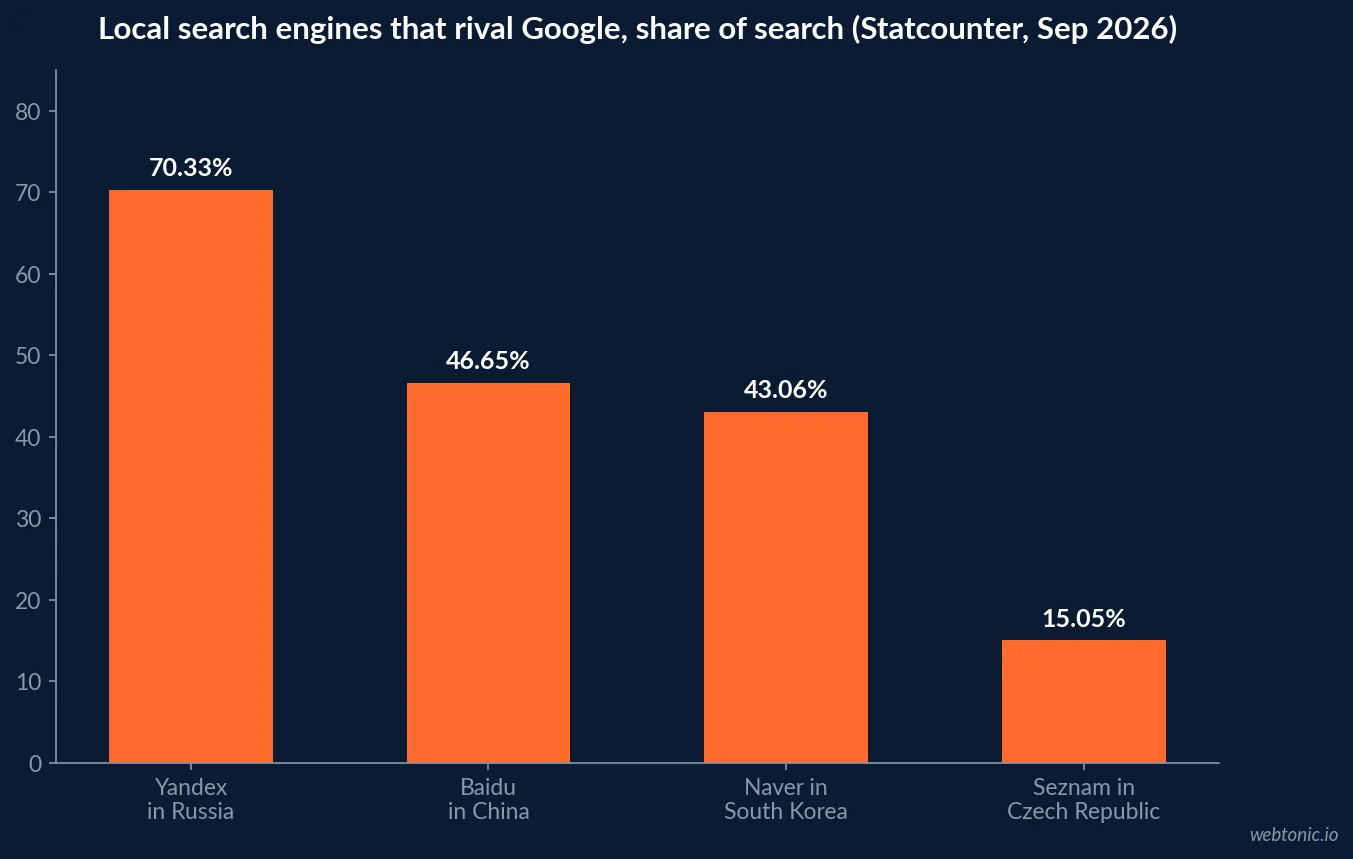
The first planning question is which engine you are optimising for. Statcounter's September 2026 country pages show how far that answer moves. In Russia, Yandex holds 70.33% and Google 28.12%. In China, Baidu leads with 46.65%, followed by Bing at 21.76%, Yandex at 14.98% and Haosou at 12.26%. In South Korea, Google's 47.97% is only a few points ahead of Naver at 43.06%.
Even inside the EU a local engine can matter: Statcounter's Czech data shows Google at 78.71% and Seznam at 15.05%. For comparison, Google held 86.1% of US search in August 2026.
| Country | Leader | Runner-up | What it means for the plan |
|---|---|---|---|
| Russia | Yandex 70.33% | Google 28.12% | Yandex Webmaster tools and Russian-language content first |
| China | Baidu 46.65% | Bing 21.76% | Separate Simplified Chinese site and Baidu requirements |
| South Korea | Google 47.97% | Naver 43.06% | Two engines of near-equal weight |
| Czech Republic | Google 78.71% | Seznam 15.05% | Google first, Seznam as a secondary check |
| United States | Google 86.1% | Bing | August 2026 figure; one engine dominates |
Which languages the web is written in
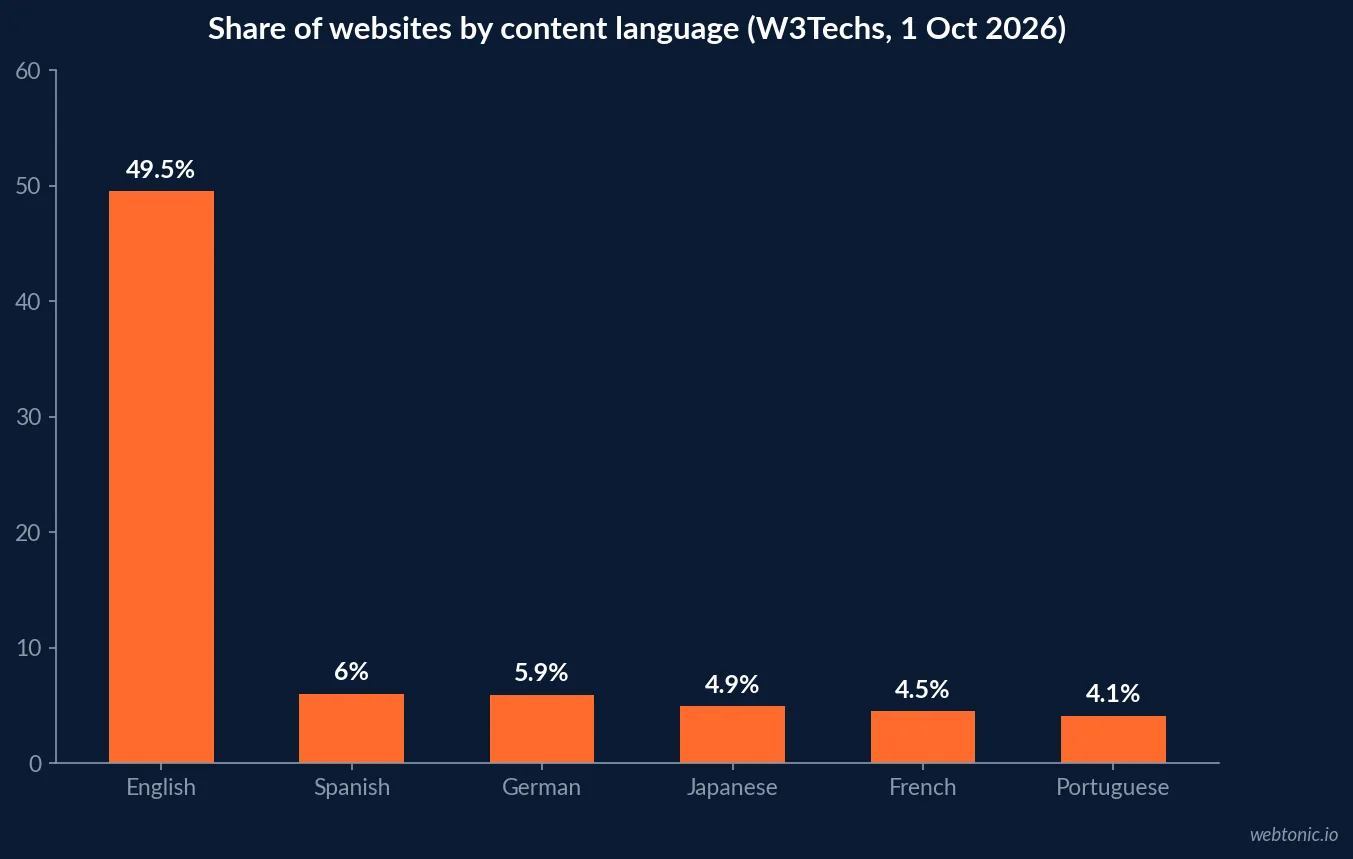
W3Techs measured content languages on 1 October 2026. English is used by 49.5% of websites whose content language it knows. Spanish follows at 6.0%, German at 5.9%, Japanese at 4.9%, French at 4.5%, Portuguese at 4.1% and Russian at 3.4%. Chinese, spoken by far more people than German, appears on only 1.3% of the sample.
The gap cuts both ways. In English, competition for a query is crowded; in a smaller web language the supply of good pages is thinner, which is one reason local-language content can surface quickly. W3Techs measures websites, not searches or buyers, so it describes supply, not demand.
How often hreflang breaks
The Ahrefs hreflang guide reports: "When we ran a study on hreflang across 374,756 domains, we found that 67% of the hreflang implementations had issues." It is the most-cited public error rate for hreflang, and it is the issuer's own figure. A second number sometimes quoted online, a 75% error rate, could not be traced to a primary study and is not used here.
Google's localized-versions page explains why errors are common. Each language version must list itself and every other version, alternate URLs must be fully qualified, and "if two pages don't both point to each other, the tags will be ignored". One missing return link silently disables a pair.
| Google hreflang rule | What the documentation says | Typical failure it prevents |
|---|---|---|
| Self-reference | Each language version must list itself as well as all others | Orphaned alternates |
| Bidirectional links | If two pages don't both point to each other, tags are ignored | One-way annotations |
| Fully qualified URLs | https://example.com/foo, not /foo | Relative URLs being dropped |
| x-default | Fallback for unmatched languages, e.g. language selectors | Users with no matching locale |
| Three equal methods | HTML, HTTP headers or sitemap; no benefit in using all three | Conflicting duplicate sets |
| Language detection | Google does not use hreflang or lang to detect language | Wrong-language pages ranking |
Choosing a URL structure
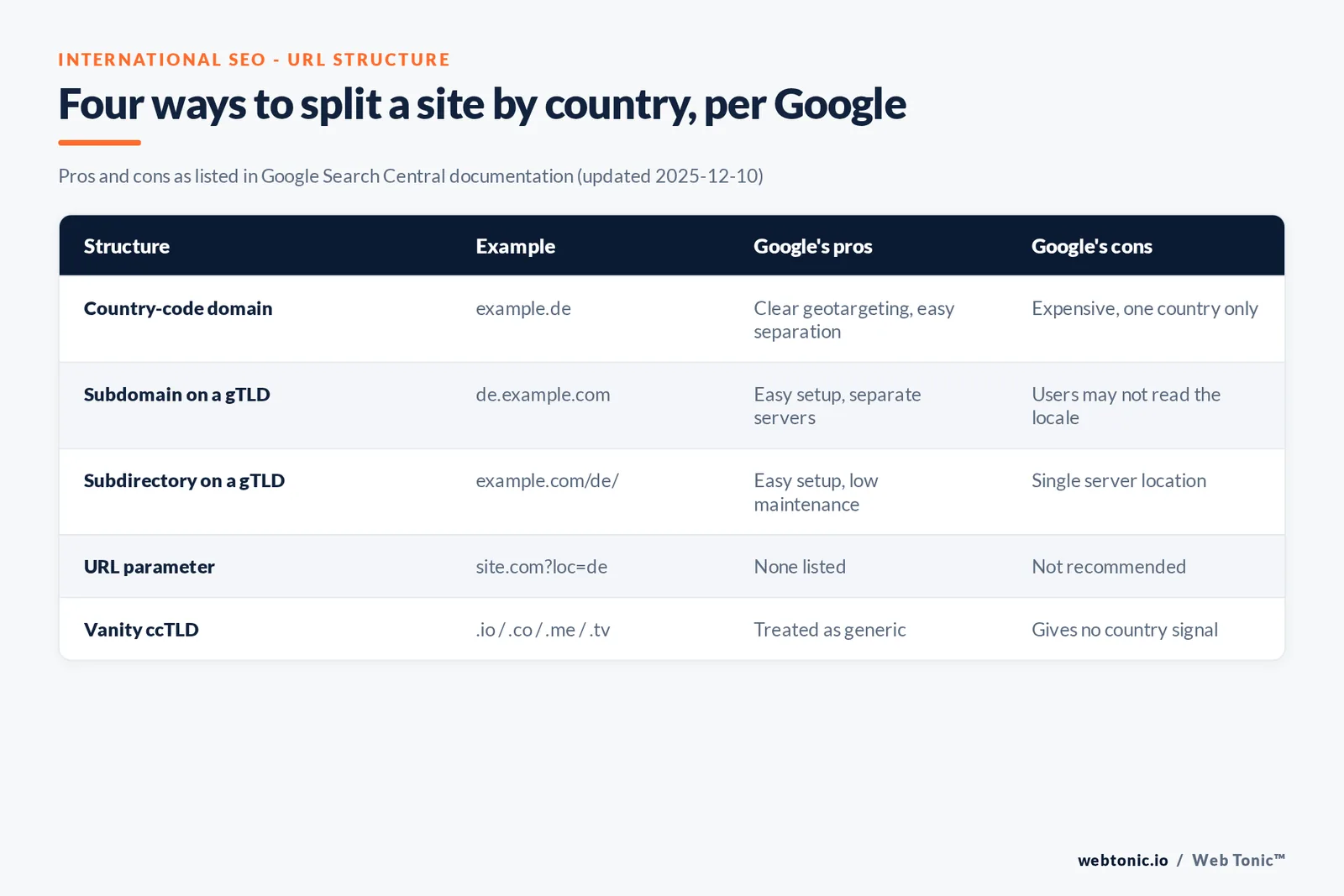
Google's multi-regional page sets out four options. A country-code domain such as example.de gives "clear geotargeting" but is "expensive", needs more infrastructure and "can only target a single country". A subdomain such as de.example.com is easy to set up but users "might not recognize geotargeting from the URL alone". A subdirectory such as example.com/de/ is easy to set up and low maintenance on a single host. URL parameters such as site.com?loc=de are "not recommended".
Google also lists a set of vanity ccTLDs it treats as generic, including .io, .co, .me and .tv, so those domains do not signal a country.
Signals Google uses to pick a locale
The same documentation lists the signals: country-code domains, hreflang statements, server location "(not a definitive signal)" and other signals such as local addresses, phone numbers, local language and currency, links from other local sites and Business Profile signals. It also says Google "ignores locational meta tags (like geo.position or distribution)".
Two warnings matter for most sites. Google advises against redirecting users automatically based on their perceived language, and against using IP analysis to adapt content, because "most, but not all, Google crawls originate from the US".
| Signal | Google's position | Weight in practice |
|---|---|---|
| Country-code top-level domain | Strong signal for one country | Highest, but one market per domain |
| hreflang annotations | Tells Google which pages are alternates | Required for multi-version sites |
| Server location | Not a definitive signal; CDNs blur it | Low |
| Local address, phone, currency | Listed as other signals | Supporting |
| geo.position meta tags | Ignored | None |
Locale-adaptive pages and crawling
Sites that change content by visitor location take a measurable risk. Google's locale-adaptive page says the crawler's default IP addresses "appear to be based in the USA" and that it "sends HTTP requests without setting Accept-Language". Google says it does crawl from IP addresses outside the USA as well, but it still recommends "separate locale URL configurations" annotated with hreflang. Robots rules must be identical in every locale.
Search Console changes for international sites
Search Console Help states that "the International Targeting report has been deprecated" and that country targeting in Search Console "was determined to have little value for the ecosystem, and is no longer supported". Google "will continue to support and use hreflang tags". In practice, the country setting that many teams relied on no longer exists, so URL structure, hreflang and local content now do all of the geotargeting work.
Language preference: the buyer side
CSA Research's Can't Read, Won't Buy B2C study, run with Kantar in 2020, surveyed 8,709 consumers in 29 countries. It found that 76% of online shoppers prefer to buy products with information in their native language and 40% will never buy from websites in other languages. CSA's marketer research page also lists a B2B edition based on 1,116 business buyers in 33 countries.
The data is six years old and was gathered before AI translation became routine, so read it as a stated preference, not a forecast of conversion loss.
Cross-border buying in the EU
Eurostat data republished in the European E-commerce Report 2025 by Ecommerce Europe shows that among people who bought online in the last three months of 2024, 83% bought from national sellers, 33% from sellers in other EU countries and 20% from sellers outside the EU. The spread is wide: Belgium reaches 62% for other EU sellers and Ireland 55%, while Germany sits at 20%.
Eurostat also reports that the share of EU internet users buying online rose from 62% in 2015 to 78% in 2025.
| Country (2024) | From national sellers | From other EU sellers | From non-EU sellers |
|---|---|---|---|
| EU-27 | 83% | 33% | 20% |
| Belgium | 84% | 62% | 16% |
| Ireland | 74% | 55% | 37% |
| Estonia | 89% | 43% | 27% |
| Denmark | 89% | 40% | 16% |
| Germany | 79% | 20% | 12% |
Clicks are shrinking in every language
International traffic sits inside the same click squeeze as domestic search. Ahrefs' AI Overviews update found the top result's click-through rate fell by an estimated 58% on queries with an AI Overview (December 2025 data, published February 2026), after an earlier estimate of 34.5% in April 2025. SparkToro and Datos put US zero-click searches at 58.5% in 2024. These studies are US-weighted; equivalent per-country figures are not published for most markets.
How to use these numbers
- Pick engines before languages. Check Statcounter for each market first.
- Choose one URL pattern and keep it. Subdirectories are the low-maintenance default in Google's table.
- Automate hreflang and audit it. With 67% of setups carrying issues, a crawl after every release is cheap insurance.
- Translate the main content, not only the template. Google treats untranslated main content as duplicates.
- Never auto-redirect by IP or language. Offer a selector and an x-default page.
For how larger organisations staff this work, see our enterprise SEO statistics. Our data intelligence team can map country-level demand before you commit to a market, and you can talk to us about a rollout.
Frequently Asked Questions
What share of hreflang implementations have errors?
Ahrefs reports that when it studied hreflang across 374,756 domains, 67% of the implementations had issues. That is the issuer's own figure from its hreflang guide, not a survey of any single industry, and it counts any issue, from a missing return link to an invalid language code. Treat it as a reason to audit, not as a ranking-loss estimate.
Is Google the dominant search engine in every country?
No. Statcounter's September 2026 data puts Yandex at 70.33% in Russia against 28.12% for Google, Baidu at 46.65% in China, Naver at 43.06% in South Korea next to Google at 47.97%, and Seznam at 15.05% in the Czech Republic. In the US, Google held 86.1% in August 2026. A market plan that assumes Google everywhere misses the first question.
Does Google use the lang attribute to detect page language?
No. Google's localized-versions documentation states that it does not use hreflang or the HTML lang attribute to detect the language of a page and instead uses algorithms. hreflang tells Google which pages are alternates of each other; the visible text decides what language the page is in.
Is the Search Console International Targeting report still available?
No. Google's Search Console Help states that the International Targeting report has been deprecated and that country targeting in Search Console was determined to have little value for the ecosystem. Google says it will continue to support and use hreflang tags, so hreflang, URL structure and local signals now carry the job.
How many online shoppers prefer their own language?
CSA Research's 2020 Can't Read, Won't Buy B2C survey of 8,709 consumers in 29 countries found that 76% of online shoppers prefer to buy products with information in their native language and 40% will never buy from websites in other languages. The study is from 2020 and has not been repeated in public since.
Sources
Google Search Central - Managing multi-regional and multilingual sites
Google Search Central - Localized versions of your pages
Search Console Help - International Targeting report deprecated
Statcounter - Search engine market share, Russia
Statcounter - Search engine market share, China
W3Techs - Content languages for websites
Ahrefs - Hreflang guide and study
CSA Research - Consumers prefer their own language
Ecommerce Europe - European E-commerce Report 2025
Eurostat - E-commerce statistics for individuals
SparkToro - 2024 zero-click search study