Table of contents

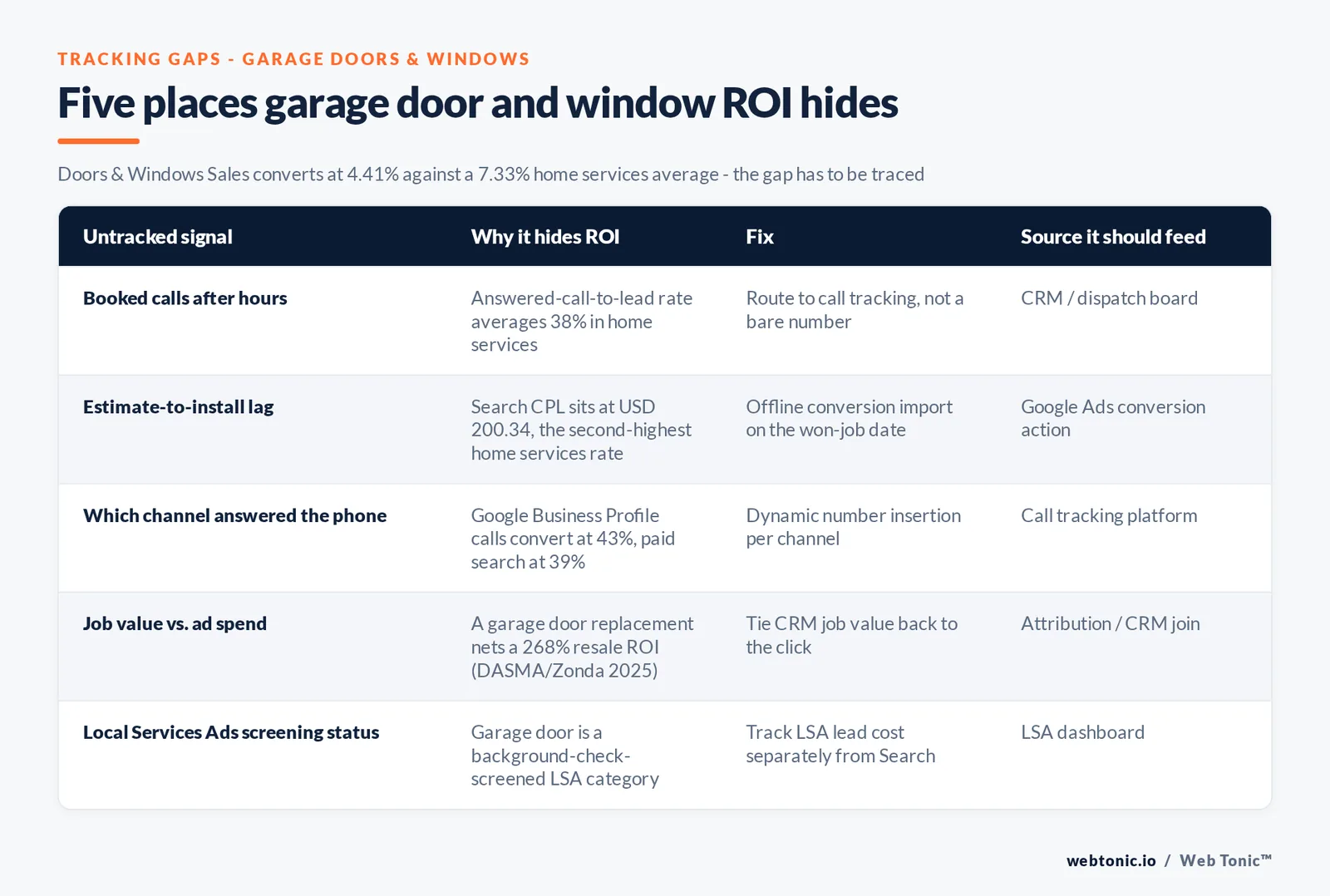
Doors & Windows Sales converts at 4.41% on search, against a 7.33% home services average, and no published study explains why in garage-door-specific terms. The gap is visible in WordStream/LocaliQ's 2025 Home Services report; closing it is a tracking problem, not a targeting one - most of what looks like underperformance is really unattributed phone calls and un-joined job value.
Key Takeaways
- Doors & Windows Sales converts at 4.41% on search, against 7.33% overall.
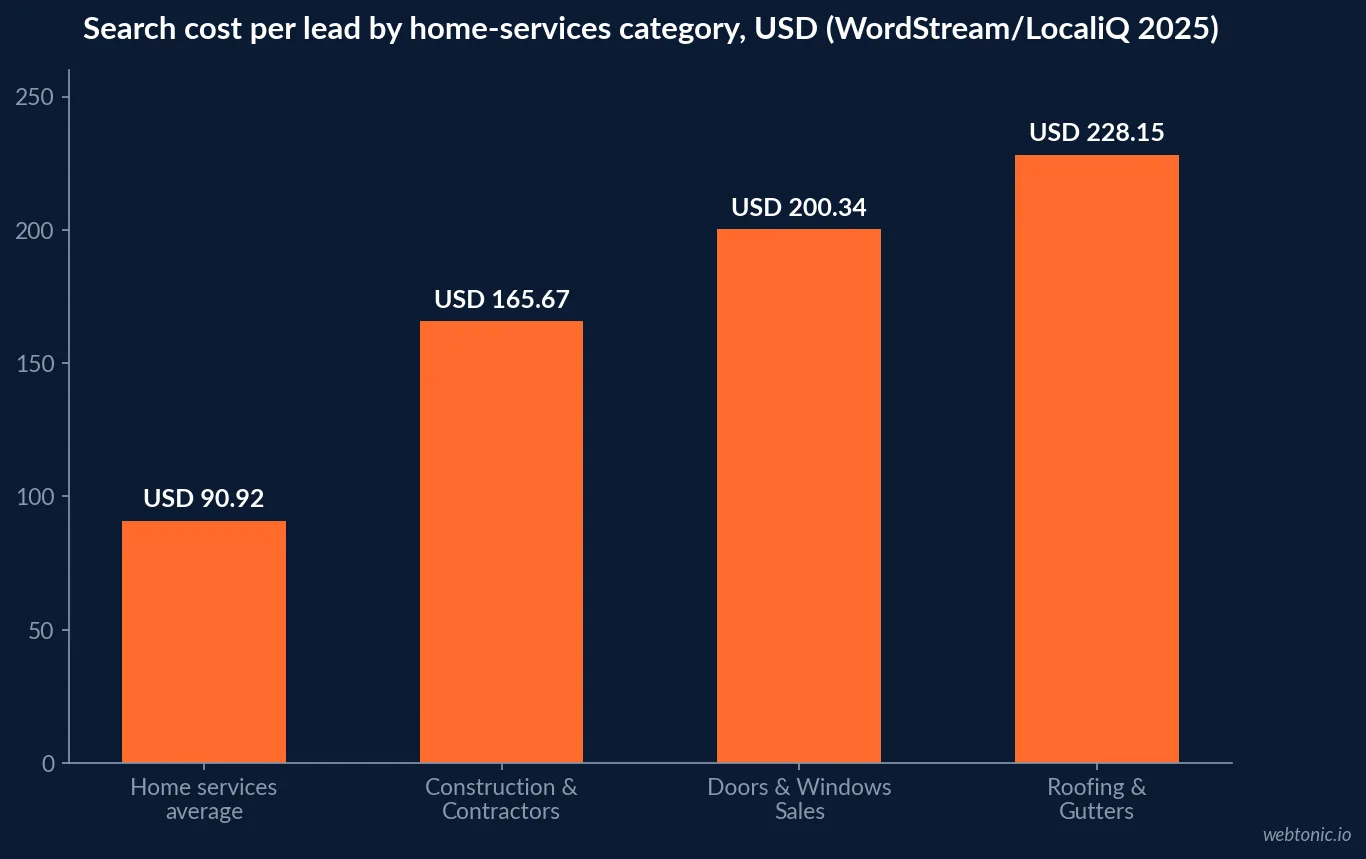
- Its search cost per lead is USD 200.34, second-highest of any home services category.
- Cost per click rose more than 46% year over year for the category.
- 38% of answered home-services calls are real leads, Invoca reports.
- 45% of those leads convert on the call itself.
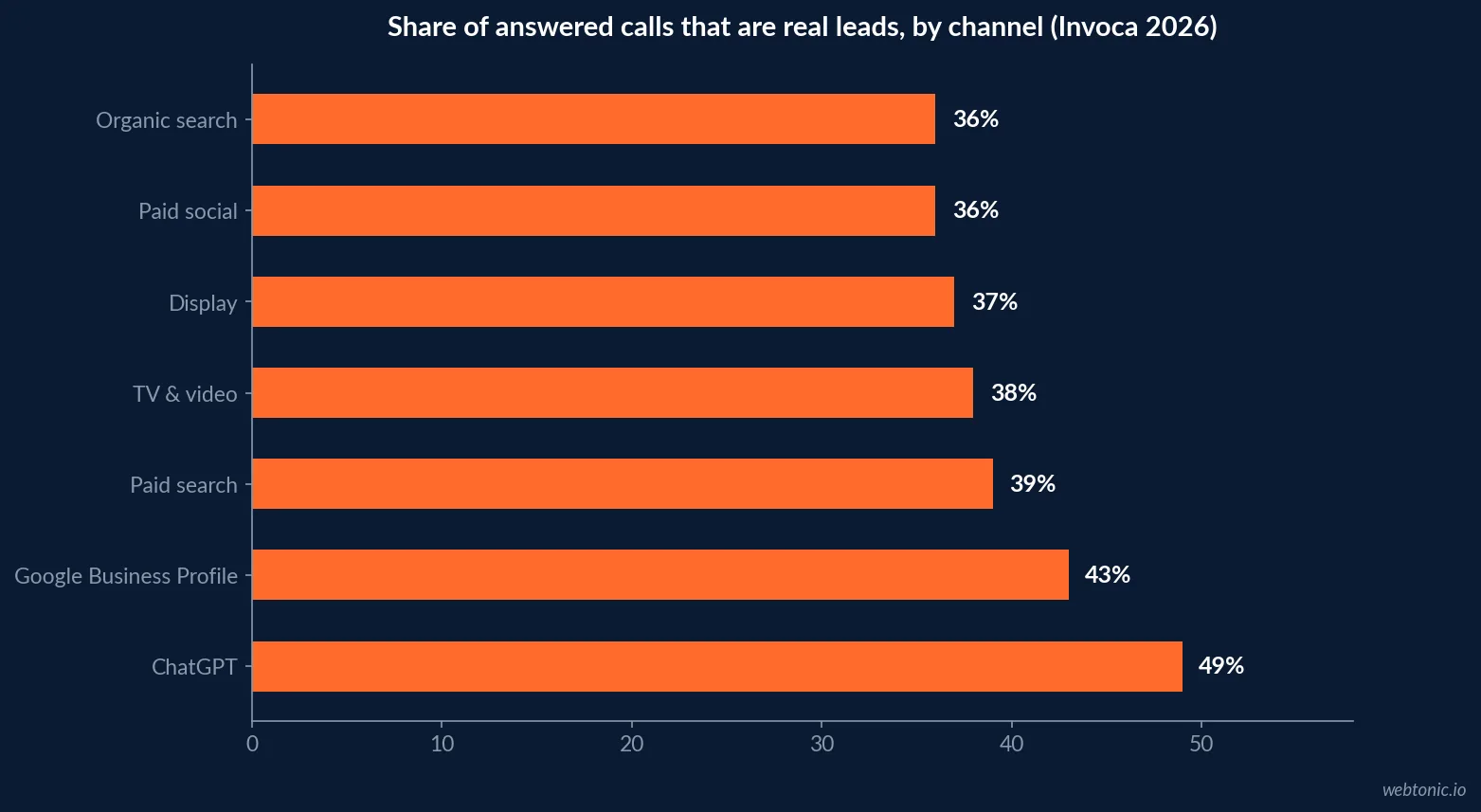
- Google Business Profile calls convert at 43%, ahead of paid search at 39%.
- ChatGPT-referred calls convert at 49%, the highest of any channel Invoca tracks.
- Organic search calls convert at 36%, the same rate as paid social.
- A garage door replacement nets a 268% resale ROI, DASMA and Zonda report.
- That is USD 4,672 spent against USD 12,507 in added resale value.
- Home services overall search CPL is USD 90.92, a different, broader category scope.
- Construction & Contractors converts at 2.61%, the category's true floor.
- Roofing & Gutters has the highest CPL, at USD 228.15.
- Garage door businesses face enhanced LSA screening, per Google's own documentation.
- 88% of home services businesses saw CTR increase year over year in 2025.
Why this category needs its own tracking read
No published study measures tracking maturity for garage door and window businesses specifically. What exists is WordStream/LocaliQ's 2025 Home Services report, which places Doors & Windows Sales among the lowest-converting, highest-cost search subcategories it tracks, and Invoca's 2026 call-tracking data, which is reported at the broader home services and channel level, not by trade. Cross- referencing the two is the honest way to read the gap: a category converting below average on search is not necessarily underperforming, it may simply be under-tracked past the click.
| Home services search category (2025) | Search CVR | Search CPL | What it signals |
|---|---|---|---|
| Cleaning/Maid/Butler Services | 17.65% | USD 46.99 | Low ticket, fast decision |
| Handyman Services | 13.45% | USD 54.05 | Low ticket, fast decision |
| Doors & Windows Sales | 4.41% | USD 200.34 | High ticket, multi-session research |
| Roofing & Gutters | 3.70% | USD 228.15 | High ticket, often insurance-adjacent |
| Construction & Contractors | 2.61% | USD 165.67 | Highest ticket, longest cycle |
The scope mismatch that trips up every comparison
A separate, broader WordStream/LocaliQ industry benchmark (13,474 US search campaigns, not limited to home services) reports a general "Home & Home Improvement" category at a USD 90.92 cost per lead - a figure that happens to closely track the narrower 2025 Home Services report's own overall home services average of the same amount. Neither of those is the Doors & Windows Sales subcategory figure of USD 200.34. Quoting the broad number against the narrow category understates true cost by more than half, which is exactly the kind of scope error a tracking setup should be built to prevent.
Always confirm which of the two reports a stated CPL comes from before setting a target: the home-services-specific report with its named subcategories, or the general cross-industry benchmark with its "Home & Home Improvement" catch-all.
Where the phone call actually gets attributed
Invoca's 2026 Lead Conversion Benchmarks, built from its own call-tracking dataset, put the home services category's answered-call-to-lead rate at 38% and its call-to-close rate at 45% once that lead is on the phone. Both figures sit above several verticals Invoca tracks, including telecom (33%) and senior care (29%). A garage door or window business counting only web form submissions as leads is very likely undercounting real demand - and cannot separate a genuinely weak search campaign from one that is simply driving calls nobody is tracking.
| Marketing channel (2026) | Answered calls that become leads | What it means for tracking |
|---|---|---|
| ChatGPT | 49% | New, currently the highest-converting call source Invoca tracks |
| Google Business Profile | 43% | Needs its own tracked number, separate from the website |
| Paid search | 39% | The channel budget usually gets judged on; verify dynamic number insertion is live |
| TV & video | 38% | Rarely call-tracked in home services; a real blind spot |
| Display | 37% | Assist channel; attribute on a multi-touch basis, not last-click |
| Paid social | 36% | Comparable to organic; don't assume paid outperforms by default |
| Organic search | 36% | The channel most often left untracked entirely |
The job value half of the equation
Tracking cost per lead without tracking closed job value only tells half the story. DASMA's members manufacture more than 95% of the US garage door market, and the trade association's 2025 Cost vs. Value data, also published by Zonda, puts the average garage door replacement at USD 4,672 against an estimated USD 12,507 in added resale value - a 268% return, among the highest of the 28 remodeling projects the report tracks. A CRM that never pushes that closed job value back to the ad platform is optimizing toward the wrong number: cheapest lead, not highest-value job.
| What to track | Where it lives today (usually) | Where it should feed | Why it matters |
|---|---|---|---|
| Search click and cost | Google Ads | Attribution layer | The easy half; already tracked |
| Phone call and its channel | Call tracking platform, if installed | CRM lead record | 38% of answered calls are real leads |
| Booked estimate | Field service / CRM software | Google Ads offline conversion import | Closes the loop from click to job |
| Closed job value | CRM / accounting | Attribution layer, tagged by lead source | Ties USD 12,507 resale value back to spend |
| LSA lead vs. Search lead | Google Local Services dashboard | Separate reporting line | Billed and reported apart from Search |
Local Services Ads add a second, separate ledger
Google's own Local Services screening documentation places garage door companies in a category requiring an enhanced level of background-check and license verification before a profile can go live. LSA leads are billed per-lead, not per-click, and reported in a separate dashboard from Search - so a shop running both channels needs two lead-cost lines reconciled against the same CRM, not a single blended cost-per-lead figure that quietly averages a USD 200.34 Search lead with a differently-priced LSA lead.
Our data and analytics practice builds that reconciliation before a garage door or window account ever gets a budget recommendation - see how we approach the wider question in cost per lead by industry and conversion rate benchmarks.
How the same phone call converts differently once it's picked up
Invoca's data splits two different metrics that a tracking dashboard should never merge: the share of answered calls that qualify as a lead, and the share of qualified leads that then close on that same call. Home services leads close at 45% once qualified - tied with healthcare and automotive as the highest close rate Invoca tracks, and well above financial services at 34% or telecom at 35%. For a garage door or window business, that means the average sale is not just about collecting the call, it's about how that call is handled once staff pick it up, which is a coaching and scripting problem no ad platform can fix.
| Industry (2026) | Answered calls that are leads | Leads that convert on the call |
|---|---|---|
| DTC eCommerce | 34% | 54% |
| Healthcare | 43% | 45% |
| Home services | 38% | 45% |
| Automotive | 53% | 45% |
| Business services | 38% | 44% |
| Financial services | 35% | 34% |
What the O*NET wage data adds to the ROI picture
A garage door installer's own labor cost is part of what a business is really protecting when it tracks job value against ad spend. O*NET's occupational data for glaziers and related installation trades shows a licensed, experienced installer represents a meaningful embedded labor cost inside that USD 4,672 average job price - which is exactly why the USD 12,507 resale value has to be tracked against the full job cost, not just the ad spend that generated the lead. A dashboard that stops at marketing CPL and never reconciles against total job cost will always overstate marketing ROI. Our Google Ads management practice builds that reconciliation into the reporting layer before a budget conversation happens.
A quick reference for what "good" looks like
Pulling the category and channel data together into one reference makes the target concrete rather than aspirational.
| Metric | Doors & Windows Sales / home services benchmark | Source |
|---|---|---|
| Search CVR | 4.41% (category) vs. 7.33% (home services average) | WordStream/LocaliQ 2025 |
| Search CPL | USD 200.34 (category) vs. USD 90.92 (home services average) | WordStream/LocaliQ 2025 |
| Answered-call-to-lead rate | 38% (home services) | Invoca 2026 |
| Lead-to-close rate on the call | 45% (home services) | Invoca 2026 |
| Job cost vs. resale value | USD 4,672 vs. USD 12,507 (268% ROI) | DASMA/Zonda 2025 |
What the 46% CPC swing means for reporting cadence
WordStream/LocaliQ's 2025 report flags Doors & Windows Sales as one of the two home services categories - alongside Pools & Spas - with a cost-per-click increase of more than 46% year over year, even as category-wide click-through rate rose for 88% of home services businesses. Rising CPC with a flat or improving CTR means the auction is getting more competitive, not that the ads are getting worse - which only shows up correctly in a dashboard that separates CTR, CPC, and CPL into three lines instead of collapsing them into one blended "cost" metric.
Frequently Asked Questions
Why does Doors & Windows Sales convert worse than other home services categories?
WordStream/LocaliQ's 2025 Home Services report puts the Doors & Windows Sales search conversion rate at 4.41%, against a 7.33% category-wide average, and its search cost per lead at USD 200.34, the second-highest of any home services subcategory after Roofing & Gutters. The category isn't underperforming creative or targeting so much as it is a high-consideration, high-ticket purchase that a single search session rarely closes - which is exactly why the tracking layer matters more here than in a lower-ticket category.
What share of garage door and window leads actually arrive by phone?
No study reports the phone share for this specific trade, but Invoca's 2026 benchmarks, built on its own call-tracking dataset, put the home services category at a 38% answered-call-to-lead rate and a 45% call-to-close rate once that lead is on the phone - both above several other verticals Invoca tracks. Any garage door or window business measuring only form fills is very likely undercounting its real lead volume.
Which channel's calls convert best once a lead picks up the phone?
Invoca's 2026 channel-level data shows Google Business Profile calls converting to leads at 43% and ChatGPT-referred calls at 49%, both ahead of paid search at 39% and organic search at 36%. That is a reason to track calls by channel and not just by ad campaign - the same click can look identical in Google Ads while the call it produces behaves very differently depending on where the number was dialed from.
Does the resale value of a garage door job matter for how a business should track spend?
Yes, if the business ties CRM job value back to marketing cost. DASMA and Zonda's 2025 Cost vs. Value data puts the average garage door replacement at USD 4,672 with an estimated USD 12,507 added resale value, a 268% return. A tracking setup that stops at cost-per-lead and never joins the CRM's closed-job value is measuring the cheaper half of the equation.
Does Local Services Ads screening status affect what gets tracked?
It changes what has to be tracked separately. Google's own Local Services documentation places garage door companies in a category that requires enhanced background-check and license screening before a listing goes live, and LSA leads are billed and reported apart from Search - so a shop running both needs to reconcile two separate lead-cost lines, not one blended number.
Sources
WordStream/LocaliQ - 2025 Home Services Search Advertising Benchmarks
WordStream/LocaliQ - 2026 Google Ads Benchmarks by Industry
Invoca - 2026 Lead Conversion Rate Benchmarks
DASMA - 2025 Cost vs. Value Report
Zonda - 2025 Cost vs. Value Report
Google Local Services Ads - Business screening and verification requirements (US)
O*NET OnLine - Glaziers occupational summary