Table of contents
No social media study prices garage doors and windows as its own category, so this page keeps every figure honestly labeled as a cross-industry proxy: Wyzowl's video marketing survey for platform choice, TikTok's own newsroom data for platform-level purchase behavior, and BrightLocal's 2026 survey for where video-based recommendations are actually gaining ground.
Key Takeaways
- 91% of businesses use video as a marketing tool, back to a joint all-time high (Wyzowl 2026).
- 93% of video marketers call video an important part of their strategy.
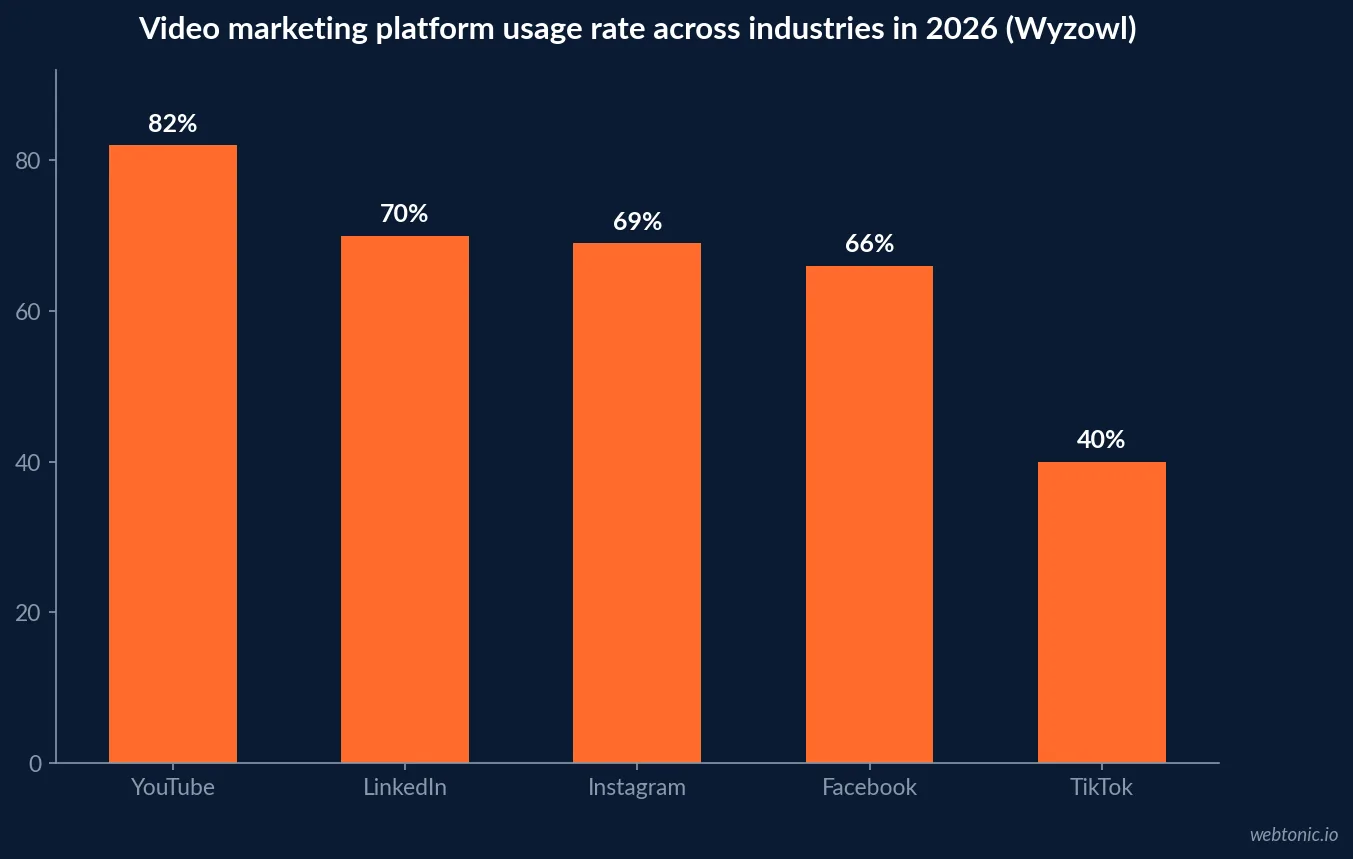
- YouTube is the most widely used video platform at 82% of businesses.
- YouTube is also rated the most effective at 69% success reported.
- Instagram follows at 69% usage and 56% effectiveness.
- Facebook sits at 66% usage and 55% effectiveness.
- LinkedIn is used by 70% of video marketers, rated 50% effective.
- TikTok trails at 40% usage and 29% effectiveness among video marketers broadly.
- 47% of TikTok users in the UK have purchased something seen on the platform (TikTok's own newsroom data).
- Video-based recommendation sites gained traction in 2026, per BrightLocal's consumer survey.
- YouTube, Instagram and TikTok all grew usage for local business recommendations year over year.
- TikTok's Local Explorer Program mirrors Google Local Guides, formalizing local video recommendations.
- The overhead and garage door services market is projected past $16 billion in 2026, the audience this content reaches.
- DASMA, the industry's own trade association, runs its market updates primarily on LinkedIn, not consumer platforms.
Video adoption is close to saturated, everywhere
Wyzowl's 2026 Video Marketing Statistics survey, its twelfth consecutive year of data, found 91% of businesses now use video as a marketing tool, back to a joint all-time high after a slight 2025 dip, and 93% of video marketers call it an important part of their overall strategy. This is a general business survey, not a home-trades one, but it sets the baseline expectation: a garage door and window company with no video presence at all is now the exception, not the norm, among its marketing peers.
| Platform (Wyzowl 2026 video marketer survey) | Usage rate | Reported effectiveness |
|---|---|---|
| YouTube | 82% | 69% |
| 70% | 50% | |
| 69% | 56% | |
| 66% | 55% | |
| Webinars | 56% | 42% |
| TikTok | 40% | 29% |
Where the gap between usage and effectiveness matters
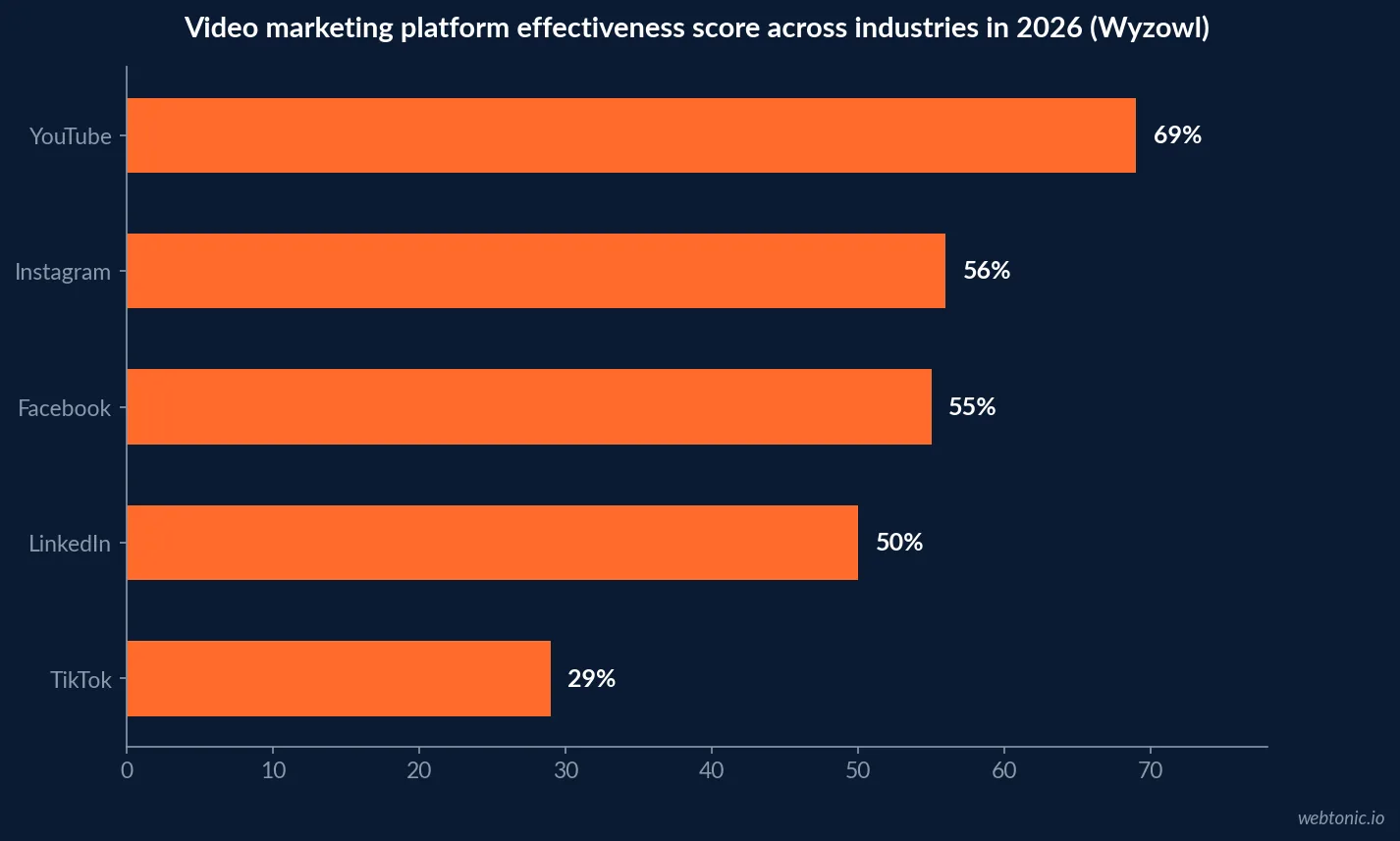
The Wyzowl data shows LinkedIn used by more video marketers (70%) than Instagram (69%), yet rated less effective (50% versus 56%). For a home-trade business, that gap is a useful filter: platforms where usage outpaces effectiveness are probably being used out of habit rather than results, while YouTube's matched high scores on both measures (82% usage, 69% effectiveness) argue it deserves first claim on video production budget, not last.
TikTok sits at the bottom on both measures among general video marketers, at 40% usage and 29% effectiveness. That does not mean TikTok fails for this trade specifically - transformation footage is a natural fit for the platform's format - but it does mean a garage door company should not expect TikTok alone to outperform YouTube or Instagram without its own testing.
What actually gets filmed for this trade
The video formats that fit a garage door and window company are narrower than the platform-level data above suggests. Wyzowl's survey does not break out content type by industry, but its broader findings on video length and purpose still apply directly: shorter, problem-focused clips consistently outperform long-form brand videos for driving action, which for this trade usually means a 30-to-90 second installation or repair clip rather than a polished five-minute company overview.
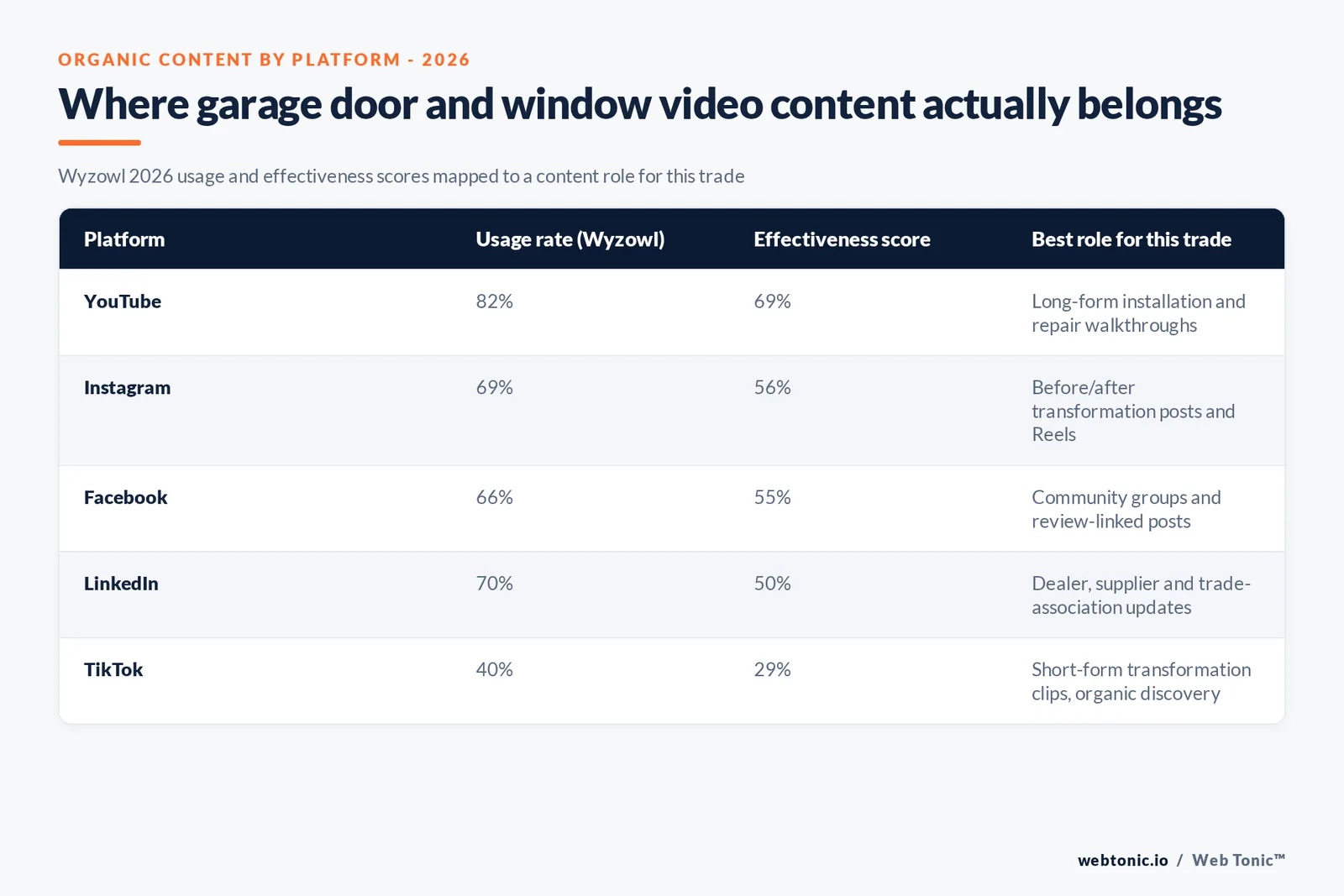
Three formats do the heaviest lifting for a home-trade business: the full installation timelapse (best suited to YouTube, where usage and effectiveness both peak), the same-day repair transformation (a natural fit for Instagram Reels and TikTok's short-form feed), and the customer walkthrough testimonial (which doubles as both marketing content and, if handled correctly under the FTC rule above, review evidence).
| Content format | Best-fit platform (Wyzowl 2026 data) | Primary purpose | FTC consideration |
|---|---|---|---|
| Full installation timelapse | YouTube (82% usage, 69% effective) | Education, SEO-adjacent discovery | None if unpaid and genuine |
| Same-day repair transformation | Instagram / TikTok (short-form) | Discovery, shareability | Disclose if the homeowner or creator was comped |
| Customer walkthrough testimonial | Facebook / Instagram | Trust-building, review reinforcement | Must be a real customer per 16 CFR 465 |
| Dealer or supplier update | LinkedIn (70% usage, B2B-leaning) | Trade relationships, recruiting | None - not consumer-facing |
How often this content actually needs to post
None of the sources above set a garage-door-specific posting cadence, so the safer benchmark is consistency over volume: Wyzowl's broader video-marketer data shows the businesses reporting the highest platform effectiveness are the ones treating video as a standing production line, not a one-off campaign, which lines up with the same flows-beat-campaigns pattern documented on the email side of this batch. A garage door company posting one real installation clip a week, cross-posted to three platforms, will out-produce a competitor posting an occasional polished ad.
| Cadence model | What it requires | Where it fits this trade |
|---|---|---|
| Weekly real-job posting | One crew member with a phone camera | Sustainable for most local companies |
| Monthly polished campaign only | External production budget | Supplements, does not replace, weekly posting |
| No standing cadence | Nothing | Loses ground to consolidating competitors per FMI 2026 |
What TikTok's own data says, separate from the marketer-survey score
TikTok's own newsroom reports 47% of UK TikTok users have purchased a product or service after seeing it on the platform, and counts more than 1.5 million UK businesses now active on TikTok. That is platform-reported purchase behavior, not a controlled ad-performance study, and it is UK-specific data being used here as a general directional figure, not a US or garage-door benchmark. Read alongside the lower marketer-effectiveness score above, the honest conclusion is that TikTok clearly drives some consumer purchase behavior at the platform level, while individual video marketers across industries report mixed results executing on it.
| TikTok data point | Figure | Source | What it does and does not show |
|---|---|---|---|
| UK users who purchased after seeing a product on TikTok | 47% | TikTok newsroom, 2024 | Platform-level purchase behavior, not a garage-door-specific figure |
| UK businesses active on TikTok | 1.5 million+ | TikTok newsroom, 2024 | Adoption scale, not a performance benchmark |
| Video marketers reporting TikTok as effective | 29% | Wyzowl 2026 | Self-reported marketer sentiment across all industries |
Where video-based trust signals are actually shifting
BrightLocal's 2026 Local Consumer Review Survey found video platforms, including YouTube, Instagram and TikTok, all gaining traction as sources consumers use for local business recommendations, a distinct trend from the star-rating and review-count shifts covered in a written review context. The survey specifically notes TikTok's Local Explorer Program as a structural echo of Google's Local Guides program, formalizing the platform's push into local video recommendations rather than leaving it purely organic.
For a garage door and window business, that means the video content strategy and the review-collection strategy are converging: a well-produced installation video posted to a Google Business Profile or shared to TikTok functions as both marketing content and a trust signal in the same motion.
The disclosure rule that applies to influencer and UGC content
Garage door and window companies increasingly work with local creators for transformation videos and reviews, and that content is covered by the FTC's revised Guides Concerning the Use of Endorsements and Testimonials, 16 CFR Part 255, updated in 2023. The guides require that any material connection between a business and a creator - free installation, payment, discount - be disclosed clearly on the post itself, not buried in a bio link. A homeowner posting an unpaid before/after clip needs no disclosure; a creator paid or comped for the same clip does.
| Content type | FTC disclosure required? | Rule | Source |
|---|---|---|---|
| Unpaid homeowner review video | No | N/A - genuine, unconnected experience | FTC |
| Creator paid or comped for a transformation video | Yes, clear and conspicuous | 16 CFR Part 255 | FTC |
| Employee posting on the company's own account | Disclosure of employment status typically expected | 16 CFR Part 255 | FTC |
Where this trade sits inside broader home-services growth
The audience behind all of this organic content is growing, not shrinking. Yelp's own trends reporting found the home services category, which includes garage door and window work, leading every Yelp category in new business openings in its most recent full-year measurement, up 11% year over year with 217,000 total openings - openings that typically arrive as new social accounts needing a content strategy from day one.
That growth also means more competition for the same organic feed real estate. FMI Consulting's 2026 sector brief notes early-stage consolidation inside the overhead and garage door services market, meaning a growing share of local competitors are backed by private equity roll-ups with dedicated marketing budgets, not solo operators posting occasionally. A garage door company treating social content as an occasional extra rather than a standing weekly commitment is increasingly competing against businesses that do not make that mistake.
What a B2B trade association's own channel choice signals
DASMA, the Door and Access Systems Manufacturers Association, publishes its market updates and Cost vs. Value Report coverage primarily through LinkedIn rather than consumer-facing platforms, a real, observable choice rather than a survey statistic. That is consistent with LinkedIn's role in the Wyzowl data as a B2B-leaning channel (70% usage, moderate 50% effectiveness): useful for reaching installers, dealers and commercial property managers, but not the primary channel for reaching homeowners considering a replacement door.
The industry's other trade group, the International Door Association, runs an annual Garage Door Safety Month awareness campaign aimed squarely at homeowners rather than dealers - a reminder that this industry's own associations already split their content strategy the same way the platform data argues for: trade-facing updates on LinkedIn, safety and consumer education aimed at a broader, more visual audience.
What this means for a content calendar
Lead with YouTube and Instagram for consumer-facing installation and repair footage, where both usage and effectiveness scores are highest in the cross-industry data, repurpose the same footage as short-form TikTok and Facebook content, and reserve LinkedIn for supplier, dealer and trade-association style updates rather than homeowner-facing offers. Our performance creative team can turn a single day of real installation footage into that full cross-platform set, and our broader social media marketing statistics page has the wider cross-industry benchmarks to sanity-check engagement once the content is live. For the paid side of the same platforms, our Facebook ads ROI analysis covers when to add spend behind the organic content.
Frequently Asked Questions
Is there social media data specific to garage door and window companies?
No stated-methodology study isolates this trade on social platforms. This page uses Wyzowl's cross-industry video marketing survey, TikTok's own newsroom figures and BrightLocal's 2026 platform-usage data, all clearly labeled as general benchmarks rather than category-specific numbers.
Which social platforms should a garage door company actually prioritize?
Wyzowl's 2026 survey of video marketers ranks YouTube as the most widely used (82%) and most effective (69% report success) platform, followed by Instagram (69% used, 56% effective) and Facebook (66% used, 55% effective). TikTok sits lower on both measures for video marketers broadly (40% used, 29% report success), which does not rule it out for this trade but argues against leading with it.
Is TikTok worth it for a home-trade contractor if the effectiveness score is lower?
The lower effectiveness score is a general marketer self-report, not proof TikTok fails for home trades specifically; transformation and before/after installation footage is a format that performs well on TikTok across contractor niches anecdotally. TikTok's own newsroom reports 47% of UK users have purchased a product or service seen on the platform, and BrightLocal's 2026 survey found video platforms including TikTok gaining traction for local recommendations. Treat organic TikTok as a discovery and trust channel, not a lead-generation guarantee.
Does social proof for local trades still run through written reviews, or has video taken over?
Both channels are growing, not replacing each other. BrightLocal's 2026 survey found written review usage on core platforms holding steady to rising, while video-based recommendation sites are also gaining traction. For a garage door company, that means video content should support the review profile, not substitute for it.
What is a realistic organic content plan for this trade given the data?
Prioritize a steady stream of real installation and repair footage on YouTube and Instagram, where video marketers report the highest effectiveness, then repurpose the same footage as short-form clips for TikTok and Facebook. A trade association's own channel choice is instructive here: DASMA, the garage door industry's manufacturer trade group, runs its market updates and Cost vs. Value Report coverage primarily through LinkedIn, reflecting a B2B, dealer-facing audience rather than a homeowner one.
Sources
Wyzowl - Video Marketing Statistics 2026 (12 years of data)
TikTok Newsroom - TikTok means business, UK SME campaign
BrightLocal - Local Consumer Review Survey 2026
DASMA / Zonda Media - Cost vs. Value Report 2025 coverage
FMI Consulting - Private Equity Sector Brief: Overhead & Garage Door Services, March 2026
eCFR - 16 CFR Part 255, FTC Guides Concerning Endorsements and Testimonials
Yelp - State of Services 2024 trends report
International Door Association - Consumer resources