Table of contents

No Meta Ads study prices garage doors and windows as its own category, so this page uses the closest verified proxy - WordStream/LocaliQ's Home & Home Improvement benchmark - and states the gap on every figure. The unit of analysis is cost and conversion per platform objective, not a single blended number.
Key Takeaways
- No Meta study isolates garage doors and windows from the broader home-improvement bucket.
- Leads-objective cost per lead runs $41.26 for the Home & Home Improvement proxy.
- That is 49% above the $27.66 all-industry average cost per lead.
- Leads-objective click-through rate is 1.94%, near the 2.59% all-industry mark.
- Leads-objective cost per click is $2.23 against $1.92 all-industry.
- Conversion rate is 5.22%, below the 7.72% all-industry average.
- That conversion rate fell 36% year over year, one of the three steepest drops measured.
- Traffic-objective cost per click is $0.99, the third-highest of any category studied.
- Traffic-objective click-through rate is 1.28% for the category.
- Google search cost per lead for Doors & Windows Sales runs $200.34, near five times the Meta figure.
- Search conversion rate for the same category is 4.41%, the third-lowest of any home services vertical measured.
- The overhead and garage door services market is projected past $16 billion in 2026 (FMI Consulting).
- More than 114 million garage and overhead doors are in service across the US, 100 million residential.
- Service and maintenance demand is growing 6.2% to 7.2% a year, faster than new installation at 3.0% to 3.8%.
- Garage door replacement recouped 268% of cost at resale in 2025 (Zonda Cost vs. Value), the top-ranked project.
- That ROI figure has nearly tripled since 2023, from 103% to 193% to 268%.
- The FTC's testimonial rule, 16 CFR Part 465, has been final since August 2024 and covers fabricated before/after ad claims.
Why there is no garage-door-specific Meta benchmark
Meta does not publish ad performance broken out by contractor trade, and the two vendor studies with a stated methodology - WordStream's Facebook Ads Benchmarks 2025 (over 1,000 campaigns) and the companion Home Services Search Ads Benchmarks (over 3,200 LocaliQ campaigns, April 2024-March 2025) - group doors and windows inside broader buckets: Home & Home Improvement on the Meta side, Doors & Windows Sales as its own line only on the Google search side. Treat every Meta figure below as a proxy, and treat the search figures as the closer read on this specific trade.
This is a real limitation, not a rounding error: a garage door lead and a $150 gutter-cleaning lead sit in the same Meta category average, so the blended number understates what a $4,672 average job (see below) should really cost to acquire.
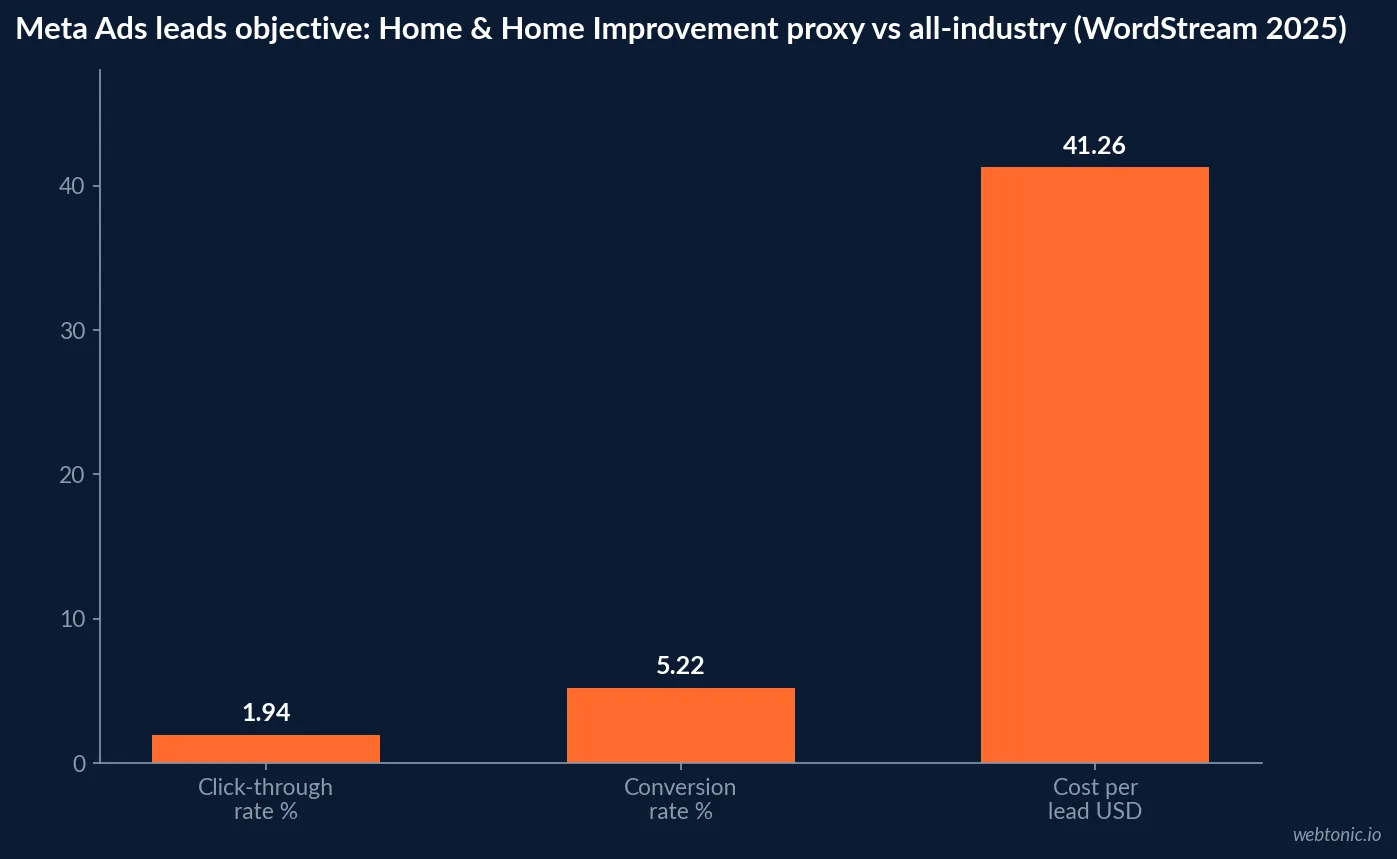
| Meta Ads metric (leads objective, 2025) | Home & Home Improvement proxy | All-industry average | Source |
|---|---|---|---|
| Click-through rate | 1.94% | 2.59% | WordStream/LocaliQ 2025 |
| Cost per click | $2.23 | $1.92 | WordStream/LocaliQ 2025 |
| Conversion rate | 5.22% (down 36% YoY) | 7.72% | WordStream/LocaliQ 2025 |
| Cost per lead | $41.26 | $27.66 | WordStream/LocaliQ 2025 |
The traffic objective tells a different story
Businesses running Meta's traffic objective instead of the leads objective see a narrower gap on cost but a real one on click quality. Home & Home Improvement traffic-campaign cost per click is $0.99, the third-highest of any category WordStream tracked behind Finance and Insurance ($1.22) and Personal Services ($1.00). Click-through rate for the traffic objective sits at 1.28%, below several lower-consideration categories.
The practical read: a garage door company running a traffic campaign is paying a premium CPC to send a click somewhere, which only pays off if that landing page can convert without a lead form's built-in qualification step.
| Meta Ads metric (traffic objective, 2025) | Home & Home Improvement proxy | Lowest-cost category for comparison | Source |
|---|---|---|---|
| Cost per click | $0.99 | Shopping, Collectibles & Gifts: $0.34 | WordStream/LocaliQ 2025 |
| Click-through rate | 1.28% | Shopping, Collectibles & Gifts: 4.13% | WordStream/LocaliQ 2025 |
Meta versus Google search: which channel actually fits this trade
The LocaliQ Home Services Search Ads Benchmarks 2025 report, drawn from over 3,200 campaigns running April 2024 through March 2025, does isolate Doors & Windows Sales as its own line, and the picture is rougher than the Meta proxy suggests. Cost per lead on search runs $200.34, the second-highest of any home services category studied after Roofing & Gutters at $228.15, and conversion rate is 4.41%, the third-lowest category measured. Cost per click for the same category climbed faster than nearly any other vertical, up more than 46% year over year.
Read together, the two studies suggest search captures people already comparing quotes at a high cost, while Meta's proxy captures a cheaper but less qualified audience. Neither figure should be treated as a target; both should be tested against your own booked-job data before reallocating budget. Our growth marketing team runs that kind of cross-channel test before recommending a shift.
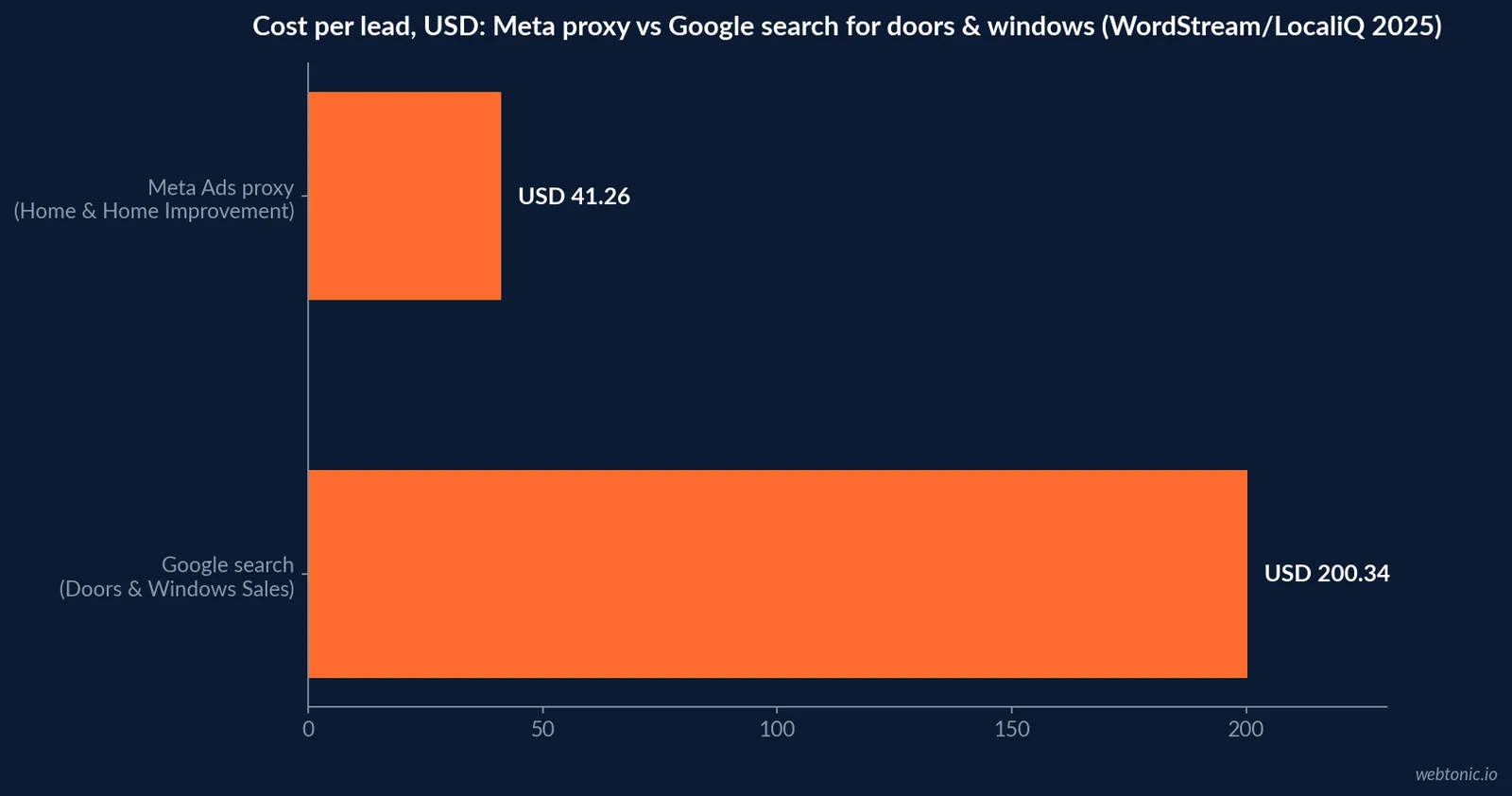
| Metric | Doors & Windows Sales (Google search) | Home & Home Improvement (Meta proxy) | Source |
|---|---|---|---|
| Cost per lead | $200.34 | $41.26 | LocaliQ 2025 / WordStream 2025 |
| Conversion rate | 4.41% | 5.22% | LocaliQ 2025 / WordStream 2025 |
| Click-through rate | 6.37% (category average) | 1.94% | LocaliQ 2025 / WordStream 2025 |
| YoY cost trend | CPC up 46%+ | CPL up 20.94% | LocaliQ 2025 / WordStream 2025 |
Why the purchase behind the click is unusually valuable
The reason a $41 Meta lead or a $200 search lead can still make sense is the size of the job behind it. DASMA's trade coverage of Zonda Media's 2025 Cost vs. Value Report puts the average garage door replacement job cost at $4,672, adding an estimated $12,507 in resale value - a 268% return, the single highest-ROI project of the 28 studied, ahead of steel entry doors (216%) for the second year running.
That ROI has moved fast: DASMA reports 103% in 2023, 193% in 2024 and 268% in 2025, while the average job cost rose only from $4,302 to $4,672 across the same three years. A rising, easily-cited ROI number is exactly the kind of proof point that belongs in ad copy - as long as it is sourced, not paraphrased into a bigger claim.
| Year | Garage door replacement job cost | Cost recouped at resale | Source |
|---|---|---|---|
| 2023 | $4,302 | 103% | Zonda / DASMA |
| 2024 | $4,513 | 193% | Zonda / DASMA |
| 2025 | $4,672 | 268% | Zonda / DASMA |
The size of the market behind these numbers
FMI Consulting's 2026 Private Equity Sector Brief sizes the US overhead and garage door services market above $16 billion in 2026, with service and maintenance revenue growing 6.2% to 7.2% a year against 3.0% to 3.8% for new installation. FMI counts more than 114 million garage and overhead doors in service across the US, roughly 100 million residential and 14 million commercial, which is the structural reason demand for this category does not disappear even when new-home construction slows.
That non-discretionary replacement base is also why paid social for this trade skews toward urgent, visible problems (a door that will not open) rather than aspirational upgrades, which shapes what creative actually converts on Meta versus what converts on search.
The compliance line that applies directly to Meta creative
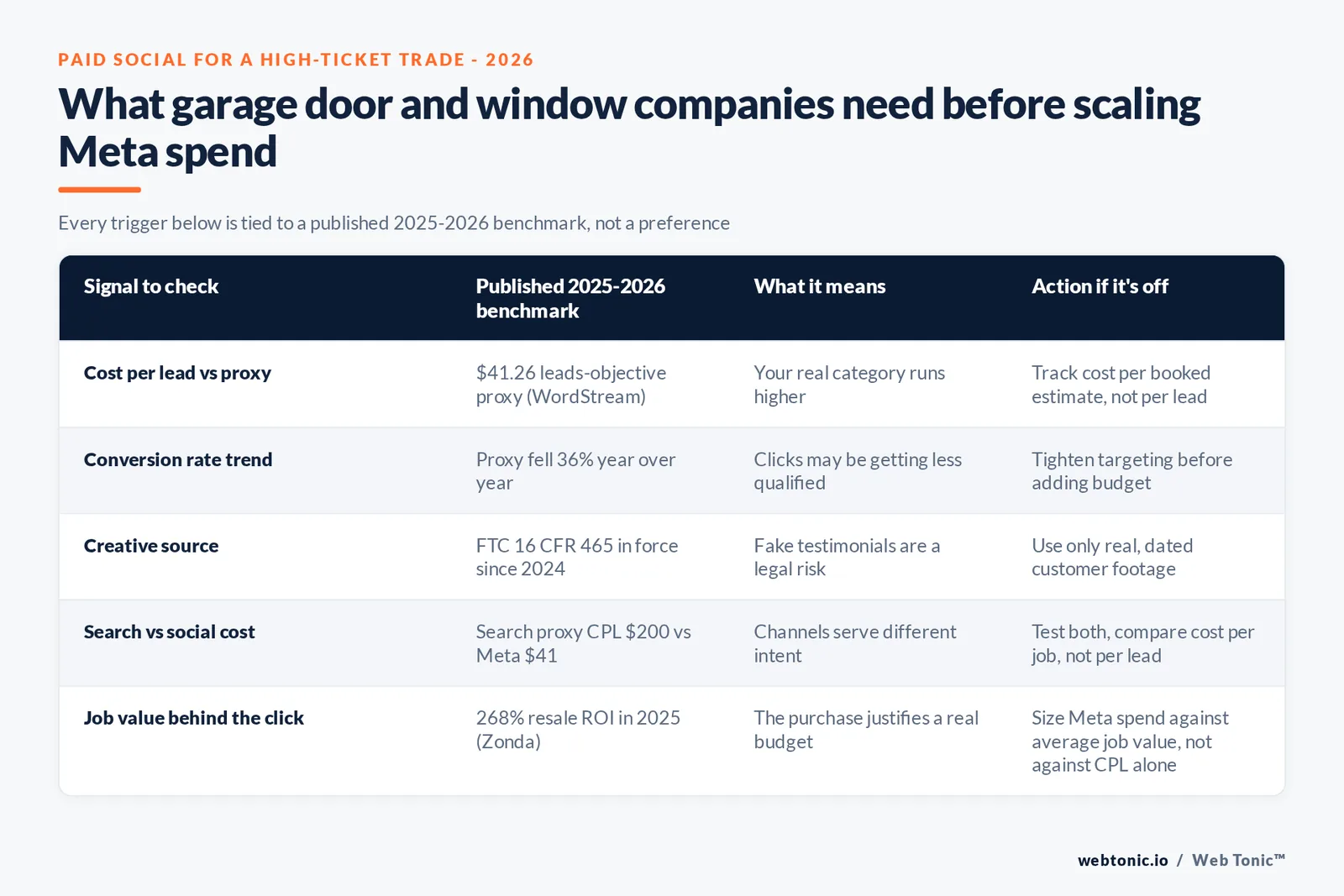
Garage door and window ads on Meta lean heavily on before/after visuals and homeowner testimonials. The FTC's final rule on consumer reviews and testimonials, in force since August 2024 as 16 CFR Part 465, bans ads that misrepresent a reviewer's actual experience, including AI-generated reviews or a real experience presented as broader than it was. A garage door ad using a stock before/after photo captioned as a real customer, or an actor delivering a scripted testimonial without disclosure, falls inside the rule's scope.
The safest creative path is the boring one: real jobs, real homeowners, real dates, and a visible opt-in for the footage to be used in advertising.
The free channel Meta spend is competing against
Before increasing Meta budget, it is worth accounting for a channel that costs nothing per lead: the International Door Association's own “Find-a-Pro” directory, which lists vetted IDA member dealers directly to homeowners researching a repair or replacement. It is a small channel next to Meta or Google in absolute volume, but it costs an IDA member nothing per click and nothing per lead beyond membership dues, which changes the math on what a paid lead needs to be worth before it beats the free alternative.
The demand backdrop behind every campaign
Paid social demand for this trade tracks the broader construction cycle more than most home services categories. Census Bureau construction spending data is the standard public reference for that cycle: residential construction put in place is reported monthly and feeds directly into new-installation demand for garage doors and windows, separate from the replacement-driven demand the ROI figures above describe. A Meta campaign built only around replacement messaging will under-perform when residential construction spending is climbing, since new-build demand runs through builders and dealers rather than homeowner-facing ads.
| Demand driver | What it feeds | Where to track it | Source |
|---|---|---|---|
| Residential construction spending | New-installation demand via builders | Monthly release | US Census Bureau |
| Existing home turnover and resale prep | Replacement demand, ROI-driven | Zonda Cost vs. Value cycle | Zonda / DASMA |
| Non-discretionary repair (114M+ doors in service) | Service and maintenance demand | FMI sector brief | FMI Consulting |
The other compliance rule that applies to insulated-door ad claims
Meta ad copy for garage doors regularly leads with an insulation or R-value claim. Those claims are covered separately from the testimonial rule above, by the FTC's R-value Rule, 16 CFR Part 460, which requires insulation R-value claims to be based on accepted test methods and disclosed accurately in advertising, not just on a spec sheet. A Meta ad claiming an “R-18 insulated door” needs that number to trace to a real tested value, the same way a testimonial needs to trace to a real customer.
Why the ROI number in ad copy needs its source named
The 268% figure above is real, but it is not the only published number for this project. The National Association of Realtors' remodeling resource page cites a separate 194% figure for garage door replacement, drawn from a different market-year cut of the same underlying Cost vs. Value research program. Both are legitimate, sourced numbers; an ad claiming “up to 268% ROI” without naming Zonda specifically risks looking inconsistent next to a competitor citing NAR's 194% figure. Name the source in the ad, not just the number.
What this means for budget allocation
Given the proxy nature of the Meta figures, the more defensible move is to run a small, tightly scoped test - a single ad set, a single geography, video-first creative built from real jobs - and measure cost per booked estimate rather than cost per Meta-reported lead. Our performance creative team builds that kind of testimonial-safe creative from real project footage rather than stock assets. For a broader read on how Meta spend compares to other paid channels for this kind of business, see our breakdown of whether Facebook ads are worth it and our cost-per-lead benchmarks by industry.
Frequently Asked Questions
Does a Meta Ads benchmark exist for garage doors and windows specifically?
No. WordStream/LocaliQ's Facebook Ads Benchmarks report, the only methodology-stated Meta study we could verify, groups garage doors and windows inside a broader Home & Home Improvement category alongside roofing, siding, HVAC and general contracting. Every figure on this page is that category proxy, not a door-and-window-only number, and should be treated as a starting range rather than a target.
What does a Meta lead actually cost for this category?
The Home & Home Improvement leads-objective average is $41.26 per lead against an all-industry average of $27.66, a roughly 49% premium. Click-through rate sits at 1.94% and cost per click at $2.23, both close to the all-industry marks of 2.59% and $1.92. The category is not expensive to click on; it is expensive to convert once someone clicks.
Why did conversion rate fall for this category?
WordStream's 2025 report lists Home & Home Improvement among the three industries with the steepest year-over-year conversion rate declines, down 36%, alongside Career and Employment and Personal Services. The report does not isolate a single cause, but a lead-form click for a garage door does not carry the same intent as a click for a $200 handyman job, and rising ad density on the platform likely pulled in more low-intent clicks industry-wide.
Should testimonial-style ad creative worry a garage door company?
Yes, if the testimonial is not real. The FTC's 16 CFR Part 465 rule, final since August 2024, bans ads that misrepresent a reviewer's actual experience, including AI-generated or paid actors presented as genuine customers. Before-and-after door transformation ads are common in this category on Meta; they need to be real jobs with real homeowners, not stock footage captioned as a testimonial.
Is Meta or Google Ads the better first paid channel for this category?
The data does not resolve that on its own. Google's home services search benchmark (LocaliQ, over 3,200 campaigns) puts Doors & Windows Sales among the highest search cost-per-lead categories at $200.34, against Meta's proxy figure of $41.26. Meta is cheaper per lead on paper, but a Google search click usually reflects someone already shopping, while a Meta click is often someone who was scrolling. Compare cost per booked job, not cost per lead, before reallocating spend.
Sources
WordStream - Facebook Ads Benchmarks 2025
LocaliQ - Home Services Search Ads Benchmarks 2025 (PDF)
FMI Consulting - Private Equity Sector Brief: Overhead & Garage Door Services, March 2026
DASMA / Zonda Media - Cost vs. Value Report 2025 coverage
Federal Trade Commission - Final rule banning fake reviews and testimonials, 2024
eCFR - 16 CFR Part 460, FTC R-value Rule
US Census Bureau - Construction Spending at a Glance
International Door Association - Consumer resources
National Association of Realtors - Remodeling resource page