Table of contents
Google still wins the Google-versus-Yelp question for garage door and window companies, but the margin narrowed in the newest data. BrightLocal's 2026 consumer survey and Whitespark's 2026 local ranking-factor survey both point the same direction: reviews matter more than ever, and no single platform owns the whole conversation anymore.
Key Takeaways
- Google's share of local recommendation traffic fell from 83% to 71% between 2025 and 2026.
- 97% of consumers read reviews for local businesses before choosing one.
- 41% now always read reviews, up from 29% a year earlier.
- The average consumer checks six different review sites, not just one.
- 31% require a 4.5-star rating or higher, up from 17% in 2025.
- 68% will only use a business with four stars or more, up from 55%.
- 47% won't use a business with fewer than 20 reviews.
- 74% only weigh reviews written in the last three months.
- Consistent sentiment across reviews is the top trust factor at 56%.
- 85% are more likely to use a business after positive reviews; 77% avoid one after negative reviews.
- Google's Local Services Ads exclude garage door services from pre-badge status, per Google's own help documentation.
- Whitespark's 2026 survey added 47 new ranking factors to its local search model.
- 187 local ranking factors were scored by 47 local SEO experts for the 2026 report.
- Review and behavioral signals grew in weight for 2026, per Whitespark's own analysis.
- Yelp's Home Services advertising revenue grew roughly 20% year over year in 2023.
- Home Services led every Yelp category in new business openings, up 11% with 217,000 openings.
The claim, tested against the newest survey
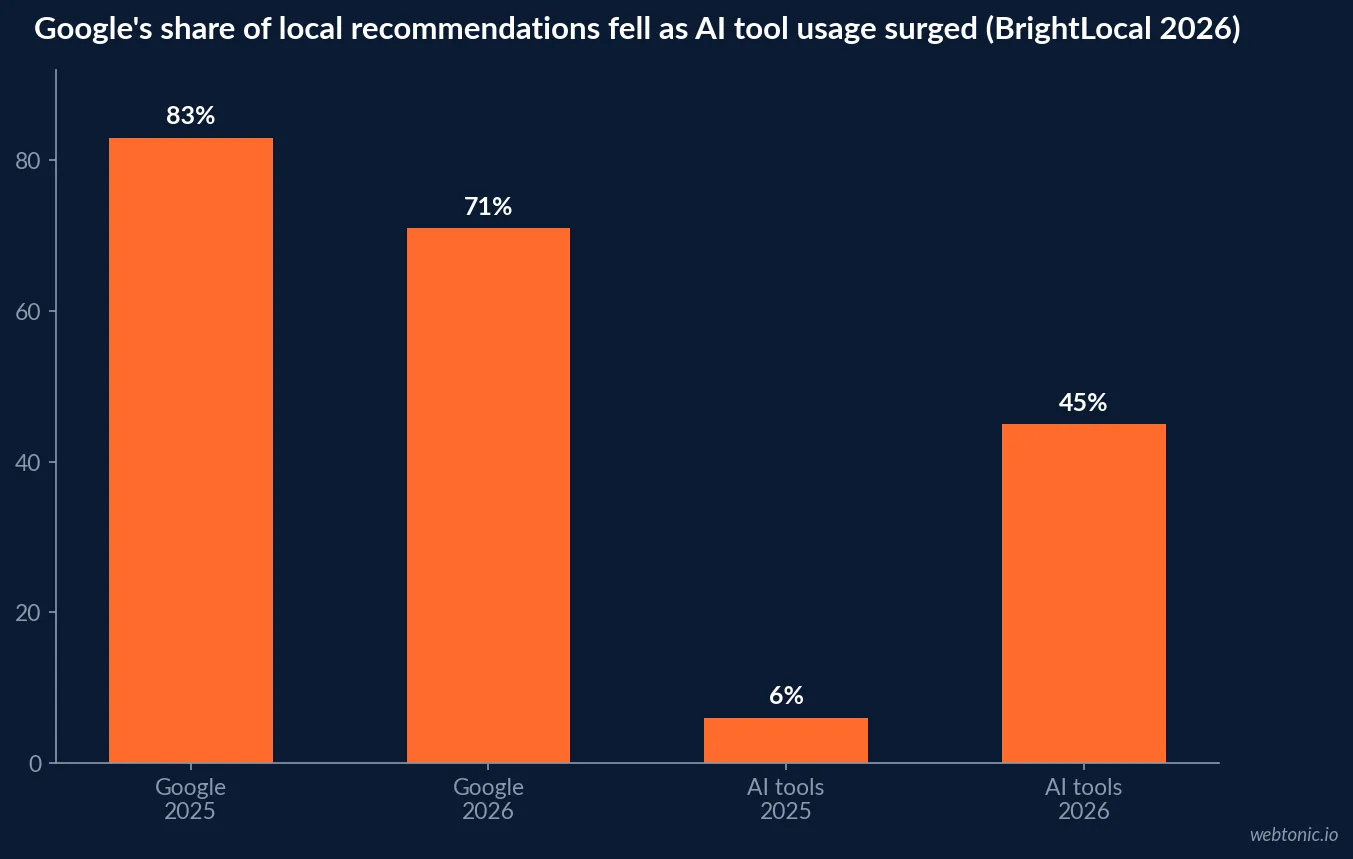
BrightLocal's Local Consumer Review Survey 2026, published February 2026, tracks where consumers actually go for local recommendations. Google's share fell from 83% in 2025 to 71% in 2026, while usage of AI tools like ChatGPT for recommendations jumped from 6% to 45%, and Apple Maps nearly doubled from 14% to 27%. Yelp, Facebook, Tripadvisor and several other traditional review sites also grew usage over the same period. Google is still comfortably ahead, but the era of Google being the only platform that matters for local trust signals is measurably over.
For a garage door company, that means a strong Google Business Profile is necessary but not sufficient. The 2026 data argues for a presence on at least the two or three next most-used platforms in your specific market, not a single-channel strategy.
| Platform behavior (BrightLocal 2026) | 2025 | 2026 | Change |
|---|---|---|---|
| Google used for local recommendations | 83% | 71% | -12 pts |
| AI tools (ChatGPT etc.) used for recommendations | 6% | 45% | +39 pts |
| Apple Maps used for recommendations | 14% | 27% | +13 pts |
| Consumers who “always” read reviews | 29% | 41% | +12 pts |
| Consumers requiring 4.5+ stars | 17% | 31% | +14 pts |
What Google's own product rules say about this trade
The Google-versus-Yelp comparison usually assumes both platforms offer the same tools to a local business, but they do not. Google's Local Services Ads help documentation lists garage door services as an eligible category, then specifically excludes it from pre-badge ads - the version that can run while a background check is still processing - alongside health care verticals and locksmiths. Practically, that means a new garage door company cannot buy its way into Google's trusted badge as quickly as a category like lawn care can, which raises the relative value of organic Google Business Profile signals and reviews for this specific trade.
The review thresholds a garage door listing has to clear
BrightLocal's 2026 survey quantifies exactly how much review evidence a local business needs before a consumer will act. 47% will not use a business with fewer than 20 reviews, and only 9% will use one with five or fewer. Recency now matters almost as much as volume: 74% only weigh reviews from the last three months, and 32% look for reviews from the last two weeks, up sharply from 20% the year before.
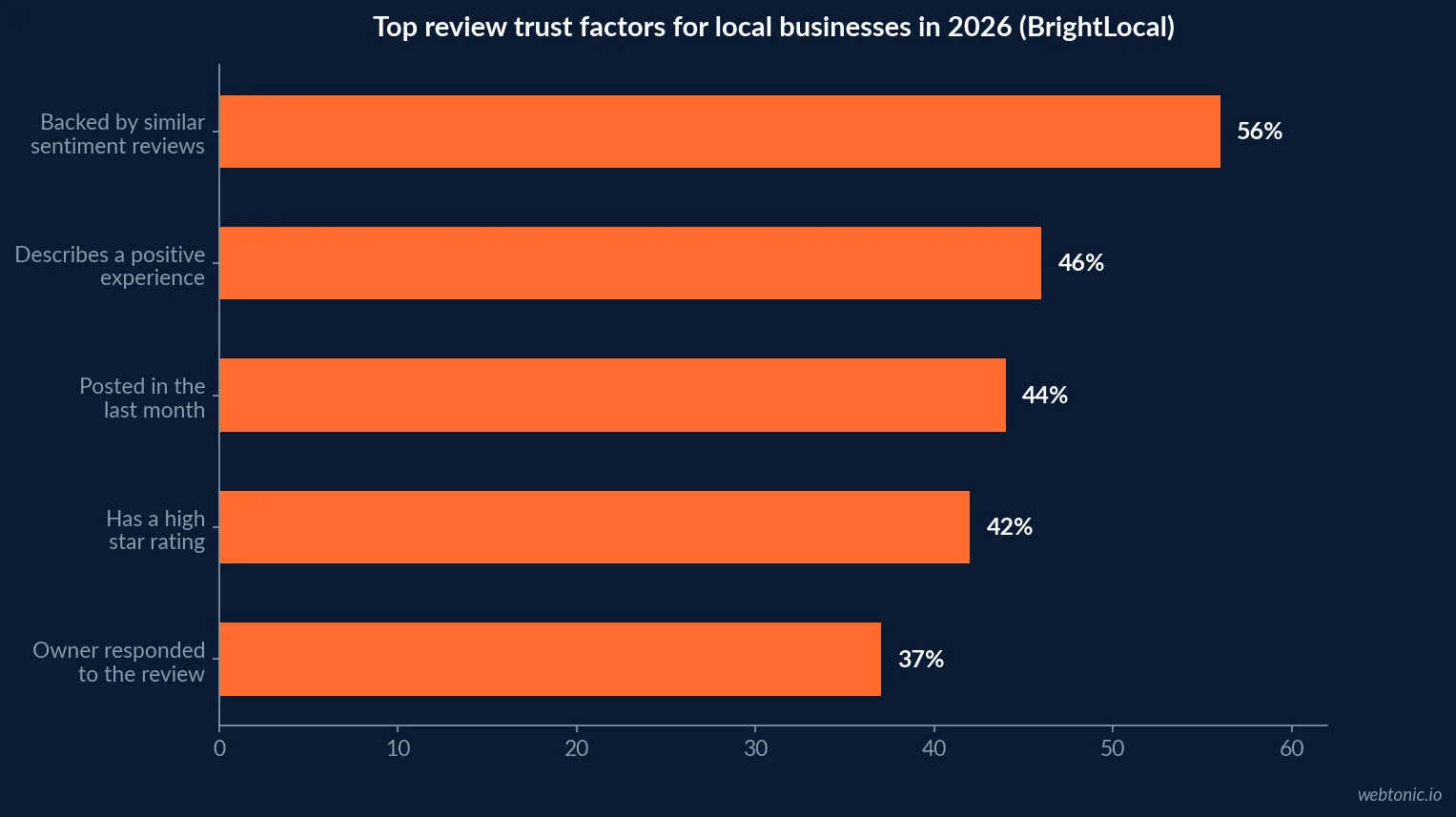
The single most influential factor in the survey was not star rating at all: 56% of consumers said a review matters most when it is backed up by other reviews describing a similar experience. A handful of five-star reviews with no supporting detail convinces fewer people than a steady stream of consistent, specific ones.
| Review trust factor (BrightLocal 2026) | Share of consumers who cite it | Rank |
|---|---|---|
| Backed up by other reviews with similar sentiment | 56% | 1 |
| Describes a positive experience | 46% | 2 |
| Posted within the last month | 44% | 3 |
| Has a high star rating | 42% | 4 |
| Business owner responded to the review | 37% | 5 |
What changed in the local ranking-factor model itself
Whitespark's 2026 Local Search Ranking Factors report, its first update in over two years, surveyed 47 local SEO experts on 187 ranking factors across local pack, local organic, AI search visibility, Local Services Ads and conversion. Darren Shaw, the report's author, notes that review signals and behavioral signals gained the most weight in the 2026 edition, while on-page and link signals softened slightly, partly because social signals were reintroduced as a separate category this year. 47 entirely new factors were added to the model, several of which - including business-hours accuracy and click-through rate from the local pack - ranked in the new top ten.
For a garage door and window business, that shift reinforces the same conclusion as the BrightLocal data from a different angle: the review profile and the behavioral signals it generates (calls, clicks, direction requests) now carry more of the local ranking weight than they did two years ago.
| Local ranking-factor category | 2026 direction of weight | Source |
|---|---|---|
| Review signals | Increased | Whitespark 2026 |
| Behavioral signals | Increased | Whitespark 2026 |
| On-page signals | Slightly decreased | Whitespark 2026 |
| Link signals | Slightly decreased | Whitespark 2026 |
| Citation signals | Decreased about half a point | Whitespark 2026 |
Where Yelp still wins real business
Yelp is not a rounding error for this category, even if it trails Google on consumer mindshare. Yelp's own 2023 results release reports Home Services advertising revenue growing roughly 20% year over year and at close to a 20% compound annual rate since 2019. Yelp's 2024 state-of-services report found Home Services led every Yelp category in new business openings, up 11% year over year with 217,000 total openings, driven partly by weatherproofing and home-upgrade services - a category garage doors and windows sit squarely inside.
The honest read: Google should get the bulk of the local SEO effort because it captures the larger share of consumer attention, but claiming a Google Business Profile and abandoning Yelp means giving up a channel Yelp's own data shows is actively growing for this trade.
The third option neither Google nor Yelp offers
The Google-versus-Yelp framing skips a channel specific to this trade: the International Door Association's own “Find-a-Pro” directory, which lists vetted IDA member dealers and positions itself explicitly as an alternative to an “overwhelming marketplace filled with varying claims.” It will never carry Google's search volume, but it is a trust signal a generic home-services directory cannot offer: trade-association vetting rather than a star rating anyone can leave.
Where AI search is already pulling its citations from
The Google-versus-Yelp question is becoming a three-way question as AI search grows. BrightLocal's analysis of AI directory sources for local search found Google Business Profile makes up 28.5% of all citations AI engines use for local answers, with Yelp at 8.53% and rising usage specifically inside ChatGPT results. The same analysis found roughly 93% of cited domains were the business's own website, not a directory at all - a reminder that neither Google nor Yelp fully replaces having accurate, crawlable information on your own site.
| Local citation source (AI search) | Share of citations | Source |
|---|---|---|
| Google Business Profile | 28.5% | BrightLocal AI directory sources analysis |
| Yelp | 8.53% | BrightLocal AI directory sources analysis |
| Business's own website | ~93% of cited domains | BrightLocal AI directory sources analysis |
The compliance angle both platforms now share
Whichever platform a garage door company leans on, the market behind that visibility work keeps growing: FMI Consulting's 2026 sector brief puts the US overhead and garage door services market above $16 billion, with more than 114 million doors already installed creating recurring, non-discretionary local search demand every time one of them needs a repair. That is the scale a local SEO program is actually competing to be visible inside.
Whichever platform a garage door company leans on for reviews, those reviews themselves are now covered by the FTC's final rule on consumer reviews and testimonials, 16 CFR Part 465, in force since August 2024. The rule bans review-buying, undisclosed insider reviews, and suppressing genuine negative reviews through the threat of legal action - all practices that show up in local-service categories where review volume decides which business gets chosen. A company that has been quietly asking employees to leave reviews on their own installs, or threatening negative reviewers, is now inside a rule the FTC can enforce directly.
| Local visibility channel | What it's best for | Cost to the business | Source |
|---|---|---|---|
| Google Business Profile | Highest share of consumer local search | Free (organic) | BrightLocal 2026 |
| Yelp business profile | Growing home-services ad category | Free profile, paid ads optional | Yelp |
| IDA Find-a-Pro directory | Trade-vetted trust signal | IDA membership dues | IDA |
| Own website | ~93% of domains AI search actually cites | Hosting and maintenance | BrightLocal 2026 |
What none of this data settles
None of the sources above measure garage door and window search behavior directly; every figure is a general local-consumer or cross-industry ranking-factor number. Treat the priorities below as a starting sequence to test against your own call-tracking and quote-request data, not a guarantee that the same percentages hold for this specific trade in every market.
How to prioritize the work
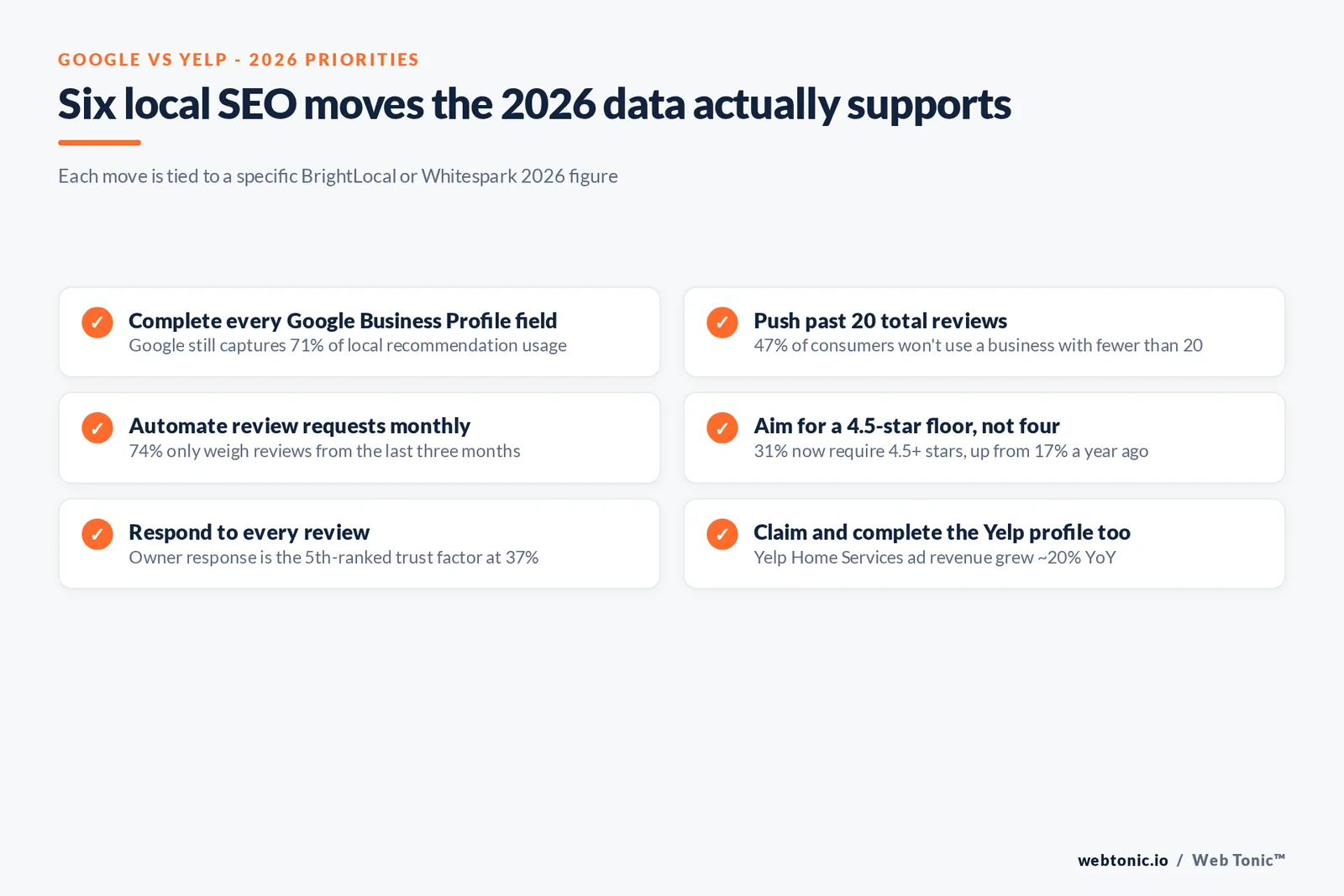
Start with the Google Business Profile category, service list and photo freshness - the factors that moved most in Whitespark's 2026 update - then build toward 20-plus recent, detailed reviews before worrying about link building. Claim and complete the Yelp profile in parallel rather than as an afterthought, since it is the platform most likely to catch homeowners doing a second check after Google. Our data and analytics team can help set up the review-recency tracking this data argues for, and our conversion rate statistics page has the benchmarks to judge whether the reviews are actually converting once they are in place. If paid local channels are also on the table, our cost-per-lead benchmarks by industry put organic and paid local visibility on the same scale.
Frequently Asked Questions
Does Google actually beat Yelp for garage door companies?
The consumer-behavior data says yes, but the gap narrowed in 2026. BrightLocal's Local Consumer Review Survey found Google's share of “which sites people use for local recommendations” fell from 83% in 2025 to 71% in 2026, while usage of other platforms, including Yelp, grew. Google is still the default starting point for most local searches, but treating it as the only channel that matters is no longer supported by the newest survey.
Can a garage door company even run Google Local Services Ads?
It depends on the market and the pre-badge status. Google's own Local Services Ads help documentation lists garage door services as an eligible category, but notes that pre-badge ads - the version that runs before a background check completes - are not available for garage door services, alongside health care verticals and locksmiths. That makes a clean, verified Google Business Profile more load-bearing for this trade than for categories where pre-badge ads can fill the gap.
How many reviews does a garage door company actually need?
BrightLocal's 2026 survey found 47% of consumers will not use a business with fewer than 20 reviews, and only 9% are willing to use one with five or fewer. Twenty reviews is a realistic floor, not a stretch goal, for a local trade business trying to clear the first filter in a homeowner's search.
Is star rating or review recency more important in 2026?
Both moved sharply. 31% of consumers now require 4.5 stars or higher before using a business, up from 17% a year earlier, and 74% only weigh reviews written in the last three months. A garage door company sitting on a strong rating built entirely from 2023 jobs is more exposed than it looks.
Does Yelp actually generate business for garage door and window companies?
Yelp's own investor materials report Home Services as a standout category: advertising revenue from Home Services grew roughly 20% year over year in 2023 and at close to a 20% compound annual rate since 2019, and Yelp's 2024 trends report found Home Services led every category in new business openings, up 11% year over year with 217,000 total openings. Yelp is a real channel for this trade, it is simply a smaller share of consumer attention than Google.
Sources
BrightLocal - Local Consumer Review Survey 2026
Whitespark - 2026 Local Search Ranking Factors Report
Google - Getting started with Local Services Ads (help documentation)
Yelp - 2023 full-year results press release
Yelp - State of Services 2024 trends report
International Door Association - Consumer resources
BrightLocal - Where AI search gets its local citations
Federal Trade Commission - Final rule banning fake reviews and testimonials, 2024
FMI Consulting - Private Equity Sector Brief: Overhead & Garage Door Services, March 2026