Table of contents
The build-or-buy question for growth leadership is rarely about the monthly cost. It is about how many hours a week the role genuinely needs, and how fast you need to be right.
Key Takeaways
- The two options are not priced on the same axis. A fractional head of growth is a variable monthly cost of roughly $5,000–$15,000; an in-house hire is a fixed annual commitment starting near $140,000 base and reaching $280,000 at senior level.
- Fully loaded cost is the honest comparison. Add benefits, payroll taxes, tooling and a search fee of 25–35% of salary before you compare anything.
- Hours decide it. Under 8 weekly hours, an advisor is enough; 10–20 hours is the fractional sweet spot; past 30 hours the permanent hire wins on both cost and continuity.
- Speed favours fractional. A senior marketing search plus a ramp quarter routinely consumes two quarters before the first decision lands; fractional engagements start inside two weeks.
- Risk is asymmetric. Senior mis-hire benchmarks run up to 213% of salary, and one executive-search view puts the total cost of a failed executive hire at 5–10x annual salary.
- Neither option fixes execution capacity. Both need someone to ship the work, and a leader with no capacity beneath them produces plans, not pipeline.
What you are actually comparing
An in-house head of growth buys presence, continuity and cultural authority. They are in every standup, they own hiring, and they carry institutional memory. A fractional head of growth buys pattern recognition and senior judgement at a fraction of the calendar — typically 10–20 hours a week — with the trade-off that they are not there for everything.
That difference produces two different failure modes. Under-scoped in-house hires get absorbed into execution and stop leading. Under-scoped fractional hires produce strategy nobody implements. Both are avoidable, and both come from writing a job description around activities rather than decisions.
Scope also differs by title. 2026 fractional pricing research puts head-of-growth work at $8,000–$20,000 a month, banded as $8,000–$12,000 at $1M–$5M ARR and $12,000–$20,000 at $5M–$20M, and prices it just below a fractional CMO because the remit is narrower. That is a feature when your problem is funnel economics rather than brand.
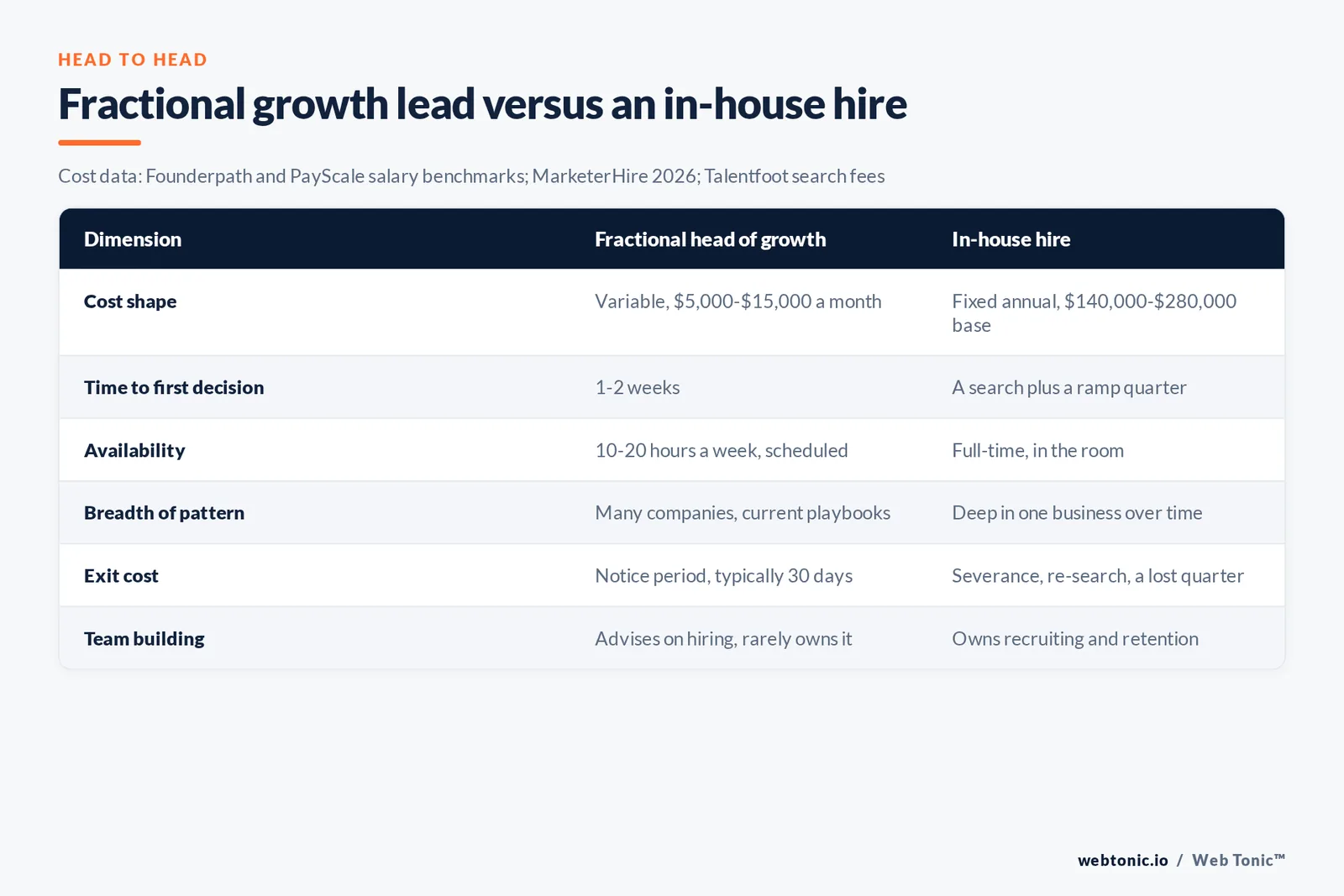
| Dimension | Fractional head of growth | In-house hire |
|---|---|---|
| Cost shape | Variable, $5,000–$15,000 a month | Fixed annual, $140,000–$280,000 base plus loading |
| Time to first decision | 1–2 weeks | A search plus a ramp quarter |
| Availability | 10–20 hours a week, scheduled | Full-time, in the room |
| Breadth of pattern | Many companies, current playbooks | Deep in one business over time |
| Exit cost | Notice period, typically 30 days | Severance, re-search, a lost quarter |
| Team building | Advises on hiring, rarely owns it | Owns recruiting, ramping and retention |
The cost comparison, done properly
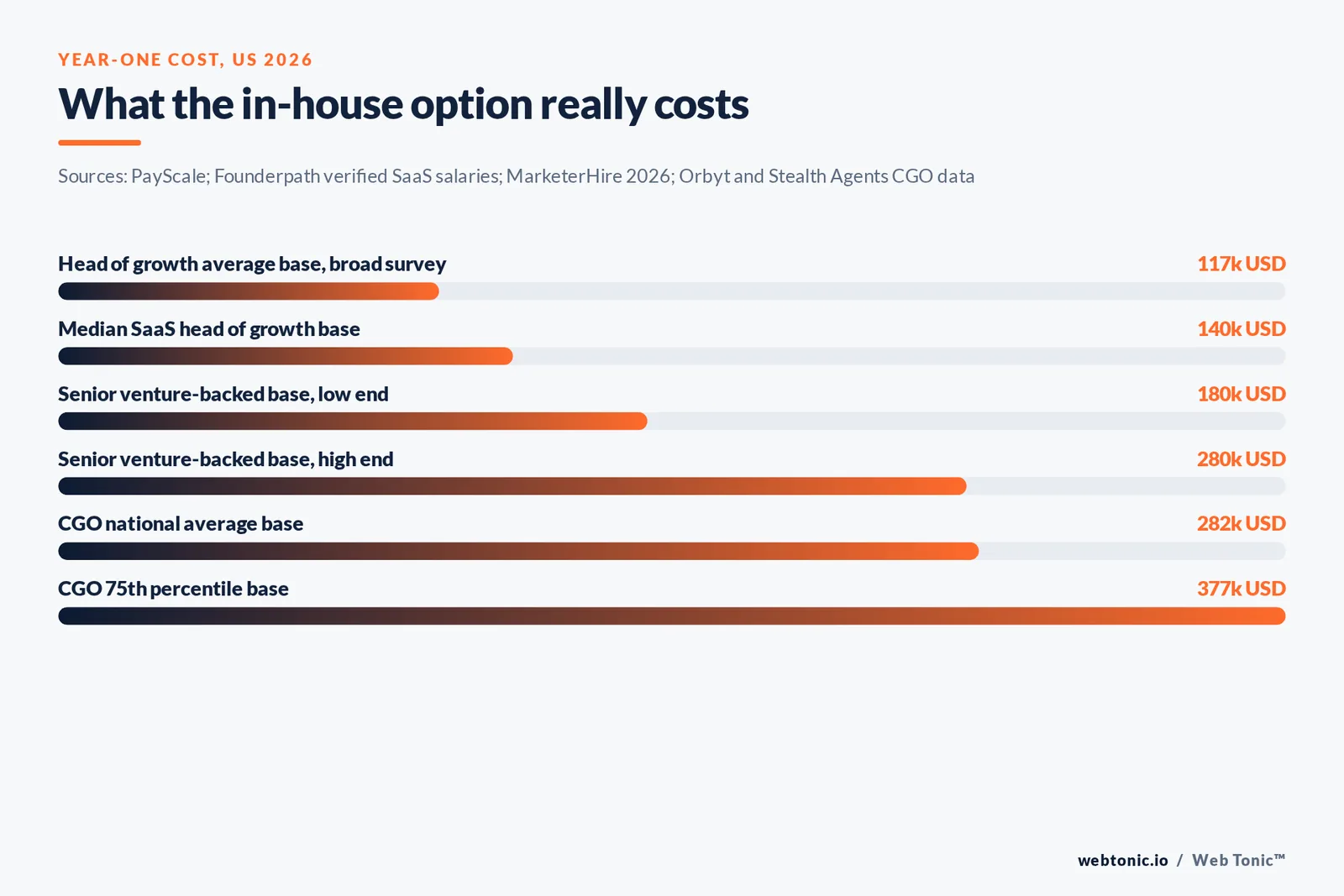
Start with the base. Verified SaaS salary data reports a $140,000 median base for a head of growth with a $100,000–$200,000 typical range and a $148,619 average across 69 salaries; broader survey data from PayScale shows an average of $117,110, reflecting smaller companies. Senior, venture-backed roles are far higher: 2026 hiring guidance quotes $180,000–$280,000 base with total cash of $220,000–$350,000.
Then add loading. Benefits and employer taxes, equipment, tooling and a recruiting fee — retained search runs 25–35% of salary, with executive process cost alone around $28,000. A $180,000 base is realistically a $250,000-plus year-one commitment before the role produces anything.
If the role you actually want is a chief growth officer, the gap widens sharply. US CGO salary data shows a $290,000 median with a $226,000 25th percentile and $377,000 at the 75th, and 2026 hiring cost research cites a $282,457 national average base with a $232,453–$336,659 interquartile range. Benchmarks by company size put base pay at $300,000–$400,000 for $100M–$500M revenue businesses.
Speed, and why it usually decides
Cost comparisons are static; the decision is not. A permanent search for senior marketing leadership takes weeks to shortlist, weeks to interview, then a notice period, then a ramp. Even a fast, well-run process rarely produces a first substantive strategic decision inside a quarter — and the 90-day arc most incoming leaders run deliberately spends the first month listening.
Fractional engagements invert that. The operator arrives with a diagnostic method, no politics to navigate and no ramp to fund, and the first decisions typically land in weeks two to four. When you are burning budget on channels you cannot yet defend, that difference is worth more than the monthly rate gap.
Speed cuts the other way on continuity. A fractional leader will not be in the room for every escalation, and if your business needs daily senior presence — heavy team management, complex stakeholder work, live crisis handling — the model strains. That is the honest boundary of it, and it is why the hours test beats the cost test.
Risk: the number nobody puts in the model
The strongest argument for starting fractional is optionality. If the role is wrong, you learn in one quarter at a cost of one quarter. If the hire is wrong, the bill is much larger. 2026 executive-hiring research benchmarks the total cost of a failed executive hire at 5–10x annual salary once vacancy, ramp, opportunity cost and re-search are counted, and mis-hire studies put the direct cost as high as 213% of salary.
There is also the specification risk. Many businesses cannot yet describe the growth role they need — which segment, which motion, which metric. A three-to-six month fractional engagement produces exactly that specification as a by-product, which is why sequencing fractional first and hiring second is often cheaper than the reverse even when you always intended to hire.
The counter-risk is vetting. Talent research for 2026 reports that fractional executive supply has roughly tripled in 24 months, some of it through relabelling, and marketplace data shows monthly postings up around 149% year on year in Q1 2026. Ask for one engagement at your stage and model, with before-and-after numbers, and check who covers continuity if their portfolio grows.
Why the market made this a real choice
Ten years ago the build-or-buy question barely existed at this level: senior growth talent was employed, and part-time meant junior. That has changed on the supply side. Market analysis for 2026 puts global fractional executive services above $5.7bn, growing at 14% a year, with analyst coverage and sub-verticals of its own.
Demand followed. Marketplace data shows monthly fractional job postings up roughly five-fold from early 2024 to Q1 2026, a 149% year-on-year rise in that quarter, and an 83% increase in the member network during 2025. The practical consequence for a buyer is that you can now run a genuine shortlist of three to five credible operators for a growth remit, at your stage, in under two weeks — which was not true before, and which is what makes fractional a real alternative to a search rather than a stopgap.
It also means the price signal has stabilised. When rates were idiosyncratic, comparing fractional to in-house was guesswork; now that published ranges cluster around $5,000–$15,000 a month for 10–20 weekly hours, you can put both options in the same model and argue about assumptions instead of numbers. The remaining variance is almost entirely scope: how much execution, analytics build and agency oversight sits inside the retainer.
The decision, in five questions
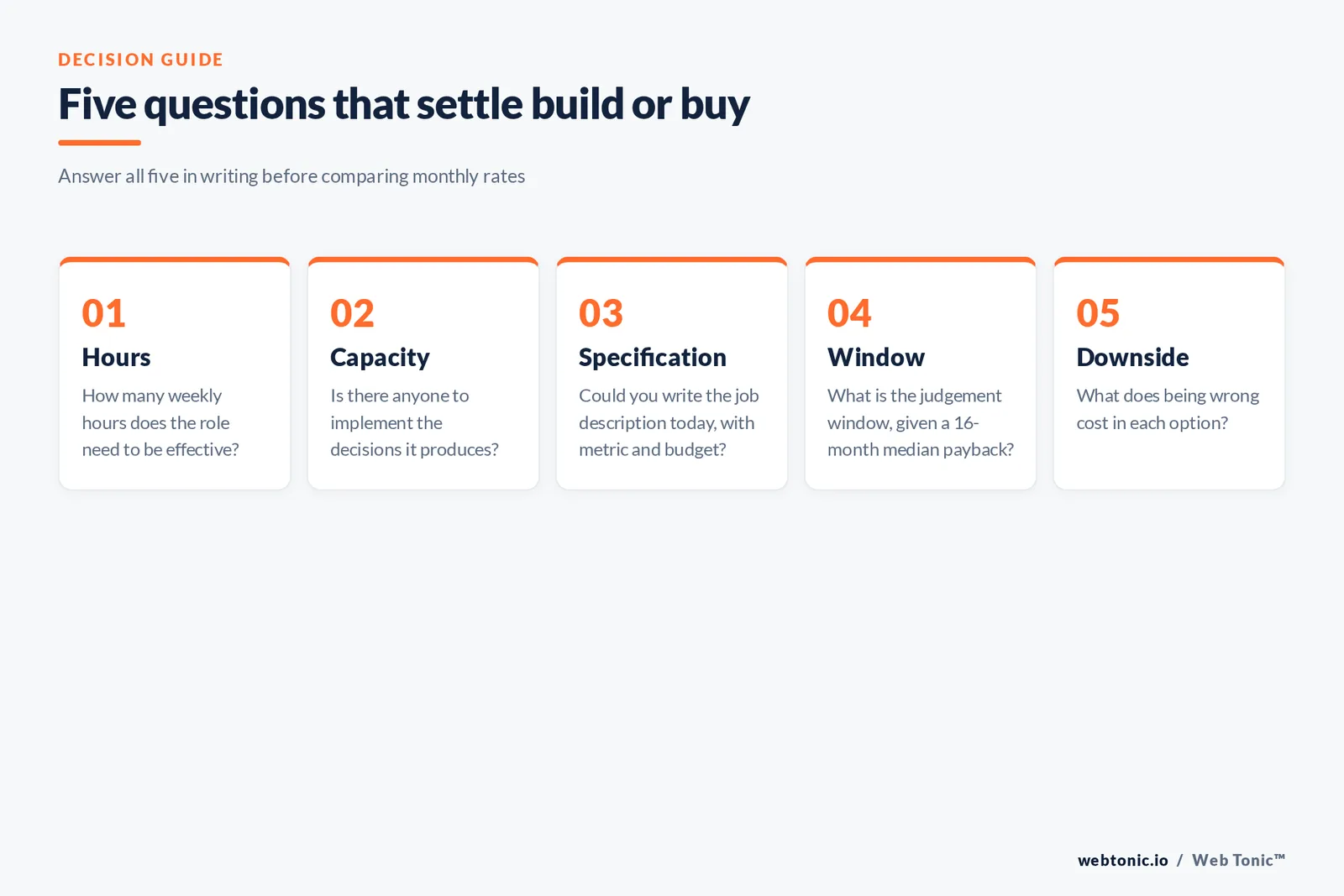
First: how many hours a week does the role need to be effective? Write the answer down before looking at rates. Second: do you have execution capacity — people or agencies — that can absorb the decisions? If not, buy capacity first, leadership second. Third: can you write the job description today, with segment, metric, channels and budget? If not, you are buying a diagnosis, and fractional is the cheaper diagnosis.
Fourth: what is the judgement window? CAC payback benchmarks from 342 companies put the median at 16 months, top quartile at 6 and bottom at 24 or more, so a role judged on payback needs quarters, not weeks. Fifth: what happens if you are wrong? Price the exit for both options and the fractional route usually looks materially safer.
A common and sensible answer is both, in sequence: a fractional head of growth for one to two quarters to set the system and write the specification, then a permanent hire who inherits a working machine rather than a blank page. That is how most of our fractional growth leadership engagements are structured, alongside the delivery teams in growth marketing and performance creative.
| Your situation | Better option | Why |
|---|---|---|
| No agreed plan, no clear metrics | Fractional | You are buying a diagnosis and a specification |
| Plan exists, nothing ships | Capacity, then leadership | The constraint is hands, not direction |
| Role needs 30+ hours a week | In-house | Fractional economics and presence both break down |
| Board event within two quarters | Fractional | A search plus ramp will not deliver in time |
| Multiple agencies, no owner | Fractional at 12+ hours | Oversight is high-leverage and part-time by nature |
| Building a growth team of 5+ | In-house | Hiring, ramping and retention need daily presence |
One more variable rarely discussed: where the person sits. Remote-first fractional operators are the norm, and for startups that is usually an advantage — you get expertise from a larger market than your city, and the help arrives in scheduled blocks rather than corridor conversations. It becomes a disadvantage when the growth role has to lead people daily, because a remote part-time leader cannot coach a junior team through their first quarter. If your growth function is one strong operator plus agencies, remote fractional works well; if it is four juniors who need daily direction, that is a full-time job with a local or at least same-timezone leader.
Getting the structure right either way
Whichever route you pick, three things do the heavy lifting. Define the role by decisions and the metrics that prove them, not by a channel list. Give it real authority over budget within agreed limits, because a growth leader who cannot move money is a reporting function. And agree the measurement window in advance — leading indicators in quarter one, sourced pipeline and payback from quarter two.
Then instrument it. Most disputes about growth leadership are really disputes about data definitions, and they are cheap to settle at the start and expensive to settle at the review. If your conversion and pipeline reporting is not yet trustworthy, fix that first; our data intelligence work exists because that single step changes what every subsequent decision is worth. More on the operating side of this sits across the blog, and if you want a view on your specific situation, start there.

Related reading
- Fractional Head of Growth Statistics: Hiring vs Outsourcing
- Fractional CMO for SaaS: vs hiring in-house
- Fractional CMO: vs hiring in-house
- Marketing Strategy Consulting services at Web Tonic
Frequently Asked Questions
Is a fractional head of growth cheaper than hiring?
Per month, usually yes: roughly $5,000–$15,000 against a fully loaded in-house cost that starts near $250,000 a year at senior level. Per hour of senior attention it is often more expensive, which is the point — you are buying judgement density, not coverage.
At what point should we switch to a permanent hire?
When the role consistently needs 30 or more hours a week, when you are building a growth team of several people, or when the strategic questions are settled and the job becomes execution management. Those three signals usually arrive together.
Can we do both at once?
Yes, and sequencing works well: a fractional leader sets the system and writes the specification, then hands over to the permanent hire with a working measurement stack and a documented plan. Keep a short overlap for handover rather than a clean break.
How do we protect ourselves from a bad fractional pick?
Start with a three-month term, a written scope expressed as decisions, one prior engagement at your stage with real numbers, and a named continuity plan. Compare that to mis-hire benchmarks of up to 213% of salary and the downside is a rounding error.
What does the in-house option cost beyond salary?
Benefits and employer taxes, equipment and tooling, and recruiting — retained search alone runs 25–35% of salary, with roughly $28,000 in process cost for an executive hire. Budget the first year at well above the headline base.
Sources
MarketerHire (fractional head of growth rates; head of growth job description and 2026 compensation), Treetop Growth Strategy (2026 fractional executive pricing guide; state of fractional executive talent 2026), Founderpath (SaaS head of growth salary benchmarks), PayScale (head of growth salary 2026), Orbyt (chief growth officer salary data 2026), Stealth Agents (cost of hiring a chief growth officer 2026), JRG Partners (chief growth officer salary guide 2026; cost of a bad executive hire 2026), Talentfoot (senior leadership mis-hire benchmark 2026), Aleph (CAC payback benchmarks 2026). Accessed September 2026.