



Table of contents

The first quarter with a fractional head of growth is not for growth. It is for building the instrument that will show whether growth is happening, and for deciding what to stop.
Key Takeaways
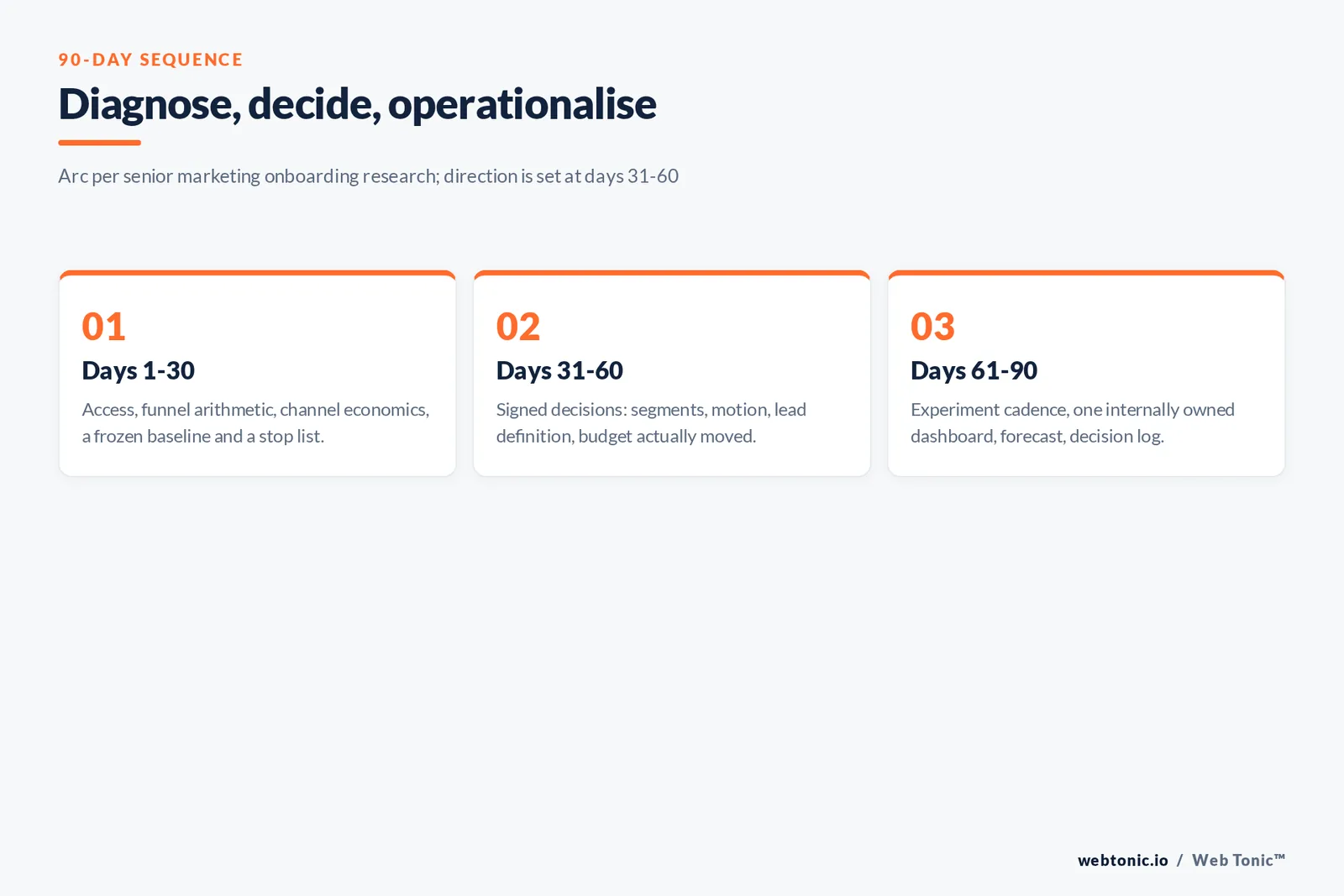
- Run the quarter in three arcs: diagnose (days 1–30), decide (days 31–60), operationalise (days 61–90). Leaders who invert the order pay for it all tenure.
- At the end of 90 days you should hold four written answers: what marketing's role in the commercial model is, what the qualified-lead definition is and who signed it, what you are betting on next quarter, and the expected return.
- Judge quarter one on leading indicators. Benchmark data shows a median CAC payback of 16 months, so day-90 revenue measures your sales cycle, not the engagement.
- Experiment velocity is the fastest honest signal. Structured teams run 3–5 valid experiments a month against 1–2 for early-stage teams; moving from the floor to the middle band inside a quarter is realistic.
- Fix data before strategy. If nobody can state marketing-sourced pipeline share — benchmarked around 31% for B2B SaaS with a 30–50% median band — every channel decision in the quarter is a guess.
- At 10–20 hours a week, capacity is the binding constraint. Cut the plan to three shipped changes rather than ten started ones.
Why the sequence matters more than the plan
Every incoming growth leader faces the same pressure: show something fast. The temptation is to launch in week two, because launching looks like progress. Onboarding research for senior marketing leaders describes the correct arc as listen-diagnose (days 1–30), align-decide (31–60), act-deliver (61–90), and notes bluntly that executives who invert the order pay for it across their whole tenure.
The published frameworks agree on the middle phase being about direction rather than delivery. A published first-90-days framework for marketing leaders puts "establish direction" — vision, goals, a structured plan — at days 31–60, after the diagnostic and before execution scales.
Fractional adds a constraint the full-time playbooks ignore: time. At the typical 10–20 hours a week, a quarter is roughly 120 to 240 working hours in total. That is enough to diagnose properly and ship a small number of changes well. It is not enough to do both at full breadth, so the plan has to be cut deliberately rather than by attrition.
| Phase | Primary output | What must not happen |
|---|---|---|
| Days 1–30 | Diagnostic: data trust, funnel maths, channel economics, stop list | New campaign launches before the numbers are trusted |
| Days 31–60 | Written decisions: segments, motion, metric definitions, budget shifts | Decisions left implicit in a deck nobody signs |
| Days 61–90 | Operating system: experiment cadence, one dashboard, forecast, owners | A dashboard only the fractional lead can open |
| Throughout | Weekly 60-minute review with the internal owner | Reviews that report activity instead of decisions |
Days 1–30: instrument, then diagnose
Week one is access and definitions. Ad accounts, analytics, CRM, billing, the last four quarters of reporting, and the list of things people believe to be true. Nothing else in the quarter is safe until this is done, because a diagnosis built on untrusted conversion data produces confident nonsense that then gets funded.
Week two is the funnel arithmetic: volume and conversion rate at each step, cost per step, and the gap between what platforms report and what the CRM holds. This is where the first uncomfortable numbers appear, and where the corrected baseline gets frozen and written down — before any change ships, so the day-90 comparison is honest.
Weeks three and four are economics and a stop list. Which channels pay back and over what horizon, which spend cannot be defended, and which reporting definitions conflict. 2026 pipeline benchmarks place the B2B SaaS median at 30–50% marketing-sourced with top quartile at 60–70% and treat sub-30% as a signal; benchmark data puts the B2B SaaS average near 31% sourced and 68% influenced. Knowing where you sit against that is the deliverable of month one, not a strategy document.
Days 31–60: decisions, written down and signed
The middle month exists to convert diagnosis into a small number of irreversible-feeling decisions. Which two segments you are actually competing for. Which motion — inbound, outbound, partner, product-led — carries the number. What a qualified lead is, in a sentence, with the sales leader's name next to it. Where budget moves from and to, in figures. And what you will stop.
Unsigned decisions are the classic failure of this phase. A deck that says "recommend focusing on mid-market" is not a decision; a line in the operating plan that says "we will not build for sub-20-seat accounts this year, signed by the CEO and CRO" is. The test is simple: could someone new read the document and know what to say no to?
Budget movement is the visible proof. If nothing has moved by day 60, the stop list was advisory and the quarter is drifting. This is also the moment to size execution capacity honestly — a fractional lead at 12 hours a week cannot also produce creative, build tracking and run the analytics, so the plan either fits the capacity you have across growth marketing and performance creative, or it gets cut.
Who sits in the room shapes the quarter as much as the plan does. The strongest version has three people: the founder or CEO sponsor, the revenue or sales leader, and one internal owner who can implement. Bringing the CFO in once, around day 45, is worth the calendar cost — the financial view of acquisition and payback is usually the fastest way to settle a disagreement about which channel deserves the next dollar. If a GTM function already exists, the consultant's job is to make it legible rather than to replace it, and companies that treat the engagement as an audit of people rather than of the system get a defensive team and a slow quarter.
Two practical notes on evidence. Ask that every claim in the diagnosis point at something real and live — an account, a report, a recording — rather than at market commentary, and ask that decisions get signed in writing rather than agreed in a meeting. A signed one-page decision log is the single artefact that makes month four productive, because the next argument starts from what was already settled instead of from scratch.
Days 61–90: build the operating system
The last month is about durability: whatever exists at day 90 should keep running if the engagement paused. That means an experiment cadence with a named owner, one dashboard both marketing and finance read, a forecast with stated assumptions, and a written decision log.
Set the velocity target from benchmarks rather than ambition. Experimentation velocity data puts early-stage teams at 1–2 valid experiments a month, teams with a structured process at 3–5, and high-performing operations at 6–10 across channels. Moving from 1 to 4 a month inside a quarter is a real achievement; promising 10 is how programmes lose credibility in month four.
Then hand over the instrument. Definitions documented, dashboards owned internally, tracking verified end to end — the work our data intelligence practice exists to make routine. The failure signal here is a reporting stack that only the outside operator can maintain, because that converts a leadership engagement into a dependency.
What to measure at each gate
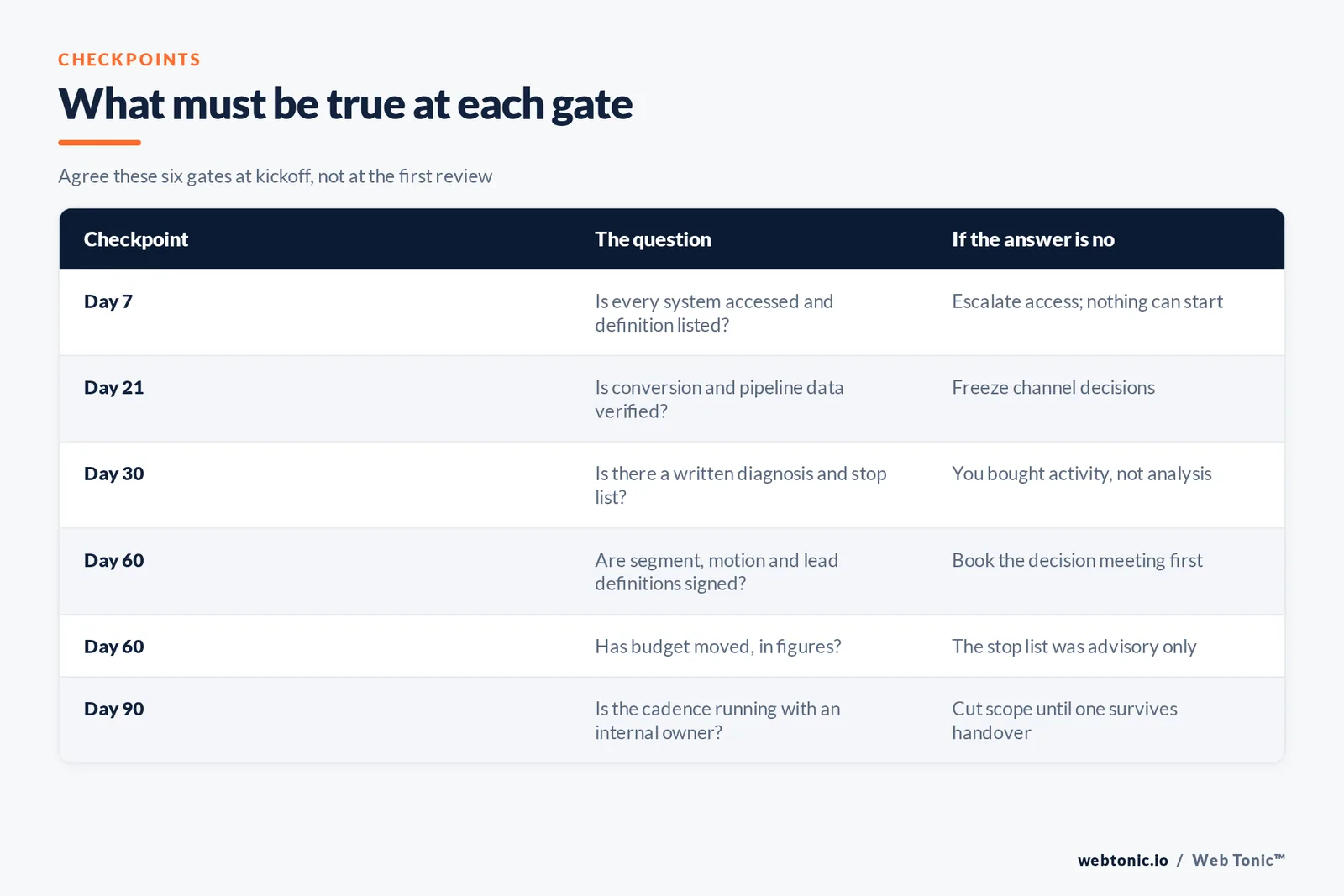
Agree the gates at kickoff, not at the first review. The point of naming them in advance is that a missed gate becomes a conversation about capacity or scope, rather than an argument about whether the engagement is working.
Keep revenue out of the quarter-one scorecard. Payback benchmarks from 342 companies show a 16-month median CAC payback, a top quartile of 6 months and a bottom quartile of 24 or more. On those timelines, day-90 closed revenue mostly reflects decisions made before the engagement started.
| Checkpoint | The question | If the answer is no |
|---|---|---|
| Day 7 | Is every system accessed and every definition listed? | Escalate access; the diagnostic cannot start |
| Day 21 | Is conversion and pipeline data verified end to end? | Freeze channel decisions until it is |
| Day 30 | Is there a written diagnosis with a stop list? | The engagement is producing activity, not analysis |
| Day 60 | Are the segment, motion and lead definitions signed? | Book the decision meeting before anything else |
| Day 60 | Has budget actually moved, in figures? | The stop list was advisory only |
| Day 90 | Is the experiment cadence running with an internal owner? | Cut scope until one cadence survives handover |
Setting the engagement up before day one
Most of what goes wrong in the first quarter is decided before it starts. Three things are worth settling in the contract rather than the kickoff: the hours, the decision rights, and the review cadence. Hours because 2026 pricing research shows head-of-growth engagements running $8,000–$12,000 a month at $1M–$5M ARR and $12,000–$20,000 above it, and the difference between those bands is almost entirely weekly commitment. Decision rights because a growth lead who cannot move budget within an agreed limit is a reporting function. Cadence because a weekly 60-minute review with the internal owner is the mechanism that keeps a part-time role from drifting.
Access is the other pre-work. Ad platforms, analytics, CRM, billing, tag manager and the data warehouse if one exists — requested and approved before day one, not during week one. A week lost to permissions is roughly 10–20 hours of senior time at the exact moment it is most valuable, and it delays every downstream gate by the same amount.
Finally, agree what quarter two would look like in each of three outcomes: the strategy needs rebuilding, the measurement needs rebuilding, or the capacity needs rebuilding. Naming those branches in advance turns the day-90 review into a decision rather than a negotiation, and it is how our fractional growth leadership engagements are scoped. Related reading sits across the blog, or talk to us about a specific quarter.
Six ways the quarter gets wasted
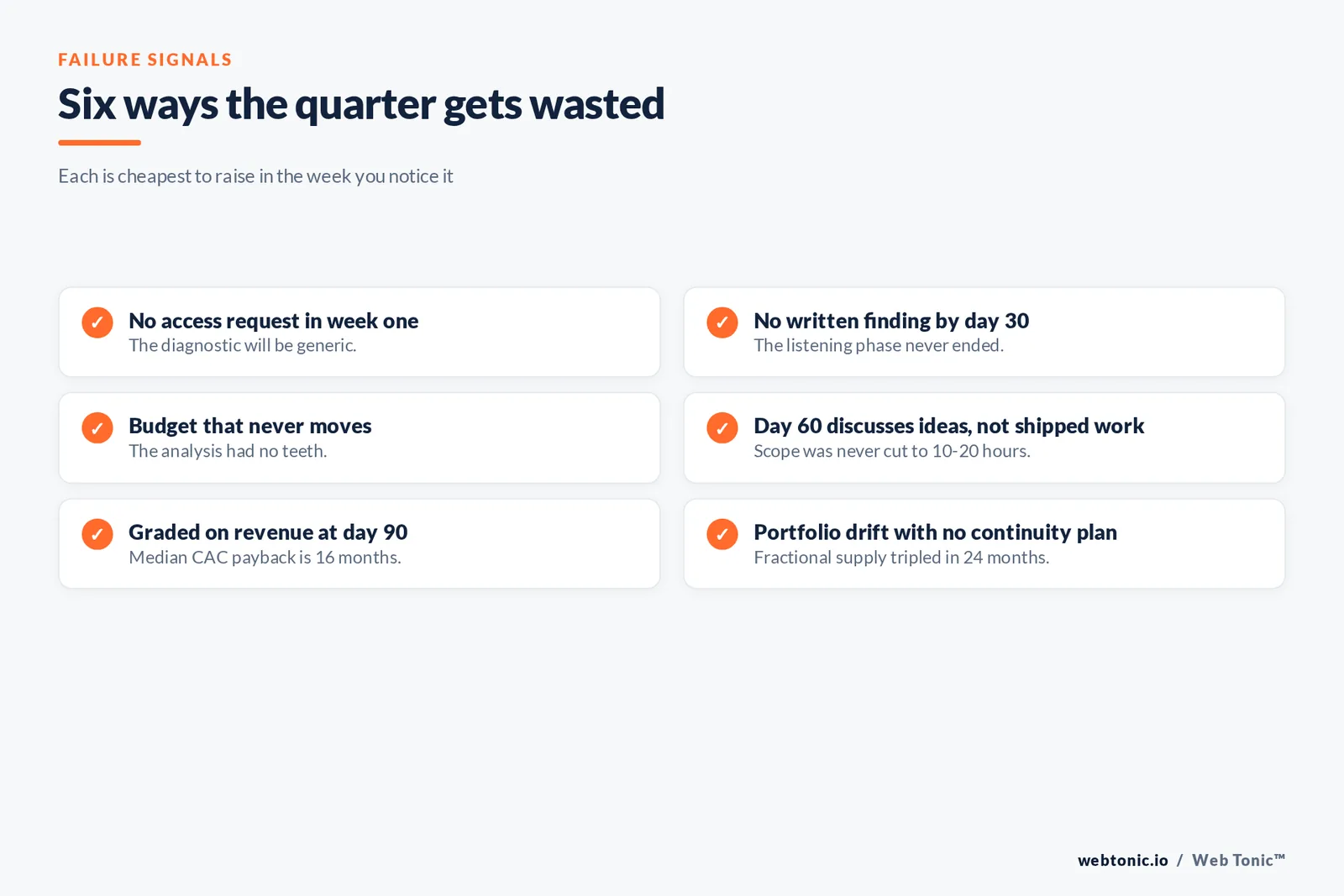
No access request in week one means the diagnostic is generic and the findings will be too. No written finding by day 30 means the listening phase never ended. Budget that never moves means the analysis had no teeth. A day-60 review that discusses ideas rather than shipped changes means scope was never cut to the hours available.
Two subtler failures matter as much. The first is a leader who is graded on revenue at day 90 and therefore optimises for whatever looks fastest — usually more spend on the channel that already converts, which flatters the quarter and hides the constraint. The second is portfolio drift: a fractional operator who takes on additional clients mid-engagement without a continuity plan. 2026 talent research notes supply has roughly tripled in two years, which makes availability easy and diligence essential.
The cost of getting it wrong justifies the discipline. Senior mis-hire benchmarks run up to 213% of salary with roughly $28,000 in executive process cost alone, against a fractional retainer that 2026 pricing data puts at $4,000–$12,000 a month. A tight first quarter is the cheapest insurance available.

Related reading
- Fractional CMO for SaaS: the first 90 days
- Fractional CGO / Head of Growth — How to Run the First Strategy Session
- Fractional CMO: the first 90 days
- Marketing Strategy Consulting services at Web Tonic
Frequently Asked Questions
What should exist at the end of 90 days?
Five artefacts: a written diagnosis with a corrected baseline, signed definitions for segment, motion and qualified lead, a documented stop list with budget actually moved, an experiment cadence with an internal owner, and one dashboard both marketing and finance use.
Should we expect pipeline growth in the first quarter?
Expect leading indicators — experiment velocity, pipeline coverage, data trust, cost per qualified opportunity — to move. Sourced pipeline and CAC payback move over two to three quarters; the median payback benchmark of about 16 months makes that arithmetic, not excuse-making.
How much of the quarter goes on diagnosis?
Roughly the first month at 10–20 hours a week, and it should overlap with quick corrections such as fixing tracking or switching off indefensible spend. If diagnosis is still running at day 45, the scope was too wide.
Who needs to be involved internally?
One named owner with authority to unblock access and implement, plus the sales or revenue leader for the lead definition, and finance for the reporting definitions. Without the first of those, the quarter produces documents.
What if the diagnosis says the strategy is fine?
That is a useful and reasonably common result: the constraint turns out to be execution capacity or measurement, not direction. In that case quarter two should shift budget from leadership hours to delivery capacity, and the engagement should say so plainly.
Sources
JRG Partners (first 90 days onboarding roadmap for a VP of Marketing), Info-Tech Research Group via PR Newswire (first 90 days as a CMO framework), MarketerHire (fractional head of growth engagement norms), Prooflytics (marketing-sourced pipeline benchmarks 2026), The Starr Conspiracy (B2B marketing benchmarks 2025–2026), Exactius (experimentation velocity benchmarks), Aleph (CAC payback benchmarks 2026), Treetop Growth Strategy (state of fractional executive talent 2026), Talentfoot (senior leadership mis-hire benchmark 2026), Knex (fractional head of growth cost 2026). Accessed September 2026.


