Table of contents

A fractional CMO is an experienced chief marketing officer who owns your marketing strategy on a part-time basis — typically 8 to 20 hours a week — instead of taking a full-time executive seat. You buy senior marketing leadership and decision-making authority, not extra execution hands.
Key Takeaways
- A fractional CMO is a part-time chief marketing officer who owns positioning, demand generation, budget allocation and the marketing team, while working across two to five client companies.
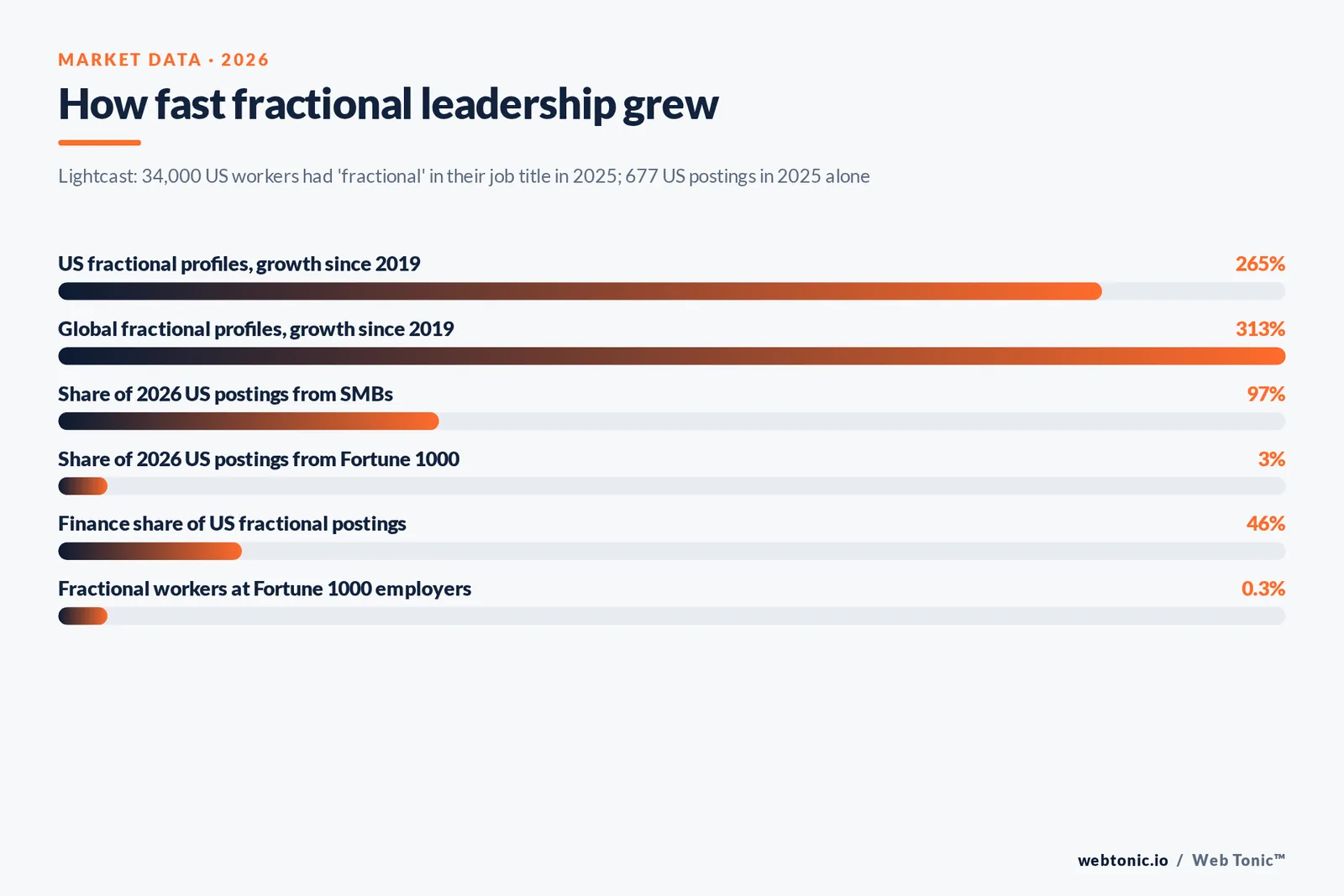
- Fractional work is no longer fringe: Lightcast counted at least 34,000 US workers with "fractional" in their job title in 2025, up 265% since 2019, with global fractional profiles up 313%.
- Demand skews to smaller companies. 97% of US fractional job postings in 2026 came from small and mid-size businesses, and only 3% from Fortune 1000 firms.
- The full-time alternative is expensive and short-lived: average CMO tenure in the S&P 500 is 4.1 years versus 5.0 years for all C-suite roles, and average US CMO total compensation sits near $293,575.
- Independent benchmarks put mid-market fractional CMO engagements at $8,000 to $25,000 per month for one to two days a week — roughly 25% to 50% of the full-time equivalent cost.
- You need one when marketing has become revenue-critical but nobody senior owns it. You do not need one when your real gap is execution capacity.
What a fractional CMO actually is
The fractional chief marketing officer model splits one experienced marketing executive across several companies. Each client gets a defined slice of that executive's week, a defined mandate, and the same seat at the leadership table a full-time CMO would hold. Prose's 2026 benchmark frames it plainly: a fractional CMO is a part-time senior marketing leader who owns strategy, prioritisation, executive alignment and team or vendor direction — not your ad buyer, SEO lead and copywriter compressed into one person.
That distinction is the whole model. A fractional CMO decides what marketing does and why; specialists and agencies decide how. When companies blur the two, they buy 10 hours of executive time and spend it on campaign production, then conclude that fractional marketing leadership does not work.
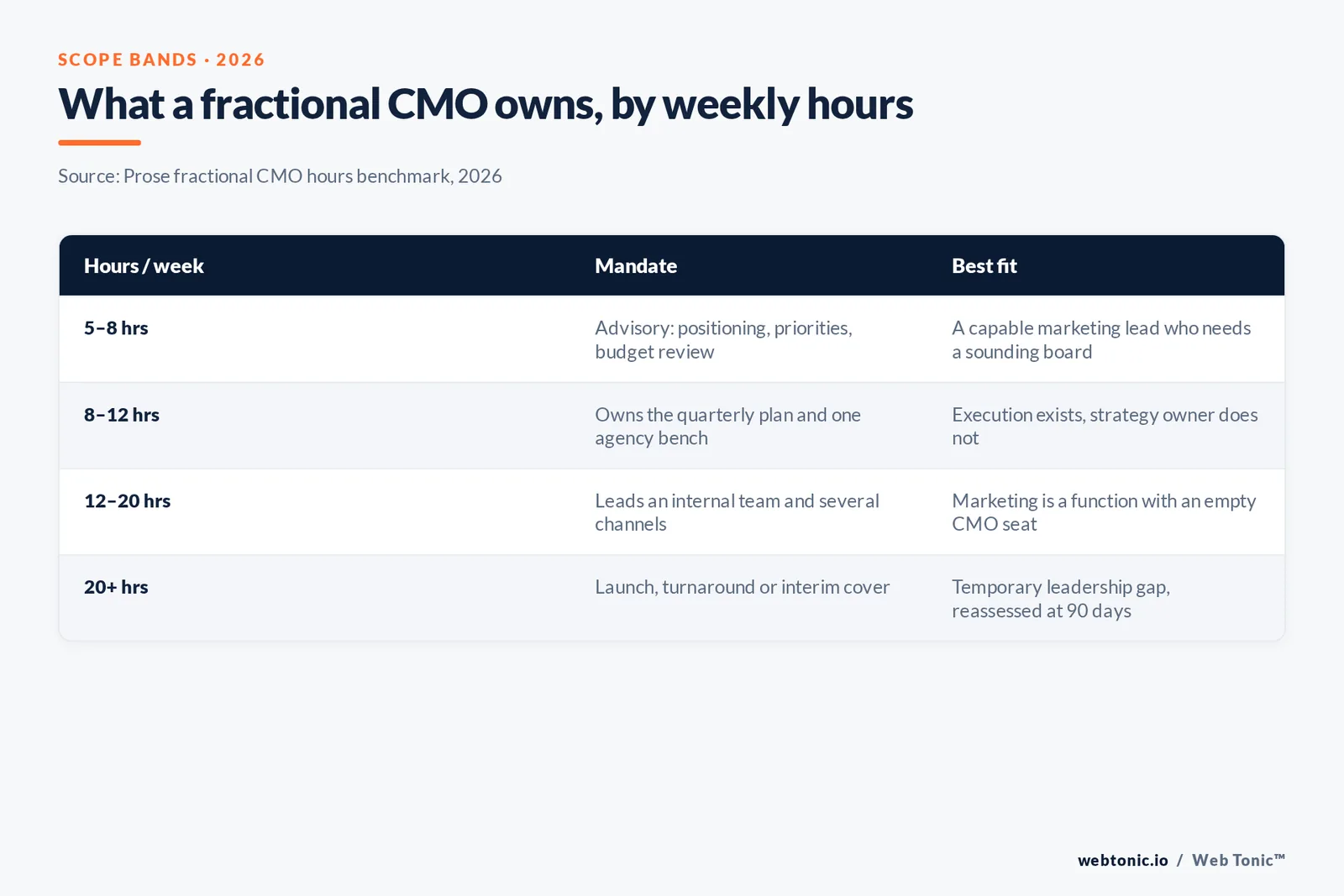
The scope bands below come from the same benchmark and are the cleanest way to size an engagement before you talk to anyone.
| Hours per week | What the part-time CMO owns | Best fit |
|---|---|---|
| 5–8 hours | Advisory leadership: ICP and positioning, budget and channel mix review, coaching the existing marketing manager | A competent marketing lead who needs a sounding board |
| 8–12 hours | Owns the quarterly marketing plan, weekly pipeline and budget reviews, manages freelancers or one agency | Companies with some execution capacity and no strategy owner |
| 12–20 hours | Manages an internal marketing team, several agencies and multiple active channels | Marketing is a real function but the CMO seat is empty |
| 20+ hours | Launch, turnaround, repositioning or leadership gap coverage, reassessed after 30–90 days | Temporary interim marketing director cover |
Why the fractional executive model exploded
Lightcast labour-market data puts numbers on a trend most founders felt before they could measure it. In 2025 there were at least 34,000 US workers whose current job title mentioned "fractional", 265% more than in 2019. Job postings moved the same way: 677 US fractional postings in 2025, more than double the year before, and nearly 1,000 in the first seven months of 2026 alone.
The adopters are not enterprises. Only 0.3% of fractional leadership workers list a Fortune 1000 employer, and 97% of 2026 fractional postings came from small and medium businesses. Finance leads the category at 46% of US fractional postings, with marketing close behind — the two functions where a founder most quickly runs out of their own expertise.
On the buyer side, a survey of 340 startup founders and SMB owners found 9% were either working with a fractional CMO or planning to within 12 months, up from 5% the previous year, with cost-effectiveness and access to high-level expertise named as the primary drivers. On the supply side, Duct Tape Marketing's survey of 260+ marketers found 48.6% currently working as fractional CMOs and over 70% of them carrying more than 10 years of marketing experience. Strategic planning (92.67%), marketing strategy development (88.67%) and content strategy (82.67%) topped the list of services they sell.
What the full-time alternative really costs
The comparison that matters is not "fractional CMO versus nothing" — it is fractional versus a full-time chief marketing officer. Built In's 2026 salary data puts average US CMO base salary at $225,908, additional cash compensation at $67,667 and average total compensation at $293,575. PayScale's 2026 figure for the same title is $191,624, with a range of roughly $99,000 to $298,000. Equity, benefits, payroll tax and recruiting fees sit on top of all of those numbers.
Then there is duration. Spencer Stuart's 2026 CMO tenure study found average tenure among S&P 500 CMOs is just 4.1 years, against 5.0 years for all C-suite roles at those companies — only chief operating officers turn over faster, at 3.3 years. The 2025 edition measured 4.3 years at Fortune 500 companies versus a 4.9-year C-suite average, so the gap is structural rather than a one-year blip, as Adweek's review of two decades of the data notes. Marketing Dive's coverage adds the reason the seat keeps changing shape: the mandate now stretches across brand, demand generation, customer experience and data.
Against that, Treetop's 2026 fractional executive pricing report puts mid-market fractional CMO retainers at $8,000 to $25,000 per month for one to two days a week, hourly work at $200 to $400, and the full-time equivalent all-in cost at $300,000 to $500,000 a year — a fractional executive at 25% to 50% of the full-time number, with senior judgement in week one rather than month four.
| Dimension | Fractional CMO | Full-time CMO |
|---|---|---|
| Typical cost | $8K–$25K/month retainer (Treetop, 2026) | $293,575 average total comp (Built In, 2026), plus equity and benefits |
| Time to productive | Days — the model assumes fast diagnosis | Search plus notice period plus ramp, commonly two to six months |
| Weekly capacity | 8–20 hours, scoped in advance | Full week, including internal load |
| Commitment | Month-to-month or 3–12 month engagements | Permanent hire; 4.1-year average tenure (Spencer Stuart, 2026) |
| Breadth | Pattern recognition from a portfolio of companies | Depth in your business, all day, every day |
| Best when | Strategy gap, transition, or marketing spend outgrowing its owner | Large team, complex org, marketing is the core engine |
When you actually need a fractional CMO
Five situations account for most good engagements.
- Marketing spend has outgrown its owner. A founder or office manager is approving five-figure monthly budgets on instinct. A part-time CMO turns that into an allocation model tied to customer acquisition cost and pipeline.
- You have agencies but no strategy. Three vendors, three plans, no shared positioning. The fractional CMO becomes the single point of accountability the agencies report into.
- The CMO seat is empty mid-flight. An interim marketing director keeps momentum during a search instead of freezing the function for a quarter.
- You are between $2M and $50M in revenue. Treetop pegs the sweet spot at $5M to $50M B2B companies that need both strategy and team leadership — big enough to need a CMO, not big enough to justify one full-time.
- You are about to raise or sell. Investors and acquirers price a defensible growth story. Experienced marketing leadership builds it before diligence starts.
And the honest inverse: if your plan is sound, your positioning is clear and your problem is that nobody has time to build the campaigns, more executive hours will not help. That is an execution gap, and it is cheaper to solve with specialists — the work our growth marketing team and performance creative team do every day.
Where fractional CMOs are used most
Fractional CMO demand concentrates in three places, and the shape of the marketing leadership mandate changes in each.
Private equity portfolio companies. A sponsor rarely funds a full-time chief marketing officer at every holding, but every portfolio company still needs a growth plan the board can underwrite. One experienced fractional CMO can carry marketing strategy across two or three private equity portfolio companies, standardise reporting on customer acquisition cost, and give the deal team a marketing performance read that survives diligence. Private equity is also where fractional CMO engagements most often end in a full-time hire, because the mandate is to build the marketing function, not to run it forever.
Financial services and other regulated sectors. In financial services, insurance and healthcare, the constraint is not creative volume but compliance, positioning and trust. A part-time CMO with sector expertise writes the messaging framework, sets the review workflow and keeps demand generation inside the lines — work that is judgement-heavy and hour-light, which is exactly what the fractional model prices well.
Founder-led B2B and SaaS companies. Here the fractional chief marketing officer usually inherits a marketing team of one to five people plus a marketing agency or two. The job is to align marketing and sales on one definition of a qualified lead, rebuild the pipeline model, and decide which channels earn budget next quarter. Duct Tape Marketing's survey found professional services and SaaS leading the industries that hire fractional CMOs.
What a fractional CMO engagement includes
Scopes differ, but a serious fractional CMO engagement almost always carries the same five workstreams. Use them as your checklist when you compare proposals from an individual operator, a fractional CMO company or a marketing agency that offers the service.
| Workstream | What the fractional CMO owns | What good looks like |
|---|---|---|
| Strategy | ICP, positioning, messaging, segment priorities | One written marketing strategy the CEO and sales team both repeat |
| Demand generation | Channel mix, budget allocation, pipeline targets | A model that ties spend to customer acquisition cost and revenue |
| Team and vendors | Marketing team direction, agency and freelancer management | One accountable owner instead of three competing plans |
| Measurement | Attribution, dashboards, the weekly marketing performance review | Leadership argues about decisions, not about whose number is right |
| Execution oversight | Campaign quality control, launch readiness, escalations | Execution stays with specialists; the CMO stays out of the weeds |
Notice what is absent: daily production. A fractional CMO who spends the week building landing pages is an expensive execution hire. Keep the strategic marketing leadership and the delivery bench separate, even when they come from the same team.
How to hire a fractional CMO without wasting a quarter
Write the mandate before the job spec. Two or three business outcomes — qualified pipeline, blended acquisition cost, launch of a new segment — beat a list of channels. Then test for the fit that matters.
- Check the pattern library, not the logo wall. Ask for two companies at your stage and what changed in the first 90 days. Over 70% of fractional CMOs bring 10+ years of experience, so experience alone does not differentiate.
- Agree the hours and the decision rights together. A 10-hour week with no authority to kill a channel produces reports, not results.
- Fix the reporting line. The engagement works when the fractional CMO reports to the CEO and the marketing team reports to the fractional CMO.
- Insist on a written 90-day plan. Diagnose, decide, then execute — see our guide to what the first 90 days should look like.
- Define the exit. Either they hand over to a full-time hire or they stay as long as the mandate does. Both are fine; ambiguity is not.
Integration is where these engagements fail. The 340-founder study flagged inconsistent communication and integration into the existing team as the leading challenges even among satisfied buyers. A standing weekly leadership slot and one shared dashboard fix most of it. If you want the marketing leadership layer and the delivery bench from one team, that is exactly how our fractional CMO service is built, with data intelligence underneath it so the numbers everyone argues about come from one source.
What to require from a proven fractional CMO
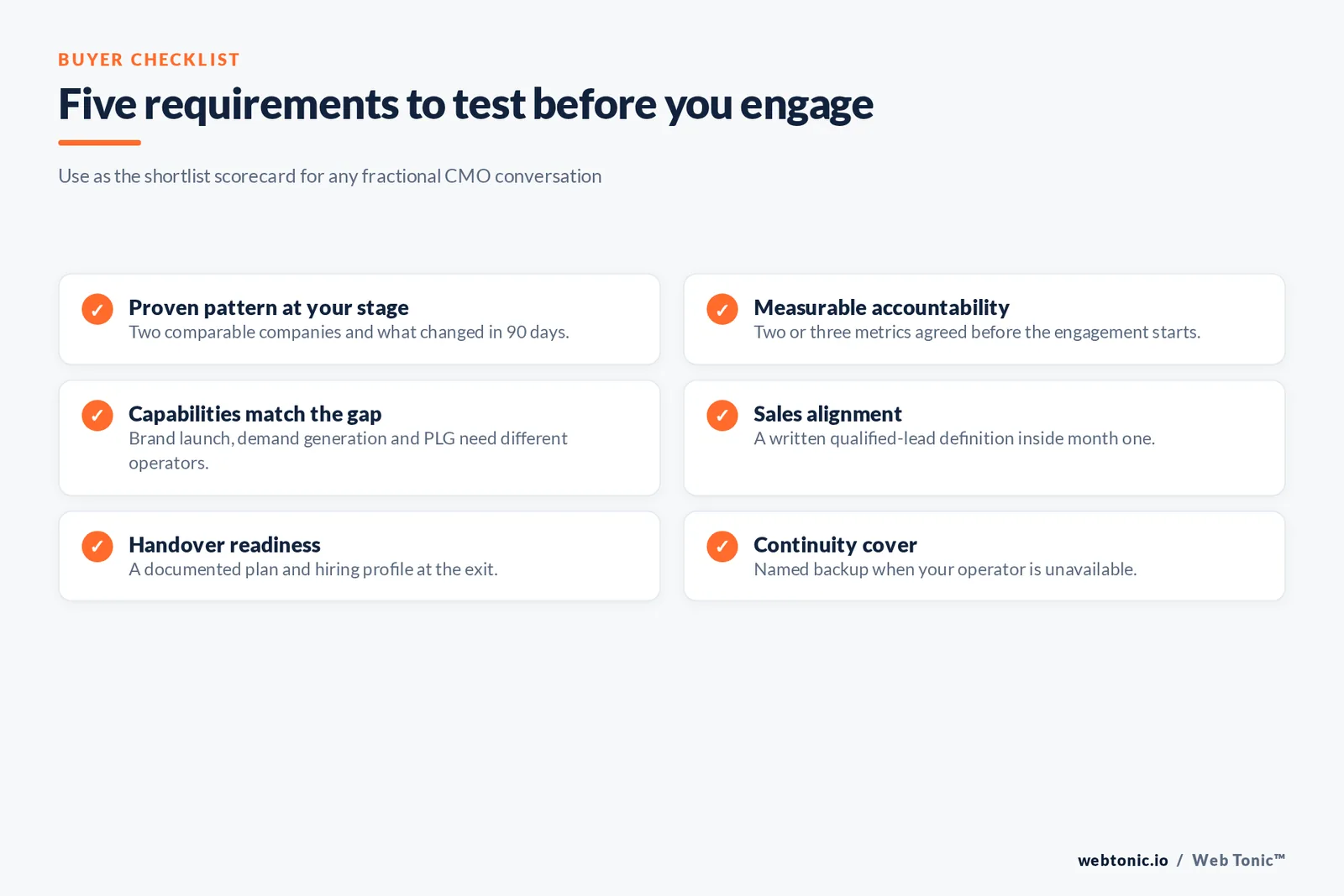
Once you know the mandate, the shortlist gets easier: you are testing for proven capabilities against your own requirements, not for a personality fit. Venture-backed organizations, bootstrapped SMBs and sponsor-owned industry groups all buy the same five things, and each one can be evidenced.
- Proven pattern in your industry. Ask what they created for two organizations at your revenue stage and which initiatives they killed. A proven operator answers with measurable outcomes, not with a channel list.
- Measurable accountability. Agree the two or three business metrics the engagement is judged on before it starts, and make them measurable from your own analytics rather than from a vendor's slide.
- Capabilities that match the gap. Brand-led product launches, demand generation for a sales team, and marketplace or products-led growth require different capabilities. Match the operator's strongest capability to your biggest gap.
- Alignment with sales and the leadership team. The marketing sales handoff is where most plans die. Require a written definition of a qualified lead in the first month, agreed by both sides.
- Readiness to hand over. The best fractional CMOs leave behind a documented plan, a hiring profile and a team that is ready to run it. Ask what they hand over on day one of month twelve.
Two practical requirements are worth writing into the agreement. First, one page a month that shows what the marketing initiatives created in pipeline and revenue, so the leadership team can judge marketing performance without a translation layer. Second, named backup — if your fractional chief marketing officer is ill or a client emergency lands elsewhere, someone in their company or network can provide continuity. Independent operators who cannot answer the continuity question are a concentration risk you should price in.
Web Tonic runs this layer as a service: an advisory lead who owns the plan, plus in-house teams who create and ship the work against it, reporting into one dashboard. That combination is what makes the strategy executable rather than a document that ages in a shared drive.
Fractional CMO versus the other marketing leadership options
Companies rarely choose between a fractional CMO and nothing. They choose between four ways to provide senior marketing leadership, and the right answer depends on how much strategic expertise the business needs versus how much execution capacity it is missing.
- Fractional chief marketing officer. Strategic ownership, decision rights and team direction, sized to the business. Best when growth has stalled for reasons nobody in the company can diagnose.
- Marketing consultant or advisor. Provides analysis and recommendations, and can create a plan quickly, but does not own delivery or the marketing performance number.
- Marketing agency. Deep execution capabilities across channels and products, strongest when the strategy and requirements are already clear and the gap is production.
- Internal VP of Marketing. A full-time hire with company-specific depth. The right long-term answer once marketing is the primary growth engine and the team is large enough to need daily management.
Many growth-stage organizations end up combining two: fractional marketing leadership for the strategic layer plus an agency or in-house specialists for delivery. That structure works when accountability is unambiguous — the fractional CMO sets priorities, the delivery teams own throughput and quality, and everyone reads the same dashboard. It fails when the fractional CMO has responsibility for outcomes but no authority over the budget or the vendors.
How to measure the return on a fractional CMO
Judge the engagement on business outcomes on a realistic clock. Marketing initiatives launched in month two rarely show revenue before month five, so set expectations by phase and hold the line on measurable proof.
| Horizon | What to expect | Evidence to require |
|---|---|---|
| Days 1–30 | Diagnosis: ICP, funnel maths, spend audit, quick wins | A written assessment and a ranked list of initiatives |
| Days 31–90 | Strategy locked, marketing sales alignment agreed, reporting rebuilt | A 12-month plan with budget, owners and targets |
| Months 4–6 | Pipeline and conversion movement from the prioritised channels | Trend in qualified pipeline and customer acquisition cost |
| Months 7–12 | Compounding growth, a capable team, a documented playbook | Revenue contribution plus a handover-ready operating model |
Two failure signals are worth watching for. If the monthly report is a summary of activity rather than a read on business performance, the engagement has drifted into project management. And if every strategic decision still routes through the founder, the company has bought advice, not leadership. Both are fixable in one conversation if you catch them in month two rather than month eight.

Frequently Asked Questions
What does a fractional CMO do day to day?
They own marketing strategy and the decisions that follow it: positioning, ICP, budget allocation, channel mix, agency and team direction, and the reporting that tells the leadership team whether it is working. In an 8–20 hour week, most of that time goes to planning, reviews and unblocking the people executing.
How much does a fractional CMO cost?
Independent 2026 benchmarks put mid-market retainers at $8,000 to $25,000 per month for one to two days a week and hourly advisory at $200 to $400, against a full-time equivalent all-in cost of $300,000 to $500,000 a year. Rates vary with scope, stage and whether you hire an individual or a firm.
Is a fractional CMO the same as a marketing consultant?
No. A consultant recommends; a fractional chief marketing officer decides, owns the number and directs the team. The clearest test is whether the person can kill a channel, reallocate budget and manage people without asking permission.
How long does a fractional CMO engagement last?
Most run three to twelve months, and many extend once the plan is working. Some end deliberately at handover to a full-time hire, which is a success, not a failure.
Can a small business use a fractional CMO?
Yes — that is the core market. 97% of 2026 US fractional job postings came from small and mid-size companies, and lower-hour advisory scopes exist precisely for teams that cannot absorb a full executive salary.
How do you find a fractional CMO?
Most companies find fractional CMO talent through founder and investor referrals, fractional talent marketplaces, or a marketing agency that offers fractional CMO services alongside execution. Whichever route you take, shortlist on relevant pattern experience at your revenue stage, then interview for decision-making style rather than channel trivia.
When should a fractional CMO become a full-time CMO?
When the marketing function needs more than 20 hours a week of leadership, when the team grows past roughly eight people, or when marketing becomes the company's primary growth engine rather than one of several. A good fractional chief marketing officer will tell you when that line is close and help hire their replacement.
Sources
Lightcast — The Rise of Fractional Leadership (2026)
Spencer Stuart — CMO Tenure 2026
Spencer Stuart — CMO Tenure Study 2025
Built In — CMO salary in US (2026)
PayScale — Chief Marketing Officer salary (2026)
Treetop — 2026 Fractional Executive Pricing Report
Prose — Fractional CMO hours per week benchmarks
Rick Ramos — State of Fractional CMO Engagement
Duct Tape Marketing — Fractional CMO Insights Survey
Adweek — Why CMO Tenure Remains Stubbornly Short
Marketing Dive — CMO-plus roles report