



Table of contents
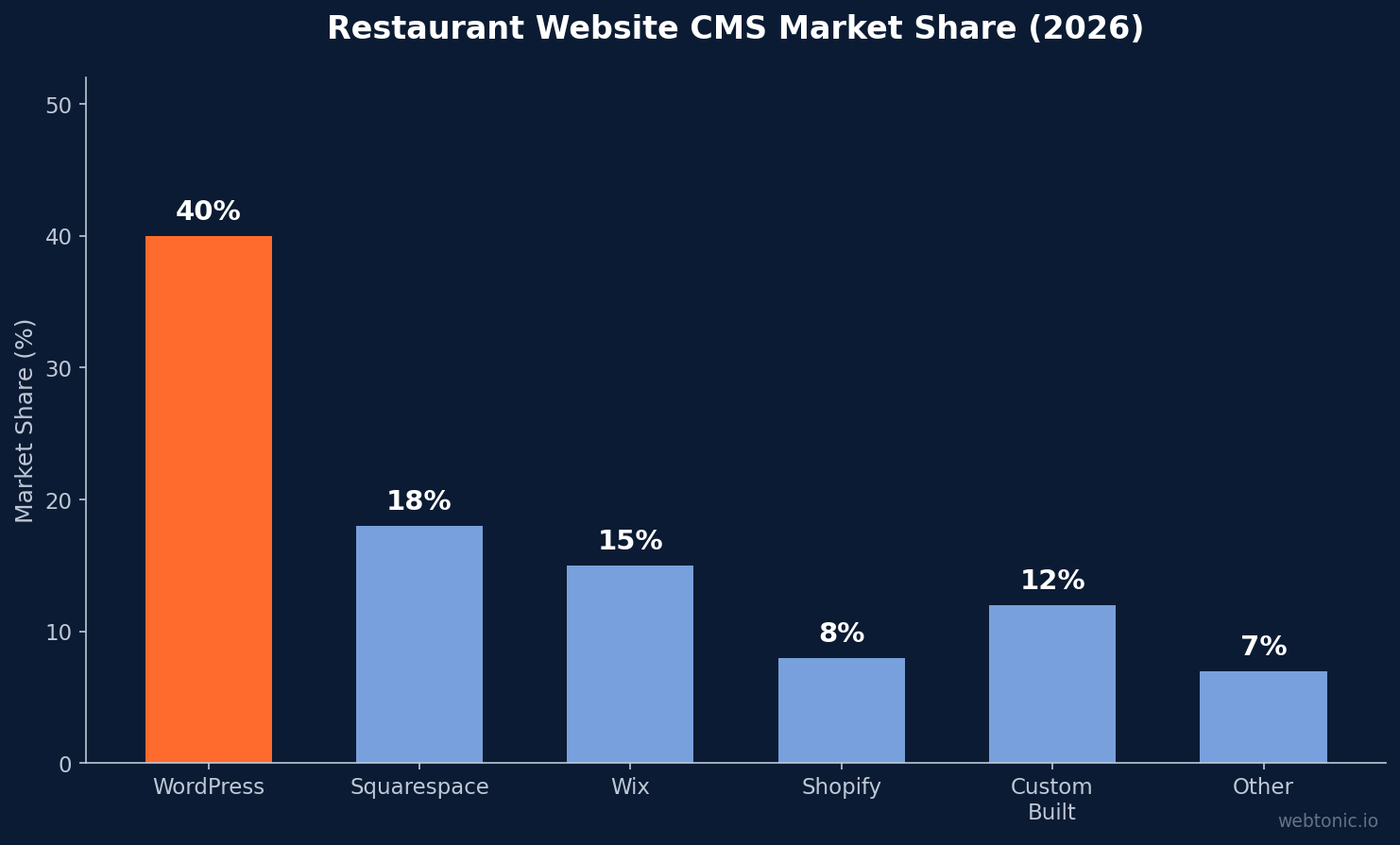
WordPress powers 40% of restaurant and food service websites — more than any other CMS platform. Despite the rise of template builders and hosted platforms, WordPress remains the dominant choice for food service businesses that need full control over their online ordering, reservations, and local SEO.
Key Takeaways
- 40% of restaurants and food service businesses use WordPress, tying with real estate for the highest adoption outside professional services (XtendedView).
- 81% of restaurant operators now have a website, up from 69% in 2024, with 68% offering online ordering (TouchBistro).
- WordPress agency builds cost $3,000–$10,000 upfront for restaurant sites, with $50–$500/month maintenance (PageDrop).
- Over 68% of restaurant website traffic comes from mobile devices (Chowly).
- WooCommerce powers 4.17 million live stores processing $30–35 billion in annual GMV (Colorlib).
- Average catering website conversion rate is 3.8%, with PPC landing pages converting at 5.5% (CuFinder).
- Custom WordPress sites routinely score 90+ on mobile PageSpeed, compared to 4–6 second load times for plugin-heavy installs (RichMenu).
- WordPress commands a 59.9% CMS market share globally as of July 2026 (W3Techs).
WordPress Adoption in Food Service at a Glance
| Metric | Value | Source |
|---|---|---|
| WordPress CMS Market Share (Global) | 59.9% | W3Techs |
| WordPress Usage in Restaurants/Food | 40% | XtendedView |
| Restaurant Operators with a Website | 81% (up from 69%) | TouchBistro |
| Restaurants Offering Online Ordering | 68% | TouchBistro |
| WooCommerce Live Stores | 4.17 million | Colorlib |
| WooCommerce Annual GMV | $30–35 billion | Colorlib |
| Avg. Catering Website CVR | 3.8% | CuFinder |
| Mobile Traffic Share (Restaurants) | 68%+ | Chowly |
| Agency WordPress Build Cost | $3,000–$10,000 | PageDrop |
| Avg. Catering Site Bounce Rate | 55.2% | CuFinder |
CMS Market Share and Restaurant WordPress Adoption
W3Techs data for July 2026 shows WordPress holds a 59.9% share of the global CMS market, making it the foundation for the majority of content-managed websites worldwide. Within the food service vertical, XtendedView's 2026 WordPress statistics report places restaurant and food industry WordPress usage at 40% — the highest adoption rate outside professional services like legal and dental.
However, ElevateWebDesign's 2026 study of 4,407 small business sites reveals an important nuance: restaurants and salons skew more heavily toward template builders like Squarespace and Wix than professional service firms. While WordPress's overall small business share sits at 43.6%, restaurants that choose WordPress tend to be multi-location operators or businesses with complex online ordering needs that template builders cannot handle effectively.
Restaurant Website Costs: WordPress vs. Alternatives
PageDrop's 2026 pricing analysis provides detailed cost breakdowns for restaurant websites across development approaches:
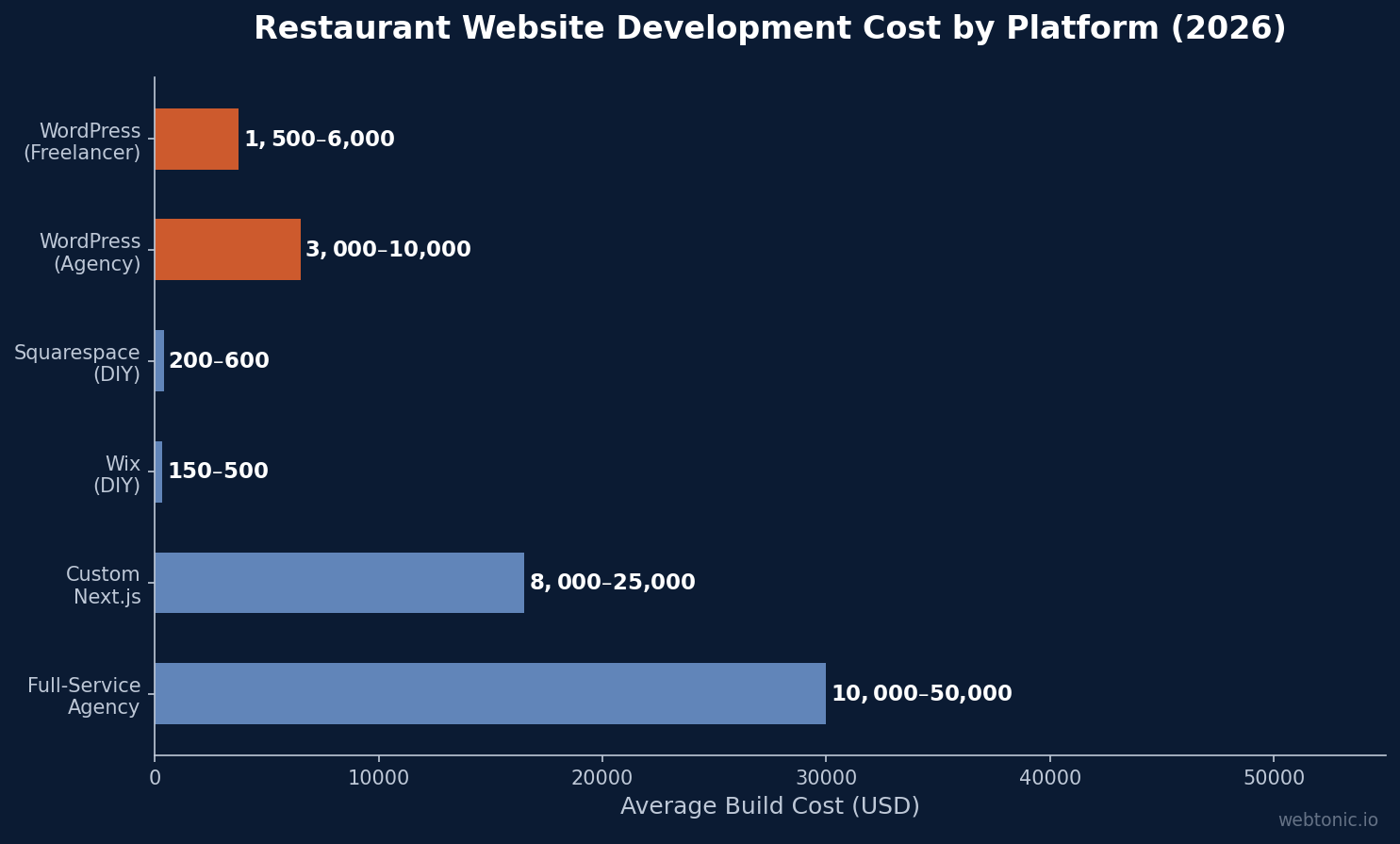
- Freelancer WordPress build: $1,500–$6,000 upfront, plus $30–$300/month maintenance.
- Agency WordPress build: $3,000–$10,000 upfront, plus $50–$500/month maintenance.
- Custom development (Next.js or headless): $8,000–$25,000+ upfront, higher ongoing costs.
WebCraftDev's European analysis adds performance context to the cost picture: a Wix site loads in 5–7 seconds on average, while a WordPress site with 12 plugins loads in 4–6 seconds and a well-built Next.js site loads in under 1.5 seconds. The WordPress sweet spot falls between template builder convenience and custom development performance — and with proper optimization, WordPress sites can approach custom performance levels.
WordPress maintenance costs in 2026 range from $30 to $5,000+ per month depending on complexity, with most restaurant sites falling in the $50–$300 range for hosting, security updates, and plugin maintenance. Businesses that invest in growth marketing alongside their website tend to see higher returns because the site is actively optimized for conversions rather than simply maintained for uptime.
Mobile Performance and Core Web Vitals for Food Sites
Mobile performance is non-negotiable for restaurant websites. Chowly's 2026 restaurant design guide reports that over 68% of restaurant website traffic comes from mobile phones, and sites that fail mobile usability lose 42% more orders than optimized competitors.
DineHere.ai's Core Web Vitals guide notes that only 59% of mobile pages across the web reach a "good" LCP score, and restaurants underperform that average because of unoptimized food photography. The target for restaurant WordPress sites should be an LCP of 2.5 seconds or less. RichMenu's mobile analysis adds that 61% of mobile searchers are more likely to contact a local business if it has a mobile-friendly site — making speed optimization directly tied to lead generation.
For WordPress specifically, RichMenu's platform comparison shows that WordPress, built correctly, routinely scores 90+ on mobile PageSpeed — achievable with the right theme, image optimization, and caching setup. Proper server-side caching can reduce server response time from 800ms+ to under 100ms, a dramatic improvement that directly impacts conversion rates.
WooCommerce and Online Ordering Statistics
WooCommerce has become the default choice for food service businesses that want to own their online ordering channel. Colorlib's 2026 statistics show that WooCommerce powers 4.17 million live stores, processes $30–35 billion in annual GMV, and commands a 20–39% share of the global e-commerce platform market.
Metorik's 2026 WooCommerce Insights Report, analyzing over 65 million orders totaling $6.6 billion in revenue across 6,000+ stores, provides granular benchmarks that food service operators can use to assess their performance. The restaurant adoption trend is clear: TouchBistro's 2026 American State of Restaurants Report shows 68% of operators now offer online ordering (up from 55% in 2024), and 81% have a website (up from 69%). With 98% of operators allowing menu viewing on their website (up from 95%), the gap between having a website and monetizing it through direct ordering is closing rapidly.
For catering businesses running WordPress with WooCommerce, the combination eliminates third-party commission fees that platforms like DoorDash or Uber Eats charge. Building a data-driven direct ordering channel on WordPress gives operators full ownership of customer data and transaction history, which is essential for building repeat business through email marketing and loyalty programs.
| Website Performance Metric | Food Service Benchmark | Optimization Target |
|---|---|---|
| Mobile Traffic Share | 68%+ | Mobile-first design |
| Average Bounce Rate | 55.2% | Below 50% |
| Website Conversion Rate | 3.8% | Above 4.5% |
| PPC Landing Page CVR | 5.5% | Above 6% |
| LCP Target (Mobile) | Often 3–5s | Under 2.5s |
| Mobile PageSpeed Score (WP) | 60–75 (unoptimized) | 90+ |
| Server Response (Cached) | 800ms+ | Under 100ms |
| New vs. Returning Visitors | 60% / 40% | Increase returning % |
WordPress SEO Advantages for Restaurant Websites
WordPress provides several structural advantages for food service SEO that template builders lack. Full control over schema markup means restaurants can implement LocalBusiness, Restaurant, and FoodEstablishment structured data that enhances local search visibility and enables rich results in Google. Custom permalink structures, XML sitemaps, and canonical URL management are built into the WordPress ecosystem through plugins like Yoast or Rank Math.
RichMenu's platform comparison found that restaurant websites built on WordPress by specialists — with no page builder bloat and purpose-built architecture — deliver dramatically better long-term SEO performance than template builder alternatives. The key factors include faster crawlability, cleaner HTML output, and the ability to implement advanced local SEO features like location-specific landing pages and review integration.
For catering companies targeting multiple service areas, WordPress makes it straightforward to create dedicated landing pages for each geographic market. When combined with targeted Google Ads campaigns pointing to location-specific pages, this architecture supports higher Quality Scores and lower cost per lead. Over 60% of catering event inquiries start on mobile devices, according to industry data, making WordPress's flexibility in building mobile-optimized local pages a significant conversion advantage.
WordPress Plugin Ecosystem for Food Service
The WordPress plugin ecosystem offers specialized tools that address nearly every food service operational need. Reservation systems like WPCafe and Restaurant Menu plugins integrate directly with WooCommerce, enabling end-to-end ordering without third-party commission fees. QR code ordering plugins allow dine-in customers to order and pay directly from their tables — all processed through the restaurant's own WordPress installation.
The key advantage is data ownership and cost control. Unlike third-party delivery platforms like DoorDash and Uber Eats that retain customer information and charge 15–30% commission fees, WordPress-based ordering channels give food service businesses complete control over their customer database and full profit margins on every order. This data feeds directly into email marketing, loyalty programs, and retargeting campaigns. Restaurants using Meta Ads retargeting built on first-party WordPress data see significantly higher return rates because the targeting is based on actual purchase behavior rather than estimated interest signals.
Best Practices for Food Service WordPress Websites
Based on the performance data and cost benchmarks above, here are evidence-backed recommendations for food service businesses building or maintaining WordPress websites:
- Optimize for mobile first. With 68%+ of traffic coming from phones and 42% more lost orders on poorly optimized mobile sites, mobile performance is the single biggest conversion lever.
- Invest in speed optimization. Target a mobile PageSpeed score of 90+ through proper caching, image compression, and minimal plugin usage. Server-side caching alone can reduce response time from 800ms to under 100ms.
- Build direct ordering on WooCommerce. Own your customer data and eliminate commission fees. With 68% of operators now offering online ordering, direct channels are becoming a competitive necessity.
- Budget $3,000–$10,000 for an agency build. This range delivers a professional WordPress restaurant site with proper performance creative, schema markup, and reservation integration.
- Monitor Core Web Vitals monthly. Restaurants underperform the web average on LCP due to unoptimized food photography — target LCP under 2.5 seconds.
- Leverage WordPress for local SEO. Full control over schema markup, page structure, and content makes WordPress the strongest platform for local search visibility, especially when paired with Google Ads campaigns.
Related reading
- 2026 Webflow Stats for Food Service & Catering: Benchmarks That Matter
- Food Service & Catering Landing Page Statistics (2026 Benchmarks)
- Food Service & Catering Shopify Statistics: 2026 Store Growth, CVR & Ecommerce Data
- Custom Web Development services at Web Tonic
Frequently Asked Questions
What percentage of restaurants use WordPress?
Approximately 40% of restaurants and food service businesses use WordPress for their websites, according to XtendedView's 2026 analysis. This ties with real estate for the highest adoption rate outside professional services. However, ElevateWebDesign notes that smaller independent restaurants increasingly lean toward template builders like Squarespace and Wix for simplicity, while multi-location operators and those with complex ordering needs prefer WordPress.
How much does a WordPress restaurant website cost?
A freelancer-built WordPress restaurant site costs $1,500–$6,000 upfront with $30–$300/month maintenance. Agency builds range from $3,000–$10,000 with $50–$500/month ongoing costs. Custom headless builds (Next.js) start at $8,000 and can exceed $25,000. The right choice depends on feature complexity — simple menu-only sites suit template builders, while restaurants needing online ordering, reservations, and Google Ads landing pages benefit from WordPress.
Is WooCommerce good for restaurant online ordering?
WooCommerce is an excellent choice for restaurants that want to own their online ordering channel. It powers 4.17 million live stores and processes $30–35 billion in annual GMV. For food service specifically, WooCommerce eliminates the 15–30% commission fees charged by third-party delivery platforms, giving operators full control over customer data and profit margins.
What is a good conversion rate for a catering website?
The average catering website conversion rate is 3.8% according to CuFinder's 2026 benchmarks. PPC landing pages convert at 5.5%, suggesting that targeted traffic converts significantly better than organic. Top-performing catering sites exceed 6% conversion rates through optimized forms, clear CTAs, and fast mobile load times. The average catering site bounce rate is 55.2%, with well-optimized sites targeting below 50%.
How fast should a restaurant WordPress site load?
Restaurant WordPress sites should target a mobile PageSpeed score of 90+ and an LCP under 2.5 seconds. Currently, many restaurant WordPress sites score 60–75 on mobile due to unoptimized food photography and excessive plugins. With proper optimization — caching, image compression, and lightweight themes — WordPress sites can match the speed of custom-built alternatives while maintaining the flexibility of the WordPress ecosystem. Speed optimization typically yields a 20–40 point improvement in PageSpeed scores and a 2–4 second reduction in actual load times, directly improving bounce rates and conversion rates for food service businesses.
Sources
cufinder.io/blog/benchmarks/catering
xtendedview.com/wordpress-statistics
w3techs.com – WordPress usage statistics
elevatewebdesign.ca/blog/small-business-cms-statistics-2026
pagedrop.pro/blog/restaurant-website-cost
colorlib.com/wp/woocommerce-statistics
metorik.com/woocommerce-insights
chowly.com – restaurant website design
richmenu.io/restaurant-website-builders
touchbistro.com – 2026 State of Restaurants
dinehere.ai – restaurant website speed
webcraftdev.com – restaurant website development


