



Table of contents
Key Takeaways
There are now 13,569+ active Shopify stores in the Food & Beverages niche (Bootleads), with 130 new stores added in the past 30 days alone. Food & Beverage holds the highest Shopify conversion rate of any category at 2.3–4.2%, depending on the benchmarking source. The DTC food market is projected to reach $195.39 billion by 2031 at an 18.7% CAGR, and nearly 20% of hospitality businesses now sell branded merchandise, with some generating up to 27% of monthly revenue from merch alone.
Shopify Food & Beverage Store Landscape
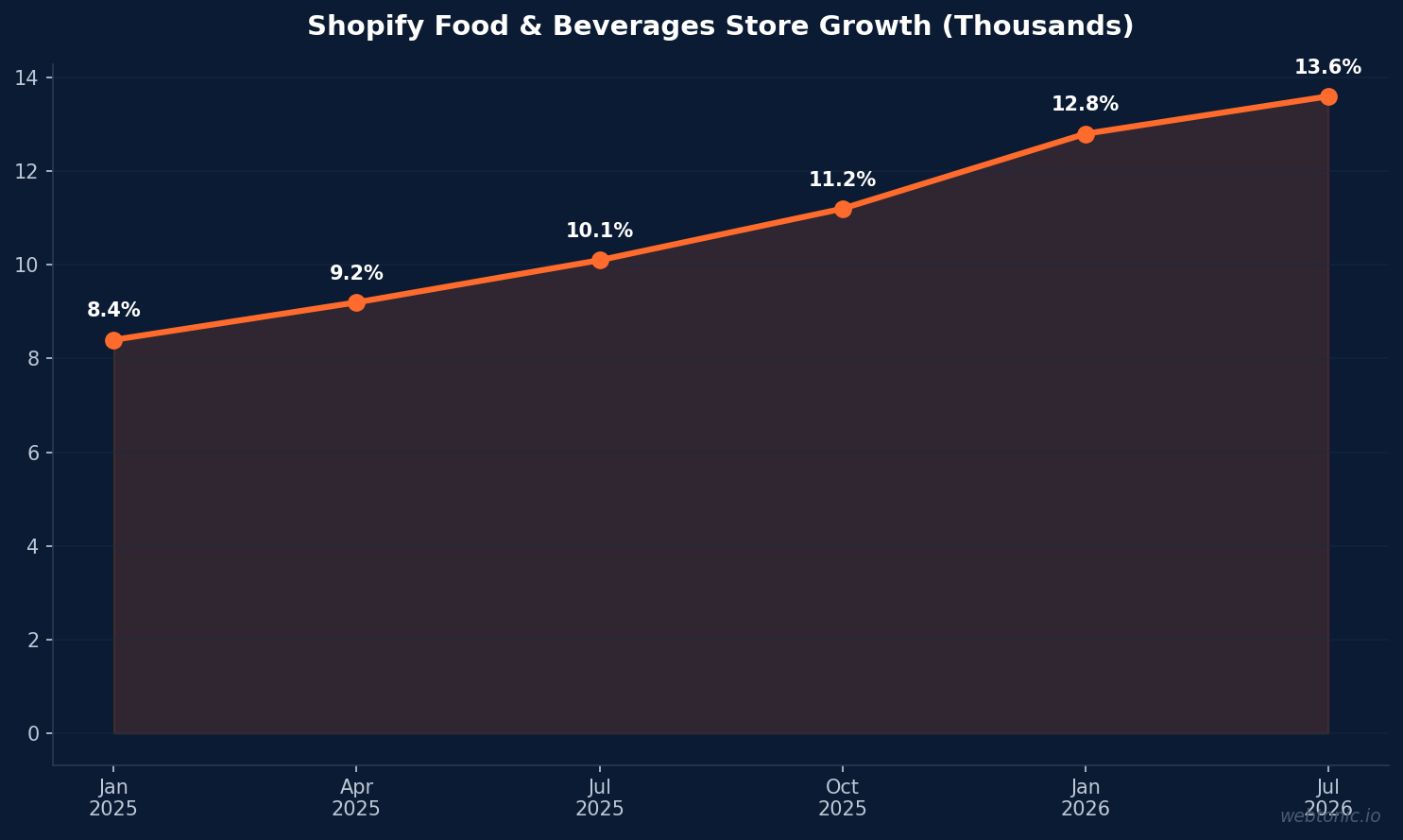
The food and beverage sector represents one of Shopify's fastest-growing verticals. Bootleads tracks 13,569 active Shopify stores in the Food & Beverages segment, with 130 new stores added in the past 30 days (roughly 1% monthly growth). When using a broader "Food & Drink" classification, Over 200,000 Shopify stores sell in the broader Food & Drink category, of which 46.1% sell food products and 37.6% sell beverages.
Food and Drink is one of the fastest-growing Shopify categories, with rapid month-over-month store growth across both DTC and wholesale segments. The broader DTC food market is projected to reach $195.39 billion by 2031 at an 18.7% CAGR, with subscription-first F&B brands driving the majority of growth (Skailama). Shopify's own B2B GMV surged 140% to $9.4 billion in H1 2026, with average B2B order values of $1,840 versus ~$130 for DTC (Ecommerce Times). This B2B growth is particularly relevant for catering suppliers and wholesale food distributors adopting Shopify for their ordering infrastructure.
Shopify F&B Conversion Rate Benchmarks
| Metric | Benchmark | Source |
|---|---|---|
| Avg. CVR (F&B, all stores) | 2.3–4.2% | Axis Intelligence / LaunchTip |
| Median CVR | 2.7–3.1% | ThunderPageSpeed / Eevy.ai |
| Top quartile CVR | 4.0–6.8% | Eevy.ai / LaunchTip |
| Top decile CVR | 5.5% | Eevy.ai |
| Mobile CVR | 2.2–2.4% | Eevy.ai / ThunderPageSpeed |
| Desktop CVR | 3.6–4.1% | Eevy.ai / ThunderPageSpeed |
| DTC specialty CVR | 2.5–3.5% | EasyApps |
| Shop Pay checkout completion | 72.5% vs 62.6% avg. | Axis Intelligence |
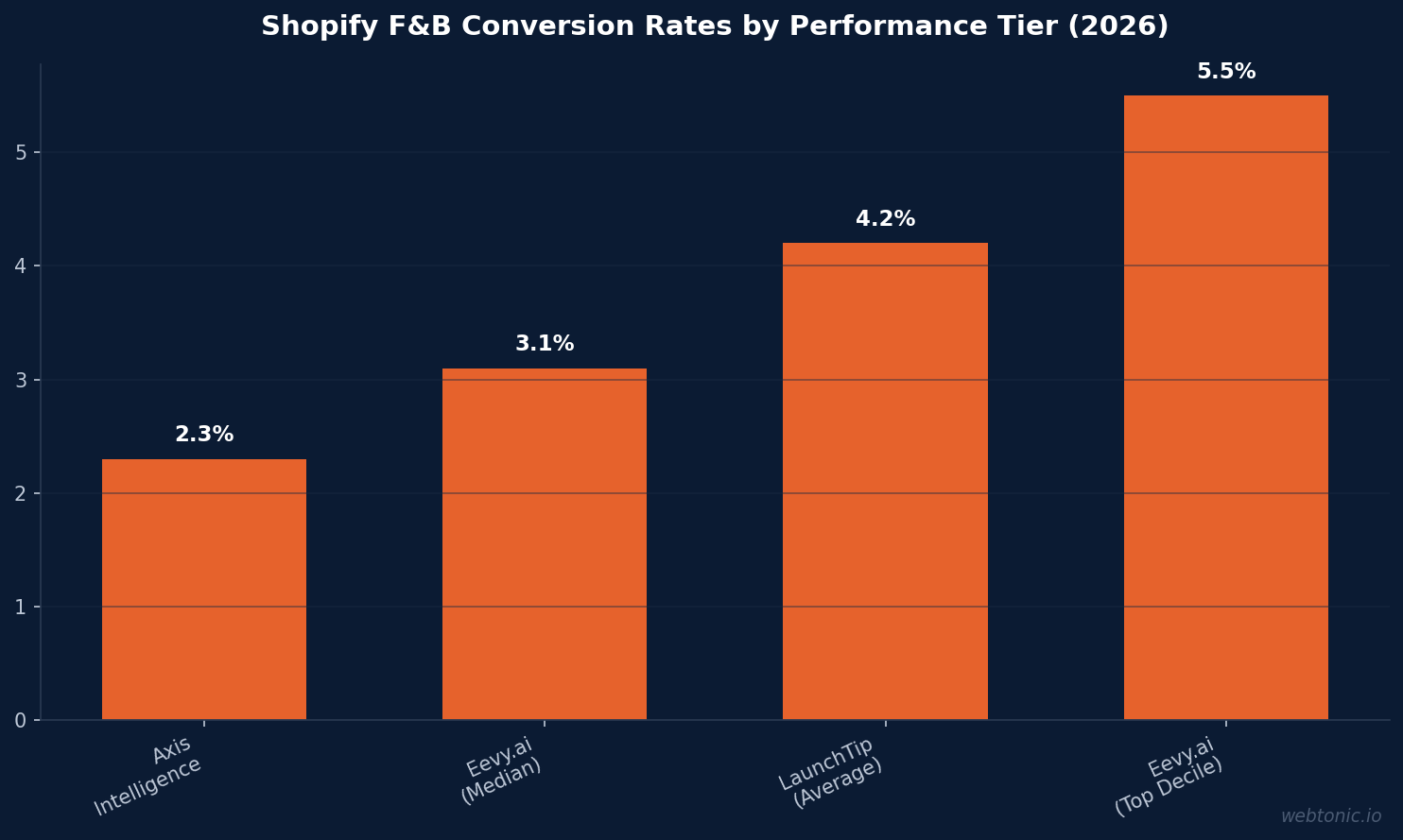
Food & Beverage consistently achieves the highest conversion rate of any Shopify category. Axis Intelligence benchmarks F&B at approximately 2.3% as the highest by category, while Eevy.ai reports a median of 3.1% with top-decile stores hitting 5.5%. LaunchTip places the average even higher at 4.2–6.22%, citing high intent, repeat purchases, and low decision friction as the key drivers.
The desktop-mobile gap is significant: desktop conversions run 3.6–4.1% versus 2.2–2.4% on mobile (Eevy.ai). Shop Pay's checkout completion rate of 72.5% versus the industry average of 62.6% (Axis Intelligence) means accelerated checkout tools meaningfully boost revenue for F&B stores selling high-intent food products.
Online Catering and Food Ordering Market Size
US online catering order volume reached $4.6 billion annually (CaterCamp), while the broader US online catering and food service market is valued at approximately $27 billion (industry analysts). The US catering industry itself recorded $13.0 billion in receipts in the most recent Census Economic Census, with average sales per location of $1.2 million (Census data).
The State of Catering 2026 report from Fast Casual draws on real transactional data from 100+ restaurant brands, 8,000+ locations, $1B+ in annual catering volume, and 2M+ annual orders. This scale of digital ordering creates substantial opportunities for food service businesses using Shopify as their ecommerce backbone. DoorDash's July 2026 integration with Shopify now allows any Shopify merchant with a brick-and-mortar presence to add their product catalog to the DoorDash marketplace (DoorDash), merging ecommerce with on-demand delivery.
Checkout and Cart Performance
Monthly checkout performance tracking tracks monthly benchmarks including conversion rate, average order value, free shipping behavior, and shipping revenue across Shopify F&B stores. Food & Beverage stores convert at 2.6% on Shopify per cart conversion analyses, while top-10th-percentile merchants across Shopify exceed 4.7% conversion rates (Axis Intelligence).
Free shipping thresholds are a critical lever for F&B stores. Cart abandonment remains the biggest revenue leak, with the industry-average Shopify cart-to-checkout rate hovering near 62.6%. Food brands that implement Shop Pay and one-click checkout see measurably higher completion rates. The custom food and beverages market on Shopify spans 1,104 stores across 37+ countries with a median price of $47, and only 20% use a visual product customizer (Podifai), suggesting room for better product page experiences.
Restaurant Merchandise and DTC Food Trends
Nearly 20% of hospitality businesses now sell branded merchandise, and for successful restaurants, merch can represent 11–27% of monthly revenue (Lightspeed Commerce via Retail Insider). Brunette, a Shopify store celebrating Canadian restaurant culture, helped popularize restaurant merch and products that were previously an afterthought in the dining experience (ShopExperts).
Wilfreds Pies, a Shopify food brand, tripled site sales in 2 years with 100,000+ pies sold and generates over £70K per year in email revenue through Klaviyo campaigns and flows (Click Digital). Conti's Bakeshop moved 100 restaurant locations to Shopify, processing 100,000+ orders with 30% growth during their busiest season (Zapiet). These cases illustrate how email marketing and ecommerce integration can scale food service businesses far beyond their physical locations.
Shopify Food & Beverage vs. Other Categories
| Category | Median CVR | Top Quartile CVR | AOV |
|---|---|---|---|
| Food & Beverage | 2.7–3.1% | 4.0–6.8% | $45–$58 |
| Beauty & Cosmetics | 2.3–2.6% | 3.5–5.2% | $55–$75 |
| Health & Wellness | 2.3–3.0% | 3.8–4.9% | $65–$89 |
| Fashion & Apparel | 1.0–2.8% | 3.8–4.5% | $73–$95 |
| Electronics | 1.2–1.5% | 2.5–3.0% | $120+ |
Food & Beverage's top-of-category conversion rate reflects the unique advantages of selling consumables: low decision friction, high repeat purchase intent, and relatively low price points. With an average order value of $45–$58 (ThunderPageSpeed), F&B stores convert more frequently than higher-AOV categories like electronics, which face returns friction and longer consideration periods. F&B subscriptions now deliver the highest lifetime values on Shopify (Skailama), making recurring revenue models particularly attractive for catering companies selling meal kits, condiments, or specialty ingredients online.
Shopify Platform Growth and Infrastructure
Shopify's overall ecosystem has grown to become the dominant ecommerce platform alongside WooCommerce. Analyses of hundreds of thousands of Shopify stores shows the platform's breadth across industries, with food and drink consistently ranking among the top growth segments. Shopify now commands a 27% share of the top million ecommerce sites (industry reports), providing food service businesses with a mature infrastructure for both DTC and B2B selling.
For catering businesses specifically, the platform's strength lies in its flexible order management: DoorDash's native Shopify sales channel launched in July 2026 means merchants can list physical products alongside catering services within a unified dashboard. DTC food brand growth on Shopify runs at approximately 25% year-over-year, with specialty food brands converting at 2.5–3.5%. Meanwhile, Shopify's B2B capabilities (custom catalogs, volume pricing, draft order automation, PO matching) make it increasingly suitable for catering suppliers serving corporate accounts with complex ordering requirements.
Case Studies: Food Service Brands Winning on Shopify
Several food service brands have achieved remarkable results on Shopify, demonstrating the platform's versatility for this vertical:
- Conti's Bakeshop: Migrated 100 restaurant locations to Shopify, processed 100,000+ orders with 30% growth during peak season. The brand outgrew a custom ordering platform and adopted Shopify with Zapiet Eats for multi-location coordination (Zapiet).
- Wilfreds Pies: Site sales tripled in 2 years with 100,000+ pies sold. Generated £70K per year in email revenue through Klaviyo campaigns and flows (Click Digital).
- So Heavenly: A Miami catering operation that grew revenue 27% by swapping phone orders for pre-order and catering functionality through a streamlined Shopify-powered website (BentoBox).
- Brunette: Built a Shopify ecommerce site selling gourmet Canadian wares and restaurant-branded apparel, helping popularize restaurant merch as a standalone revenue stream (ShopExperts).
These examples show that Shopify can scale from single-location catering businesses to multi-location restaurant empires, provided the checkout experience and email marketing automation are properly configured.
Best Practices for Catering and Food Service on Shopify
- Enable Shop Pay and accelerated checkout — Shop Pay's 72.5% completion rate meaningfully outperforms the 62.6% industry average, directly boosting revenue.
- Optimize mobile checkout first — the desktop-mobile conversion gap (up to 1.7 percentage points) means mobile UX improvements deliver the highest marginal ROI.
- Launch a subscription or auto-replenish model — F&B subscriptions deliver the highest lifetime values on Shopify and reduce customer acquisition cost over time.
- Integrate with DoorDash for hybrid online and delivery fulfillment via their native Shopify sales channel (DoorDash).
- Build email flows — Wilfreds generates £70K/year through Klaviyo, demonstrating the power of post-purchase and abandoned-cart flows for growth marketing in food brands.
- Consider restaurant merchandise — at 11–27% of monthly revenue for top performers, merch is an underexplored revenue stream for catering brands.
- Track checkout completion rate against the 62.6% industry baseline and benchmark AOV against the $45–$58 F&B range to identify friction points and pricing opportunities.
Emerging Shopify Trends for Food Service (2026–2027)
Several trends are reshaping how food service businesses use Shopify. Subscription models are booming — F&B subscriptions now deliver the highest lifetime values of any category on the platform, with meal kit and specialty ingredient brands leading the way. AI-powered product recommendations are increasing average order values for food brands that implement Shopify's built-in personalization tools. Hybrid fulfillment (combining Shopify online ordering with in-store pickup and third-party delivery through DoorDash) is becoming the standard model for restaurants that want both ecommerce revenue and foot traffic. Finally, Shopify Payments and Shop Pay continue to expand internationally, opening new markets for food brands that previously relied on region-specific checkout solutions. For agencies managing food service clients, understanding these platform-level shifts is critical when advising on data-driven ecommerce strategy.
Related reading
- WordPress in Food Service & Catering: 2026 Usage, Cost & Performance Statistics
- 2026 Webflow Stats for Food Service & Catering: Benchmarks That Matter
- Food Service & Catering Landing Page Statistics (2026 Benchmarks)
- Custom Web Development services at Web Tonic
Frequently Asked Questions
How many food and beverage stores are on Shopify in 2026?
There are 13,569 active Shopify stores in the Food & Beverages niche tracked by Bootleads, with 130 new stores added monthly. StoreLeads counts 204,694 stores using a broader Food & Drink classification. Food and Drink is one of Shopify's fastest-growing categories, now exceeding 116,000 stores by StackedReview's count.
What is the average Shopify conversion rate for food and beverage?
Benchmarks vary by source: Axis Intelligence reports 2.3%, Eevy.ai reports a 3.1% median with 5.5% at the top decile, and LaunchTip places the average at 4.2–6.22%. All sources agree Food & Beverage has the highest conversion rate of any Shopify category, driven by low price points and high purchase intent.
Is Shopify a good platform for catering businesses?
Yes — Shopify's checkout infrastructure outperforms the industry average (72.5% completion via Shop Pay vs. 62.6% industry average), and food brands see the platform's highest conversion rates. DoorDash's native Shopify integration also enables hybrid ecommerce and delivery fulfillment for brick-and-mortar food businesses.
How much revenue can restaurant merchandise generate on Shopify?
Branded merchandise can represent 11–27% of monthly revenue for successful restaurants, according to Lightspeed Commerce data. Nearly 20% of hospitality businesses now sell merch. Shopify food brands like Wilfreds have tripled site sales in 2 years, and Conti's Bakeshop scaled to 100,000+ orders across 100 locations.
What is the online catering market size?
US online catering order volume reached $4.6 billion annually (CaterCamp), while the broader US online catering and food service market is valued at approximately $27 billion (industry analysts). The NAICS-classified US catering industry recorded $13.0 billion in receipts with average sales of $1.2 million per location.
Sources
Bootleads — Shopify Food & Beverages Stores 2026
Axis Intelligence — Shopify Statistics 2026
Eevy.ai — Shopify Conversion Rate Benchmarks 2026
LaunchTip — Shopify CVR Benchmarks 2026
CaterCamp — Online Catering Ordering Stats 2026
Skailama — Top Shopify F&B Brands 2026
Ecommerce Times — Shopify B2B GMV Surge
Retail Insider — Restaurant Merchandise Trends
Zapiet — Conti's Bakeshop Case Study
DoorDash — Shopify Integration 2026


