Table of contents
X (formerly Twitter) remains one of the most cost-efficient paid social platforms for food service brands, with a median CPC of $0.74 — roughly half of Meta's equivalent (SearchLab, 2026). Below are the performance benchmarks, cost data, and campaign results that food service marketers need to evaluate the channel.
Key Takeaways
- X advertising CPC averages $0.26–$0.50 per first action for promoted posts, making it one of the cheapest paid social channels available.
- Food & cooking content achieves a 1.9% engagement rate on X, more than triple the platform-wide average of 0.6%.
- X's CPM of $4–$8 undercuts Meta's $8–$18 by roughly 50%, creating arbitrage opportunities for awareness-focused restaurant campaigns.
- Every $1 spent on X ads returns $2.70 on average, 40% higher than the cross-platform median.
- X ad revenue rebounded to $1.8 billion in 2025 (+7% YoY), signaling a stabilizing advertiser ecosystem after post-acquisition declines.
X Ad Cost Benchmarks for Food Service (2026)
X's cost structure is the platform's strongest selling point for budget-conscious food service operators. The average CPC of $0.74 compares favorably to Meta's $1.41 on equivalent placements (Hootsuite, 2025), and the median CPM of $5.65 makes awareness campaigns particularly affordable (SearchLab, 2026).
| Metric | X (Twitter) Avg. | Range | Source |
|---|---|---|---|
| CPC (Promoted Posts) | $0.26–$0.50 | Per first action | WebFX, 2026 |
| CPC (Overall) | $0.74 | $0.27–$1.95 | SearchLab, 2026 |
| CPM | $5.65 | $4–$8 (awareness) | SearchLab / AdLibrary |
| Cost Per Follow | $1.01–$2.00 | Promoted accounts | WebFX, 2026 |
| Median CPE | $0.13 | Engagement campaigns | EnrichLabs, 2025 |
| Median CPA | $21.55 | Across verticals | EnrichLabs, 2025 |
| Average CPL | $41 | Lead gen campaigns | SearchLab, 2026 |
Food Content Engagement on X
Food and cooking creators on X achieve an average engagement rate of 1.9% (UseSnippet, 2026), more than triple the platform-wide average of 0.59% (EnrichLabs, 2025). This advantage comes from the real-time, conversational nature of food content on X — restaurant openings, menu drops, and chef commentary all generate organic engagement that paid campaigns can amplify.
Nando's has built one of the strongest QSR presences on the platform with 1.55 million X followers (Whito, 2026), demonstrating that food brands that invest in voice and personality on X can build audiences that rival much larger platforms. For a full look at how paid social investments compare across channels, see our analysis of Facebook ad ROI.
ROI & Conversion Data
X delivers a $2.70 return for every $1 spent on ad campaigns, nearly 40% higher than the average return on other paid media investments (Spiralytics, 2025). A local business case study reported 3x ROAS from a $5,000 campaign that generated 550,000 impressions, 6,600 clicks, and 165 conversions at a 2.5% conversion rate (Social Ads Studio, 2026).
| Metric | Value | Context |
|---|---|---|
| Avg. ROAS | $2.70 per $1 spent | 40% above cross-platform median |
| Conversion Rate (Local Biz) | 2.5% | Social Ads Studio case study |
| Cost Per Conversion | $30.30 | At $90 avg. order value |
| Vertical Video CPM Savings | 14% lower | vs. other X ad formats |
| Engagement Rate (Food) | 1.9% | 3.2x platform average |
X vs. Meta vs. TikTok: Cost Comparison for Food Service
For food service brands evaluating channel allocation, X occupies a distinct niche: lowest cost per impression and engagement, but smaller total addressable audience. The platform reaches approximately 557–586 million accounts (Vidico, 2026), compared to Meta's 3.2 billion+.

| Metric | X (Twitter) | Meta (Facebook/IG) | TikTok |
|---|---|---|---|
| CPM (Awareness) | $4–$8 | $8–$18 | $5–$10 |
| CPC (Avg.) | $0.74 | $1.41 | $0.52 |
| Engagement Rate (Food) | 1.9% | 0.18%–1.65% | 4.2% |
| Monthly Active Users | ~570M | 3.2B+ | 1.5B+ |
| Best Use Case | Real-time, trending | Full-funnel, retargeting | Discovery, Gen Z |
The takeaway for restaurant marketers is that X works best as a complement to larger Meta or TikTok budgets — particularly for real-time promotions, trending conversations, and news-driven audience segments. Brands that need broad growth marketing reach should prioritize Meta and TikTok, then use X for event-driven amplification and cheaper awareness impressions.
X Ad Revenue & Advertiser Trends
X's advertising business has stabilized after the post-acquisition exodus. Ad revenue reached $1.8 billion in 2025, a 7% increase year over year (Business Insider, 2026), though still well below the $4.5 billion peak in 2021.
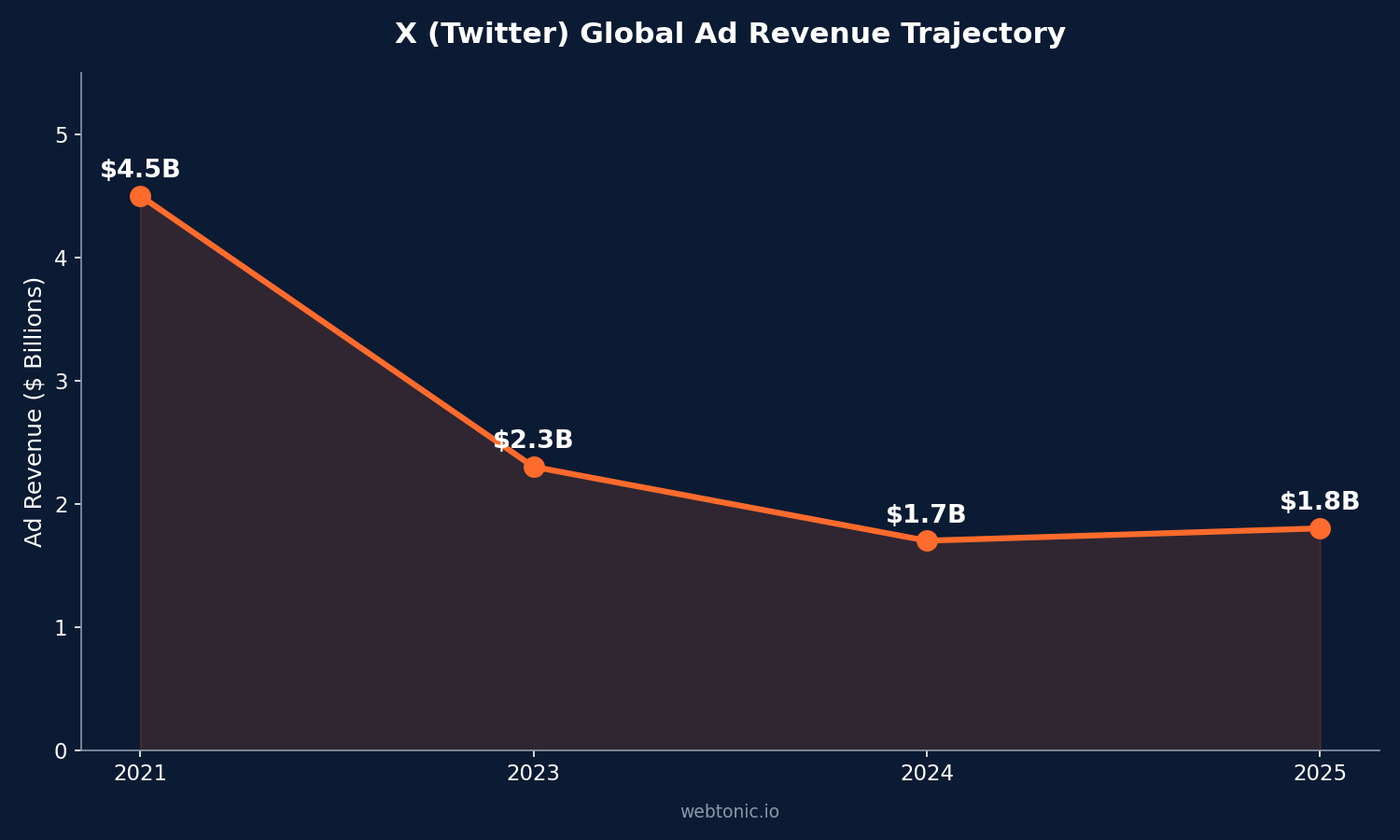
| Year | X Ad Revenue | YoY Change |
|---|---|---|
| 2021 (pre-acquisition) | $4.5 billion | +40% |
| 2023 | $2.3 billion | N/A |
| 2024 | $1.7 billion | −26% |
| 2025 | $1.8 billion | +7% |
The media sector accounts for roughly 32% of total X ad spend (Marketing LTB, 2026), and small businesses have largely replaced the large brand budgets that departed. 53% of businesses spend $101–$500 per month on X ads (WebFX, 2026), making the platform accessible for single-location restaurants and caterers looking for cost-efficient paid social alternatives.
Best Practices for Food Service X Advertising
- Use vertical video ads to cut CPMs by 14%. Early adopters of X's vertical video format see meaningfully lower impression costs than static or horizontal placements.
- Target food-related keywords and trending topics. X's keyword targeting lets restaurant brands appear alongside conversations about dining, recipes, and food trends — reaching users with active food intent.
- Budget $500–$1,500/month for testing. At a $0.74 CPC, that delivers 675–2,000 clicks per month — enough to evaluate whether the channel generates meaningful foot traffic or online orders.
- Layer on interest and behavior targeting. Combine food-interest audiences with behavioral signals (e.g., users who follow competitor restaurants or food delivery services) for tighter targeting.
- Pair X campaigns with attribution tools to connect impressions to in-store visits. X's engagement metrics alone won't capture offline impact.
Ad Format Performance by Objective
X offers several ad formats, and performance varies significantly depending on the campaign objective. The platform's data shows distinct cost tiers across the funnel.
For awareness campaigns, CPMs of $4–$8 make X one of the cheapest platforms for impression-based reach. At scale, this means a $500 budget delivers approximately 62,500–125,000 impressions — more than double what the same budget would produce on Meta. For food brands launching new menu items or locations, this cost efficiency makes X a strong awareness complement to more expensive channels.
For engagement campaigns, the median cost per engagement of $0.13 is remarkably low. Food-related content benefits from the platform's conversational nature — tweets about menu items, food trends, and restaurant experiences naturally generate replies and reposts that amplify reach beyond the paid audience. This makes X particularly effective for building word-of-mouth around food brands.
For conversion campaigns, X's limitations become apparent. The platform's conversion rate across all verticals averages just 0.02% — significantly lower than Meta (2–5%) or TikTok (1–2%). This makes X a poor choice as a primary direct-response channel. However, when used for retargeting warm audiences with time-sensitive offers (flash sales, last-call reservations), conversion rates improve substantially.
E-commerce and retail brands on X achieve CTRs of 1.0–2.5% and CPCs of $0.50–$1.50 (Improvado, 2026). Food service brands should expect performance in the same range, with delivery-focused ads performing at the higher end and brand-building content at the lower end.
Audience Reach & Demographics
X ads reached approximately 557–586 million accounts globally as of early 2026 (Vidico, 2026). While this is a fraction of Meta's 3.2 billion+, X's audience skews heavily toward news-driven, engaged users who are 7 times more likely to interact with ads than users on other platforms (SocialPilot, 2026).
For food service brands, the key audience advantage is real-time engagement. X users are active during meal times, food events, and cultural moments — all of which create natural ad inventory windows for restaurants. A taco chain running promoted posts during a trending food conversation reaches users who are actively thinking about dining, which is qualitatively different from interrupting a passive scroll on Instagram or TikTok.
The platform's keyword targeting capability is uniquely valuable for food brands. Unlike Meta's interest-based targeting, X lets advertisers target users based on specific words they've recently tweeted about or engaged with. Targeting keywords like "dinner plans," "best pizza," or "food delivery" reaches users with genuine, recent food intent — a capability that no other social platform matches at this price point.
Wendy's remains the gold-standard case study for food brand voice on X, having built a cultural presence that drives both organic engagement and paid amplification efficiency. Their strategy of personality-driven, real-time content has been replicated by brands like Nando's (1.55M followers) and Five Guys, proving that brand voice is the primary differentiator for food brands on the platform rather than ad spend alone.
Content Strategy That Works on X for Restaurants
The most successful food service brands on X share a common content strategy: personality-driven, real-time engagement that feels more like a conversation than an advertisement. This approach works because X's audience expects brands to be part of the cultural conversation, not just broadcast promotional messages into it.
Wendy's pioneered this model with their iconic roast-style tweets, which generated billions of organic impressions and made their paid campaigns significantly more effective. The lesson for food service brands is that organic presence amplifies paid performance — users who recognize and engage with a brand organically are far more likely to click on that brand's promoted posts.
For local restaurants and caterers, the content playbook is different from national chains but equally effective. High-performing local food content on X includes daily specials with appealing photos, behind-the-scenes kitchen content, responses to local food conversations, and time-sensitive promotions (happy hour, lunch rush deals). The key metric to watch is engagement rate per post — food content that generates above-average engagement can then be amplified as promoted posts for a fraction of the cost of cold-audience targeting.
The platform's Grok-powered ad analysis is a newer tool that food service advertisers should evaluate. Instead of static dashboards, advertisers can ask Grok to explain campaign performance and receive AI-driven recommendations for optimization. While the feature is still early, it signals X's investment in making the ad platform more accessible to smaller businesses without dedicated media buyers.
Budget Allocation & Spend Patterns
X advertising costs remain among the lowest in paid social, which makes it accessible to food service operators at virtually every budget level. At the platform's average CPC of $0.74, a $500 monthly budget delivers approximately 675 clicks — enough to evaluate channel performance over 4–6 weeks.
The most common monthly ad spend for businesses on X is $101–$500 (WebFX, 2026), with 53% of advertisers falling in this range. Only 10% of businesses spend more than $10,000 per month. This distribution reflects X's position as a complementary channel rather than a primary ad platform for most marketers.
For food service brands specifically, the recommended allocation strategy is to dedicate 10–15% of total paid social budget to X, focusing spend on three priorities: awareness campaigns at low CPMs, engagement amplification of high-performing organic posts, and retargeting warm audiences with time-sensitive offers. This approach leverages X's cost advantages without over-investing in a platform that has limited full-funnel conversion capability compared to Meta or Google Ads.
Frequently Asked Questions
How much do X (Twitter) ads cost for restaurants?
Promoted posts on X cost $0.26–$0.50 per first action, with an overall average CPC of $0.74. Monthly spend for most restaurant advertisers falls in the $101–$500 range, making X one of the most affordable paid social channels.
Is X advertising effective for food service brands?
Yes, particularly for real-time promotions and trending content. X delivers $2.70 return per $1 spent on average, and food content engagement rates (1.9%) are more than triple the platform average. The channel works best as a complement to broader Meta or TikTok campaigns.
What types of food brands perform best on X?
QSR chains with strong brand voices (Wendy's, Nando's) and local restaurants that participate in food conversations and trending topics see the highest engagement. Brands that rely on personality-driven, real-time content outperform those using traditional promotional messaging.
How does X compare to TikTok for restaurant advertising?
X offers lower CPMs ($4–$8 vs. $5–$10) but lower engagement rates (1.9% vs. 4.2%) than TikTok. X excels at real-time promotions and news-driven reach, while TikTok delivers stronger discovery and Gen Z targeting. Most food brands benefit from running both.
What is the best X ad format for food service?
Vertical video ads deliver 14% lower CPMs than other formats. Promoted posts with strong visuals and conversational hooks also perform well, especially when timed to trending food topics or events.
Sources
searchlab.nl
webfx.com
spiralytics.com
businessinsider.com
usesnippet.app
adlibrary.com
socialadsstudio.com
vidico.com
marketingltb.com
improvado.io