Table of contents
Key Takeaways
- Food & drink websites need a median of 284 referring domains to rank on Google's first page, according to a WebFX study of 1,462 domains across 15 industries (VastCope, 2026).
- Dining & nightlife sites require 235 referring domains for page-one rankings — lower than food & drink but still demanding consistent link acquisition over months (12AM Agency, 2026).
- 15–30 dofollow backlinks from event and hospitality sites within 6 months can lift domain authority and improve local pack rankings by 20–35% for caterers (RankPill, 2026).
- A restaurant SEO campaign grew backlinks by 683% in six months through strategic outreach to food blogs and restaurant directories (K2Rankings).
- A food e-commerce brand climbed from DR 21 to DR 40 while building 727 quality backlinks and reaching 26,400+ monthly organic visitors (LinkScope, 2026).
- The Local Pack captures 40–60% of all clicks for local food queries, and backlink authority is a key factor in earning those positions (Authority Specialist, 2026).
- Consistent digital PR earned 500+ editorial placements and grew organic traffic 331% for a food content site over five years (Reporter Outreach).
Backlink Benchmarks for the Food Service Industry
How many backlinks does a catering or restaurant website actually need? The answer depends on your competitive landscape, but industry-wide data provides clear benchmarks.
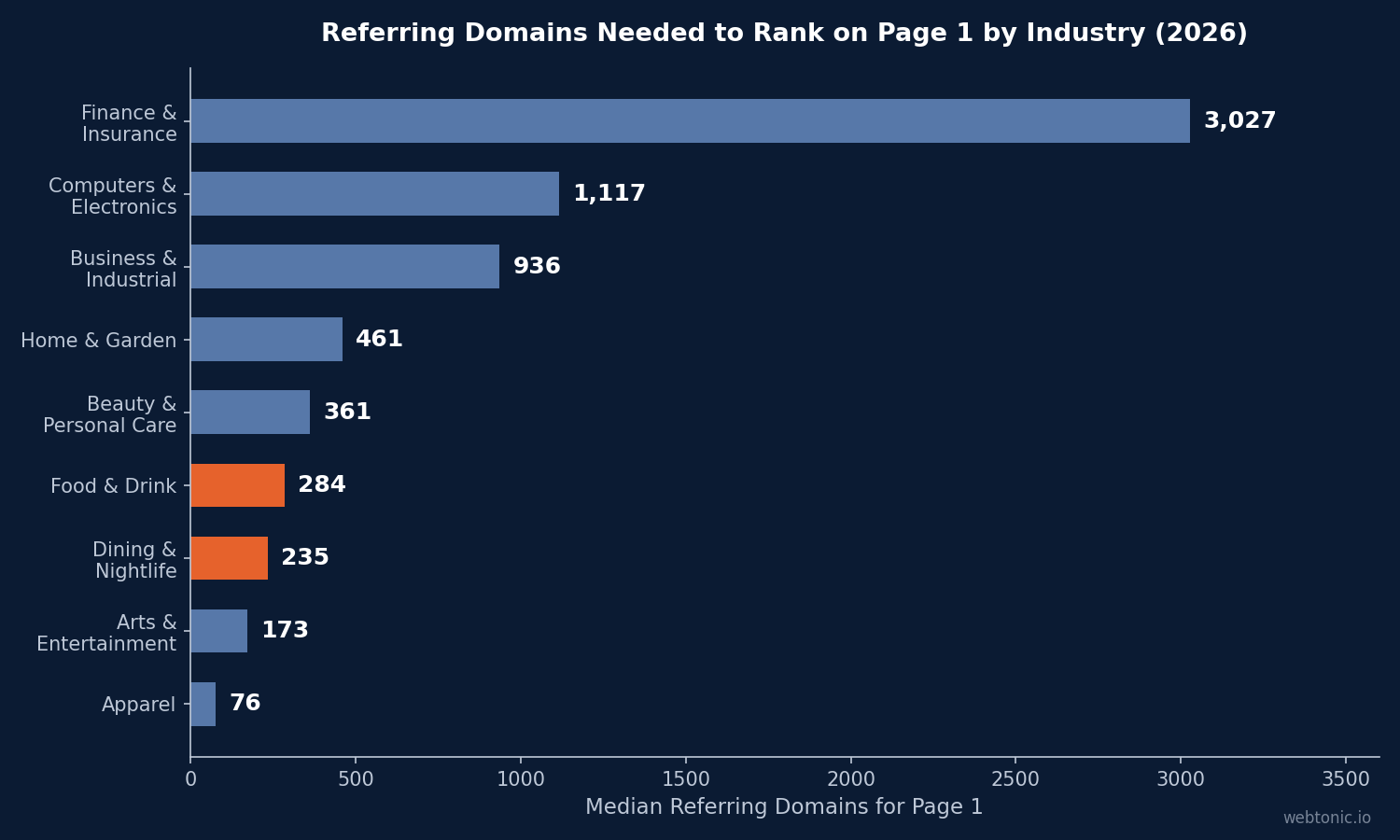
A 2026 WebFX study of 1,462 domains across 15 industries found that the median page-one website has 907 referring domains. The food sector sits below that median but still demands a substantial link profile. Food & drink websites need 284 referring domains, while dining & nightlife sites need 235 — both far above apparel (76) but well below finance & insurance (3,027) (Stacker / WebFX, 2026).
| Industry | Median Referring Domains (Page 1) | Relative Difficulty |
|---|---|---|
| Finance & Insurance | 3,027 | Very High |
| Computers & Electronics | 1,117 | High |
| Business & Industrial | 936 | High |
| Home & Garden | 461 | Moderate |
| Beauty & Personal Care | 361 | Moderate |
| Food & Drink | 284 | Moderate |
| Dining & Nightlife | 235 | Moderate |
| Arts & Entertainment | 173 | Low–Moderate |
| Apparel | 76 | Low |
For catering businesses targeting local keywords ("catering near me," "corporate caterer [city]"), the bar is lower. Local search results rely more heavily on Google Business Profile signals, reviews, and proximity than raw backlink volume, but domain authority still matters — it determines whether your site appears in the organic listings below the local pack and strengthens your overall search visibility (food service digital marketing statistics).
Link Building ROI for Food Service Businesses
Link building is one of the highest-ROI channels in SEO for food service companies, but it compounds over time rather than delivering instant results. RankPill's 2026 guide for caterers recommends acquiring 15–30 dofollow backlinks from event and hospitality sites within 6 months, projecting a 20–35% improvement in local pack rankings from that effort (RankPill, 2026).
Authority Specialist's analysis of 34 hospitality groups confirms that SEO is a compounding investment for food and beverage brands. While the initial phase focuses on technical foundations and local listings, long-term organic growth is driven by content authority and backlink profiles. Businesses that show steady, high-quality link acquisition over several quarters earn favored treatment from search engines (Authority Specialist, 2026).
The economics are straightforward for food service operators. Organic search drives 48.2% of all catering website traffic (CuFinder, 2026). With an average customer lifetime value exceeding $12,500 for corporate catering clients, even a modest improvement in organic rankings translates to significant revenue. A catering business ranking #1 locally for "corporate catering [city]" can generate dozens of qualified inquiries monthly — each worth thousands in contract value — making link building one of the best investments in the food service marketing budget.
Link Building Case Studies in Food Service
Real-world campaigns demonstrate what structured link building achieves for food and restaurant brands:
- Wok 'N Roll (K2Rankings): Strategic outreach to food blogs and restaurant directories produced 683% growth in backlinks over six months, driving measurable organic traffic gains (K2Rankings).
- Saudi Food E-Commerce (LinkScope): A link building campaign lifted domain rating from DR 21 to DR 40, generating 727 quality backlinks from 296 referring domains and reaching 26,400+ monthly organic visitors (LinkScope, 2026).
- Roots Indian Bistro (MindCentrix): Content marketing paired with structured backlink acquisition from hospitality publications grew the restaurant to 5,000+ monthly visitors, 1,000+ ranking keywords, and 100+ leads per month (MindCentrix, 2026).
- Negi and Nori (Sanzumia): Consistent acquisition of 80–90 high-DA backlinks per month plus local citations resulted in 1,100+ total backlinks and 523,000 impressions (Sanzumia).
- The Forked Spoon (Reporter Outreach): Five years of consistent digital PR earned 500+ editorial placements and grew organic traffic by 331% — proof that link building compounds dramatically over time (Reporter Outreach).

Link Velocity and Acquisition Strategy
The concept of "link velocity" — how quickly a site gains new backlinks — matters as much as total count. Search engines favor domains that grow their backlink profiles steadily rather than in sudden spikes. For food service businesses, a sustainable velocity of 10–15 new referring domains per month signals healthy, organic growth to Google's algorithms (12AM Agency, 2026).
The most effective link building strategies for catering and restaurant brands include:
- Local food media and blog outreach — Pitching local food bloggers, newspaper food sections, and city guides for coverage, reviews, and event listings.
- Event and venue partnership pages — Getting listed as a preferred caterer on wedding venue, corporate event space, and conference center websites.
- Industry directory submissions — Claiming profiles on catering-specific directories, restaurant review sites, and hospitality association member pages.
- Content-driven link building — Publishing original research (menu trend reports, food cost analyses, industry benchmarks) that other food industry websites naturally reference.
- Digital PR and data studies — Creating shareable food industry content — surveys, seasonal trend data, or dietary preference statistics — that earns editorial coverage and backlinks from food and lifestyle publications.
A gluten-free flour company demonstrated the power of content-driven links: by publishing an article on allergen testing protocols in Modern Baking, the brand earned 11 high-quality backlinks from a single piece of content (SerpsGrowth).
Backlinks and Local SEO for Food Service Operators
For catering businesses, backlinks serve a dual purpose: they boost organic rankings and strengthen local search visibility. The Local Pack captures 40–60% of all clicks for local food queries, making it the most valuable real estate in food service search (Authority Specialist, 2026).
Local backlinks carry particular weight. Links from regional food publications, city tourism boards, chamber of commerce pages, and local event sites signal geographic relevance to Google's local algorithm. Catering companies that combine local link building with strong analytics tracking and data intelligence can precisely measure which backlink sources generate the most valuable referral traffic and local ranking improvements.
| Link Source Type | Typical DA Range | Local SEO Impact | Difficulty |
|---|---|---|---|
| National Food Publications | 70–90 | Medium | High |
| Local Newspaper Food Sections | 50–75 | Very High | Medium |
| Wedding Venue Partner Pages | 30–55 | High | Low–Medium |
| Event Venue Preferred Vendor Lists | 25–50 | High | Low |
| Hospitality Association Directories | 40–65 | High | Low |
| Food Blogger Reviews | 20–45 | Medium–High | Medium |
| City Tourism Board Listings | 55–80 | Very High | Low–Medium |
Link Building Best Practices for Catering Businesses
- Prioritize relevance over raw DA — A DR 35 link from a wedding planning site is more valuable for a catering business than a DR 70 link from a generic web directory. Topical relevance drives better rankings and higher-quality referral traffic.
- Build links at a steady velocity — Aim for 10–15 new referring domains per month. Sudden spikes followed by dormancy can trigger algorithmic scrutiny.
- Leverage event partnerships — Every venue, planner, and corporate client you work with is a potential link source. Request preferred vendor listings, co-create event recap content, and offer testimonials in exchange for profile links.
- Create linkable food industry data — Original research (menu pricing surveys, seasonal booking trends, event type breakdowns) naturally attracts links from food media, industry blogs, and marketing publications.
- Invest in local citations — Consistent NAP (name, address, phone) across restaurant directories, catering listings, and local business profiles strengthens both backlink breadth and local SEO signals.
- Track link quality metrics — Monitor domain rating, referring domain count, and link velocity monthly using tools like data analytics platforms. Remove or disavow toxic links that could drag down your profile.
Frequently Asked Questions
How many backlinks does a catering website need to rank on Google?
Industry benchmark data shows that food & drink websites need a median of 284 referring domains to rank on Google's first page. For local catering queries in smaller markets, the threshold is lower — often 50–100 referring domains are sufficient to compete in the local pack. The key is acquiring links from relevant food, event, and hospitality websites rather than chasing volume from generic directories.
What types of backlinks are most valuable for restaurants and caterers?
The most valuable backlinks for food service businesses come from local food publications, wedding and event venue partner pages, hospitality association directories, and city tourism boards. These sources combine topical relevance with geographic signals that strengthen both organic and local rankings. National food media links (DA 70+) provide authority boosts but carry less local SEO weight than a link from a regional publication.
How long does link building take to show results in the food industry?
Most food service link building campaigns show measurable ranking improvements within 3–6 months. Case studies show 683% backlink growth in six months (Wok 'N Roll) and DR jumps from 21 to 40 in a single campaign (LinkScope). However, the full compounding effect takes 12–18 months, as demonstrated by The Forked Spoon's 331% traffic growth over five years of consistent digital PR.
What is a healthy link velocity for a catering business?
A sustainable link velocity for catering websites is 10–15 new referring domains per month. This pace signals organic growth to search engines without triggering algorithmic scrutiny. Larger multi-location food service operators can sustain 20–30 per month across all properties, but even small single-location caterers should target at least 5 new quality referring domains monthly to maintain competitive link growth.
Is link building worth the investment for local caterers?
Yes — organic search drives 48.2% of all catering website traffic, and the Local Pack captures 40–60% of clicks for food-related local queries. Given that corporate catering customer lifetime values exceed $12,500, ranking improvements from link building translate directly to high-value leads. Even modest campaigns of 15–30 quality backlinks over six months can improve local rankings by 20–35%.
Sources
vastcope.com — Backlink Benchmarks 2026
stacker.com — 2026 Backlink Study by Industry
12amagency.com — How Many Backlinks Should a Website Have?
rankpill.com — SEO for Caterers 2026
authorityspecialist.com — F&B SEO Benchmarks 2026
k2rankingstech.com — Wok 'N Roll SEO Case Study
mindcentrix.com — Roots Indian Bistro Case Study
sanzumia.com — Negi and Nori SEO Case Study
linkscope.io — Saudi Food E-Commerce SEO Case Study
reporteroutreach.com — The Forked Spoon Case Study
serpsgrowth.com — Link Building for Food Manufacturers
cufinder.io — Catering Marketing Benchmarks 2026