Table of contents
The budget goes to three jobs in this order of leverage: converting trial leads, renewing expiring memberships, and winning back lapsed members - in that order, per the vendor and customer data available. This page maps where fitness SMS spend concentrates and what each use case is priced and reported to return.
Key Takeaways
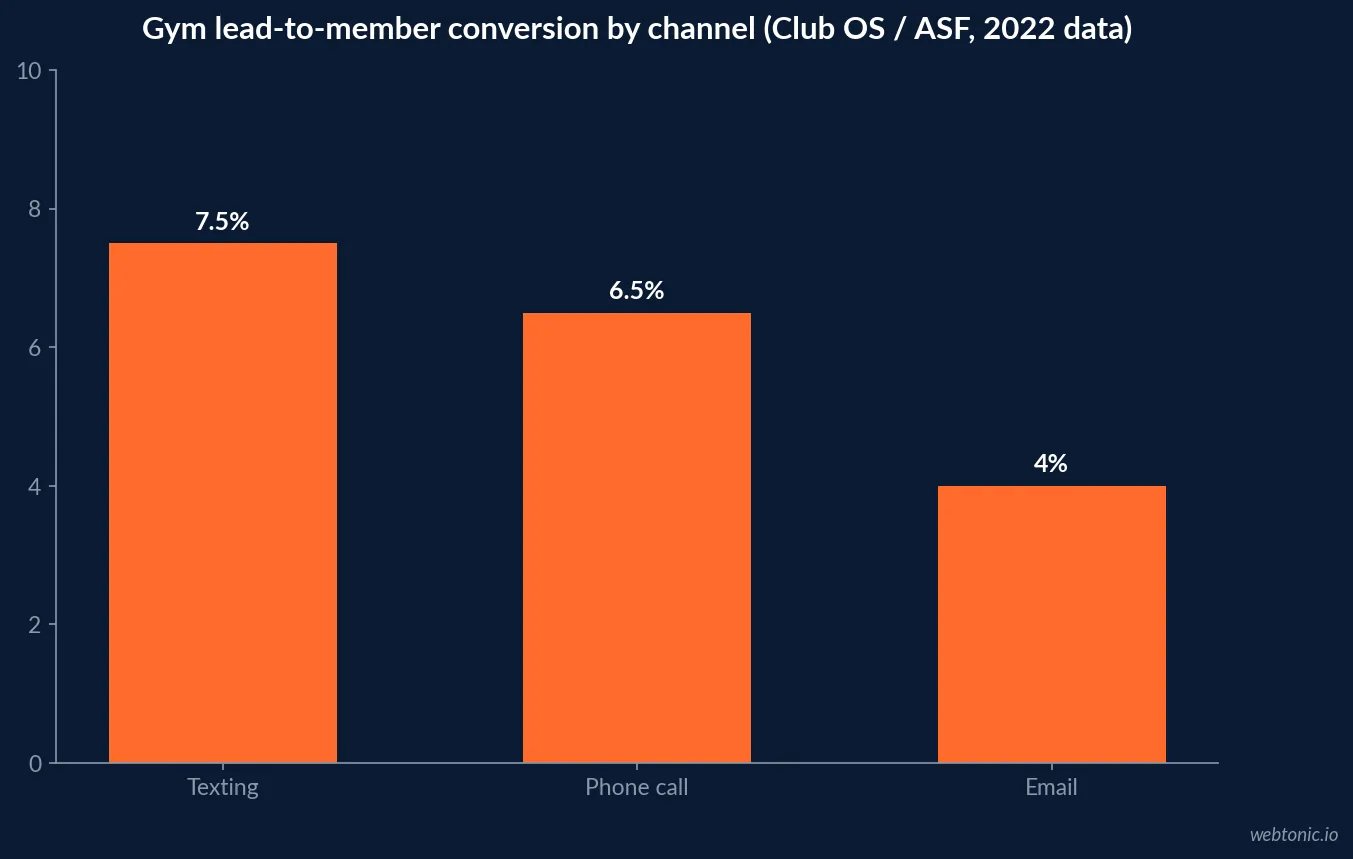
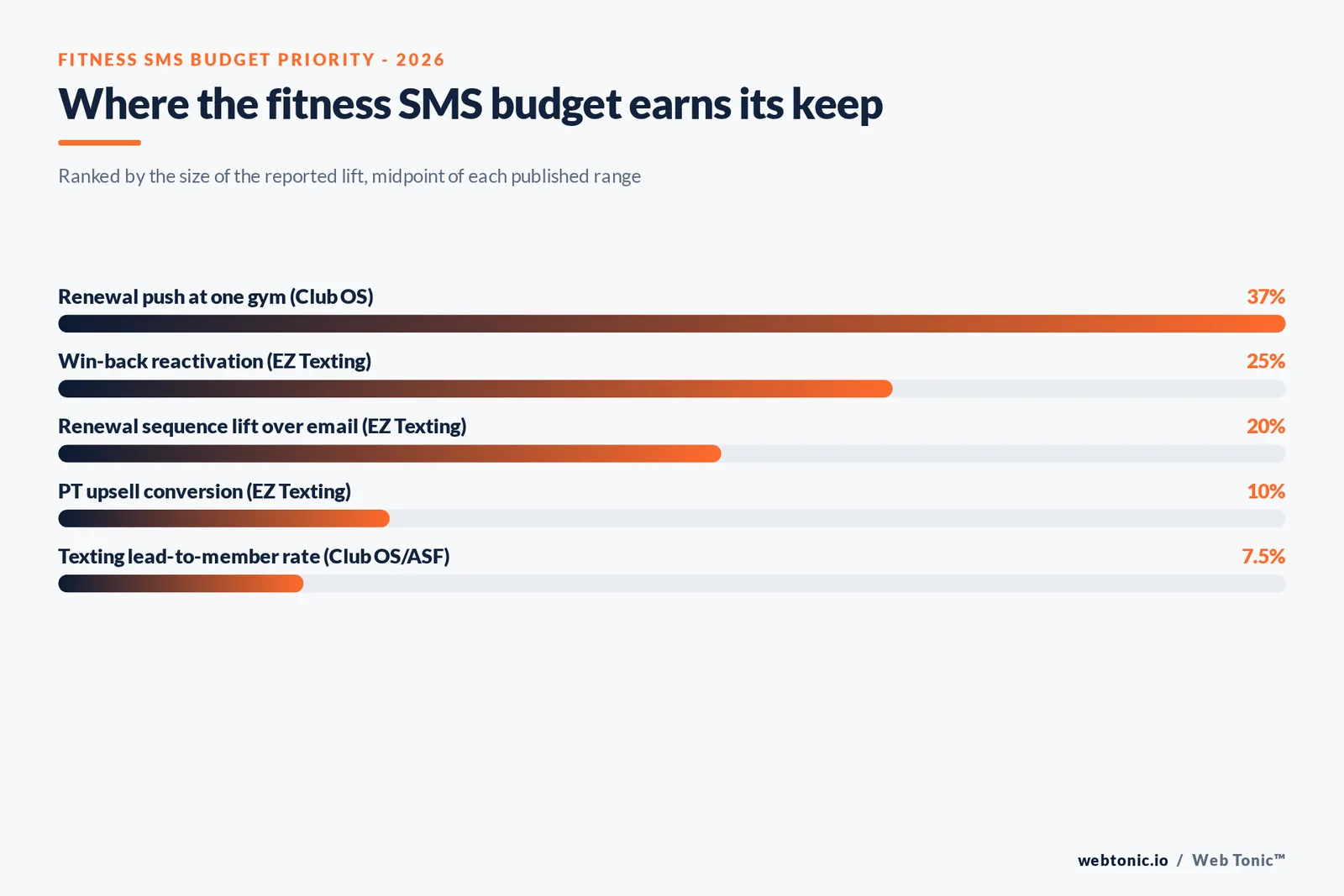
- Texting converts 7% to 8% of gym leads to members, against under 7% for phone and about 4% for email, per Club OS/ASF 2022 customer data.
- A four-touch, 60-day renewal sequence lifts renewals to 75-85% from a roughly 60-70% baseline, EZ Texting's own use-case data shows.
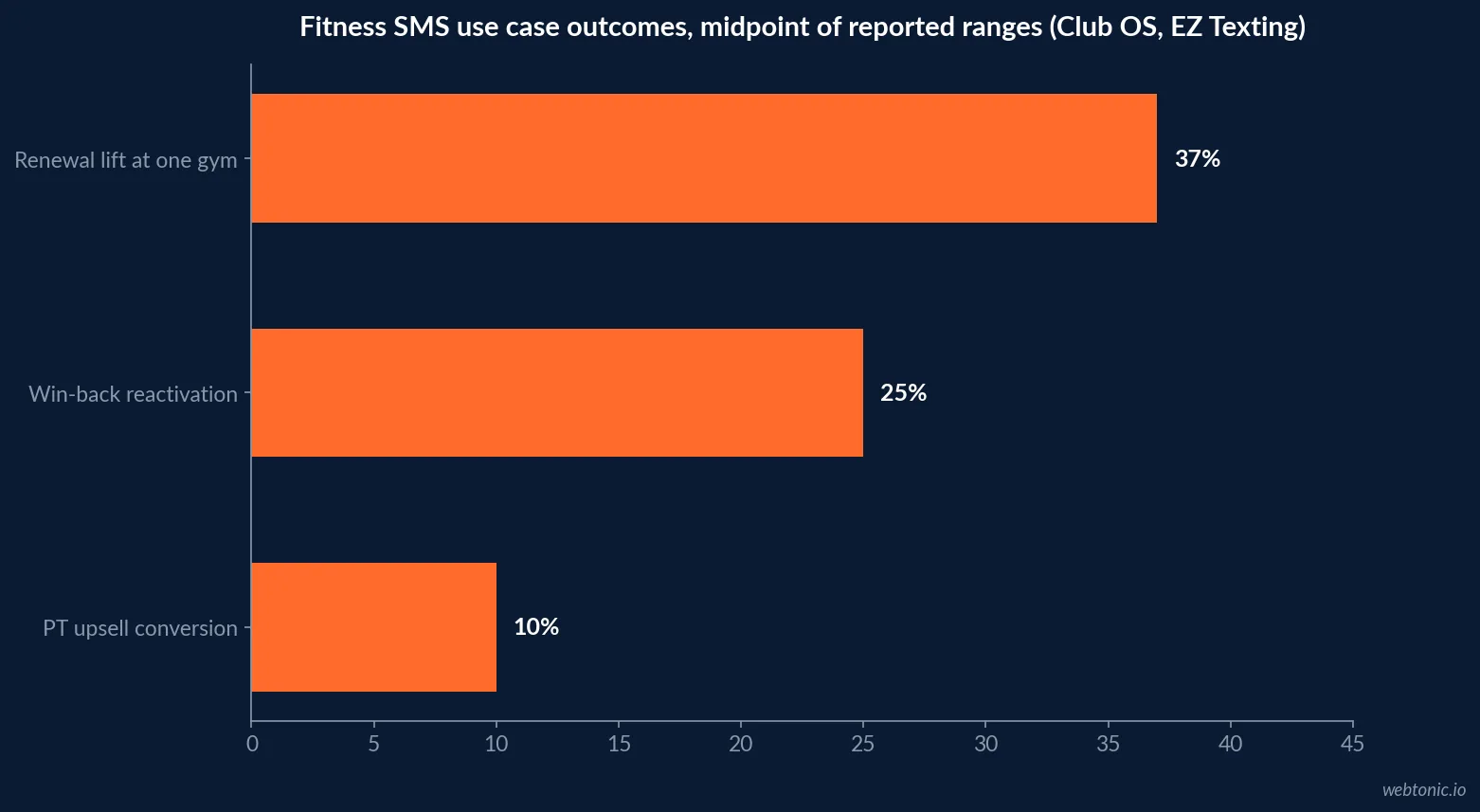
- One Club OS customer saw a 37% increase in monthly renewals, from 1,841 to 2,528 renewals year over year.
- Win-back sequences reactivate 20% to 30% of lapsed members, per EZ Texting's clubs and membership use-case page.
- Personal-training upsell texts convert 8% to 12% of eligible members, same source.
- 15% to 25% of eligible members respond to a multi-touch upsell sequence.
- A US SMS segment costs USD 0.0083 to send or receive, Twilio's own pricing page.
- EZ Texting's entry plan is USD 25 a month for up to 500 contacts.
- SimpleTexting's entry tier runs USD 29 to 39 a month for 500 credits.
- Podium's Core plan is USD 399 a month for texting plus reviews and payments.
- Klaviyo's SMS click rate benchmarks run 8.9% to 14.9% across its customer base.
- SMS conversion benchmarks run 1.2% to 2.2%, same Klaviyo source.
- 10DLC brand registration costs USD 4.50 for a for-profit entity.
- A Marketing use-case campaign vet costs USD 10.00 one time.
The highest-leverage line item: converting leads
Club OS, citing ASF and its own customer data, reports gym lead-to-member conversion rates of 7% to 8% for texting, a little under 7% for phone calls, and about 4% for email, based on 2022 data. That is the strongest single argument for putting SMS budget against new-lead follow-up first: a percentage-point gap on conversion compounds across every trial pass and free-class signup a gym runs.
The data is vendor-published and dated to 2022, so read the gap as directional rather than a precise current-year figure - but no more recent independent study has replaced it as of this writing.
| Channel | Lead-to-member conversion | Source | Year of data |
|---|---|---|---|
| SMS/text | 7-8% | Club OS / ASF customer data | 2022 |
| Phone call | Under 7% | Club OS / ASF customer data | 2022 |
| About 4% | Club OS / ASF customer data | 2022 |
The second-highest line item: renewal sequences
EZ Texting's sports and recreation use-case page reports that a 60-day, four-touch renewal sequence lifts membership renewals to a 75% to 85% range from a roughly 60% to 70% baseline - a 10 to 20 percentage-point improvement the vendor attributes to texting over a single reminder email. Separately, Club OS documents one customer that texted expiring members ahead of a price increase and saw monthly renewals rise 37%, from 1,841 to 2,528 in the same month year over year.
EZ Texting's clubs and membership use-case page separately reports that a win-back sequence targeting members near a 90-day lapse point reactivates 20% to 30% of them, and that layering SMS onto renewal outreach produces a 15% to 25% higher renewal rate than email alone.
| Use case | Reported result | Baseline | Source |
|---|---|---|---|
| Renewal sequence (60-day, 4 touches) | 75-85% renewal rate | ~60-70% single-email baseline | EZ Texting sports & recreation |
| Price-increase renewal push (one gym) | +37% monthly renewals | 1,841 to 2,528 renewals YoY | Club OS customer example |
| Win-back at 90-day lapse | 20-30% reactivated | n/a | EZ Texting clubs & memberships |
| SMS layered onto renewal outreach | +15-25% renewal rate | vs. email alone | EZ Texting clubs & memberships |
| Personal-training upsell sequence | 8-12% convert; 15-25% respond | Eligible member base | EZ Texting fitness & wellness |
What the platform itself costs
At the carrier level, Twilio's own pricing page lists USD 0.0083 per segment. Most gyms buy a packaged platform instead of the raw API: EZ Texting's Launch plan starts at USD 25 a month for up to 500 contacts, and SimpleTexting's entry tier runs USD 29 to 39 a month for 500 credits. A multi-location chain that also wants review management and payments in the same inbox typically prices up toward Podium's Core plan at USD 399 a month.
| Vendor | Entry price | Fits | Source |
|---|---|---|---|
| Twilio (raw API) | USD 0.0083/segment | A gym building its own renewal logic | Twilio pricing |
| EZ Texting | USD 25/mo | Single-location studio | EZ Texting pricing |
| SimpleTexting | USD 29-39/mo | Single to multi-location small chain | SimpleTexting pricing |
| Podium | USD 399/mo | Multi-location chain wanting reviews + payments | Podium pricing page |
Broad engagement benchmarks, used carefully
No vendor publishes fitness-specific click or conversion benchmarks at scale, so the closest available reference is Klaviyo's own SMS click-rate benchmarks (8.9% to 14.9%) and its conversion-rate benchmarks (1.2% to 2.2%), both built primarily from ecommerce sending. Use them to sanity-check a gym's own click and conversion numbers, not as an industry-specific target - the fitness-specific figures above (conversion, renewal, win-back) are the ones actually measured in this vertical.
Compliance costs that sit inside the same budget line
The TCPA (47 U.S.C. 227) and its FCC rule at 47 CFR 64.1200 require prior express consent for marketing texts and bar solicitation before 8 a.m. or after 9 p.m. local time. A2P 10DLC registration through The Campaign Registry costs USD 4.50 for brand identity plus a one-time USD 10.00 Marketing use-case vet. None of that is fitness-specific, but it is a fixed cost every gym's SMS budget has to clear before the first renewal text goes out, and it is small next to any single month of platform fees above.
Our growth marketing practice builds SMS budget splits like this from a club's own funnel data rather than a flat percentage rule of thumb.
Sequencing the budget across a member's lifecycle
The use cases above map cleanly onto a membership lifecycle, and budgeting by stage is more useful than budgeting by channel alone: acquisition texting to a trial lead, a mid-cycle engagement nudge, a renewal sequence in the 60 days before expiry, and a win-back sequence once a member has lapsed past 90 days. Each stage has a different message cadence and, per the data above, a different expected return - acquisition texting carries the largest reported percentage-point gap over other channels, while renewal sequences carry the largest absolute revenue protection because the member relationship already exists.
A gym allocating a fixed monthly SMS budget should weight spend toward whichever stage has the largest member count moving through it that month, rather than splitting evenly across all four stages by default.
| Lifecycle stage | Primary use case | Reported metric | Budget weight logic |
|---|---|---|---|
| New trial lead | Fast reply to inquiry | 7-8% lead-to-member conversion | Weight highest when trial volume is up |
| Active member | Class/PT upsell nudges | 8-12% PT upsell conversion | Weight to fill under-booked sessions |
| 60 days before renewal | Renewal sequence | 75-85% renewal rate vs. 60-70% baseline | Weight highest before a price increase |
| 90+ days lapsed | Win-back sequence | 20-30% reactivated | Weight to a fixed monthly test batch |
What a full monthly SMS budget looks like, assembled
Putting the pieces together: a single-location studio running Twilio directly or an entry platform like EZ Texting spends roughly USD 25 to 40 a month in software plus fractions of a cent per message, easily under USD 100 a month all-in for a few hundred active member and lead threads. A multi-location chain layering in review management and a shared inbox through Podium's Core plan is closer to USD 399 a month per location before message volume. Neither figure includes staff time to write and review the renewal and win-back sequences, which is the actual bottleneck most gyms report, not the platform cost itself.
Splitting that budget by the lifecycle weighting above rather than evenly across use cases is the difference between an SMS program that pays for itself on renewal protection alone and one that spreads too thin to move any single number.
| Gym size | Platform tier | Monthly software cost | What it's sized for |
|---|---|---|---|
| Single-location studio | EZ Texting Launch or SimpleTexting entry | USD 25-40 | A few hundred active threads |
| Mid-size gym, one location | SimpleTexting mid-tier or EZ Texting Boost | USD 75-125 | Up to a few thousand credits/month |
| Multi-location chain | Podium Core per location | USD 399/location | Shared inbox with reviews and payments |
Related reading on gym and studio marketing spend
Gyms comparing SMS against the acquisition channels that feed the trial-lead stage above can read our Facebook Ads pricing guide and the cross-industry SMS marketing statistics hub for benchmarks outside fitness. Multi-location chains weighing a broader retention program can also review our customer retention statistics page for churn and lifetime-value benchmarks that apply beyond gyms.
Frequently Asked Questions
What share of a gym's SMS budget should go to lead conversion versus retention?
No published survey states an industry-standard split, so the honest guidance is directional: lead-to-member conversion is the highest-leverage use case per available data (texting converts 7-8% of leads to members versus under 7% for phone and about 4% for email, per Club OS/ASF customer data from 2022), but renewal and win-back sequences protect revenue that is already booked. A gym running both should track cost per acquired member against cost per retained member separately rather than assume a fixed split.
Does texting really convert more gym leads than calling or emailing?
That is what the one publicly available comparison shows, with limits worth naming. Club OS, citing ASF and its own customer data from 2022, reports lead-to-member conversion rates of 7-8% for texting, a little under 7% for phone calls, and about 4% for email. It is vendor-published customer data, not an independent controlled study, and the year (2022) predates this year's benchmark reports, so treat the gap as directional rather than exact.
How much does an SMS renewal campaign typically lift renewals?
EZ Texting's own sports and recreation use-case page reports that a 60-day, four-touch renewal sequence lifts membership renewals to a 75-85% range from a roughly 60-70% baseline - a 10 to 20 percentage-point improvement over a single reminder email, per EZ Texting's own customer data. A separate Club OS case study cites one customer's before/after: a 37% increase in monthly renewals, rising from 1,841 to 2,528 renewals year over year, tied to expired-member outreach before a price increase.
What does an SMS platform cost a gym per month?
Entry tiers start under USD 40 a month. EZ Texting's Launch plan is USD 25 a month for up to 500 contacts; SimpleTexting's entry tier runs USD 29 to 39 a month for 500 credits plus a one-time carrier registration fee. Multi-location chains needing review management and payments alongside texting price up toward Podium's Core plan at USD 399 a month. The underlying carrier cost (Twilio: USD 0.0083 per segment) is a rounding error against any of those platform fees.
Are TCPA and 10DLC rules different for gyms than for other small businesses?
No - the same federal rules apply. The TCPA (47 U.S.C. 227) and 47 CFR 64.1200 require prior express consent for marketing texts and bar solicitation before 8 a.m. or after 9 p.m. local time; a2p 10DLC registration through The Campaign Registry costs USD 4.50 for brand identity plus a USD 10.00 one-time Marketing use-case vet. The FCC's 2023 one-to-one consent add-on was vacated by the Eleventh Circuit in January 2025 and is not currently in force, but a gym still needs a documented opt-in per member, typically collected at sign-up or through a keyword join campaign.
Sources
Club OS - Choosing the Right Communication Methods to Maximize Gym Member Conversions
EZ Texting - SMS marketing for sports & recreation
EZ Texting - SMS marketing for clubs & memberships
Club OS - Dos and don'ts of text and email for member retention
Twilio - US SMS pricing
EZ Texting - pricing
SimpleTexting - pricing
Podium - Pricing
Klaviyo Help Center - SMS click rate benchmarks
Cornell LII - 47 U.S.C. 227, Telephone Consumer Protection Act
The Campaign Registry - TCR Fees and Pricing