Table of contents

Fitness retention in 2026 is a split picture. National consumer-panel data shows industry-wide churn at a decade low, while operator platform data shows traditional gym cancellations creeping back up in the first half of the year. Both are real, and a lifecycle strategy has to account for which one describes your facility type.
Key Takeaways
- Industry-wide churn fell to 7.1% in 2025, the lowest level in a decade.
- That is down from 10.2% in 2024.
- Average membership tenure rose to five years, also a decade high.
- Ghost members fell to just 4.6% of the membership base.
- That is roughly half the pre-pandemic norm of around 10%.
- Average visit frequency sits at 81 days a year, against 109 days in 2019.
- Total U.S. fitness membership surpassed 81 million people in 2025.
- Membership penetration climbed to 26.1% of the population.
- Gen Z posted the highest penetration rate, at 35.5%.
- Adults 65-plus grew fastest year over year, up 8.6%.
- HFA's operator benchmark puts retention at 66.4% for 2025.
- Median EBITDA margin reached 23.6% across 175 benchmarked companies.
- Gym cancellations rose 8% year over year in the first half of 2026.
- Gym new joins fell 9% over the same period.
- Studio cancellations fell 6% while gym cancellations rose.
- Studio check-ins rose 27% year over year, against 1% for gyms.
- Studio spend grew 9.7% year over year, against 3% for gyms.
- The 35-44 age band drove 74% growth in new studio joins.
The industry-wide retention picture: a decade high
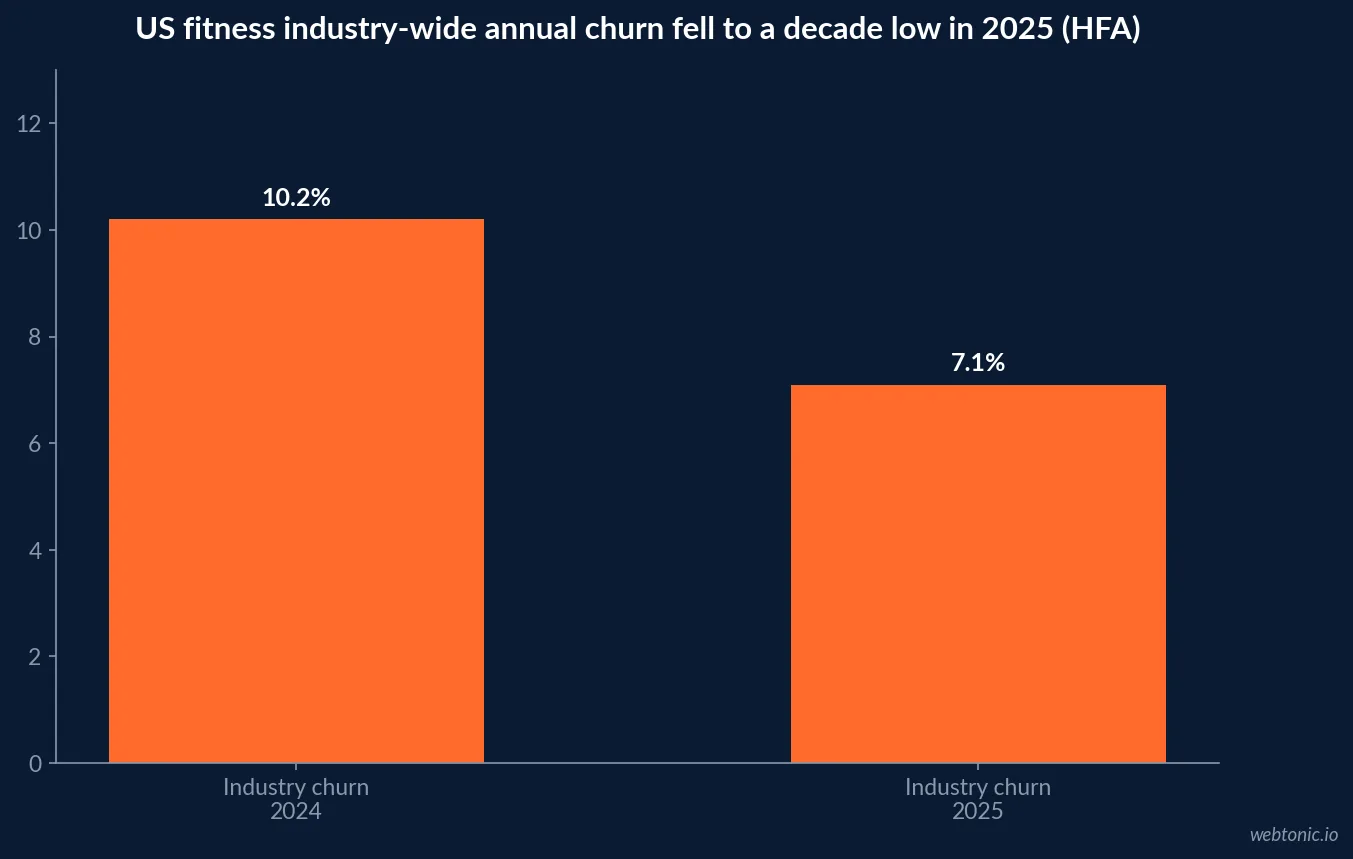
HFA's 2026 US Health & Fitness Consumer Report found the industry-wide churn rate falling to 7.1% — its lowest level in a decade, down from 10.2% in 2024 — while average membership tenure rose to five years, also a decade high. Total U.S. membership surpassed 81 million people, with membership penetration climbing to 26.1% and total consumer penetration (including day-pass and guest access) reaching 33.5%. The industry logged an estimated 7 billion facility visits in 2025, an all-time high that eclipsed the pre-pandemic 2019 peak.
| Industry-wide metric (HFA 2026 Consumer Report) | 2024 | 2025 |
|---|---|---|
| Annual churn rate | 10.2% | 7.1% |
| Average membership tenure | — | 5 years (decade high) |
| Ghost member share (paying, never visiting) | — | 4.6% (vs. ~10% pre-pandemic) |
| Total US membership | — | 81M+ |
| Membership penetration | — | 26.1% |
| Total consumer penetration (incl. day passes) | — | 33.5% |
Who is driving that growth, by demographic
Penetration rose across every age group, income bracket and gender in the HFA panel. Gen Z adults aged 18-24 posted the highest penetration rate of any age group, at 35.5%. Adults 65 and older recorded the strongest year-over-year growth of any age group, at 8.6%, and the $150,000-plus household income segment grew fastest by income bracket, up 10.5%, though lower-income brackets continued adding members in absolute terms.
| Demographic signal (HFA 2026) | Figure |
|---|---|
| Highest penetration rate by age group | Gen Z (18-24), 35.5% |
| Fastest year-over-year growth by age group | 65+, up 8.6% |
| Fastest-growing income bracket | $150,000+ household income, up 10.5% |
| Visit frequency, 2025 | 81 days/year |
| Visit frequency, 2019 (pre-pandemic) | 109 days/year |
The operator benchmark: revenue, EBITDA and retention side by side
HFA's 2025 Fitness Industry Benchmarking Report, its first in-depth benchmarking study since 2019, surveyed 175 companies representing more than 17,000 facilities across 27 countries between April and June 2025. It found median revenue growth of 9.9% compared to 2023, median EBITDA margins of 23.6% with two-thirds of clubs profitable, net membership expansion averaging 5.5%, and member retention averaging 66.4% for the year — a different measurement basis than the national consumer-panel churn figure above, since this is operator-reported retention across a smaller, benchmarked cohort.
| Operator benchmark (HFA 2025, 175 companies / 17,000+ facilities) | Figure |
|---|---|
| Median revenue growth vs. 2023 | 9.9% |
| Median EBITDA margin | 23.6% |
| Clubs in positive EBITDA territory | ~66% (two-thirds) |
| Average net membership growth | 5.5% |
| Average member retention for the year | 66.4% |
Gyms vs. studios in the first half of 2026: two different trend lines
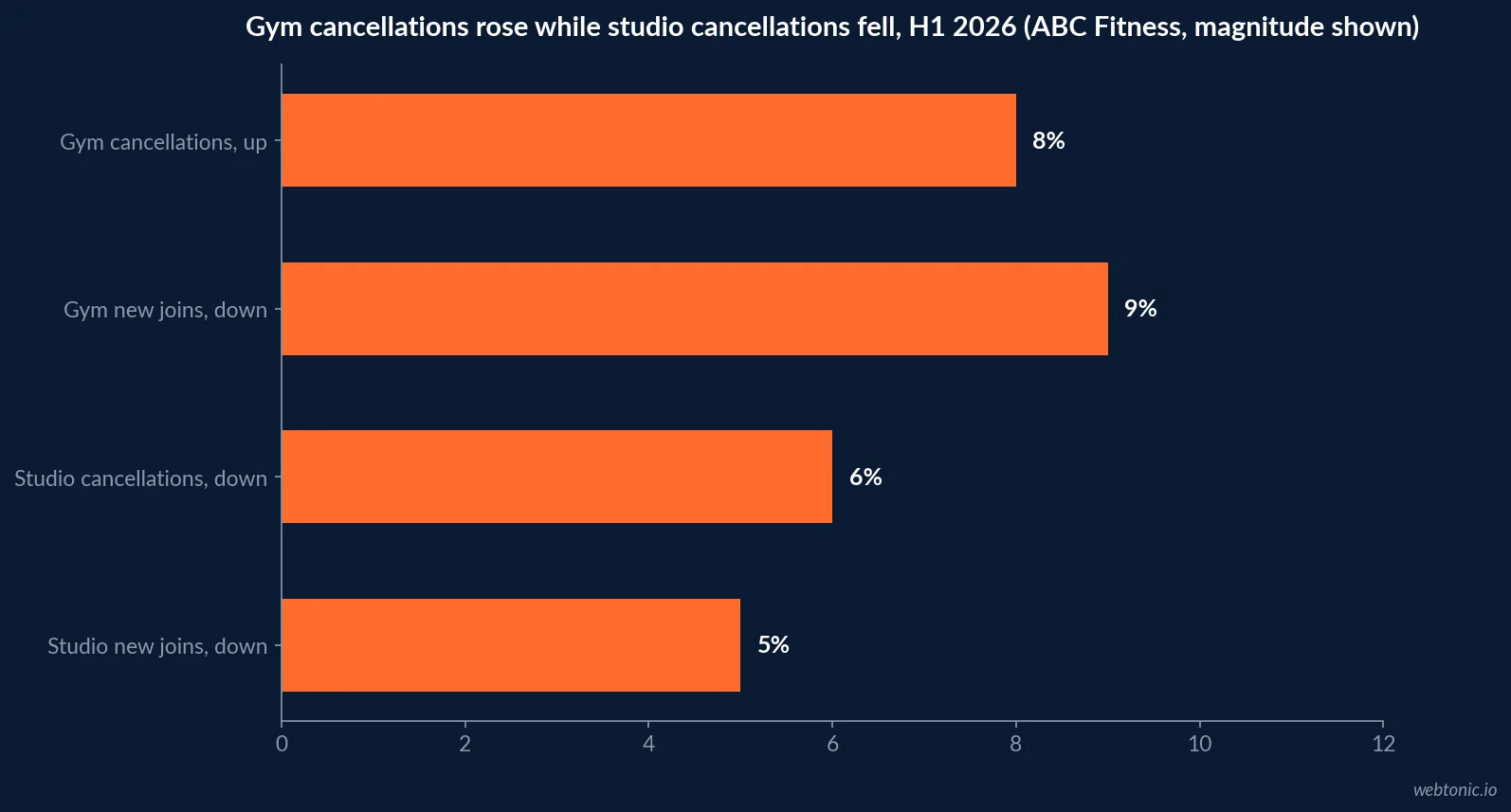
ABC Fitness's Mid-Year 2026 Wellness Watch report, based on its own platform data across gyms and studios, found traditional gym new joins down 9% year over year with cancellations up 8% and check-ins up just 1%. Boutique studios told a different story: new joins down a smaller 5%, but cancellations actually down 6% and check-ins up 27%. Average monthly spend rose 3% at gyms and 9.7% at studios. The lifecycle lesson is that acquisition softness looks similar across channels, but studios are converting the members they keep into deeper engagement while traditional gyms are not yet.
| Metric (H1 2026, ABC Fitness Wellness Watch) | Traditional gyms | Boutique studios |
|---|---|---|
| New joins, YoY | -9% | -5% |
| Cancellations, YoY | +8% | -6% |
| Check-ins, YoY | +1% | +27% |
| Average monthly spend, YoY | +3% | +9.7% |
| Strongest age cohort by new-join growth | Gen Z, 46% of new joins | 35-44, up 74% YoY |
How churn is actually measured, and why the figures differ
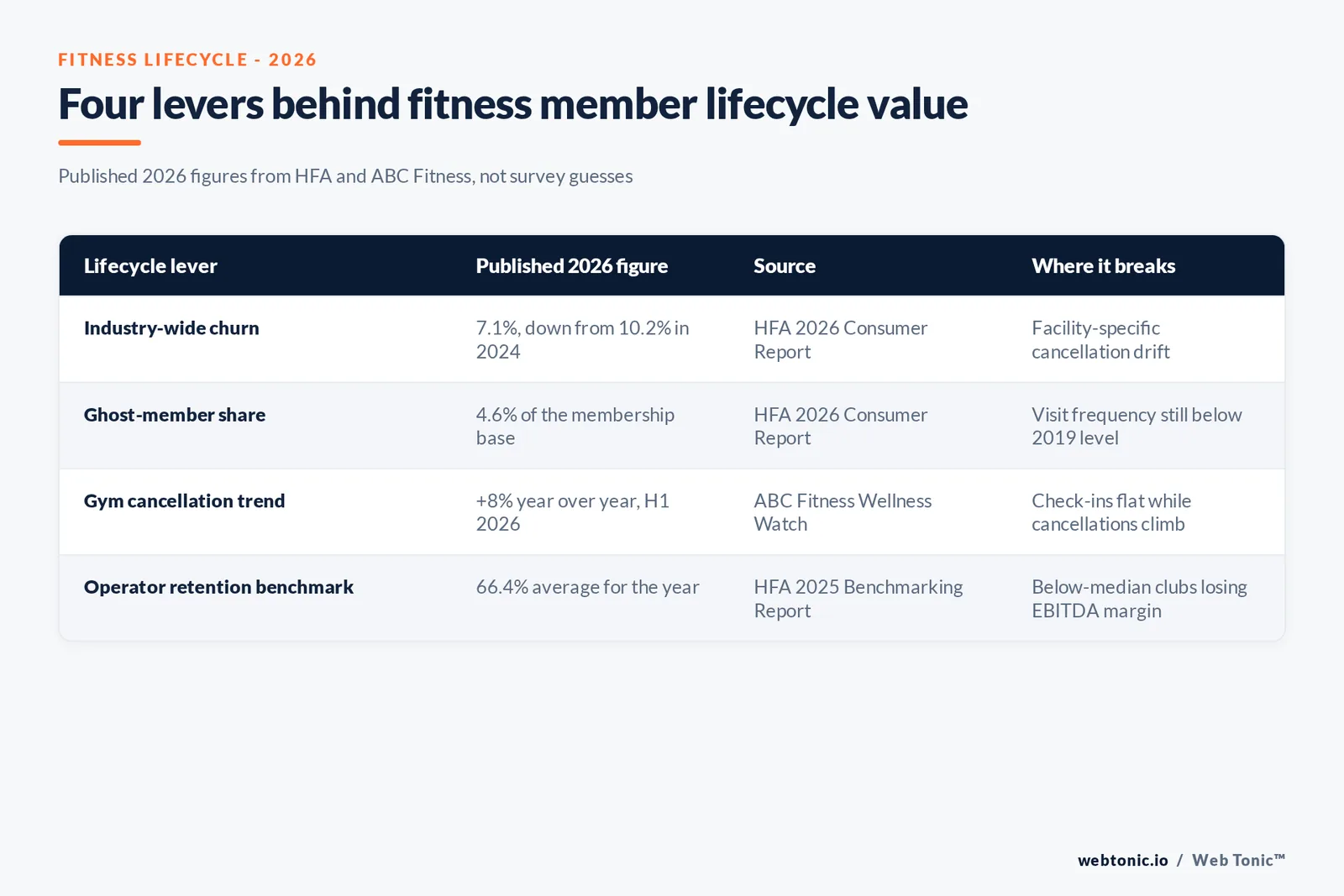
The 7.1% and 66.4% figures above are not the same measurement. IHRSA's membership attrition and retention methodology defines attrition using average opening monthly membership over a rolling twelve-month period — beginning memberships, plus new and reinstated accounts, minus dropped accounts, and excludes upgrade/downgrade churn entirely. HFA's national churn figure (7.1%) comes from a consumer panel; its operator-benchmark retention figure (66.4%) comes from 175 companies self-reporting against their own formula. Compare your own number only after confirming which formula the source used.
Operator sentiment behind the retention numbers
Confidence tracks the same split. Mindbody's 2025 State of the Industry Report found 72% of fitness and wellness businesses optimistic about performance for the year ahead, against just 9% describing themselves as pessimistic — consistent with an industry whose national churn number is improving even where individual facility types, like traditional gyms in H1 2026, are seeing cancellations tick back up.
Where the lifecycle risk actually sits in 2026
Put the two datasets together and the lifecycle risk for a fitness operator in 2026 is not whole-industry churn, which is improving, but facility-type-specific cancellation drift. A traditional gym watching cancellations rise 8% while check-ins stay flat is losing members who are still showing up right up until they leave — the opposite of the ghost-member problem that dominated the pre-2025 conversation. A studio watching check-ins rise 27% has room to convert that engagement into longer tenure before the industry-wide five-year average becomes the ceiling rather than the floor.
Applying this to a retention program
- Track cancellations and check-ins as a pair by facility type — a flat check-in trend with rising cancellations (traditional gyms, H1 2026) is a different problem than falling new joins with rising engagement (studios).
- Benchmark tenure against the five-year industry average and treat anything shorter as a program gap, not a market condition.
- Segment retention messaging by the demographic actually growing: Gen Z for volume, 65+ for growth rate, and 35-44 specifically for studio formats.
- Use the EBITDA and revenue-growth benchmarks (9.9% revenue, 23.6% EBITDA) to size how much a retention program can spend before it erodes margin.
Where this fits alongside acquisition data
Our growth marketing practice builds retention segmentation directly from platform data like the ABC Fitness figures above, and our data and analytics team can track cancellation-vs-check-in trends per location instead of waiting for an annual industry report. For the tooling side of this same lifecycle, see our companion piece on customer retention statistics and our customer lifetime value data across other service industries.
What the global picture adds
Zooming out from the U.S., HFA's 2026 Global Report, covering 33 countries and combining operator-submitted data with independent audits, found 244 operators representing nearly 27,000 facilities worldwide reporting median revenue growth of 10.7% in 2025, median net membership growth of 6.1%, and a median EBITDA margin of 22.1% — figures close enough to the U.S.-weighted 2025 Benchmarking Report above to suggest the retention story is not a U.S.-only phenomenon.
| Global operator benchmark (HFA 2026 Global Report, 33 countries) | Figure |
|---|---|
| Operators surveyed | 244, representing ~27,000 facilities |
| Median revenue growth, 2025 | 10.7% |
| Median net membership growth | 6.1% |
| Median EBITDA margin | 22.1% |
What this means for a retention budget in 2026
None of the figures above argue for spending less on retention; they argue for spending it on the specific gap a facility actually has. A traditional gym with rising cancellations and flat check-ins has an engagement problem money alone will not fix — it needs a program that gets existing members back on the floor, not another acquisition campaign. A studio riding a 27% check-in increase has a conversion problem: turning that engagement into the five-year tenure the national average now sets as the benchmark, before it plateaus. Sizing a retention budget against the right one of those two problems is the practical output of this data.
Frequently Asked Questions
What is the average member retention rate for gyms and fitness clubs?
The Health & Fitness Association's 2025 Fitness Industry Benchmarking Report, drawing on 175 companies representing more than 17,000 facilities across 27 countries, put member retention at 66.4% for the year. Separately, HFA's 2026 US Health & Fitness Consumer Report puts the industry-wide annual churn rate at 7.1%, the lowest level in a decade, down from 10.2% in 2024 -- the two figures measure retention at different levels (operator benchmarking vs. national consumer panel) so read them as complementary, not identical.
Is fitness industry churn getting better or worse in 2026?
Better, on the national panel data, but with a caveat inside individual facility types. HFA's 2026 research shows industry-wide churn falling to 7.1% and average membership tenure rising to five years, both decade highs, with ghost members (paying but never visiting) down to 4.6% of the base. ABC Fitness's mid-2026 Wellness Watch report, drawn from its own platform data, shows traditional gym cancellations rising 8% year over year in the first half of 2026 even as check-ins held roughly flat, so the improvement is not uniform across every facility type.
How does studio retention compare to traditional gym retention?
ABC Fitness's mid-2026 Wellness Watch report found traditional gyms losing new joins (down 9% year over year) with cancellations up 8%, while boutique studios saw new joins fall less (down 5%) with cancellations actually down 6% and check-ins up 27%. Studios also saw stronger spend growth, at 9.7% year over year in average monthly spend versus 3% for gyms.
What is a 'ghost member' and how common are they in 2026?
A ghost member holds an active membership but never visits the facility during the measurement period. HFA's 2026 Consumer Report found the ghost-member share fell to 4.6% in 2025, roughly half the pre-pandemic norm of around 10%, even though average visit frequency (81 days a year) has not fully recovered to the 2019 level of 109 days. That combination reframes the retention problem: fewer members disengage completely, but the ones who stay are visiting less often than before.
Which age group is driving fitness membership growth in 2026?
By penetration rate, Gen Z adults aged 18-24 lead at 35.5%, the highest of any age group tracked by HFA. By year-over-year growth, adults 65 and older grew fastest at 8.6%, and the $150,000-plus household income segment grew fastest by income bracket, up 10.5%. Among new studio joins specifically, ABC Fitness found the 35-44 age band grew 74% year over year, the strongest momentum of any age segment in that channel.
Sources
Health & Fitness Association - 2026 US Health & Fitness Consumer Report: Headline Trends
Health & Fitness Association - 2025 Fitness Industry Benchmarking Report
Health & Fitness Association - 2026 HFA Global Report
ABC Fitness - Mid-Year 2026 Wellness Watch Report, 'The Reinforcement Shift'
IHRSA - Membership Attrition and Retention methodology
Mindbody - Top 5 Takeaways from the 2025 State of the Industry Report