Table of contents
Fitness has the audience and the creators: a record 77 million Americans held a gym membership in 2024, and Health and Fitness was one of the fastest-growing creator niches on Collabstr. What no source publishes is a gym-specific engagement or return benchmark, so the creator figures below are cross-industry and labelled that way.
Key Takeaways
- 77 million Americans held a fitness facility membership in 2024 (HFA).
- Nearly 96 million people used a US fitness facility that year.
- Health and Fitness creator demand rose 76% year on year on Collabstr.
- Athlete and Sports demand rose 108%, the fastest-growing niche.
- Athlete and Sports creators average USD 233 per engagement.
- YouTube videos draw 6% engagement, the highest format in Collabstr's data.
- TikTok videos draw 2% engagement, the lowest of the five formats.
- Health and Fitness is 10% of male creators' collaborations.
- Male creators earned USD 205 per engagement vs USD 166 for women.
- 31% of marketers name TikTok as their top investment platform (IMH 2026).
- TikTok Shop is 66.17% of social-commerce platform selections among adopters.
- 79% of enterprise marketers struggle to measure influencer ROI (Linqia).
The demand side: a record gym audience
The Health and Fitness Association's 2025 US Health and Fitness Consumer Report found that gyms, studios and other facilities welcomed 77 million members in 2024 and served nearly 96 million total customers, drawing on a nationally representative sample of 18,000 Americans aged 6 and older. That is the audience a fitness creator is talking to: people already paying for training who compare classes, coaches and clubs on their phones.
A bigger market is not a cheaper one. Every studio, franchise and supplement brand is courting the same members, and the creator economy they are buying into is also growing: Goldman Sachs Research estimated in 2023 that it could rise from about USD 250 billion to USD 480 billion by 2027.
| Market figure | Value | Source | What it means for creator spend |
|---|---|---|---|
| US fitness facility members, 2024 | 77 million | HFA 2025 consumer report | Largest in-market audience on record |
| Total facility customers, 2024 | Nearly 96 million | HFA 2025 consumer report | Non-members are reachable too |
| Survey sample | 18,000 Americans aged 6+ | HFA 2025 consumer report | Nationally representative base |
| Creator economy size estimate | USD 250 billion | Goldman Sachs Research, 2023 | Competition for creator time |
| Creator economy by 2027 | USD 480 billion | Goldman Sachs Research, 2023 | Rates unlikely to fall |
Fitness is one of the fastest-growing creator niches
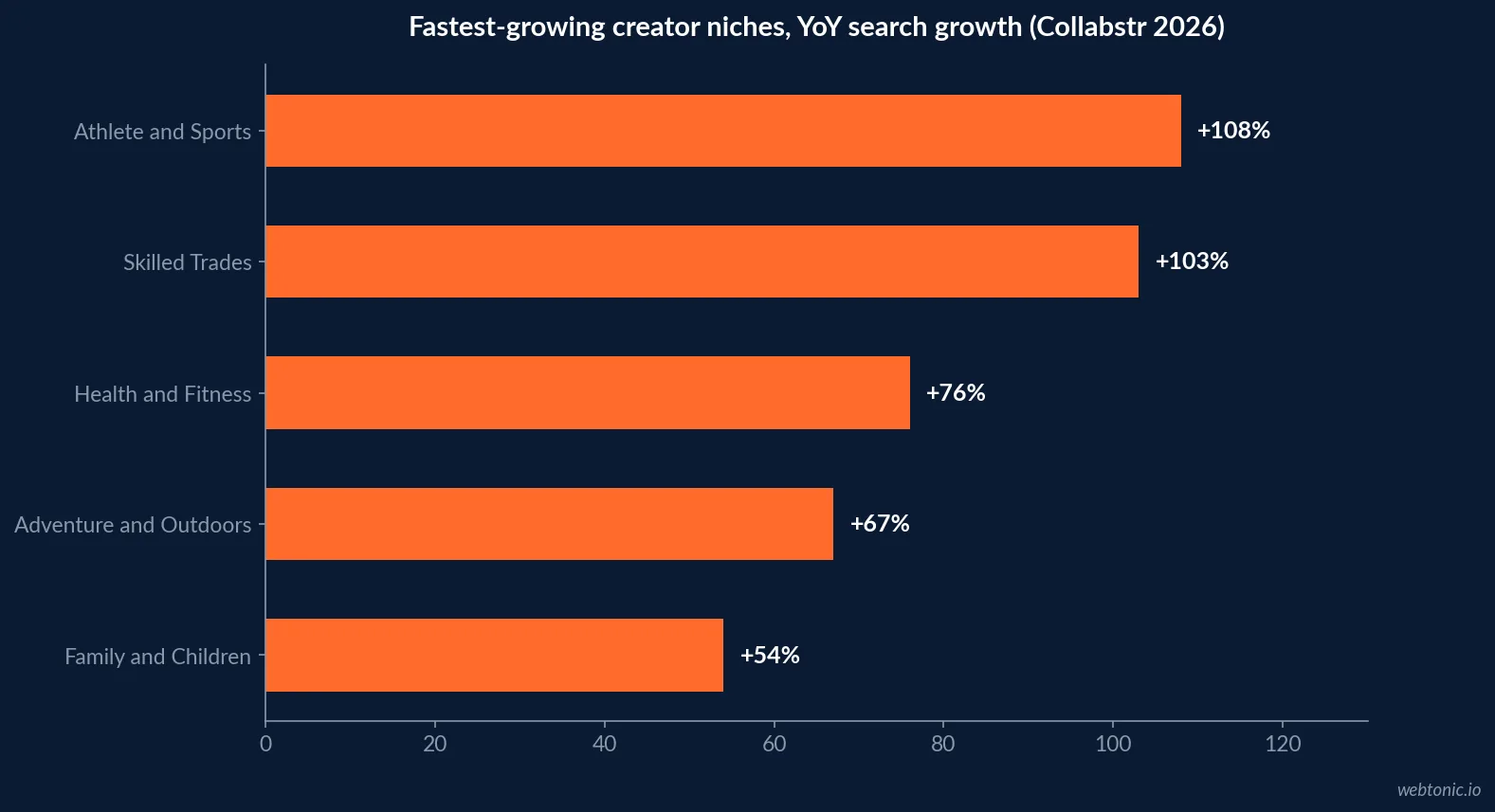
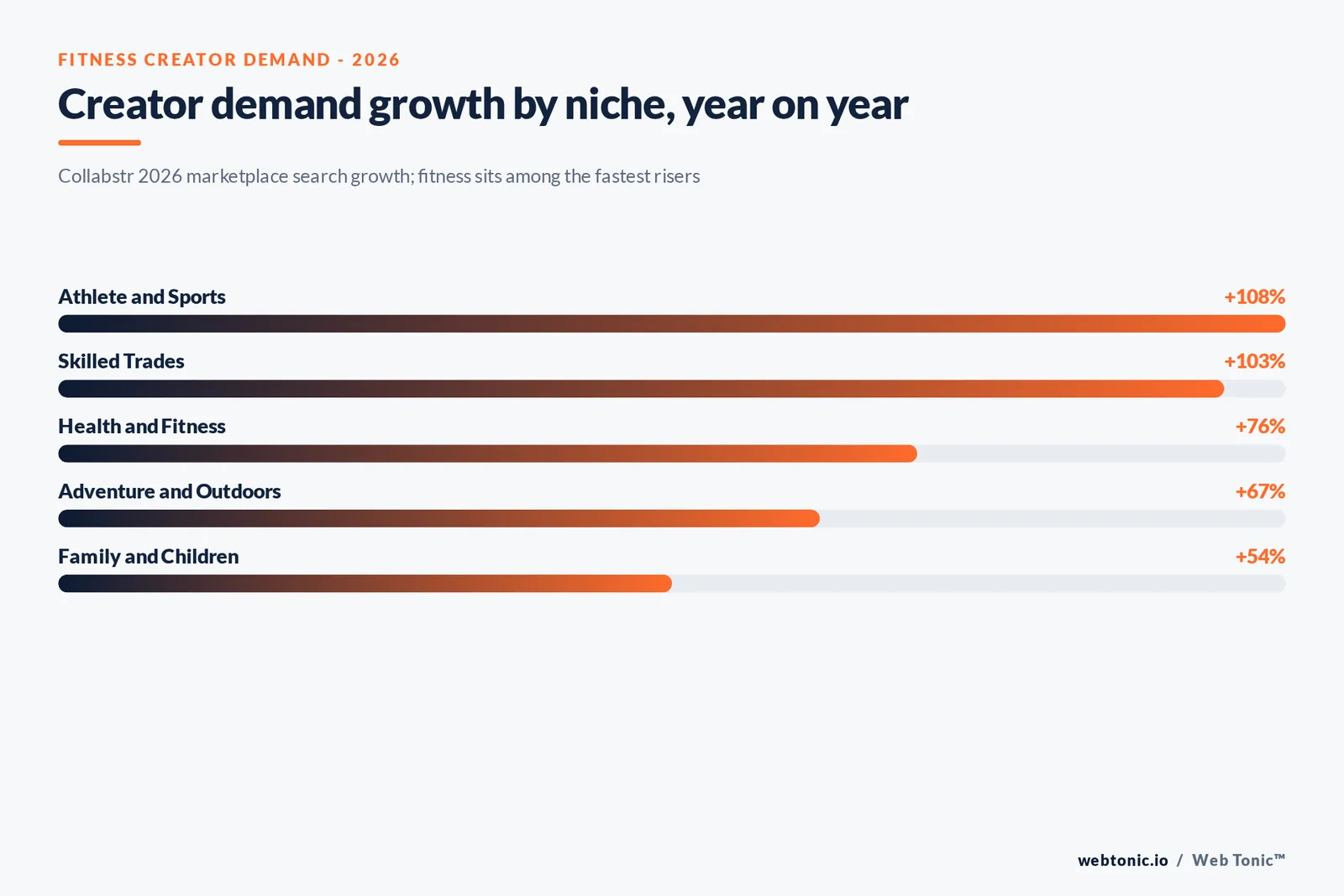
Collabstr's 2026 report, built on more than 21,000 collaborations and 2.3 million brand searches, ranks Health and Fitness among the five most in-demand niches alongside Lifestyle, Beauty, Fashion and Travel. On year-on-year search growth, Athlete and Sports rose 108%, Skilled Trades 103%, Health and Fitness 76%, Adventure and Outdoors 67% and Family and Children 54%. The report links four of the five to wellness and self-improvement content.
| Niche (Collabstr 2026) | Search growth YoY | Average price per engagement | Fitness brand use |
|---|---|---|---|
| Athlete and Sports | +108% | USD 233 | Performance and sport-specific programs |
| Skilled Trades | +103% | USD 309 | Not relevant to fitness |
| Health and Fitness | +76% | Not published | Core fit for gyms and studios |
| Adventure and Outdoors | +67% | USD 274 | Outdoor training and endurance |
| Family and Children | +54% | Not published | Family memberships, kids' classes |
What fitness creators cost
Collabstr does not publish a Health and Fitness price, so plan from the adjacent and platform-wide rates. Athlete and Sports creators average USD 233, one of the most affordable niches, and 80% of all collaborations cost under USD 300. The report also shows fitness skews male more than most niches: Health and Fitness is 10% of male creators' collaborations, and male creators earned USD 205 per engagement against USD 166 for women, a gap of roughly 24%. A gym briefing a mixed roster should expect that spread in quotes.
The spread of deal sizes is narrow at the bottom. Beyond the 80% of collaborations under USD 300, another 18% fall between USD 301 and 1,000 and only 2% exceed USD 1,000. For a studio, that means a first round of five to ten local trainers or members is a content-fee decision measured in hundreds of dollars each, with paid distribution and ad rights priced on top. The bigger budget question is how many clips it takes to find the one that fills a class.
Format engagement: where trainer content lands
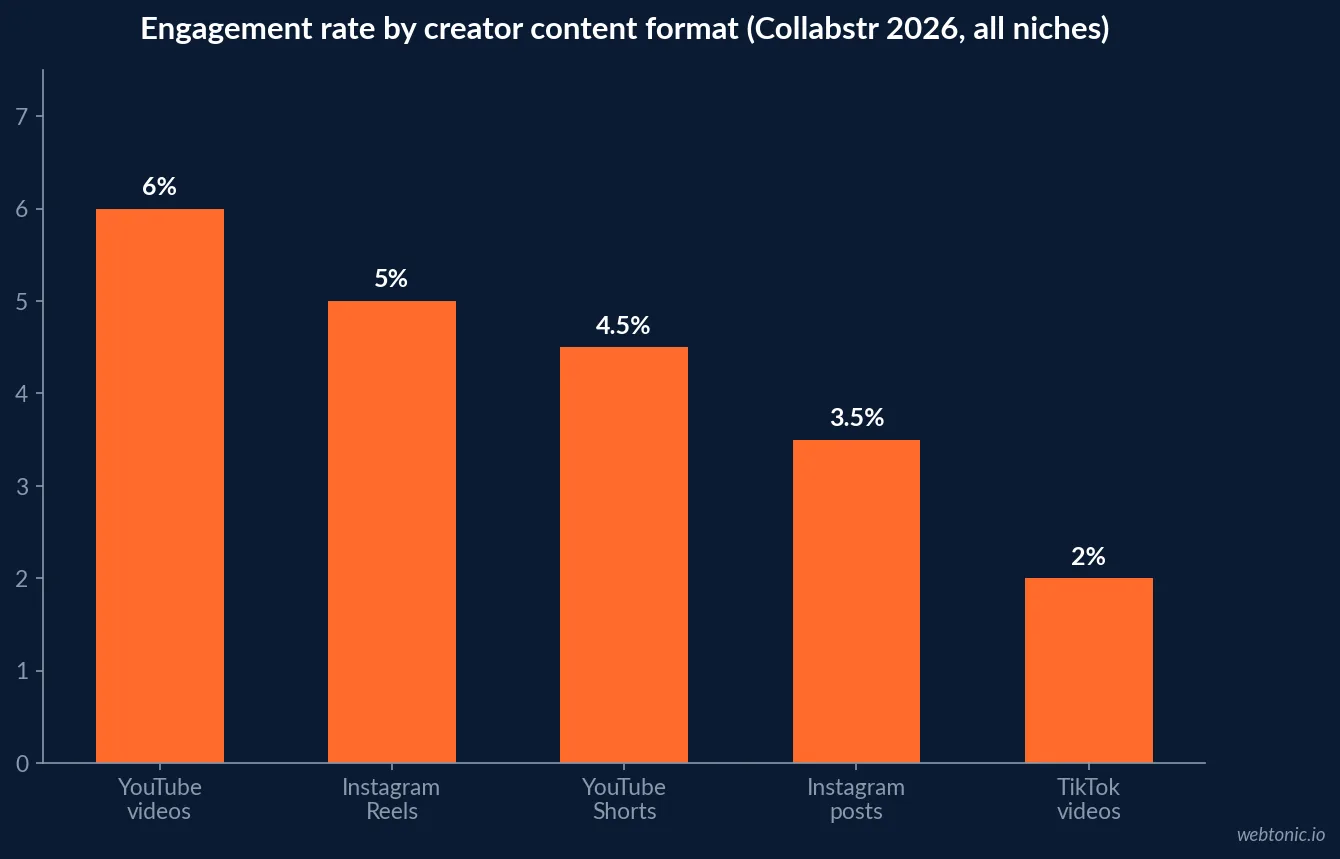
Collabstr reports engagement by format across its marketplace: YouTube videos at 6%, Instagram Reels at 5%, YouTube Shorts at 4.5%, Instagram posts at 3.5% and TikTok videos at 2%. Short-form still leads on impressions and is what brands request most, with Instagram Reels at the top of the request list. For fitness the split maps neatly onto content types: a full workout or form breakdown suits long-form, while a class teaser suits a Reel.
| Format (Collabstr 2026) | Engagement rate | Fitness content that fits | Role in the funnel |
|---|---|---|---|
| YouTube videos | 6% | Full workouts, form breakdowns | Trust and consideration |
| Instagram Reels | 5% | Class teasers, transformations of a routine | Reach in the club's city |
| YouTube Shorts | 4.5% | Single-exercise tips | Discovery |
| Instagram posts | 3.5% | Schedules, coach profiles | Retention and community |
| TikTok videos | 2% | Trend-led challenges | Top-of-funnel reach |
Platform bets and social commerce
The Influencer Marketing Hub 2026 Benchmark Report (600+ respondents, cross-industry) finds 31% naming TikTok as their main investment platform, with every other platform in a narrow 8% to 15% band. Social commerce is still early: 53.33% are not using it and 46.67% plan to test it in 2026. Among current adopters, TikTok Shop takes 66.17% of platform selections, Instagram Checkout 13.16% and YouTube Shopping 9.02%. For a gym selling memberships rather than products, shop features matter less than lead forms and trial-class offers, but for fitness apparel or supplements they are central.
| Signal (IMH 2026, cross-industry) | Figure | Reading | Fitness application |
|---|---|---|---|
| TikTok as main investment platform | 31% | One primary bet per brand | Pick one platform for the first test |
| Not using social commerce | 53.33% | Most brands are not selling in-app yet | Memberships sell off-platform |
| Planning to test social commerce | 46.67% | Early adopters | Supplements and apparel first |
| TikTok Shop share among adopters | 66.17% | Concentrated | Product-led fitness brands |
| Instagram Checkout share | 13.16% | Distant second | Low priority for clubs |
The mechanics that turn a trainer post into an ad
The creator line becomes a paid line through platform tools. The TikTok Ads Manager user guide describes Spark Ads as a native format built from organic posts, either from the advertiser's own account or from creators who authorize their posts, and lists three identity routes: association through Business Center, binding a personal account, or using another creator's authorized account or post via a video code. On YouTube, Creator Partnerships lets brands discover creators who are at least 18, in the YouTube Partner Program and free of active Community Guidelines strikes.
Who runs the program: in-house or outsourced
Most brands keep creator work close. The Influencer Marketing Hub survey finds 66.3% of respondents running programs entirely in-house. When they do outsource, it is for specific jobs: creator discovery and vetting at 19.44%, content production at 15.28%, and paid amplification and authenticity checks at 12.5% each, while reporting and analytics is the least outsourced function at 6.9%. AI follows the same pattern: 36.67% use it for creator discovery, 21.11% for content generation and only 7.22% for fraud detection.
For a multi-location gym or franchise, that suggests a practical split. Keep the relationship with local trainers and members in-house, where coaches already know who has a following, and buy help only for the parts that need scale: sourcing creators in new cities, editing raw member footage into ads and running the paid budget behind the best clips. Single-site studios can usually do all of it with one person and a clear brief.
| Function (IMH 2026) | Share outsourced or using AI | Type of signal | Gym or studio read |
|---|---|---|---|
| Run entirely in-house | 66.3% | Program ownership | Coaches own creator relationships |
| Outsource creator discovery | 19.44% | Most outsourced task | Useful when opening new locations |
| Outsource content production | 15.28% | Second most outsourced | Edit member footage into ads |
| Outsource reporting and analytics | 6.9% | Least outsourced | Keep member tracking in-house |
| AI used for creator discovery | 36.67% | Top AI use | Shortlist local trainers faster |
Disclosure rules for trainers and ambassadors
A free membership, a discounted personal-training block or an ambassador rate is a material connection under the FTC Endorsement Guides, 16 CFR Part 255. The FTC's Disclosures 101 guidance says the disclosure should sit with the endorsement, inside the video rather than only in the caption, and that terms like 'ad' or 'sponsored' work when hard to miss. Results claims matter too: a transformation clip implies what members can expect, so keep claims to what the program typically delivers.
Measurement is the weak link
Linqia's 2026 survey of more than 200 enterprise marketers finds 79% struggling to measure influencer ROI and 48% naming attribution as the biggest gap, even as 62% raise budgets. A gym has an advantage here: memberships and trial bookings are countable. Give each creator a trackable trial link or code and compare cost per new member with your other channels. Our fitness SMS marketing data covers the follow-up that converts those trials, and the e-commerce influencer and UGC statistics page covers product-led fitness brands.
A first creator test for a gym or studio
- Pick one platform: the survey data shows most brands commit to a primary platform rather than testing everywhere.
- Mix one long-form trainer with several short-form members: long-form for trust, short-form for local reach.
- Secure ad rights up front: authorization codes or partnership permissions before the post goes live.
- Track trials, not likes: a unique offer per creator ties spend to sign-ups.
Our growth marketing team sets up that tracking before the first post, and you can contact us to scope a test.
Frequently Asked Questions
Is there a fitness-specific influencer engagement benchmark?
Not one we could verify with a stated sample. The figures on this page are cross-industry: Collabstr's 2026 marketplace data reports engagement of 6% for YouTube videos, 5% for Instagram Reels, 4.5% for YouTube Shorts, 3.5% for Instagram posts and 2% for TikTok videos across all niches. Use them as format benchmarks, not as a promise for a gym or studio account.
Should a gym use influencers or UGC from members?
Both have a role. Influencers and trainers bring reach, and Collabstr reports Health and Fitness demand up 76% year on year on its platform. Member UGC gives a club an asset it can reuse in ads, and Linqia's 2026 survey finds 81% of enterprise marketers say repurposed creator content outperforms brand-made assets. Neither source breaks out gyms, so test both on your own membership sign-ups.
How can a gym run a trainer's TikTok video as an ad?
Through Spark Ads. TikTok's Ads Manager user guide describes Spark Ads as a native format that uses organic posts, either from the advertiser's own account or from creators who authorize them. A creator can authorize a single post with a video code or an account through Business Center, and the advertiser then selects that authorized identity when building the ad.
How many Americans belong to a gym?
The Health and Fitness Association reports that US gyms, studios and other fitness facilities had a record 77 million members in 2024 and served nearly 96 million total customers, based on a nationally representative sample of 18,000 Americans aged 6 and older.
Do fitness creators have to disclose a free membership?
Yes. The FTC Endorsement Guides at 16 CFR Part 255 treat free products and perks as a material connection. The FTC's Disclosures 101 guidance says the disclosure belongs with the endorsement itself, in the video and not only in the description, and warns against vague tags such as 'spon' or 'collab'.
Sources
Health and Fitness Association - 2025 US Health and Fitness Consumer Report release
Collabstr - 2026 Influencer Marketing Report
Influencer Marketing Hub - Influencer Marketing Benchmark Report 2026
Linqia - 2026 State of Influencer Marketing
TikTok for Business - TikTok Ads Manager user guide
YouTube Help - Get started with YouTube Creator Partnerships
eCFR - 16 CFR Part 255, FTC Endorsement Guides
FTC - Disclosures 101 for social media influencers
Goldman Sachs Research - The creator economy could approach half a trillion dollars by 2027