Table of contents

Gym memberships cannot be sold through Google Shopping, but the equipment, apparel and supplements a fitness business retails can, through either a manual feed or Google's automated website crawl. This page compares the two methods using Google's documentation and 2025 industry data.
Key Takeaways
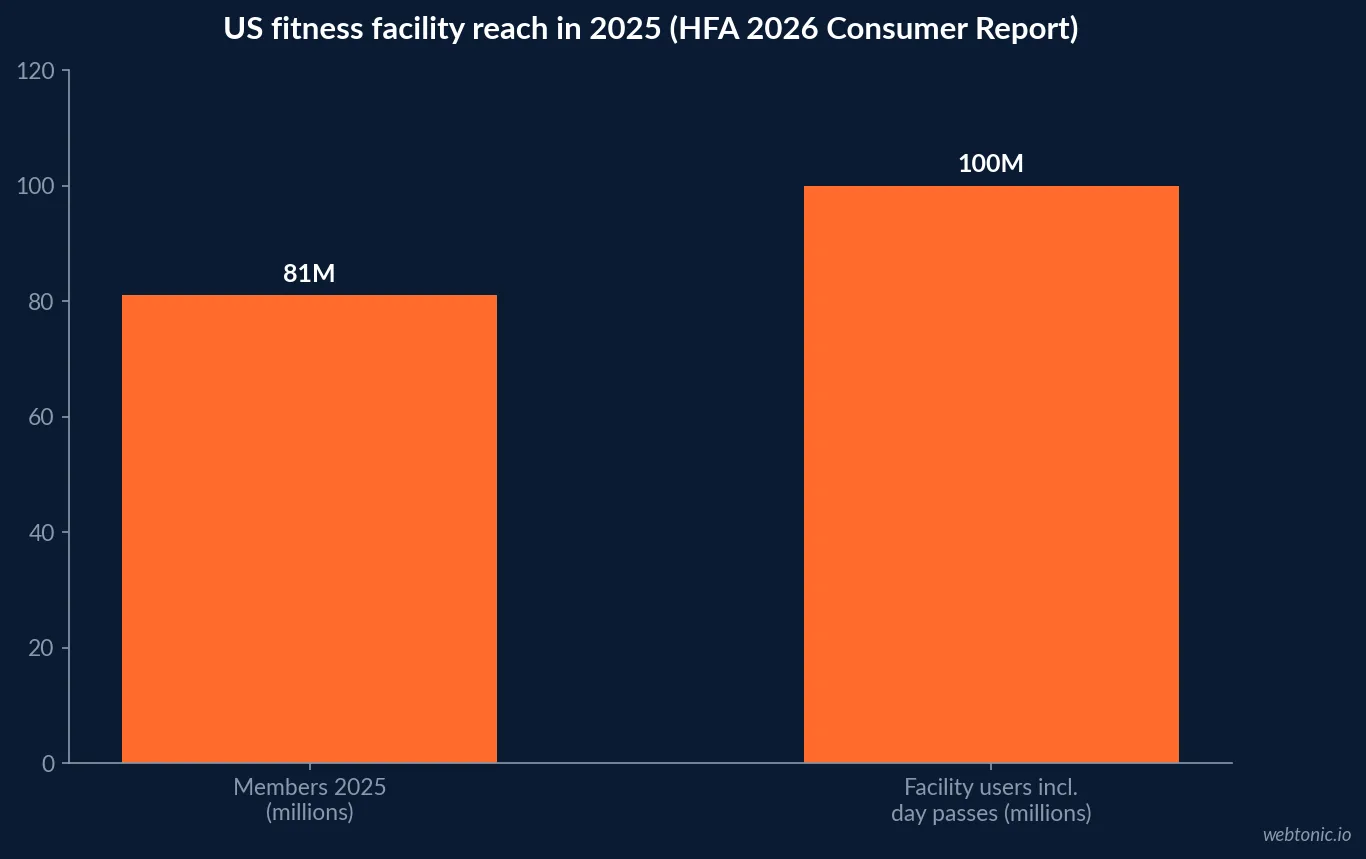
- 81 million Americans belonged to a fitness facility in 2025, up 5.2% (HFA).
- More than 100 million used a facility when day passes and guests are included.
- Facilities logged an estimated 7 billion visits in 2025.
- Members who never used their membership fell to 4.6%, from around 10%.
- US sporting goods wholesale sales reached USD 130 billion in 2025, up 3.7% (SFIA).
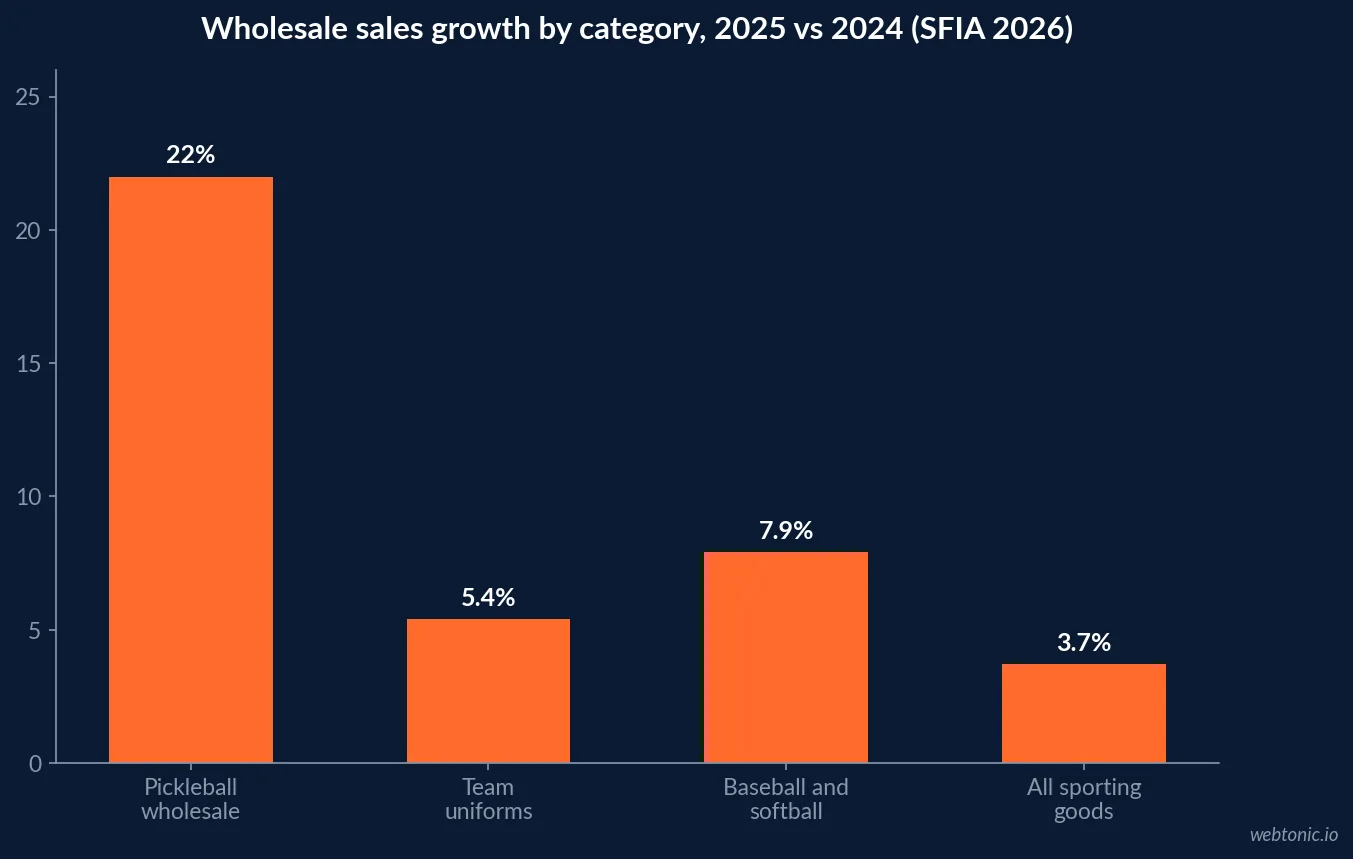
- Pickleball wholesale sales climbed 22%; athletic footwear totalled USD 24.1 billion.
- Merchant Center automations update 4 attributes: price, sale price, availability, condition.
- Google shopping CPC fell 1% year over year in Q4 2025 (Tinuiti).
- US e-commerce hit USD 340.2 billion in Q2 2026 (Census).
First, what a fitness business cannot put in a feed
Google's Unsupported Shopping content policy rules out "labor, time, effort, expertise, or actions, which do not result in ownership of a tangible product," including "any services sold bundled with physical goods." Memberships, class packs, personal training and a "free shirt with every annual plan" offer all fall under that wording.
The same page lists recurring billing rules: prepaid software subscriptions that auto-renew only annually are allowed, but that exception is about software, not gym access. The feed question for a fitness brand is therefore only about physical goods: equipment, apparel, footwear, accessories and supplements.
| Fitness offer | Shopping status | Why, in Google's terms | Where it can run instead |
|---|---|---|---|
| Monthly membership | Not eligible | Service: access and time | Search, Performance Max |
| Personal training pack | Not eligible | Service: expertise and effort | Local Services, Personal trainer category |
| Class pass with free gear | Not eligible | Service bundled with goods | Search |
| Dumbbells, kettlebells, mats | Eligible | Tangible product | Shopping, free listings, local inventory |
| Apparel and footwear | Eligible | Tangible product | Shopping, free listings, local inventory |
The market the retail side is selling into
The Health & Fitness Association 2026 consumer report finds 81 million Americans belonged to a gym, studio or other facility in 2025, a 5.2% increase and an all-time high, with more than 100 million users once day passes and guest visits are counted. Gen Z adults aged 18 to 24 had the highest penetration at 35.5%, and members aged 65 and older grew 8.6%.
HFA also reports free weights - dumbbells, barbells and kettlebells - growing faster than any other equipment category since 2021, and pickleball reach among members rising 21.3% to 7.6 million. Those are usage signals, not purchase data, but they point at the product lines a gym shop is most likely to stock.
What manufacturers are actually shipping
The SFIA 2026 Manufacturers' Sales by Category Report puts 2025 US wholesale sporting goods sales at USD 130 billion, up 3.7% and 34.7% since 2020. Pickleball was the fastest-growing category at 22%, baseball and softball rose 7.9%, team uniforms 5.4%, and athletic footwear was the largest single driver at USD 24.1 billion.
SFIA adds a split that matters for feed planning: institutional fitness equipment grew broadly while "portions of the consumer/home equipment segment experienced declines." Its 2026 State of the Industry report puts overall industry growth at 3.4% in 2025.
| SFIA 2025 wholesale figure | Value | Feed implication |
|---|---|---|
| Total sporting goods wholesale | USD 130 billion, +3.7% | Steady category, not a boom |
| Growth since 2020 | +34.7% | Post-pandemic base is higher |
| Pickleball | +22% | Worth its own product group and labels |
| Athletic footwear | USD 24.1 billion | Size and colour variants multiply SKUs |
| Consumer home equipment | Declines in portions | Watch stock and price accuracy |
Method one: the manual feed
A manual feed is a file or API upload you control. Google's product data specification defines the attributes, from id, title and price to availability and image link, and you decide how each is written, how products are grouped and which custom labels drive campaign structure. For footwear and apparel, that control is where size, colour and gender variants get handled cleanly.
The cost is maintenance. Every price change, sell-out and restock has to reach Merchant Center on your upload schedule, and mismatches between the feed and the landing page are a common cause of disapprovals.
Method two: the automated website crawl
Google's automatic product submission works in three steps: it discovers product pages, extracts details "like title, price, and availability" from their structured data, and submits them to Merchant Center. It requires structured data on the store, permission for Google to collect it, and a verified, claimed website; products already in another data source are not duplicated. Google's product structured data documentation and the schema.org Product type define what that markup contains.
Separately, Merchant Center automations can correct 4 attributes - price, sale price, availability and condition - from landing-page data. Google's example: a feed says USD 4, the page says USD 3, and the listing is updated to USD 3. Google also warns automations "aren't a replacement for regular updates" and are designed for "a small percentage of your products."
| Dimension | Manual feed (file or API) | Automated website crawl | Source |
|---|---|---|---|
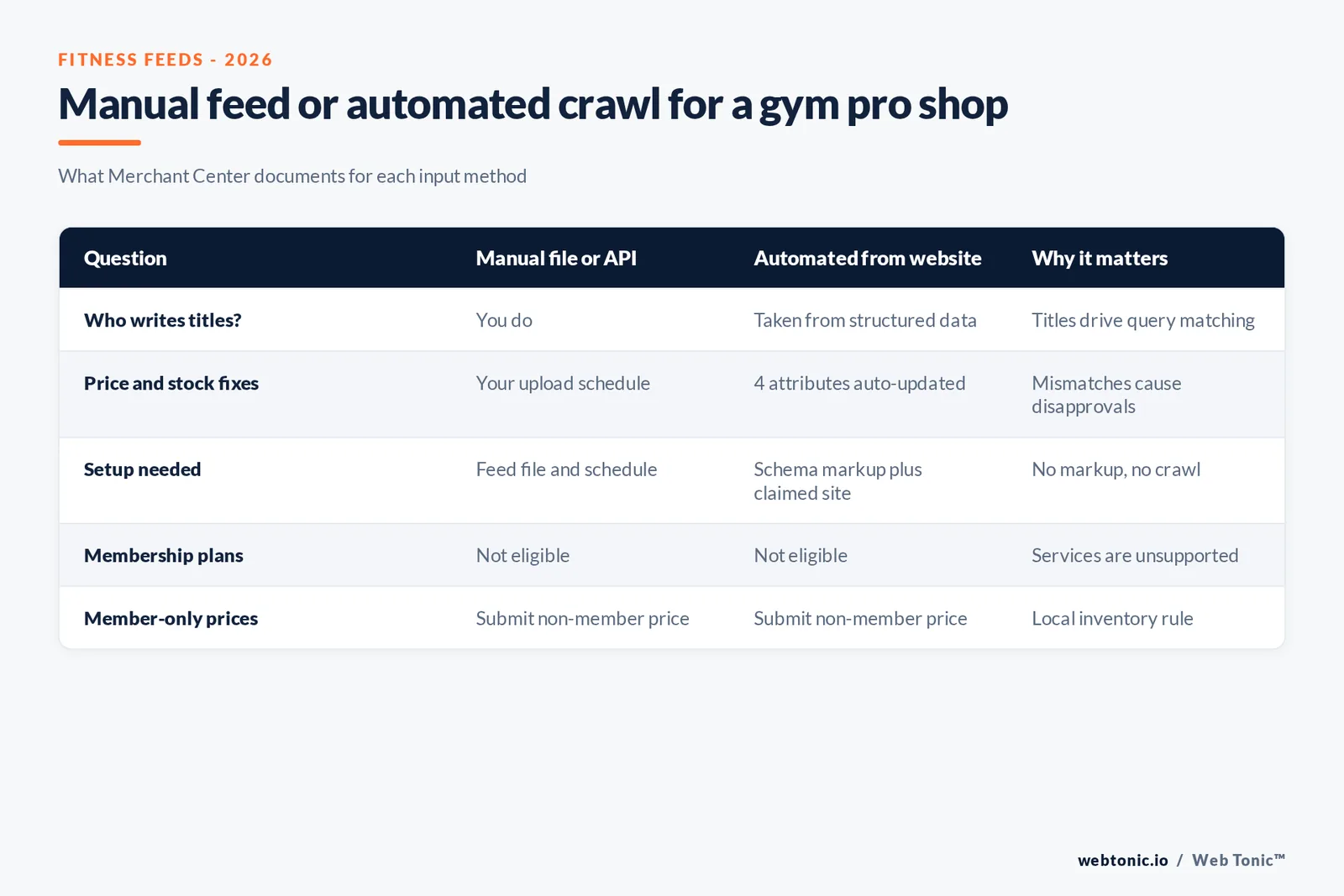
| Who writes the title | You | Taken from page structured data | Merchant Center Help |
| Setup requirement | Feed file and schedule | Structured data plus claimed site | Merchant Center Help |
| Price and stock drift | Fixed on your schedule | Automations cover 4 attributes | Merchant Center Help |
| Custom labels and grouping | Full control | Limited to what pages expose | Product data specification |
| Duplicates | Your responsibility | Products in other sources are not re-added | Merchant Center Help |
Local inventory and the membership trap
Google's local inventory ads policy needs a brick-and-mortar location where customers can "physically visit, view, and purchase" the item, and has a rule written almost for gyms: "If you require customers to be a club or store member to purchase products, you're ineligible." Non-member access keeps you eligible, and tiered pricing is allowed if the non-member price goes in the price attribute and is displayed on the landing page.
A front-desk shop that sells protein and straps only to members cannot use local inventory ads until it opens purchase to walk-ins.
Memberships themselves need a different Google route. Google's Local Services category list includes Personal trainer and Yoga studio, and Performance Max can run for membership sign-ups from assets and conversion goals alone, with no product feed attached. Keeping that split clean - goods in the feed, access in Search, Local Services or Performance Max - also means never adding Product markup to a membership page, since the automated crawl reads product structured data.
Retail auction context for fitness sellers
Tinuiti's Q4 2025 Digital Ads Benchmark Report, based on its client base, shows Google shopping ad spending up 16%, CPC down 1%, clicks growing in the upper teens for a third straight quarter, and Performance Max at 62% of retailer shopping spend, after Amazon left nearly all US Google shopping auctions in July 2025. The Census Bureau puts Q2 2026 e-commerce at 17.1% of retail sales. Neither figure is fitness-specific, and no published source gives a fitness Shopping CTR or ROAS.
| Cross-retail metric | Figure | Period | Source |
|---|---|---|---|
| Google shopping ad spend growth | +16% YoY | Q4 2025 | Tinuiti |
| Google shopping CPC | -1% YoY | Q4 2025 | Tinuiti |
| Performance Max share of retail shopping spend | 62% | Q4 2025 | Tinuiti |
| US e-commerce sales | USD 340.2 billion | Q2 2026 | US Census Bureau |
| E-commerce growth | +12.2% YoY | Q2 2026 | US Census Bureau |
What every fitness listing has to carry, whichever method you pick
Both methods end in the same product record, so the same minimums apply. Google's image link requirements set a new floor of 500 x 500 pixels for all products from January 31, 2027, recommend around 1500 x 1500 pixels for best performance across listing formats, and cap files at 64 megapixels and 16MB. A crawl will pick up whatever image the product page uses, so a small thumbnail on the page becomes a small image in the ad; a manual feed lets you point to a larger file.
Supplements add a claims layer. The FTC's Health Products Compliance Guidance says claims about the health benefits or safety of dietary supplements and other health-related products require "competent and reliable scientific evidence." A product title such as "burns fat fast" is an advertising claim whether a person typed it into a feed file or Google lifted it from the product page. Automated feeds do not launder claims; they copy them.
For the budget side of running those listings through Performance Max or Search, see our Google Ads cost guide.
| Requirement | Figure or rule | Manual feed impact | Automated crawl impact |
|---|---|---|---|
| Minimum image size | 500 x 500 px from Jan 31, 2027 | Point to a compliant file | Page image must already comply |
| Recommended image size | About 1500 x 1500 px | Set per product | Depends on page template |
| Maximum image | 64 megapixels, 16MB | Checked on upload | Checked on crawl |
| Supplement claims | Competent and reliable scientific evidence (FTC) | Edit in the feed | Edit on the product page |
| Services in the feed | Not allowed | Exclude by rule | Keep off product markup |
Choosing a method: a short decision path
- Fewer than a few dozen SKUs, good markup: start with the automated crawl and turn on automations.
- Variant-heavy apparel or footwear: use a manual or API feed so sizes and colours map cleanly.
- Seasonal lines such as pickleball: add custom labels in a manual feed to budget them apart.
- Supplements: check Google's list of unapproved pharmaceuticals and supplements before listing.
- Memberships: keep them out of every feed and run them through Search or Performance Max.
For the service side of a fitness brand, see our fitness CTV report and fitness creator marketing data, or talk to our Google Ads team about feed setup.
Frequently Asked Questions
Can a gym advertise memberships in Google Shopping?
No. A membership buys access, coaching and time, which Google's Unsupported Shopping content policy treats as a service: labour, time, effort, expertise or actions that do not result in ownership of a tangible product. Memberships belong in Search, Performance Max without a product feed, or Local Services where categories such as Personal trainer and Yoga studio are listed.
What is an automated feed in Merchant Center?
Google can build product data from your website: it scans the site for product pages, reads their structured data for details such as title, price and availability, and submits the result to Merchant Center. You need structured data on the pages, permission for Google to collect it and a verified and claimed website.
Is an automated feed better than a manual one for a fitness shop?
It is faster to start, not automatically better. A manual file or API feed gives you control over titles, categories and custom labels; the automated route inherits whatever the product pages say. Google also notes its automations are designed to fix sporadic price, availability and condition problems for a small share of products and are not a replacement for regular updates.
Which fitness products are growing?
SFIA's 2026 manufacturers report puts 2025 US sporting goods wholesale sales at USD 130 billion, up 3.7%, with pickleball up 22% and athletic footwear at USD 24.1 billion. It also reports growth in institutional fitness equipment and declines in parts of the consumer home-equipment segment.
Can a gym pro shop use local inventory ads?
Yes, if it has a physical location where anyone can buy. Google's local inventory policy excludes stores that require membership to purchase, but allows tiered pricing as long as the non-member price is submitted and shown on the landing page.
Sources
Google Merchant Center Help - Unsupported Shopping content
Google Merchant Center Help - Product data specification
Google Merchant Center Help - Add products automatically from your online store
Google Merchant Center Help - Automations
Google Merchant Center Help - Local inventory ads policies
Google Merchant Center Help - Image link
FTC - Health Products Compliance Guidance
Google Search Central - Product structured data
Schema.org - Product
Health and Fitness Association - 2026 US Consumer Report release
SFIA - 2026 Manufacturers' Sales by Category Report
SFIA - 2026 State of the Industry Report
Tinuiti - Digital Ads Benchmark Report Q4 2025
US Census Bureau - Quarterly Retail E-Commerce Sales, Q2 2026