Table of contents
"PPC vs organic" is the wrong frame for fitness demand generation, because the two channels are solving different parts of the same funnel, not competing for the same job. This page prices paid search, organic/profile visibility and referral against each other and shows where each one actually earns its budget line.
Key Takeaways
- Referral programs convert at 41% in one large gym-platform vendor's 2025 data.
- That produced 92,000 sign-ups from 224,000 referrals across its customer base.
- Fitness paid search cost per lead reached USD 67.36 in 2026.
- Cost per click rose about 23% year over year to roughly USD 6.17.
- Click-through rate fell 19.08% year over year, to 5.81%.
- Conversion rate on fitness search ads sits at 6.94%.
- 81 million Americans held a gym or studio membership in 2025, up 5.2%.
- Industry-wide churn fell to a decade-low 7.1% in the same year.
- Average member tenure rose to 5 years, also a decade high.
- Median operator revenue growth reached 9.9% in the 2025 benchmarking cohort.
- Median EBITDA margin hit 23.6% for the same cohort.
- Organic and profile visibility need 6 to 12 months to compound, against paid's immediate but rented result.
- Google Business Profile signals carry 32% of local pack ranking weight, the largest single organic-discovery lever.
- Gen Z accounted for 46% of new gym joins in one 2026 mid-year industry check-in.
- B2B buying committees now average 13 internal plus 9 external stakeholders - a contrast figure, not a fitness number.
- Only 5%, on average, of B2B buyers are in-market at any moment, per the Ehrenberg-Bass Institute's 95:5 rule - again a B2B contrast, not a member statistic.
What each channel is actually being asked to do
A useful gym demand-generation model separates "demand capture" (paid search, catching someone who has already decided to join a gym this week) from "demand creation" (organic, profile visibility, referral, and content that gets someone to consider joining who was not actively searching). Treating the two as one line item, and judging both against the same cost-per-lead number, is the single most common mistake in this comparison.
Paid search is priced and fast. Referral is the cheapest and the slowest to build deliberately. Organic and profile visibility sit in between: no per-lead cost once established, but a 6 to 12 month runway before that "once established" state exists.
| Channel | Funnel role | Typical cost signal | Time to full effect |
|---|---|---|---|
| Paid search | Demand capture (active searchers) | USD 67.36 cost per lead (2026) | Immediate, rented |
| Google Business Profile / local organic | Demand creation + capture | No per-lead cost once built | 6-12 months |
| Referral programs | Demand creation (warm intros) | Well below paid CAC per vendor data | Ongoing, compounding |
| Paid social | Demand creation (interruption) | Variable, volume-driven | Fast to start, fatigues |
Referral: the cheapest channel, and the hardest to force
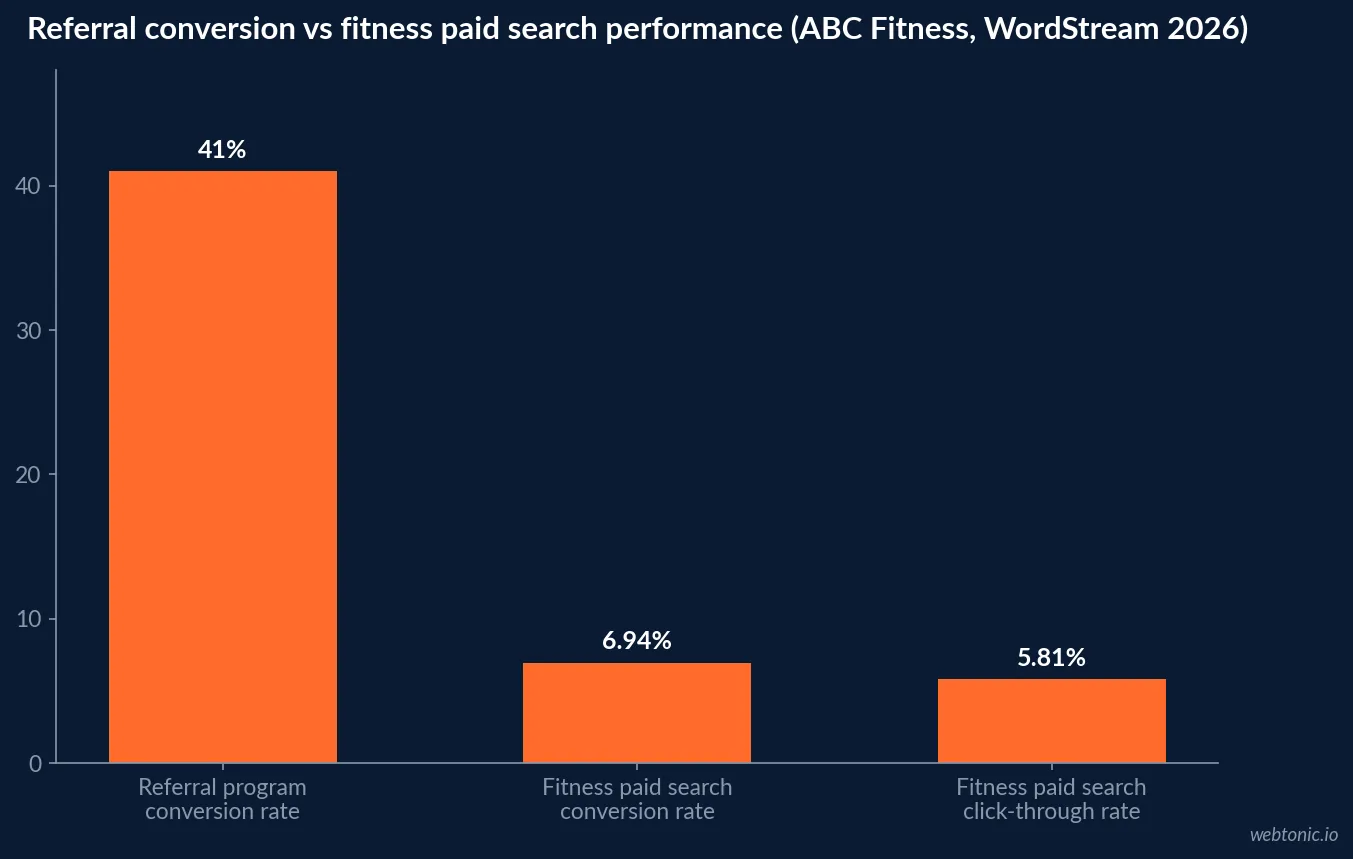
ABC Fitness, whose gym-management software sits under a large share of the US club and studio market, reports referral programs converting at 41% across its customer base in 2025, generating 92,000 sign-ups from 224,000 referrals. That conversion rate sits well above what cold paid channels typically post, because the referred prospect arrives with trust already established by the referring member rather than by an ad.
The honest caveat: this is one vendor's book of business, not an industry census, and referral volume is capped by existing member count and willingness to ask - it cannot be scaled the way a paid budget can be increased on demand.
Paid search: priced, fast, and getting more expensive
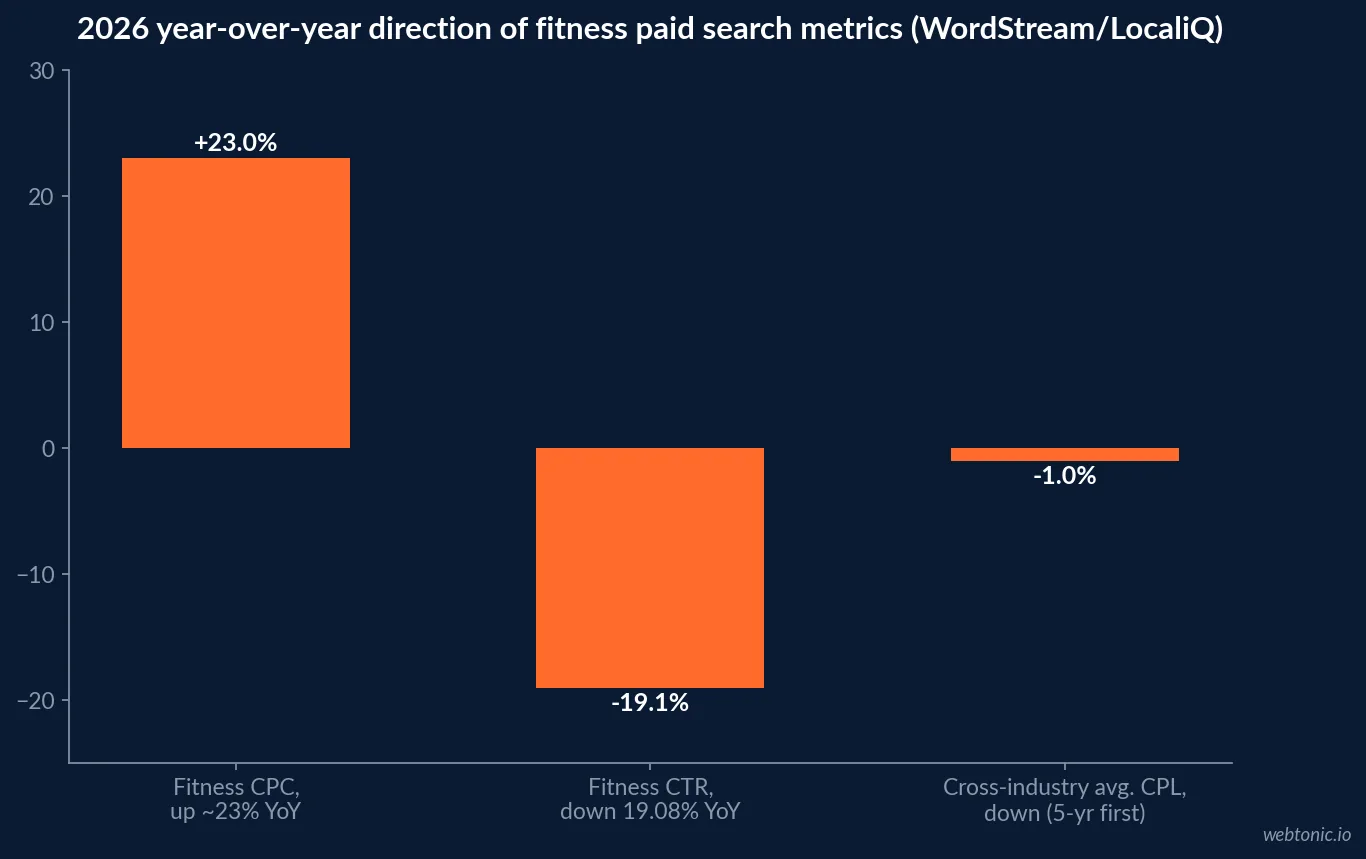
WordStream/LocaliQ's 2026 Search Advertising Benchmarks, built from over 13,000 campaigns across 23 industries, put Health and Fitness cost per click at roughly USD 6.17, up about 23% year over year, with click-through rate down 19.08% to 5.81%, conversion rate at 6.94%, and cost per lead landing near USD 67.36. Health and Fitness was one of only a handful of tracked industries to see cost per lead rise in 2026 while the overall cross-industry average actually fell for the first time in five years.
That divergence matters for budgeting: a fitness marketer benchmarking against a generic "search ads are getting cheaper" headline will underbudget, because their specific category moved the other way.
| Fitness paid search metric (2026) | Value | YoY change | Source |
|---|---|---|---|
| Cost per click | ~USD 6.17 | +~23% | WordStream/LocaliQ 2026 |
| Click-through rate | 5.81% | -19.08% | WordStream/LocaliQ 2026 |
| Conversion rate | 6.94% | n/a in source | WordStream/LocaliQ 2026 |
| Cost per lead | USD 67.36 | Rising (one of few industries) | WordStream/LocaliQ 2026 |
| Cross-industry avg. CPL | USD 66.69 | First fall in 5 years | WordStream/LocaliQ 2026 |
Organic and Business Profile: the compounding, unpriced channel
Whitespark's 2026 Local Search Ranking Factors report puts Google Business Profile signals at 32% of local pack ranking weight, the single largest bucket ahead of review signals at 20% - meaning organic local visibility for a gym is not really "SEO" in the content-marketing sense, it is profile management plus reviews plus on-page detail, compounding over the 6 to 12 month horizon that local-search practitioners consistently cite for new listings to mature. Once that maturity is reached, the marginal cost of an additional profile view or organic click is effectively zero, unlike paid search's per-click cost that never goes away.
This is the channel most gyms under-invest in relative to its ranking weight, because it does not have a media invoice attached to force a monthly budget conversation the way paid search does.
The membership backdrop demand generation is working against
The Health & Fitness Association's 2026 US Health & Fitness Consumer Report counts 81 million US gym, studio and fitness-facility members in 2025, up 5.2% year over year, with industry-wide churn falling to a decade-low 7.1% and average membership tenure rising to 5 years. HFA's 2025 Fitness Industry Benchmarking Report put median operator revenue growth at 9.9% and median EBITDA margin at 23.6% for its 175-company reporting cohort. Separately, ABC Fitness's mid-year 2026 Wellness Watch report found Gen Z accounted for 46% of new gym joins, ahead of millennials at 32%, Gen X at 13% and boomers at 7%.
Falling churn and rising tenure change what "demand generation" should optimize for: a market with decade-low churn is less about winning switchers from a competitor and more about winning first-time joiners and reactivating lapsed members, which favors organic and referral over aggressive paid retargeting of existing gym-goers.
| Fitness industry metric (2025-26) | Figure | Source |
|---|---|---|
| US gym/studio membership | 81 million, +5.2% YoY | HFA 2026 Consumer Report |
| Industry churn rate | 7.1% (decade low) | HFA/HFB Survey, May 2026 |
| Average membership tenure | 5 years (decade high) | HFA/HFB Survey, May 2026 |
| Median operator revenue growth | 9.9% | HFA 2025 Benchmarking Report |
| Median EBITDA margin | 23.6% | HFA 2025 Benchmarking Report |
| Gen Z share of new joins | 46% | ABC Fitness Mid-Year Wellness Watch 2026 |
What a B2B buying journey has to do with a gym sign-up (honestly, not much)
Some of the most-cited demand-generation research is B2B, not consumer, and it is worth naming that clearly rather than borrowing its numbers as if they applied here. Forrester's own reporting on its Buyers' Journey Survey documents business buyers turning to AI tools and generative search at rising rates during a purchase process, and the Ehrenberg-Bass Institute's widely cited 95:5 rule, developed by Professor John Dawes and promoted through LinkedIn's B2B Institute, holds that only about 5% of B2B buyers are in-market at any given moment.
Neither describes a consumer deciding whether to join a gym this month. The useful contrast is structural: a B2B purchase runs through a multi-stakeholder committee over months, while a gym membership is a single-decision-maker choice usually resolved inside one visit or one phone call. Any demand-generation plan that imports B2B-style long nurture sequences into fitness marketing is solving a problem fitness buyers do not have.
Building the budget line without B2B assumptions
The workable split for a single-location gym, based on the channel economics above rather than a generic rule of thumb: fund referral first because it is free to run and highest-converting, fund Business Profile and on-page work second because its 32% ranking weight is the largest organic lever available, and treat paid search as the variable top-up channel scaled to whatever volume the first two cannot fill - accepting that its cost per lead moved against the category in 2026.
If a location needs that mix built, measured and reported on rather than guessed at, our growth marketing practice runs full-funnel local acquisition programs, and our team can model the specific split for a given location count.
Seasonality: when demand generation actually needs to flex
Fitness demand is not flat across the year, and a channel mix priced only on annual averages misses the two windows that matter most: the January new-year surge and the pre-summer push. HFA's research on the 2026 Consumer Report tracks membership and visit data through these cycles, and the practical implication for budgeting is straightforward: paid search capacity should scale up ahead of January, while referral and retention programs carry more of the load in the slower mid-year months when new-search volume itself is thinner.
A gym that holds a flat monthly paid budget all year is either overspending in the slow months or under-capturing in January - the two are not symmetric risks.
| Period | Demand pattern | Channel to lean on |
|---|---|---|
| January-February | New-year search surge | Paid search, scaled up |
| March-May | Pre-summer consideration window | Organic + paid search, blended |
| June-August | Seasonal dip in new search volume | Referral and retention programs |
| September-October | Secondary back-to-routine bump | Organic + light paid support |
| November-December | Lowest new-search volume, highest churn risk | Retention-focused, not acquisition-focused |
What "speed to lead" means for a gym, not just B2B software
Invoca's 2026 Home Services Lead Conversion Benchmarks Report, built from over 70 million calls across nine sub-industries, found only 52% of inbound calls are answered by a live person, that 38% of digital-marketing-driven calls qualify as leads, and that 55% of businesses never explicitly ask the caller to book. That data set is home-services, not fitness specifically, but the structural pattern - a call that isn't answered promptly is a paid or organic lead thrown away after the money to generate it is already spent - applies to a trial-class inquiry exactly the same way it applies to a plumbing call. A gym that routes a website inquiry or a call to voicemail during business hours is losing exactly the demand its paid and organic spend just paid to generate.
The fix is operational, not a media-buying decision: a named staff owner for same-day follow-up on every inbound inquiry, regardless of which channel produced it, and an explicit ask to book on every call - the gap Invoca's data says most businesses in this pattern still leave open.
| Invoca 2026 home-services call benchmark | Figure | Read-across for a gym |
|---|---|---|
| Inbound calls answered by a live person | 52% | Nearly half of trial-class calls may go unanswered |
| Digital-marketing-driven calls that qualify as leads | 38% | The rest are wasted media spend |
| Businesses that never ask the caller to book | 55% | A trained ask-to-book script closes this gap |
Where this fits against organic paid-search benchmarks
Our own fitness Google Ads statistics page goes deeper on the CPC and CPL figures cited above, and our broader cost-per-lead benchmarks by industry page places fitness's USD 67.36 figure against other verticals for context. If a location needs its funnel modeled channel by channel rather than benchmarked in the abstract, our data and analytics practice builds that view before a budget conversation happens.
Frequently Asked Questions
So is PPC or organic actually better for filling a gym?
Neither wins outright because they solve different problems. Paid search captures people already typing "gym near me" today, at a published cost per lead near USD 67.36 in 2026. Organic and Business Profile visibility compound over months and carry no per-lead cost once built, but need 6 to 12 months to reach that state, per industry guidance on the channel mix. The honest framing is paid for this month's trial bookings, organic for next year's, and referral for the cheapest of all three.
What does a referral program actually convert at?
ABC Fitness, whose gym-management platform sits under a large share of the US club market, reports referral programs converting at 41% in 2025 across its customer base, generating 92,000 sign-ups from 224,000 referrals. That is a vendor's own book of business, not an industry census, but it is real usage data at scale, and it is far above what cold paid channels typically convert.
How long does organic and Business Profile work take to show up in new-member volume?
There is no single published number for fitness specifically, and any exact week count would be a guess dressed as data. What is consistently reported across local-search guidance is a 6 to 12 month horizon before organic and profile-driven visibility compounds into a stable lead flow, versus an immediate but rented result from paid channels. Budget both timeframes into a launch plan rather than judging organic on a 90-day window.
Why did fitness paid search cost per lead move the way it did in 2026?
WordStream/LocaliQ's 2026 benchmarks show Health and Fitness cost per click up roughly 23% year over year to about USD 6.17, while click-through rate fell 19.08% to 5.81% - a smaller, more expensive audience clicking through, which pushes cost per lead higher even where conversion rate holds. That is a fitness-specific 2026 shift, not a general market trend; several other tracked industries saw cost per lead fall in the same period.
Is any of the buyer-journey research behind this page actually about fitness members?
No, and it should be labeled that way. Figures like B2B buying-committee size or self-directed buying journeys come from B2B software and services research (Forrester, LinkedIn's B2B Institute) and describe a company purchase process, not a consumer joining a gym. This page uses that research only to contrast a long, multi-stakeholder B2B journey against fitness membership's short, single-decision-maker, visit-driven path - never as a stand-in for gym-member data.
Sources
ABC Fitness/Glofox - Gym Marketing in 2026: What's Working & What's Not
WordStream/LocaliQ - 2026 Search Advertising Benchmarks by Industry
Whitespark - 2026 Local Search Ranking Factors report
Health & Fitness Association - 2026 US Health & Fitness Consumer Report
Health & Fitness Association - 2025 Fitness Industry Benchmarking Report
ABC Fitness - Mid-Year Wellness Watch Report 2026
Invoca - 2026 Home Services Lead Conversion Benchmarks Report
Forrester - B2B Buyers Make Zero-Click Buying Number One
LinkedIn B2B Institute - Why You Should Follow the 95-5 Rule