Table of contents
No single study measures "trucking local SEO," because this industry is really two search behaviors wearing one label. Intrastate hauling, local moving, and driver recruiting behave like any local business on Google; long-haul freight brokerage is found through referrals and load boards, not the map pack. This page applies 2026 review and Google Business Profile data to each segment honestly, rather than pretending one number covers both.
Key Takeaways
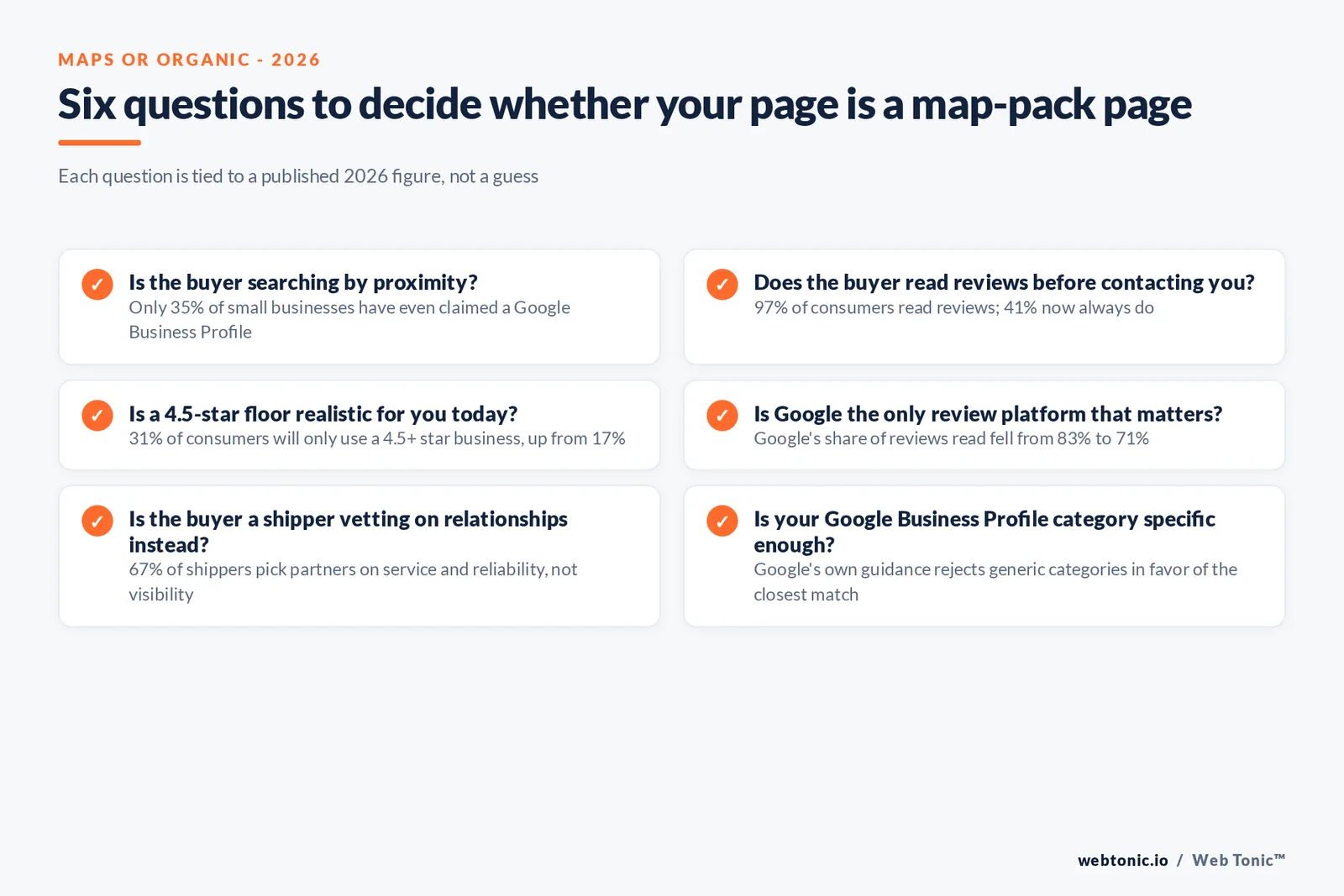
- 97% of consumers read reviews for local businesses (BrightLocal, 2026).
- 41% of consumers now "always" read reviews, up from 29% a year earlier (BrightLocal).
- 31% of consumers will only use a business with 4.5 stars or better, up from 17% (BrightLocal).
- Google's share of where consumers read reviews fell from 83% to 71% year over year (BrightLocal).
- Only 35% of small businesses have claimed a Google Business Profile (BrightLocal).
- More than 99% of carriers operate 100 trucks or fewer, so most terminals are exactly the kind of small business likely to have an unmanaged listing (ATA).
- Trucking is a USD 906 billion industry built almost entirely on small operators (ATA, 2026).
- Trucks moved 72.7% of the nation's freight by weight in 2024 (ATA).
- 67% of shippers name service level and reliability as the top factor in choosing a carrier or broker (Denim/Peerless Research Group, 2025).
- 30% of shippers cite unrecognized third-party contact as a top frustration (Denim).
- 27% cite unprofessional tone as a top frustration (Denim).
- Freight brokers report finding loads through referrals, cold outreach, shipper lists, warm leads and load-board technology, not local search (FreightWaves).
- Google's own Business Profile guidance lists Trucking company, Transportation service, Freight forwarding service and Courier service as distinct categories (Google Business Profile Help).
- The average cost to operate a truck hit a record USD 2.336 a mile in 2025, up 3.4% (ATRI), tightening the budget for any marketing spend, local or national.
One industry, two search behaviors
The mistake this page is built to avoid is treating "trucking local SEO" as one thing. A shipper choosing a national freight brokerage is not searching Google Maps for one, the same way nobody searches Maps for a management consultant. But a homeowner needing a dump truck, a small business needing intrastate hauling, or a driver searching "trucking jobs near me" is running exactly the kind of local, review-driven search Google's map pack is built to answer.
Splitting the industry this way is not a hedge. It is the only way the review and visibility data below means anything, because applying it to the wrong segment produces a confident, wrong conclusion either way.
| Segment | Search behavior | What decides it |
|---|---|---|
| Intrastate hauling, local moving, junk/dump-truck services | Map-pack, "near me" driven | Reviews, category, proximity, star rating |
| Driver recruiting | Map-pack and organic job-search driven | Reviews, employer reputation, pay transparency |
| Long-haul freight brokerage / 3PL | Referral and relationship driven | Safety score, insurance, service reliability |
| National fleet carrier selection | RFP, relationship and load-board driven | Track record, not search visibility |
What actually moved in the 2026 review data
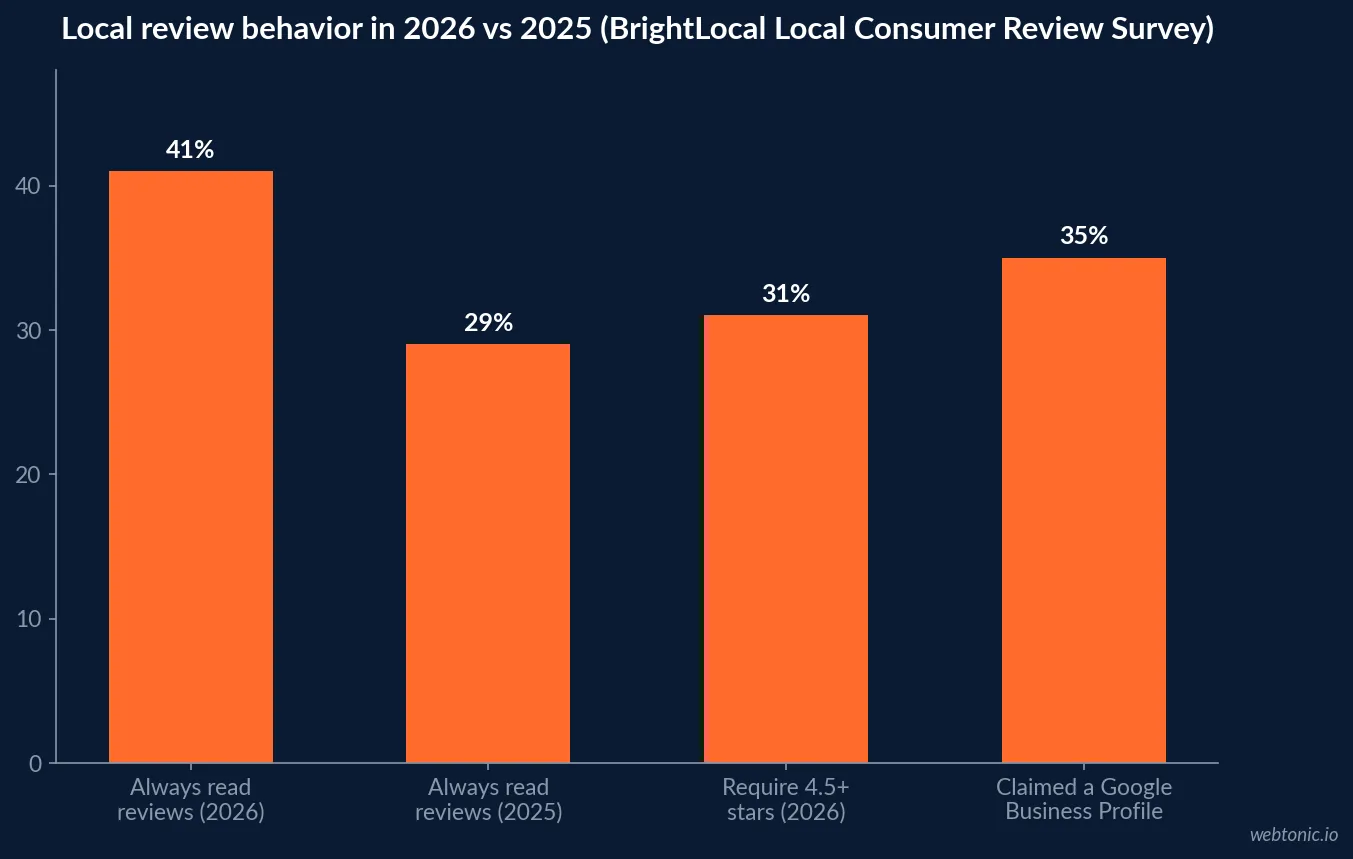
BrightLocal's 2026 Local Consumer Review Survey, run on a representative panel of 1,002 US adults, found 97% of consumers read reviews for local businesses and 41% now "always" do, up sharply from 29% a year earlier. Star rating tolerance tightened too: 31% will now only use a business with 4.5 stars or better, up from 17%.
For a local-intent hauler or a driver-recruiting page, that is unambiguous: the reputation bar keeps rising, and a thin or unmanaged review profile is a heavier handicap than it was twelve months ago. For a national brokerage competing on RFPs, it is close to irrelevant, since the buyer is not reading Google stars before signing a contract.
| BrightLocal 2026 metric | 2025 | 2026 | Direction |
|---|---|---|---|
| Always read reviews before choosing a business | 29% | 41% | Rising |
| Only use businesses with 4.5+ stars | 17% | 31% | Rising |
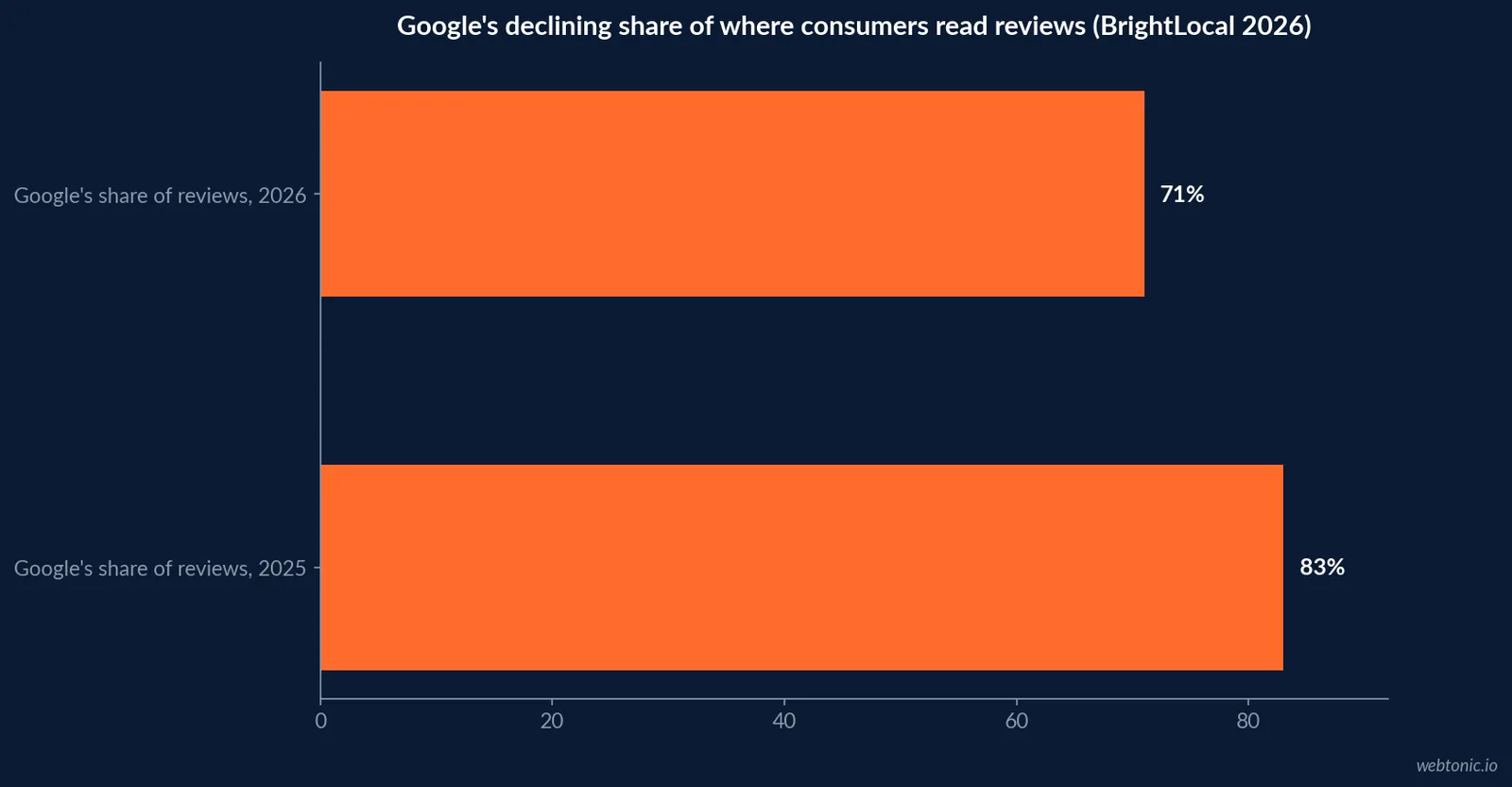
| Google's share of where reviews are read | 83% | 71% | Falling |
| Small businesses with a claimed Google Business Profile | n/a in this cut | 35% | Low, flat opportunity |
Google is still ahead, but its share is shrinking
The same BrightLocal research found Google's share of where consumers actually read reviews slipped from 83% in 2025 to 71% in 2026, with video platforms including YouTube, Instagram and TikTok gaining share. Google is still, by a wide margin, the default; it is no longer the whole picture the way it was a year ago.
More striking for this industry specifically: BrightLocal also found only 35% of small businesses have claimed a Google Business Profile at all. Given that the American Trucking Associations puts more than 99% of carriers at 100 trucks or fewer, the honest read is that most local trucking, hauling and moving operators in this country are sitting on an unmanaged or unclaimed listing, which is the single cheapest fix available before any content work starts.
Picking the right Google Business Profile category
Google's own Business Profile Help instructs businesses to select the most specific primary category available rather than a generic one, and to add secondary categories rather than force everything into one label. For this industry, that means choosing among distinct categories including Trucking company, Transportation service, Freight forwarding service and Courier service, not defaulting to whichever one ranked first in a dropdown.
A local intrastate hauler that lists itself as a generic "Transportation service" is competing in a broader, less specific pool than one correctly filed under "Trucking company." That single setting change costs nothing and is exactly the kind of fix the 65% of unclaimed or unmanaged profiles above are missing entirely.
| Google Business Profile category | Best fit for | Source |
|---|---|---|
| Trucking company | General freight and local hauling operators | Google Business Profile Help |
| Transportation service | Broader passenger or freight movement | Google Business Profile Help |
| Freight forwarding service | 3PLs and freight forwarders | Google Business Profile Help |
| Courier service | Same-day, parcel or expedited delivery | Google Business Profile Help |
Why national freight discovery does not run through Maps
Industry commentary on how brokers actually find loads points to five channels working consistently: referrals from existing clients, cold outreach to shipper lists, warm inbound leads, re-engaging former accounts, and load-board technology. A map-pack search for "freight broker near me" is not on that list, and it is not an oversight; shippers are not geography-constrained the way a homeowner hiring a local mover is.
That is reinforced by what shippers themselves say matters. Denim's 2025 survey, run with Peerless Research Group across nearly 100 shippers, found 67% name service level and reliability as the top factor in choosing a partner, while 30% flag unrecognized third-party contact and 27% flag unprofessional tone as top frustrations. None of that is a search-visibility problem; it is a service and communication problem that no amount of local SEO fixes.
Local Services Ads: real for towing, not for freight brokerage
Google's own Local Services Ads screening and verification documentation lists Towing as one of the eligible categories, requiring a business background check, an owner check and, in some categories, checks on individual field workers before a provider can display the Google Verified badge. That is a genuine local-intent product built for exactly the "tow truck near me" segment of this industry.
There is no equivalent Local Services Ads category for freight brokerage or long-haul carriers, because the product is built around consumers hiring a local provider for a bounded, in-person job, not a shipper vetting a national carrier network. Applying LSA logic to freight-B2B marketing is a category error the product itself does not support.
| Google Local Services Ads fact | Detail | Source |
|---|---|---|
| Eligible category relevant to this industry | Towing | Google Local Services Ads Help |
| Verification required | Business background check, owner check, some field-worker checks | Google Local Services Ads Help |
| Badge awarded on completion | Google Verified badge (replaced "Google Guaranteed", Oct 2025) | Google Local Services Ads Help |
| Freight brokerage / long-haul carrier category | Not offered | Google Local Services Ads Help |
The public trust signal that actually substitutes for reviews in freight
Freight buyers have a trust signal local review stars can't replace: the federal safety rating. Under 49 CFR Part 385, Appendix B, FMCSA rates every investigated motor carrier Satisfactory, Conditional or Unsatisfactory, and that rating, along with a carrier's inspection and crash history, is published free on FMCSA's SAFER Web system with no login required.
That is the freight-side equivalent of a Google star rating, publicly checkable, federally maintained, and already the first thing a serious shipper or broker checks before extending business. No amount of local SEO substitutes for a clean safety rating, and no amount of a poor safety rating is fixable with a better Google Business Profile.
Multi-terminal carriers face a different local SEO problem
A carrier or 3PL running several regional terminals is not solving the same problem as a single-location hauler. Each terminal that handles local pickup, drop yards, or driver hiring in its own market benefits from its own correctly categorized Google Business Profile; a single headquarters listing covering five states answers none of the local, "near me" searches those individual markets generate. Given that only 35% of small businesses have claimed even one profile, a multi-terminal operator auditing all of its locations at once is very likely to find several completely unmanaged.
That audit is cheap relative to the fragmentation problem it fixes: correcting a category, adding real terminal photos, and setting accurate hours costs nothing beyond the time, and it is the highest cost-to-impact item ATA's own fragmentation data implies most carriers have simply never touched.
| Carrier footprint | Local SEO priority | Why |
|---|---|---|
| Single-location hauler or mover | High - this is the whole local SEO opportunity | Every review and category signal applies directly |
| Multi-terminal regional carrier | High per terminal, audited individually | Each terminal is a separate local search market |
| National asset-based fleet (recruiting only) | Medium - relevant mainly for driver applicant search | Freight side is not map-pack driven |
| Freight brokerage / 3PL (no physical drop points) | Low | Buyers vet on relationships and safety data, not proximity |
Recency now matters as much as volume
BrightLocal's 2026 data adds a detail that changes how a local hauler or moving company should actually run review generation: 74% of consumers say they only care about reviews written in the last three months, and most consumers do not weigh star ratings past one decimal place once a business clears roughly 20 reviews. A terminal with fifty reviews from three years ago is, on this evidence, treated closer to a terminal with none at all.
That reframes the fix: a steady monthly cadence of new reviews beats a one-time push to accumulate a large historical total, and it is a cheaper, ongoing habit rather than a single project.
| BrightLocal 2026 recency finding | Figure |
|---|---|
| Consumers who only care about reviews from the last 3 months | 74% |
| Point at which additional review volume stops moving perception | Roughly 20 reviews |
| Consumers who will only use a 4.5+ star business | 31% |
How to split the work honestly
Claim and correctly categorize the Google Business Profile for every terminal or local service line, since 65% of the industry has not done even that. Build review generation into driver and customer touchpoints for the local-intent segment, where the 4.5-star bar BrightLocal documents is now the effective floor. For the national freight-brokerage side of the business, redirect that effort toward the referral, RFP and relationship channels the FreightWaves and Denim data show actually move freight, and stop expecting a map-pack ranking to do that job.
If local visibility is the gap, our growth marketing practice treats Google Business Profile hygiene as a first-week fix, and our write-up on building a paid search strategy is a useful companion once the free listing is in order. For the freight-side demand generation this page argues local SEO cannot solve, talk to our team about the referral and relationship channels that actually move freight.
Frequently Asked Questions
Does the map pack matter for a freight brokerage or a national fleet?
Not in the way it matters for a home-service business. FreightWaves' own reporting on how brokers actually find loads lists referrals, cold outreach to shipper lists, warm inbound leads, re-engaged former accounts and load-board technology as the working channels; a Google Maps search for "freight broker near me" is not among them, because shippers vet carriers on safety scores, insurance and relationships, not proximity.
Where does the map pack actually matter in this industry?
For anything with real local intent: intrastate hauling, dump truck and junk-removal-style local moving, and "trucking jobs near me" recruiting searches. Those queries behave like any other local service search, and BrightLocal's 2026 Local Consumer Review Survey behavior, 97% of consumers reading reviews and 31% now requiring 4.5 stars or better, applies to that segment the same way it applies to a plumber or a dentist.
Which Google Business Profile category should a trucking company use?
Google's own Business Profile Help documentation lists specific categories under transportation, including Trucking company, Transportation service, Freight forwarding service and Courier service, and instructs businesses to pick the most specific one that fits rather than a generic label. A local hauler and a national freight brokerage should not share a category, because they are not competing for the same search.
Is Google losing ground as the review platform of record?
Among consumers generally, yes, and the trend is worth watching. BrightLocal's 2026 survey found Google's share of where consumers read reviews slipped from 83% in 2025 to 71% in 2026, with video platforms including YouTube, Instagram and TikTok gaining. The same research found only 35% of small businesses have claimed a Google Business Profile at all, which for a fragmented, 99%-small-carrier industry likely means most terminals are sitting on an unmanaged listing.
What do shippers actually evaluate carriers and brokers on, if not search visibility?
Service level and reliability, overwhelmingly. Denim's 2025 shipper survey, run with Peerless Research Group across nearly 100 shippers, found 67% name service level and reliability as the top factor in choosing a freight partner, while unrecognized third-party contact (cited by 30% as a top frustration) and unprofessional tone (27%) are bigger risks than any visibility gap. Local SEO wins the click; it does not win the freight.
Sources
BrightLocal - Local Consumer Review Survey 2026
Google Business Profile Help - Manage your business category
Google Local Services Ads Help - Business screening and verification requirements
Cornell Law (Legal Information Institute) - 49 CFR Appendix B to Part 385, Safety Rating Process
FMCSA SAFER Web - Company Safety Records System
American Trucking Associations - Navigate the Challenges of 2026
American Trucking Associations - Economics and Industry Data
Denim (with Peerless Research Group) - 2025 shipper survey
American Transportation Research Institute - Operational Costs of Trucking, 2026 Update