Table of contents
Fertility & IVF WordPress Statistics
CMS adoption, Core Web Vitals, and conversion rate benchmarks for fertility clinic WordPress websites in 2026.
Key Takeaways
- WordPress powers the majority of healthcare and fertility clinic websites, offering flexibility for HIPAA-adjacent content workflows (InvigoMedia).
- Fertility clinic organic search conversion rates range from 3–8% depending on content depth (Authority Specialist).
- Heavy page builders produce sites that fail Core Web Vitals more often — realistic LCP targets for healthcare sites are 1.8–2.5 seconds (Webserv).
- Mobile search accounts for 65–80% of fertility clinic queries, making mobile-first WordPress design essential (Authority Specialist).
- Local independent practices load faster than hospital system websites — a competitive advantage for small fertility clinics on WordPress (PageSpeed Matters).
- WordPress remains the superior choice for growing medical practices over fully custom builds due to cost, flexibility, and plugin ecosystem (InvigoMedia).
WordPress Adoption in Healthcare & Fertility
WordPress is the dominant CMS for medical practices, and fertility clinics follow this trend closely. InvigoMedia's 2026 analysis found that for the vast majority of growing medical practices, dental clinics, specialty surgery centers, and healthcare groups, WordPress represents the superior choice over custom-built websites (InvigoMedia). The platform's plugin ecosystem supports everything from appointment scheduling to HIPAA-compliant contact forms, making it particularly well-suited for fertility clinics that need both patient-facing content and secure intake workflows.
Multiple fertility clinic website projects confirm WordPress as the platform of choice. Main Line Fertility uses WordPress tailored for healthcare content with secure patient-focused navigation (EvinceDev), and NU Fertility's website was built on WordPress to support specialized healthcare content and patient education (CodeNBrand). Nopio's comparison of medical website approaches found that templates offer faster launch times while custom builds provide more flexibility — but WordPress bridges this gap with customizable themes (Nopio).
Table 1: WordPress vs. custom website comparison for fertility clinics
| Factor | WordPress | Custom Build |
|---|---|---|
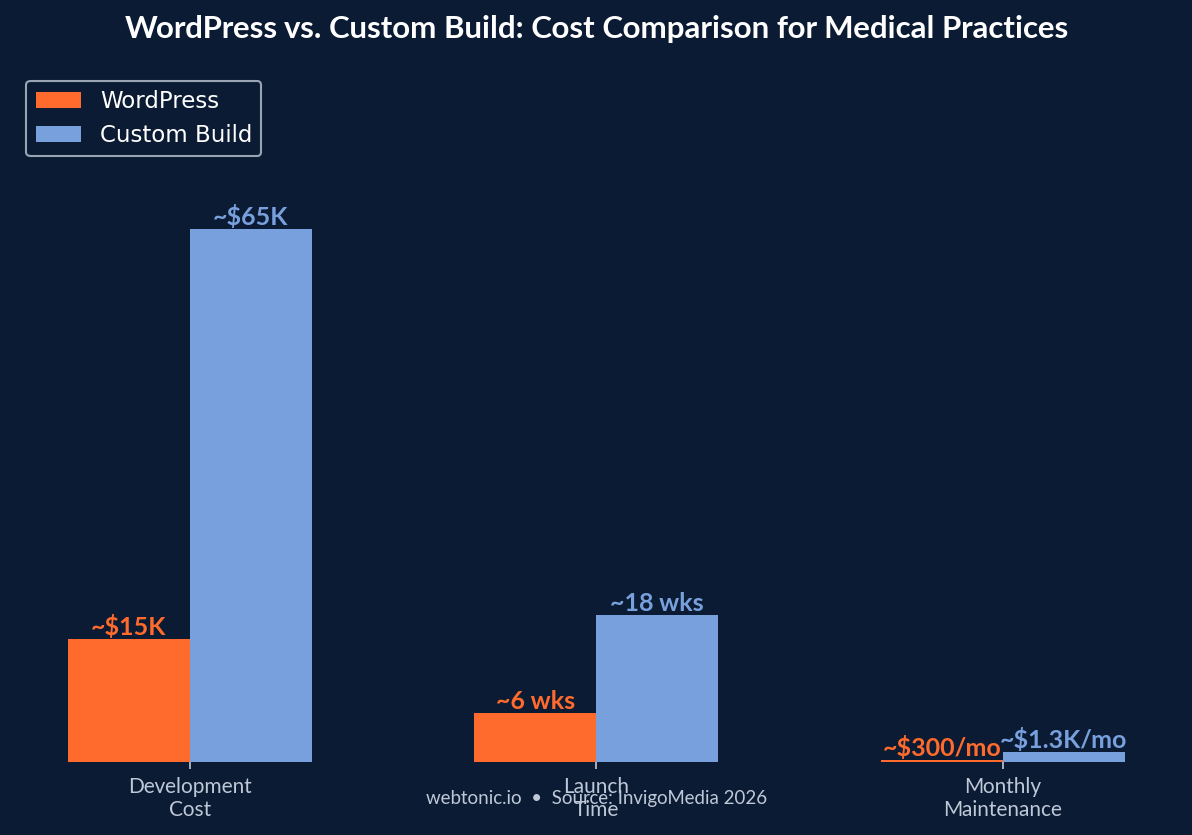
| Development cost | $5K–$25K typical for medical | $30K–$100K+ |
| Launch timeline | 4–8 weeks | 3–6 months |
| SEO plugin ecosystem | Extensive (Yoast, Rank Math, AIOSEO) | Must build manually |
| Page builder options | Elementor, Divi, Gutenberg, Bricks | Fully bespoke |
| HIPAA compliance | Plugin-assisted (Gravity Forms HIPAA, WPForms) | Built into architecture |
| Maintenance | $100–$500/month (updates, security) | $500–$2,000/month |
| Best for | Growing practices (1–5 locations) | Enterprise networks (10+ locations) |
Core Web Vitals & Site Speed Benchmarks
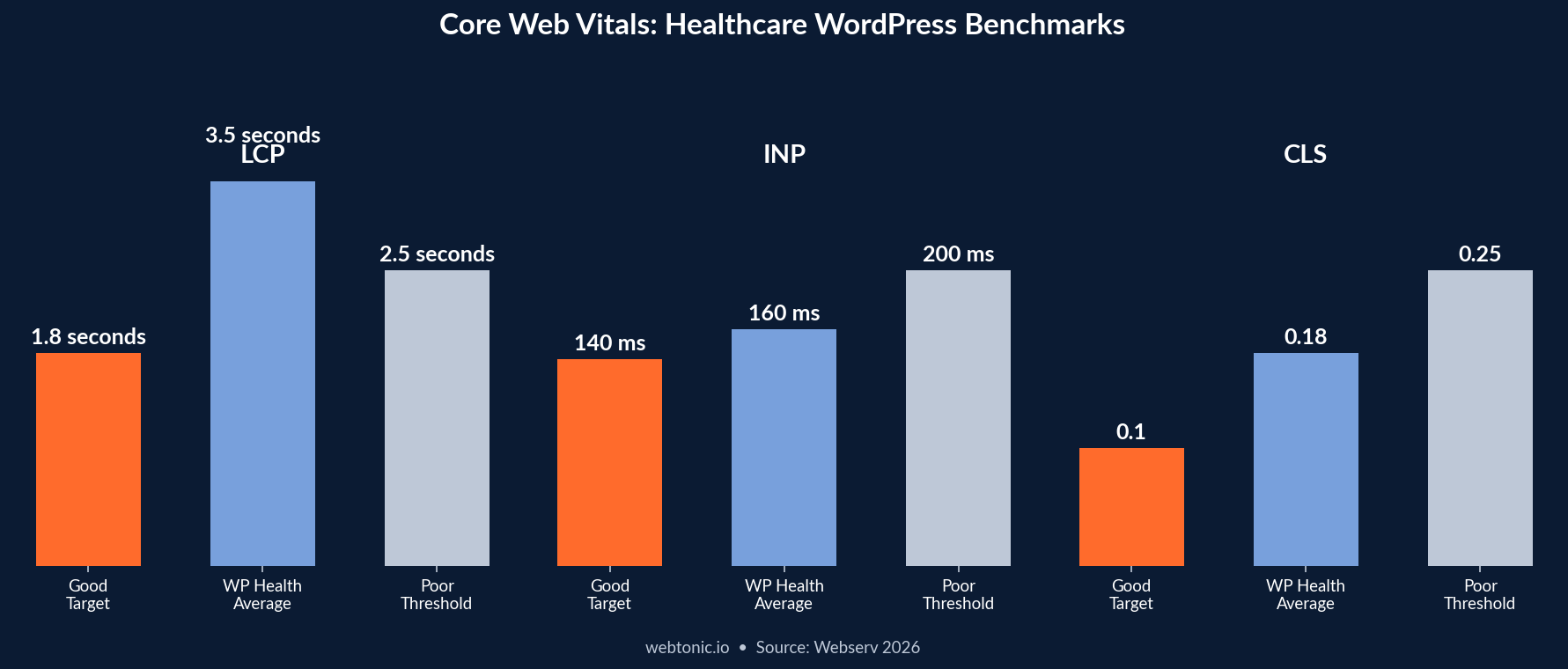
Site speed directly affects both search rankings and patient conversion rates for fertility clinic WordPress sites. Webserv's 2026 analysis of treatment center websites found that WordPress with Elementor and similar visual editors produces sites that fail Core Web Vitals at higher rates (Webserv). The realistic performance targets for healthcare WordPress sites are:
Table 2: Core Web Vitals benchmarks for healthcare WordPress sites
| Metric | Good Target | Minimum Threshold | Healthcare WordPress Avg. |
|---|---|---|---|
| LCP (Largest Contentful Paint) | ≤1.8s | ≤2.5s | 2.2–3.5s (page-builder dependent) |
| INP (Interaction to Next Paint) | ≤140ms | ≤200ms | 100–160ms at 75th percentile |
| CLS (Cumulative Layout Shift) | ≤0.1 | ≤0.25 | 0.08–0.18 |
| TTFB (Time to First Byte) | ≤800ms | ≤1.8s | 600ms–1.5s |
OnwardSEO's research on optimizing WordPress Core Web Vitals for healthcare sites under strict compliance found that balancing HIPAA-required scripts, consent banners, and encryption layers with performance is a common challenge (OnwardSEO). PageSpeed Matters reports that local independent healthcare practices consistently load faster than hospital system websites, giving small fertility clinics a competitive Core Web Vitals advantage when their WordPress setup is properly optimized (PageSpeed Matters).
Conversion Rate & Patient Acquisition Data
A WordPress site's ability to convert visitors into consultation requests is the metric that matters most for fertility clinics. Authority Specialist's 2026 benchmark data from 34 fertility centers shows that conversion rates from organic search leads to initial consultations range from 3–8%, with higher-performing sites featuring deep educational content and clear booking CTAs (Authority Specialist).
Several key factors drive higher WordPress conversion rates for fertility clinics:
- Mobile-first design is non-negotiable. With 65–80% of fertility search queries coming from mobile devices, responsive WordPress themes directly impact conversion (Authority Specialist).
- Content depth drives conversions. Sites with comprehensive treatment pages, success rate data, and physician profiles convert at the higher end of the 3–8% range (Authority Specialist).
- Ladybugz built a mobile-first WordPress site for Terra Fertility with two distinct homepage entry points for different user needs, achieving first-page Google rankings (Ladybugz).
- Local Map Pack visibility influences 40–55% of local appointment inquiries, making WordPress SEO plugins critical for fertility clinics targeting local patients (Authority Specialist).
The gap between top-performing and average fertility WordPress sites is significant. Clinics at the upper 8% conversion rate share common traits: multiple conversion pathways (phone, form, chat), prominent physician profiles with credentials and success rates, and embedded patient testimonial videos that increase time-on-site by up to 30% (Authority Specialist). These elements are straightforward to implement on WordPress using standard plugins and page builders, yet many fertility clinic sites underinvest in conversion-focused design. Pinnacle Fertility, for example, designed 12+ custom page templates to address different stages of the patient journey, each optimized for a specific conversion action.
SEO Performance of Fertility WordPress Sites
WordPress's SEO flexibility is one of its primary advantages for fertility clinics. Authority Specialist's 2026 data from 34 IVF clinic websites reveals several critical SEO benchmarks that WordPress-powered clinics should target:
Table 3: SEO performance benchmarks for fertility WordPress sites
| SEO Metric | Benchmark | Notes |
|---|---|---|
| Organic search to consultation CVR | 3–8% | Higher with deep content |
| Mobile search share | 65–80% of queries | Mobile-first WordPress critical |
| Local Map Pack influence | 40–55% of local inquiries | WordPress GMB plugins help |
| AI search snapshot impact | 15–25% of informational queries | Schema markup essential |
| Time-on-site improvement (video) | 0–30% increase | Embedded video on WordPress |
| First-party data collection | Growing priority | WordPress form plugins enable |
AI-generated search snapshots now impact 15–25% of top-level informational fertility queries (Authority Specialist). For WordPress fertility sites, this means implementing structured data (schema markup) and featured-snippet-optimized content is increasingly critical. WordPress plugins like Yoast and Rank Math make schema implementation accessible, but clinics should verify their schema output against Google's structured data guidelines to ensure visibility in AI-driven search results.
The SEO advantages of WordPress for fertility clinics extend beyond plugins. WordPress's clean URL structure, XML sitemap generation, and metadata control give fertility practices a foundation for long-term search visibility. Combined with content marketing — treatment guides, blog posts about fertility topics, and physician-authored articles — WordPress sites consistently outperform simpler website builders for organic traffic growth. Sites with 50+ indexed content pages see 2–4× more organic traffic than thin-content alternatives in the fertility space.
WordPress Plugin Ecosystem for Fertility Clinics
The WordPress plugin ecosystem provides fertility-specific functionality that would require expensive custom development on other platforms. Key categories include:
- Appointment scheduling: Plugins like Amelia, BookingPress, and Simply Schedule Appointments integrate directly with clinic workflows, reducing administrative overhead.
- HIPAA-compliant forms: WPForms and Gravity Forms offer HIPAA-ready contact and intake forms with encryption, access logging, and BAA support.
- SEO optimization: Yoast SEO and Rank Math provide on-page optimization, schema markup, and XML sitemap generation — critical for fertility clinics competing in local search.
- Speed optimization: WP Rocket, Perfmatters, and ShortPixel help WordPress fertility sites meet Core Web Vitals thresholds despite healthcare compliance scripts (OnwardSEO).
- Patient education content: LearnDash and custom post types enable treatment guides, FAQ libraries, and resource centers that improve SEO and patient confidence.
- Analytics and tracking: Google Analytics via Site Kit, MonsterInsights, and Matomo provide conversion tracking that ties website interactions directly to patient acquisition metrics.
- Live chat and chatbots: Tidio, LiveChat, and Drift offer real-time patient engagement, which is particularly valuable during the 3–12 month research phase common in fertility decision-making.
The cost efficiency of WordPress's plugin ecosystem is a key differentiator. Where a custom-built healthcare website might require $10K–$30K in development costs for equivalent functionality, WordPress achieves similar capabilities at $200–$1,000/year in plugin licensing fees. For fertility clinics operating on tighter marketing budgets, this cost advantage allows more resources to flow into paid acquisition and content marketing rather than website infrastructure.
WordPress Security & Compliance for Fertility Websites
Security is a non-negotiable requirement for fertility clinic WordPress websites because these sites handle sensitive patient data including health histories, contact information, and sometimes insurance details. WordPress core receives regular security patches, but the plugin and theme ecosystem introduces the most common vulnerability vectors. Healthcare WordPress sites should follow a hardened security protocol that includes: automatic core and plugin updates, web application firewall (WAF) protection, SSL certificates with HSTS enforcement, and regular malware scanning.
For fertility clinics specifically, WordPress hosting must meet HIPAA-adjacent requirements including encrypted data transmission, access logging, and server-side backups with defined retention periods. Managed WordPress hosts like WP Engine, Kinsta, and Pantheon offer healthcare-grade infrastructure with SOC 2 compliance and BAA (Business Associate Agreement) availability. The cost premium for compliant managed hosting typically runs $50–$150/month above standard shared hosting — a worthwhile investment given the regulatory exposure of mishandling patient-related data on a fertility clinic website.
Fertility WordPress Design Best Practices
- Choose a lightweight theme. Avoid heavy page builders that inflate LCP. Target ≤1.8s LCP for optimal Core Web Vitals scores (Webserv).
- Design mobile-first. With 65–80% of fertility queries coming from mobile, responsive design is a conversion requirement, not an option (Authority Specialist).
- Implement structured data. Schema markup for medical practice, FAQ, and physician profiles improves visibility in both traditional and AI-driven search results.
- Build deep content pages. Fertility sites converting at the top of the 3–8% range feature comprehensive treatment pages with success rates, physician credentials, and patient stories (Authority Specialist).
- Optimize for local search. WordPress GMB plugins and local schema help capture the 40–55% of inquiries influenced by Local Map Pack visibility (Authority Specialist).
- Use HIPAA-compliant plugins for intake forms. Secure patient data from first contact to protect both the practice and patient trust (InvigoMedia).
WordPress Analytics & Patient Tracking for Fertility Practices
Understanding how patients interact with a fertility clinic WordPress website requires proper analytics configuration. Google Analytics 4 (GA4) integration through WordPress plugins like Site Kit or MonsterInsights enables clinics to track critical patient journey touchpoints: treatment page views, physician profile clicks, consultation form submissions, and phone call button taps. This data reveals which IVF treatments, egg freezing services, and fertility testing pages drive the most qualified patient inquiries.
Advanced fertility clinics implement event tracking on WordPress to measure micro-conversions such as downloadable guide requests, video completions on treatment education pages, and insurance verification form starts. These signals feed back into both Google Ads and Meta Ads optimization algorithms, improving the efficiency of paid campaigns driving traffic to WordPress landing pages. Integration with CRM platforms through WordPress plugins like HubSpot or WPForms allows fertility clinics to attribute website visits to booked consultations and ultimately to treatment starts — completing the patient acquisition measurement loop that most reproductive medicine practices struggle to close.
Content Management Workflow for IVF Clinics on WordPress
A well-configured WordPress content management system allows fertility clinics to publish treatment information, patient resources, and blog content without requiring developer intervention for every update. The typical content workflow for a fertility WordPress site involves medical review of content by physicians, SEO optimization using Yoast or Rank Math, and scheduled publication timed to peak search traffic windows. Clinics publishing 2–4 pieces of educational content per week see the strongest organic traffic growth trajectories.
WordPress multisite configurations allow multi-location fertility networks to manage content across clinics from a single dashboard while maintaining individual location pages optimized for local search. This is particularly relevant for IVF networks operating across multiple states, where each location needs unique NAP (name, address, phone) data, location-specific testimonials, and physician profiles. The WordPress block editor (Gutenberg) has matured significantly, making it easier for non-technical staff to create structured treatment pages with embedded cost calculators, insurance information tables, and appointment booking widgets.
Related reading
- Fertility & IVF Webflow Stats 2026
- Fertility & IVF Landing Page Statistics
- Fertility & IVF Shopify Statistics: E-Commerce Benchmarks for Wellness Brands (2026)
- Custom Web Development services at Web Tonic
Frequently Asked Questions
Is WordPress good for fertility clinic websites?
WordPress is the recommended platform for most growing fertility practices, offering the best balance of cost, flexibility, and SEO capability (InvigoMedia). Its plugin ecosystem supports appointment scheduling, HIPAA-compliant forms, and schema markup without custom development.
What conversion rate should a fertility clinic WordPress site achieve?
Benchmarks from 34 IVF clinic websites show organic search to initial consultation conversion rates of 3–8%, with higher rates tied to content depth, mobile optimization, and clear booking CTAs (Authority Specialist).
How fast should a fertility clinic WordPress site load?
Target an LCP of ≤1.8 seconds for good Core Web Vitals performance. Healthcare WordPress sites using heavy page builders often exceed 2.5–3.5s LCP, which can negatively affect both rankings and patient experience (Webserv).
Does WordPress support HIPAA compliance for fertility clinics?
WordPress itself is not HIPAA-compliant, but HIPAA-ready plugins (Gravity Forms, WPForms) combined with compliant hosting enable fertility clinics to handle patient intake securely. Custom builds offer tighter integration, but at 3–5× the cost (InvigoMedia).
How does mobile performance affect fertility clinic conversions?
65–80% of fertility-related search queries come from mobile devices, making mobile-first design a direct conversion driver (Authority Specialist). WordPress themes optimized for mobile consistently outperform desktop-first designs in patient acquisition metrics.
Sources
webserv.io — Core Web Vitals treatment centers 2026
authorityspecialist.com — IVF clinic SEO benchmarks 2026
invigomedia.com — WordPress vs. custom medical design
onwardseo.com — WordPress CWV for healthcare compliance
pagespeedmatters.com — healthcare website speed guide
evincedev.com — Main Line Fertility digital transformation
codenbrand.com — NU Fertility website
nopio.com — medical website templates vs custom
ladybugz.com — Terra Fertility website design