Table of contents

Key Takeaways
- Webflow holds 1.2% of the global CMS market and 14.5% of the website builder segment, with healthcare adoption reaching 2.0% among UK healthcare companies.
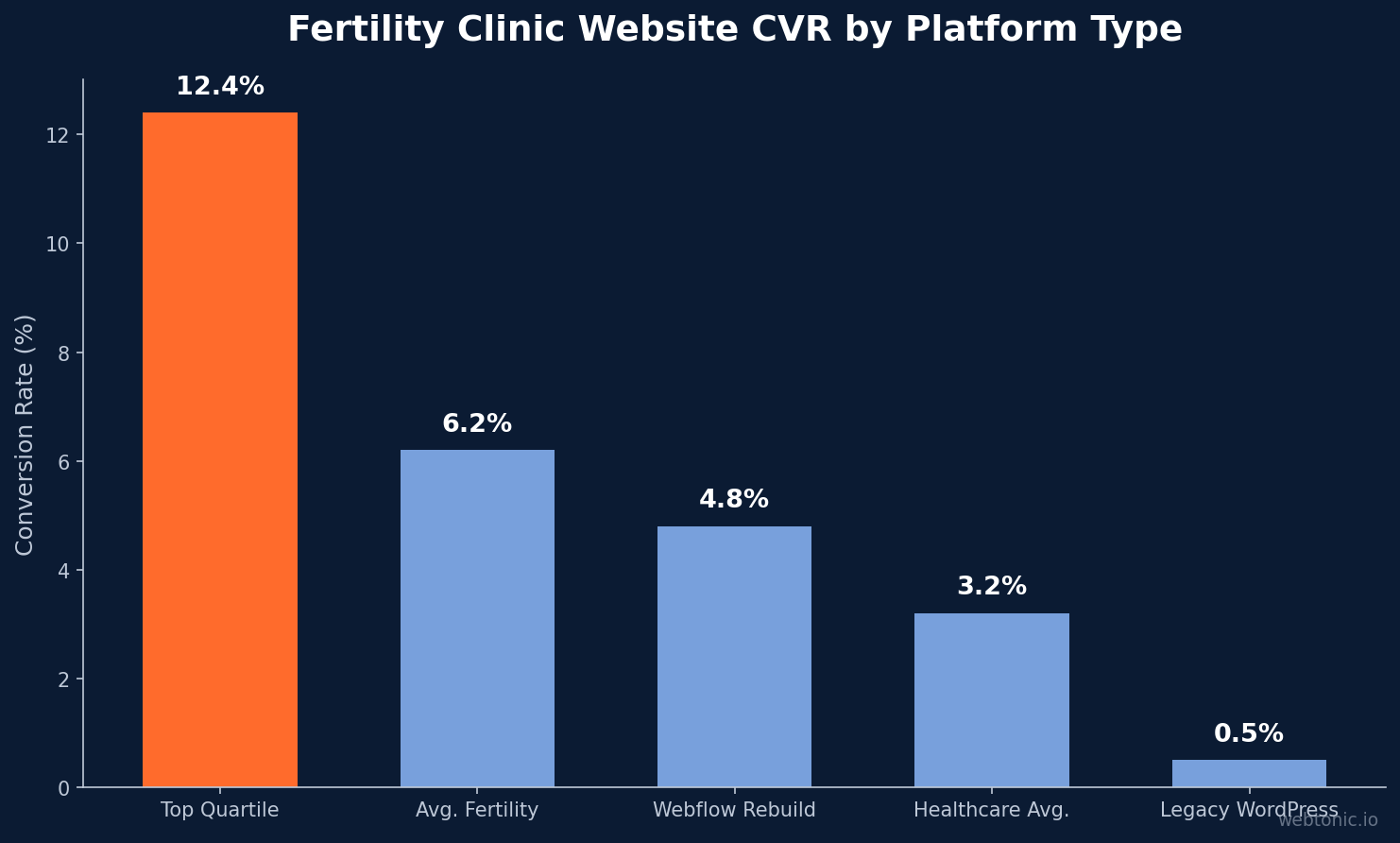
- Fertility clinic landing pages convert at 6.2% on average, with top-quartile pages reaching 2–3x the median through deliberate optimization of speed, trust signals, and conversion paths.
- A Webflow healthcare rebuild delivered +312% organic traffic and a 4.8% conversion rate (up from 0.5% on WordPress) within six months of launch.
- Mobile search accounts for 65–80% of fertility clinic queries, making mobile-first design and Core Web Vitals compliance critical for patient acquisition.
- 84% of patients check online reviews before booking fertility care, requiring websites to integrate trust signals, testimonials, and transparent success rate data.
- 64.2% of new B2B SaaS site launches in 2025–2026 chose Webflow over WordPress, reflecting a broader industry shift toward no-code platforms.
Webflow Market Share and Healthcare Adoption
Webflow reached approximately 1.2% of the global CMS market in 2026, doubling its 0.4% share from 2021 (Sales Hacking). Within the website builder segment specifically, Webflow holds 14.5% market share, trailing only Squarespace (17.8%) and Wix (15.0%) (Colorlib). The platform's year-over-year growth rate of approximately 32% makes it one of the fastest-growing website builders in the market.
Healthcare adoption of Webflow is growing but remains concentrated in specific segments. Among UK healthcare companies, Webflow ranks sixth by detected CMS share at 2.0% (195 of 9,740 companies), according to Firmbase. In the digital health startup ecosystem, Webflow adoption is significantly higher: 15% of digital health companies use Webflow as their primary CMS, second only to WordPress (Atomic Health). This higher adoption among health startups reflects Webflow's appeal to design-forward organizations that prioritize user experience and rapid iteration capability.
| Metric | Webflow | WordPress | Squarespace |
|---|---|---|---|
| Global CMS Share | 1.2% | 62.7% | 3.4% |
| Website Builder Share | 14.5% | N/A (full CMS) | 17.8% |
| UK Healthcare Adoption | 2.0% | ~55% | ~3% |
| Digital Health Startups | 15% | ~45% | ~8% |
| YoY Growth Rate | +32% | +2% | +5% |
| B2B SaaS Launch Share | 64.2% | ~25% | ~5% |

Fertility Clinic Website Conversion Benchmarks
Fertility clinic landing pages convert at 6.2% on average, according to Benchmarketing's 2026 industry data. Top-quartile pages reach 2–3x the median conversion rate through deliberate optimization of trust signals, page speed, and conversion path design. A healthy organic conversion rate for an IVF clinic falls between 3% and 7%, encompassing both primary conversions (consultation bookings) and secondary conversions (newsletter sign-ups, resource downloads) (Authority Specialist).
Website speed directly impacts these conversion rates. Mobile search accounts for 65–80% of fertility clinic queries, yet most clinic websites fail mobile Core Web Vitals assessments. The average healthcare Largest Contentful Paint (LCP) sits at 9.74 seconds, placing most sites well above Google's 2.5-second threshold for a "good" score. Slow sites face a measurable penalty: healthcare websites that fail to meet performance thresholds lose 15–20% of potential conversions to bounce and abandonment (Authority Specialist).
Webflow-hosted sites typically outperform these healthcare averages significantly, delivering LCP of 2.1–3.5 seconds on managed hosting. This performance gap is one of the primary reasons fertility clinics and digital marketing teams consider migrating from WordPress to Webflow as part of a broader performance creative strategy.
Webflow Healthcare Case Studies
Documented Webflow healthcare rebuilds demonstrate measurable performance improvements that translate directly to patient acquisition metrics for fertility clinics looking to redesign their web presence.
| Case Study | Platform Shift | Key Result | Timeline |
|---|---|---|---|
| Medical Practice (General) | WordPress → Webflow | +312% organic traffic, 4.8% CVR (was 0.5%) | 6 months |
| Maven Clinic (Fertility/Health) | Legacy → Webflow Enterprise | +18% engagement, +38% demo page visits | Post-launch |
| Dimer Health (Telehealth) | Legacy → Webflow | +288% conversions | Post-rebrand |
| Exact Medicare | Legacy → Webflow | Reduced technical debt, full CMS control | Ongoing |
The medical practice case study is particularly instructive for fertility clinics. The WordPress site had a PageSpeed score of 38 on mobile, 11 security vulnerabilities, and converted less than 0.5% of visitors into leads. After rebuilding on Webflow with 50 city-specific landing pages, the site achieved PageSpeed scores above 90 and 60% of new patients came through organic search (Webflow Developers).
Maven Clinic, a global healthcare company serving fertility and family-building needs, rebuilt their platform on Webflow Enterprise with N4 Studio. The modular, content-first architecture enabled personalization across multiple audience types without constant developer involvement, resulting in 18% engagement growth and 38% more visits to their demo page — the primary commercial conversion point (N4 Studio).
Fertility Patient Website Journey and Trust Signals
Fertility patients undergo a longer, more emotionally complex decision journey than most healthcare consumers. 84% of patients check online reviews before booking fertility care (Fertility SEO Expert), and the average fertility patient visits multiple clinic websites over weeks or months before scheduling a consultation.
This extended research phase means website design directly impacts patient trust and conversion. TYPZA's fertility clinic analysis identifies several website design elements that differentiate top-converting fertility sites: transparent success rate displays, patient story libraries, treatment timeline visualizations, and insurance or cost calculators. The 30–40% patient drop-off rate between initial consultation and IVF cycle start highlights the critical role websites play in nurturing prospective patients through the decision funnel.
Clinics with comprehensive, regularly updated content libraries see measurably higher cycle-start rates than those with static brochure-style websites. Webflow's CMS collections make it straightforward to maintain dynamic content like monthly success rate updates, new provider profiles, patient testimonials, and treatment FAQ pages that keep the site fresh for both patients and search engines.
Page Speed and Core Web Vitals for Fertility Sites
Website performance is a measurable differentiator for fertility clinics competing in high-value local search results. Webflow's managed hosting infrastructure provides built-in advantages over self-hosted solutions like WordPress, particularly for clinics without dedicated development resources.
| Performance Metric | Healthcare Avg. | Webflow Avg. | Google "Good" Threshold |
|---|---|---|---|
| LCP (Largest Contentful Paint) | 9.74s | 2.1–3.5s | ≤2.5s |
| FCP (First Contentful Paint) | 3.92s | 1.2–2.0s | ≤1.8s |
| CLS (Cumulative Layout Shift) | 0.07 | 0.02–0.05 | ≤0.1 |
| CWV Pass Rate (Mobile) | 48.7% | ~70% | 100% |
| Mobile Traffic Share | 68.5% | 65–80% | — |
Sources: Authority Specialist, prior verified healthcare CWV data (Borah Labs).
Why Fertility Clinics Choose Webflow
- No-code CMS flexibility. Fertility clinics need to update treatment pages, success rates, and provider bios frequently. Webflow's visual CMS lets non-technical staff make changes without developer involvement, reducing content update cycles from weeks to hours and keeping information current for patients researching treatment options.
- HIPAA-adjacent compliance. While Webflow itself is not HIPAA-certified, its architecture supports compliance when paired with HIPAA-compliant form processors and analytics tools like FreshPaint. Fertility clinics build patient-facing informational sites on Webflow while routing sensitive data through compliant third-party systems for intake and scheduling.
- Performance-first hosting. Webflow's managed CDN and hosting deliver significantly better Core Web Vitals than the average healthcare WordPress site, directly impacting SEO rankings, bounce rates, and ultimately patient acquisition volume.
- Design precision for trust. Fertility websites require emotional design sensitivity that generic templates cannot achieve. Webflow's pixel-level design control enables clinics to build sites that convey empathy, clinical authority, and cost transparency simultaneously — all critical factors in a patient's decision to schedule a consultation.
- Scalable multi-location architecture. Fertility networks with multiple clinic locations use Webflow's CMS collections to generate location-specific landing pages dynamically, supporting local SEO strategies without duplicating development effort. One documented rebuild created 50 city-specific pages that drove 60% of new patient acquisitions through organic search.
Webflow vs. WordPress for Fertility Clinic Websites
The WordPress-to-Webflow migration decision is one of the most consequential technology choices a fertility clinic can make for its digital presence. WordPress powers approximately 62.7% of all CMS-based websites globally, giving it an unmatched ecosystem of plugins, themes, and developer talent. However, this ecosystem comes with well-documented maintenance overhead that particularly impacts small-to-mid-size fertility practices without dedicated IT staff or web development resources to manage ongoing updates.
WordPress fertility sites frequently accumulate security vulnerabilities through outdated plugins — the medical practice case study documented 11 separate vulnerabilities on a single site before the Webflow rebuild. For fertility clinics handling sensitive patient inquiries through contact forms and consultation requests, these vulnerabilities create both a data security risk and a patient trust concern that directly impacts conversion rates.
The performance gap between the two platforms is equally significant for fertility clinics competing in local search results. WordPress sites relying on shared hosting and multiple plugins typically deliver PageSpeed scores of 30–50 on mobile, while Webflow sites routinely achieve scores above 85 on mobile. Given that mobile search accounts for 65–80% of fertility queries and Google uses mobile-first indexing for ranking decisions, this performance difference directly impacts search visibility and organic patient acquisition volume for clinics in competitive metropolitan markets.
The total cost of ownership often favors Webflow for fertility practices: the platform eliminates the need for separate hosting fees, SSL certificates, security monitoring subscriptions, and plugin licensing costs that WordPress requires. When developer time for ongoing WordPress maintenance, security patches, and plugin conflict resolution is factored into the three-year cost calculation, Webflow typically delivers a 30–50% lower total cost of ownership while providing superior performance and design flexibility for patient-facing websites.
Frequently Asked Questions
What is Webflow's market share in healthcare?
Webflow holds approximately 2.0% of detected CMS share among UK healthcare companies and 15% adoption among digital health startups. Globally, Webflow has 1.2% of the CMS market, with its share doubling since 2021. Among website builders specifically, Webflow ranks third at 14.5% market share behind Squarespace and Wix.
How do fertility clinic websites convert on Webflow?
Fertility clinic landing pages convert at 6.2% on average across all platforms, with Webflow sites typically performing above average due to faster page speeds and better design control. A documented Webflow healthcare rebuild achieved a 4.8% conversion rate, up from 0.5% on WordPress, a nearly tenfold improvement driven by speed, design, and structured conversion paths.
Is Webflow HIPAA compliant for fertility clinics?
Webflow itself is not HIPAA-certified. However, fertility clinics commonly use Webflow for their public-facing informational site and route patient intake forms, appointment scheduling, and health data through HIPAA-compliant third-party integrations. This architecture separates marketing content management from protected health information handling.
How fast are Webflow fertility clinic websites?
Webflow-hosted sites typically achieve LCP of 2.1–3.5 seconds, significantly outperforming the healthcare average of 9.74 seconds. This speed advantage directly impacts SEO rankings, bounce rates, and conversion rates for fertility clinics competing in high-value local search results.
Should a fertility clinic switch from WordPress to Webflow?
The data supports the switch for clinics prioritizing design quality, page speed, and marketing team autonomy. Documented WordPress-to-Webflow healthcare migrations show +312% organic traffic gains and dramatically improved conversion rates. The primary trade-off is fewer HIPAA-specific plugins compared to WordPress's extensive plugin ecosystem.
Sources
colorlib.com
sales-hacking.com
firmbase.co
benchmarketing.org
authorityspecialist.com
webflow-developers.com
n4.studio
loudface.co
typza.com
fertilityseo.expert