



Table of contents
Fertility clinic landing pages convert at 6.2% on average, but optimized treatment pages hit 8–12% while generic pages limp at 1.9–2.5%. Here are the benchmarks and optimization data shaping fertility landing pages in 2026.
Key Takeaways
- Fertility clinic landing pages convert at 6.2% on average, above the general healthcare website conversion rate of 3.6% (Benchmarketing).
- Top-performing fertility landing pages achieve 8–12% conversion rates when optimized with treatment-specific messaging and clear booking CTAs (Tandem Medical).
- EuroCARE IVF grew UK landing page conversion from 1.9% to 6.8% with country-specific messaging and localized social proof (Tandem Medical).
- Pages loading in under 2 seconds convert 47% better than slower alternatives, making speed a direct conversion factor for fertility sites (AdJet Marketing).
- Mobile optimization delivers a 32% increase in patient inquiries for healthcare websites, critical given that the majority of fertility searches start on mobile (Anzolo Medical).
Fertility Landing Page Conversion Benchmarks
| Page Type | Avg Conversion Rate | Top Performer | Bottom Quartile |
|---|---|---|---|
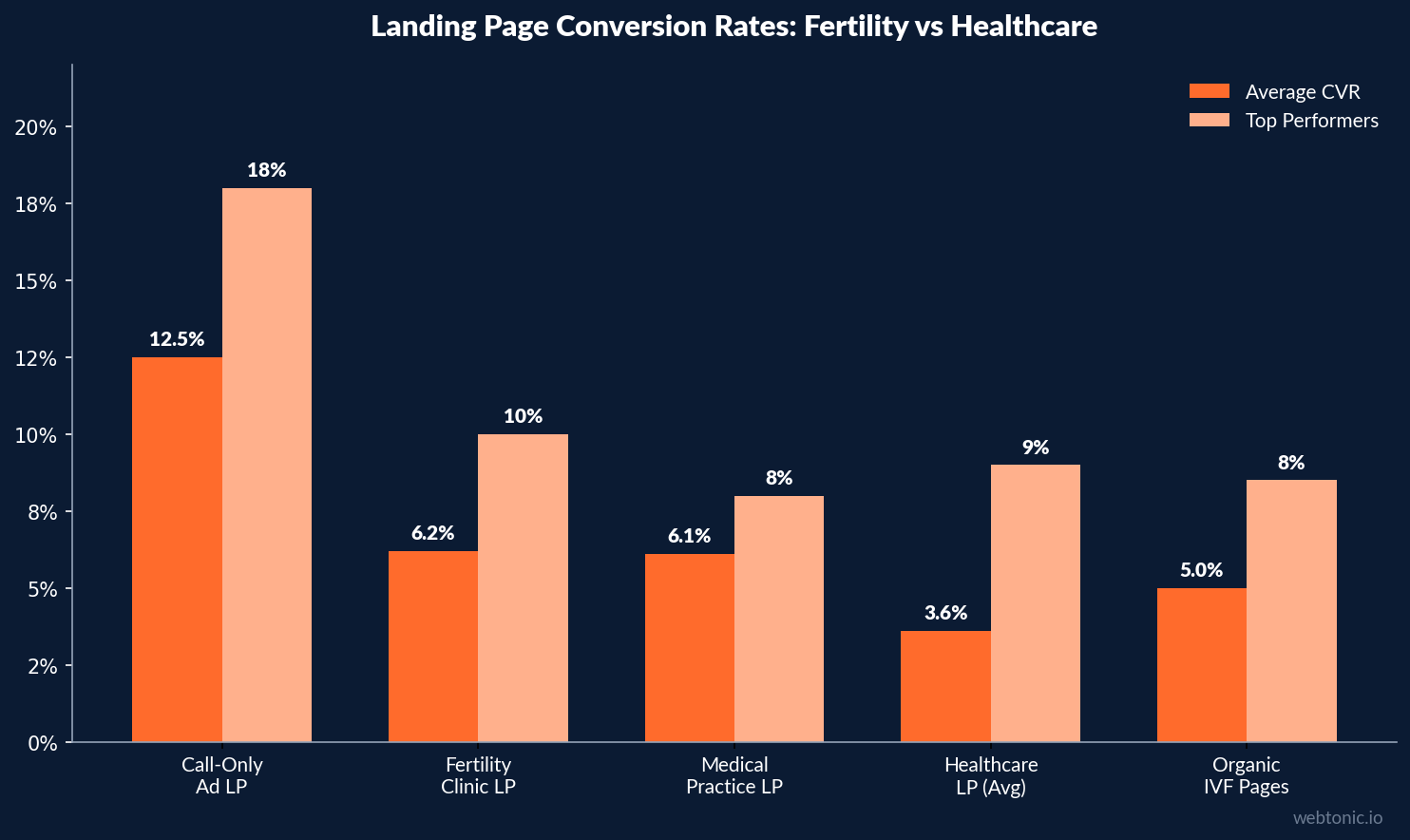
| Fertility Clinic LP (PPC) | 6.2% | 8–12% | 1.5–2.5% |
| Healthcare LP (General) | 3.0–4.2% | 8–10% | 1.0–2.0% |
| Medical Practice Website | 3.6% | 6.1% | 1.2–2.0% |
| Call-Only Ad LP | 12.5% | 16–20% | 6–8% |
| Organic IVF Pages | 3–7% | 7–10% | 1–2% |
Sources: Benchmarketing 2026, CuFinder, Wolfable
Conversion Rate Optimization Case Studies
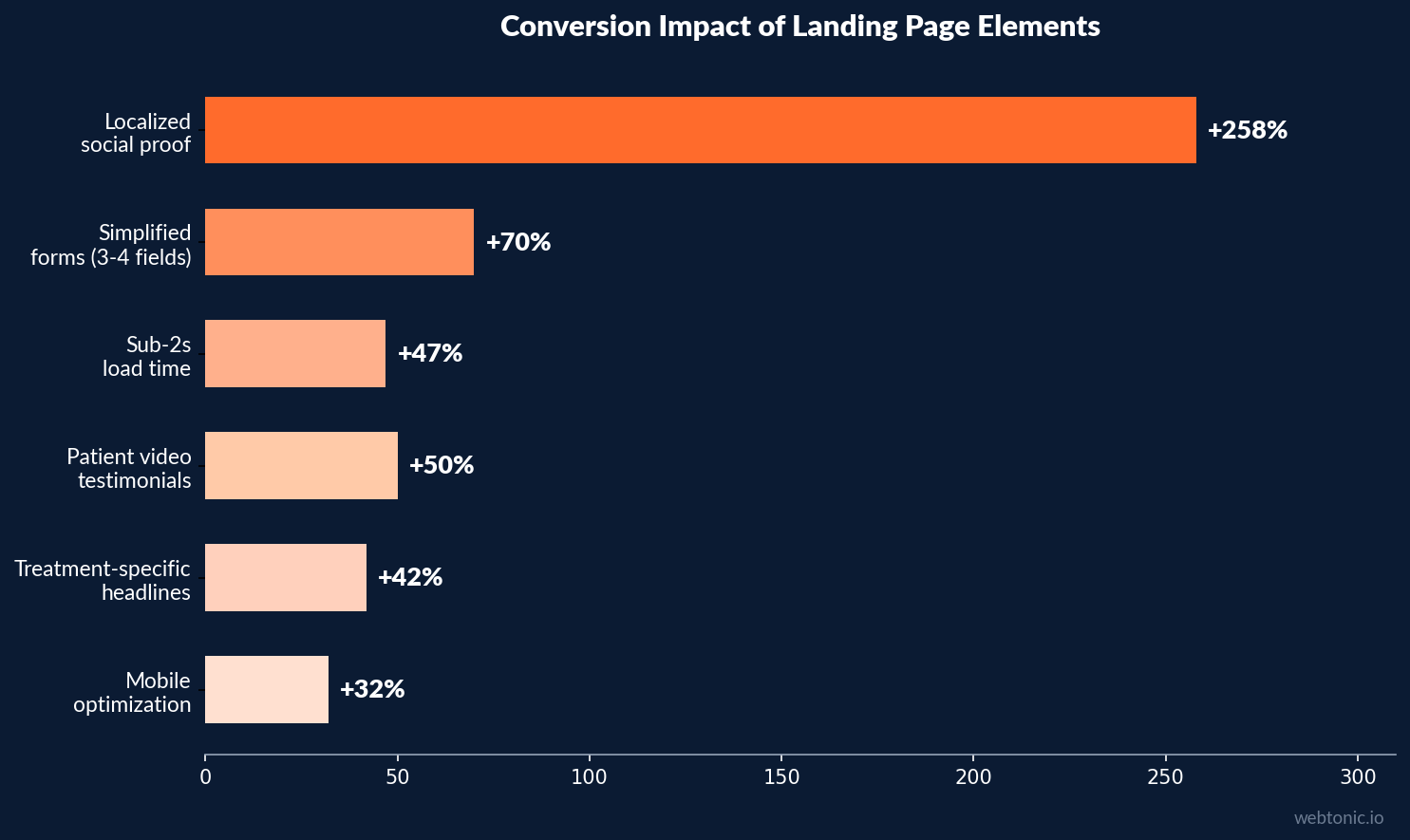
EuroCARE IVF's UK landing page conversion jumped from 1.9% to 6.8% — a 258% improvement — by implementing country-specific messaging, localized success stories, and social proof relevant to Scandinavian and British patients. The key insight was that generic international landing pages underperform dramatically compared to pages tailored to the patient's cultural context and healthcare expectations (Tandem Medical).
A Chicago fertility clinic achieved 240% conversion growth with a 148% improvement in conversion rate within six months by redesigning their PPC landing pages around treatment-specific messaging and reducing form fields from 8 to 4 (Lead Horse).
ReproMed IVF's landing pages delivered 4.26% conversion at an average cost of EUR 59.81 per conversion across 1,425 total leads, with a 12.35% CTR from ads to landing pages (Utopiads).
Page Speed and Mobile Performance Data
Speed directly impacts fertility clinic conversions. A page that loads in under 2 seconds converts 47% better than a slow-loading page. Every additional second of load time costs measurable conversion volume, especially on mobile where impatient users bounce faster (AdJet Marketing).
Mobile optimization delivers a 32% increase in patient inquiries for healthcare websites. With the majority of healthcare searches now occurring on mobile devices, responsive design is no longer optional — it directly impacts patient acquisition (Anzolo Medical).
RoastPage's healthcare analysis found that the average healthcare page scores 44 out of 100 on their conversion audit, with the top quartile scoring 59+. Scores above 52 indicate the practice is ahead of most competitors. The biggest improvement opportunities typically lie in trust signals and booking friction reduction (RoastPage).
Trust Signals and Social Proof Impact
Fertility patients make deeply personal decisions, and trust signals carry more weight than in most healthcare verticals. Landing pages featuring patient testimonials and success rates see 40–60% higher engagement compared to pages with only clinical information. Video testimonials from past patients are particularly effective, as they humanize the experience and reduce the anxiety associated with fertility treatment decisions.
Key trust elements that measurably improve conversion include board certification badges, professional association memberships (ASRM, ESHRE), success rate data presented transparently, and photos of the actual medical team rather than stock imagery. Clinics displaying SART-verified success rates prominently on landing pages report higher form completion rates because patients perceive the data as credible and independently validated.
The ICG OHMRC model identifies five stages of healthcare landing page optimization: Objection handling, Hero framing, Micro-commitments, Risk reversal, and Conversion architecture. Clinics that systematically address each stage close the gap between the typical 2% conversion rate and the achievable 6%+ benchmark (ICG).
Landing Page Elements That Drive Conversions
| Element | Impact on Conversion | Implementation Priority |
|---|---|---|
| Treatment-specific headline | +35–50% vs generic headlines | Critical |
| Online booking form (3–4 fields) | +60–80% vs 8+ field forms | Critical |
| Click-to-call button (mobile) | +25–40% mobile conversions | Critical |
| Patient video testimonials | +40–60% engagement | High |
| Transparent pricing / cost info | +35–50% time on page | High |
| SART success rate display | +20–30% form completions | High |
| Sub-2-second load time | +47% vs slow pages | High |
| Localized social proof | +258% (EuroCARE case) | Medium |
Booking Funnel and Patient Journey Metrics
The fertility patient journey is notably longer than most healthcare verticals. Research from Irresist.io shows that clinics growing fastest measure operator metrics tied to booked consultations: inquiry-to-booked rate, booking completion rate, time-to-first-response, and cost per consultation — not just traffic or impressions.
ICG's data across 12 IVF centers shows that Google Ads pages convert at 12.16% from click to lead, while Meta Ads landing pages convert at just 1.36%. However, the lead-to-consultation conversion rate averages 41% for Google leads versus lower rates for social leads, with an average of 11 touchpoints per conversion before a patient books a consultation (ICG India).
Fertility Associates' shift to self-service online booking — allowing patients to select dates, complete forms, and submit appointments directly — eliminated the friction of phone-only scheduling. This approach works because fertility patients often research and book outside business hours, typically between 8 PM and midnight when traditional phone lines are closed.
A/B Testing and Optimization Insights
Healthcare landing page optimization is particularly challenging because conversion volumes are lower than e-commerce, requiring longer test durations to reach statistical significance. Fertility clinics should plan for 4–8 week test cycles at minimum, focusing on high-impact elements rather than minor design tweaks.
The highest-impact tests for fertility landing pages involve headline messaging (treatment-focused vs. outcome-focused), form placement and length (above-fold vs. below-fold, 3 fields vs. 5), and social proof format (written testimonials vs. video vs. success rate statistics). Testing click-to-call button color and position typically yields 15–25% mobile conversion improvements with minimal effort.
First Page Sage's 2026 healthcare benchmarks show that personalized CTAs convert 202% better than generic alternatives. For fertility clinics, this means dynamically adjusting the CTA based on the patient's entry point — an IVF-specific ad should land on a page with "Book Your IVF Consultation" rather than a generic "Contact Us" button (Wolfable).
Multi-step forms that break the booking process into 2–3 progressive steps (select treatment, choose time, enter details) consistently outperform single long forms. This approach reduces perceived effort and leverages the commitment-consistency principle — once patients complete step one, they are significantly more likely to complete the remaining steps.
Fertility Landing Page vs Industry Averages
| Metric | Fertility Clinics | Healthcare Average | All Industries |
|---|---|---|---|
| PPC Landing Page CVR | 6.2% | 3.0–4.2% | 4.3% |
| Organic Page CVR | 3–7% | 2.1–3.5% | 2.9% |
| Mobile CVR | 4.5–6% | 2.5–3.8% | 3.5% |
| Bounce Rate | 45–55% | 50–60% | 47% |
| Avg Time on Page | 3:15–4:30 | 2:30–3:15 | 2:45 |
Sources: Benchmarketing, CuFinder, AdJet Marketing
Best Practices for Fertility Clinic Landing Pages
- Create separate landing pages for each treatment — IVF, IUI, egg freezing, and fertility testing pages should each have tailored messaging, relevant success data, and treatment-specific CTAs rather than pointing all ads to a single service page.
- Minimize form fields — reduce booking forms to 3–4 essential fields (name, phone, email, preferred treatment). The Chicago clinic case study showed that cutting from 8 to 4 fields contributed to a 148% CVR improvement.
- Feature real success metrics — display SART-verified success rates, patient count milestones, and years of experience prominently above the fold. Avoid vague claims; specific numbers build credibility.
- Optimize for mobile-first booking — add click-to-call buttons, sticky mobile CTAs, and tap-friendly form elements. Mobile-optimized healthcare pages see 32% more inquiries (Anzolo Medical).
- Add cost transparency — patients searching for fertility treatments are highly cost-conscious. Pages that address pricing directly see significantly higher time-on-page and form submission rates.
Common Landing Page Mistakes in Fertility Marketing
The most costly mistake fertility clinics make is sending paid traffic to their homepage instead of treatment-specific landing pages. Homepage conversion rates for PPC traffic typically sit at 1.5–2.5%, less than half the achievable rate on dedicated pages. Each treatment type — IVF, IUI, egg freezing, genetic testing — deserves its own landing page with tailored messaging, relevant success metrics, and a clear single CTA.
Another common pitfall is requiring too much information upfront. Fertility patients are often anxious and protective of their privacy during early research. Forms asking for medical history, insurance details, or partner information before a simple consultation booking create unnecessary friction and suppress conversion rates by an estimated 30–50% compared to minimal-field forms.
Related reading
- Locksmith Landing Page Statistics: 2026 Conversion Rates & CRO Data
- Manufacturing Landing Page Statistics (2026): Conversion Rates, RFQ Benchmarks & CRO Data
- Mortgage Landing Page & CRO Statistics (2026)
- Landing Page Design services at Web Tonic
Frequently Asked Questions
What is a good landing page conversion rate for fertility clinics?
The industry average is 6.2% for PPC landing pages. Top performers hit 8–12% with treatment-specific pages, localized messaging, and streamlined booking forms. Anything below 4% indicates structural issues that need immediate attention — typically ad-to-page mismatch, too many form fields, or missing trust signals.
How do fertility landing pages compare to other healthcare specialties?
Fertility clinics outperform the general healthcare average of 3.0–4.2% on landing pages. The higher baseline reflects the motivated nature of fertility patients who arrive via high-intent search queries. Medical practice websites overall average only 3.6%, while call-only ad landing pages achieve the highest rates at 12.5%.
What elements have the biggest impact on fertility landing page conversion?
Three elements deliver the most impact: treatment-specific headlines (+35–50% vs generic), simplified booking forms with 3–4 fields (+60–80% vs complex forms), and mobile click-to-call buttons (+25–40% mobile conversions). Localized social proof — testimonials and success stories from patients in the visitor's region — provides the largest single-element uplift documented.
Does page speed really affect fertility clinic conversions?
Yes, significantly. Pages loading under 2 seconds convert 47% better than slower pages. For fertility clinics spending $5,000–$20,000 monthly on PPC, even a 1-second delay costs real leads and revenue. Compress images, minimize third-party scripts, and use a fast hosting environment. Google's Core Web Vitals also factor page speed into search rankings, creating a double penalty for slow pages — lower organic visibility and worse conversion rates from the traffic that does arrive.
How do multi-step forms compare to single forms for fertility clinics?
Multi-step forms that break the booking process into 2–3 progressive stages consistently outperform single long forms for fertility clinics. Patients who complete the first step (selecting a treatment type) show significantly higher completion rates for subsequent steps. This approach leverages commitment psychology while reducing the initial perceived effort of scheduling a consultation.
Should fertility clinics use long-form or short-form landing pages?
Treatment-specific PPC landing pages should be concise and action-oriented — typically 400–800 words with clear CTAs above the fold. However, informational pages for patients still researching treatment options can be longer (1,200–2,000 words) to address concerns and build trust before asking for the booking. The best approach is to test both formats and measure which drives more qualified consultation requests.
Sources
benchmarketing.org/benchmarks/industries/fertility-clinics
tandemmedicalmarketing.com/case-studies/eurocare-ivf
tandemmedicalmarketing.com/seo-for-fertility-clinics
leadhorse.co/case-studies/chicago-fertility-clinic-growth
utopiads.com/case-studies/driving-growth-for-repromed-ivf-clinic-case-study
cufinder.io/blog/benchmarks/medical-practices
wolfable.com/optimize-landing-pages-healthcare-clinics-convert-patients
adjetmarketing.com/what-is-a-landing-page-clinic-owners-guide-to-more-patients
business.anzolomed.com/medical-website-conversion-benchmarks-2026
ichelonconsulting.com/insights/ohmrc-model-healthcare-landing-page-cro
irresist.io/en/blog/fertility-clinic-marketing-booked-consultations
roast.page/for/healthcare


