



Table of contents
Key Takeaways
- Fertility clinics achieve a 1.72% Meta Ads CTR with a 2.8x ROAS, outperforming the healthcare median CTR of 0.9% by nearly double (Benchmarketing; Varos, 2026).
- Meta Ads generate 45% of IVF digital conversions by volume, making Facebook and Instagram the largest single paid channel for fertility patient acquisition ahead of Google Ads at 20% (ICG, 2026).
- Patient journey narrative videos produce the lowest cost per qualified lead among all creative formats, with documented results of 243% qualified lead growth and 8.2x ROAS sustained over 2+ years (Tandem Medical Marketing, 2026).
- Healthcare Facebook Ads average $2.80–$12 CPC and $30–$200 CPL depending on sub-vertical and measurement constraints, with fertility clinics trending toward the higher end due to HIPAA-driven attribution limitations (AdLibrary, 2026).
- Click-to-WhatsApp (CTWA) campaigns reduce cost per qualified lead by 39–45% compared to traditional landing page funnels by eliminating form abandonment entirely (ICG, 2026).
Fertility Meta Ads Performance Benchmarks
| Metric | Fertility Clinics | Healthcare Avg | All-Industry Avg |
|---|---|---|---|
| CTR | 1.72% | 0.6–1.4% | 1.24% |
| CPC | $4.50–$12 | $2.80–$12 | $1.76 |
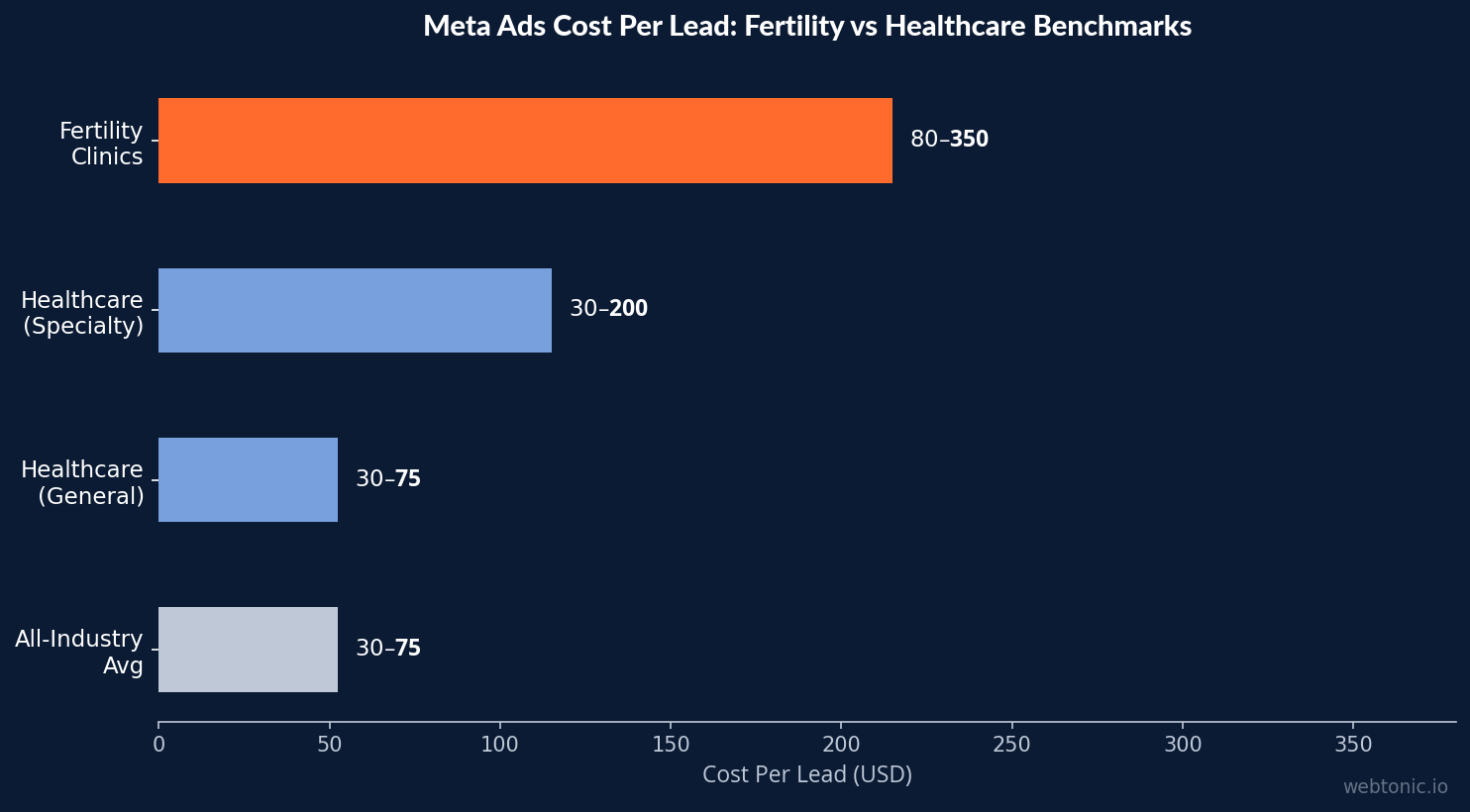
| CPL | $80–$350 | $30–$200 | $30–$75 |
| ROAS | 2.8x | 1.5–3x | Varies |
| CVR (LP) | 2–5% | 2–5% | 2.84% |
| CPM | $18–$45 | $18–$45 | $5.61–$28 |
Cost Benchmarks: CPC, CPL, and CPM Trends
Facebook advertising costs for fertility clinics sit at the premium end of the healthcare spectrum. According to AdLibrary, healthcare Facebook Ads average $2.80–$12 CPC and $30–$200 CPL depending on sub-vertical and HIPAA-driven measurement constraints. Fertility clinics typically occupy the upper range due to the high-value nature of IVF treatment ($15,000–$25,000 per cycle).
CPM data from ConversionStudio shows concerning upward pressure across all industries, with CPMs rising 70% year-over-year from $22.76 to $38.70 in some sectors. Healthcare CPMs range from $18–$45, with fertility clinics experiencing seasonal variation — costs peak during January and September when treatment cycle demand increases.
The healthcare median CPC of $1.76 reported by Stethon Digital Marketing (sourced from Varos) represents a broad average that masks significant variation. Fertility-specific campaigns targeting high-intent keywords like "IVF consultation" or "egg freezing near me" regularly see $8–$15 CPC, while awareness campaigns featuring educational content can achieve $2–$5 CPC. Explore our Facebook Ads pricing guide for additional context on cost management.
Channel Mix: Meta vs Google vs Organic for IVF Clinics
Meta Ads play a unique role in the fertility marketing ecosystem. Data from ICG's portfolio of 20+ IVF clinics reveals that Meta Ads generate 45% of IVF digital conversions by volume, making it the single largest paid acquisition channel. Google Search Ads generate 20% of conversions but at higher average revenue per user (patients opting for 2–3 cycle packages), while organic channels drive 35% with zero marginal cost.
This channel mix data reveals an important strategic insight: Meta Ads attract primarily affordable single-cycle patients, while Google Search captures higher-value multi-cycle commitments. Clinics that optimize for patient lifetime value rather than raw lead volume often find that Google's 20% conversion share produces a disproportionate share of revenue.
According to Tandem Medical Marketing, Meta reaches patients during the 3–12 month consideration window before active search begins. This makes Facebook and Instagram essential for demand generation and brand building, while Google Ads captures patients who have already decided to seek treatment. The most effective fertility marketing strategies run both simultaneously, allocating 20% of total budget to Meta retargeting alongside Google Search campaigns.
Creative Performance by Format
Video testimonials from real patients are the highest-performing creative format for fertility clinic Meta Ads. Tandem Medical Marketing identifies patient journey narrative videos as the most effective creative, with LIV Fertility Center documenting 243% growth in qualified leads and sustaining 8.2x ROAS over a 2+ year engagement.
| Creative Format | CTR | Engagement | Relative CPQL |
|---|---|---|---|
| Patient Journey Video | 2.4–3.1% | Highest | Lowest (baseline) |
| Doctor Q&A Reels | 1.8–2.5% | High | 1.1–1.3x baseline |
| Procedure Walkthrough | 1.6% | 58% completion | 1.1x baseline |
| Facility Tour Reel | 1.2% | 41% completion | 1.4x baseline |
| Before/After (Compliant) | 3.1% | 61% completion | 1.0x baseline |
| Static Educational | 0.8–1.2% | Moderate | 1.5–2x baseline |
Data from ICG's Meta campaigns reveals that before/after content achieves the highest CTR at 3.1% when executed compliantly (non-surgical, GDPR-appropriate). Procedure walkthrough videos reach 1.6% CTR with 58% completion rates, while facility tour Reels drive awareness at 1.2% CTR but with higher cost per qualified lead. Stethon Digital Marketing notes that Instagram Story Ads explaining the IVF journey reduce fear by replacing uncertainty with clear process visualization.
Three creative compliance constraints from Practice Growth Co apply to all fertility advertising: no guaranteed outcome claims, no misleading success rate presentations, and no exploitation of emotional vulnerability. Clinics that work within these constraints and invest in authentic patient stories see the strongest sustained performance. Read our performance creative approach for data-driven ad design.

Conversion Funnel and Lead Quality Analysis
Raw lead volume from Meta Ads masks significant quality variation. ICG's comprehensive funnel data from IVF clinic campaigns reveals the true conversion journey:
| Funnel Stage | Volume | % of Raw Leads |
|---|---|---|
| Raw Leads Generated | 3,008 | 100% |
| Qualified | 725 | 24.1% |
| Expressed Interest | 249 | 8.28% |
| Scheduled Appointment | 248 | 8.24% |
| Confirmed | 233 | 7.75% |
| Visited Clinic | 112 | 3.72% |
| Converted to Patient | 41 | 1.36% |
This data underscores why Irresist.io argues that cost per lead misleads fertility clinics. A channel with $150 CPL and 3% lead-to-patient rate costs $5,000 per patient, while a channel with $350 CPL and 11% conversion rate costs only $3,182 per patient. The correct metric is cost per acquired patient, not cost per raw lead.
Case study data from Eraya Fertility demonstrates what optimized Meta campaigns can achieve: the clinic generated 1,500 total leads with 45% from paid social, achieving a 40% cost per lead reduction through targeted segment-based campaigns for distinct patient groups including couples, egg freezing candidates, and international patients.
Instagram and Placement Strategy
Instagram plays an increasingly important role in fertility advertising, particularly for reaching younger demographics considering egg freezing and fertility preservation. According to Tandem Medical Marketing, egg freezing campaigns are especially effective on Instagram, where the visual format aligns with the younger target audience's content consumption patterns.
Top-performing Instagram placements for fertility clinics include clinic tour Reels (30–60 seconds), embryo transfer process animations, patient journey Stories, and embryologist meet-the-team videos. Facebook lead generation forms remain a powerful tool, generating 2.4x more leads on average than traffic-to-landing-page campaigns thanks to lower friction from in-platform form completion.
The strategic allocation between Facebook and Instagram depends on campaign objectives. Brand awareness and trust-building campaigns perform strongest on Instagram Stories and Reels, while direct lead generation campaigns achieve higher conversion rates on Facebook where lead forms and detailed targeting options provide more control. Clinics running both placements through Advantage+ placement optimization typically see 15–25% lower CPL than manual placement selection. Learn more about our Meta Ads management services for fertility clinics.
Budget Allocation and Campaign Structure
Effective Meta Ads budget allocation for fertility clinics follows a clear hierarchy. Stethon Digital Marketing recommends allocating 20% of total digital marketing budget to Meta retargeting, with the remainder split between Google Search campaigns (60–70%) and education/brand authority content (10–15%).
For clinics investing directly in Meta campaigns, a 4–8 week data collection period is essential before making major strategic changes. According to Clicks Geek, fertility clinics should expect 15–40 top-of-funnel leads per month across brand awareness, IUI portfolio, and retargeting campaigns during the initial cold prospecting phase. Campaigns that survive the initial 30-day learning phase run 30% above the benchmark for the remainder of the engagement.
See our guide on whether Facebook Ads are worth it for a broader ROI framework that applies to fertility clinics.
Best Practices for Fertility Facebook Ads
- Lead with patient journey video testimonials — they produce the lowest cost per qualified lead and highest engagement among all creative formats (Tandem Medical Marketing, 2026).
- Measure cost per acquired patient, not cost per lead — a $350 CPL with 11% conversion beats a $150 CPL with 3% conversion on actual patient economics (Irresist.io, 2026).
- Allocate 20% of total marketing budget to Meta retargeting campaigns alongside Google Search for high-intent capture (Stethon Digital Marketing, 2026).
- Allow a 4–8 week learning period before making major campaign changes — algorithms need time to learn the specialized fertility audience (Practice Growth Co, 2026).
- Test Click-to-WhatsApp (CTWA) campaigns where available to reduce CPQL by 39–45% by eliminating form abandonment (ICG, 2026).
- Segment campaigns by patient type — couples, egg freezing candidates, international patients, and returning patients each require distinct messaging and creative (Eraya Fertility case data, 2026).
- Use Instagram Reels and Stories for egg freezing campaigns targeting younger demographics, and Facebook lead forms for direct consultation booking (Tandem Medical Marketing, 2026).
- Comply with three creative constraints: no guaranteed outcomes, no misleading success rates, and no exploitation of emotional vulnerability (Practice Growth Co, 2026).
Related reading
- Med Spa Facebook & Instagram Ads Statistics: 2026 Benchmarks & Costs
- Mortgage Facebook & Meta Ads Statistics: 60+ Performance Benchmarks (2026)
- Plumbing Facebook Ads Statistics (2026): Cost, ROI & Lead Gen Data
- Meta Ads Agency services at Web Tonic
FAQ
How much do Facebook Ads cost for fertility clinics?
Facebook Ads for fertility clinics typically cost $4.50–$12 CPC and $80–$350 CPL, with CPMs ranging from $18–$45. These costs sit at the premium end of healthcare advertising due to the high value of IVF treatment cycles ($15,000–$25,000). Costs vary significantly by market, with competitive metros like NYC and LA commanding the highest rates.
What ROAS should fertility clinics expect from Meta Ads?
Fertility clinics typically achieve a 2.8x ROAS from Meta Ads according to industry benchmarks. Top-performing clinics sustain 4.6–8.2x ROAS through optimized creative (primarily video testimonials) and multi-touch attribution. The high patient lifetime value of $40,000–$80,000 means even modest ROAS figures translate to significant profitability.
Which Facebook ad creative works best for IVF clinics?
Patient journey narrative videos are the highest-performing creative format, achieving the lowest cost per qualified lead among all tested formats. Before/after content (executed compliantly) achieves the highest CTR at 3.1%, while procedure walkthrough videos reach 1.6% CTR with strong completion rates. Static educational ads underperform video by 50–70% on cost efficiency.
Should fertility clinics use Facebook or Instagram for ads?
Both platforms serve complementary roles. Facebook delivers higher direct lead generation conversion rates through lead forms that generate 2.4x more leads than landing page campaigns. Instagram is more effective for brand awareness and egg freezing campaigns targeting younger demographics through Reels and Stories. Running both through Advantage+ placement optimization typically reduces CPL by 15–25%.
How do Meta Ads compare to Google Ads for fertility clinics?
Meta Ads generate 45% of IVF digital conversions by volume versus Google Ads at 20%, but Google captures higher average revenue per patient (multi-cycle packages). Meta reaches patients during the 3–12 month consideration window before active search, making it essential for demand generation. The most effective strategies run both channels simultaneously.
Sources
benchmarketing.org/benchmarks/industries/fertility-clinics
adlibrary.com – Facebook Ads Healthcare Benchmarks 2026
ichelonconsulting.com – IVF Google Ads vs Meta Ads Data
ichelonconsulting.com – IVF Meta Ads Creative 2026
tandemmedicalmarketing.com – IVF Marketing 2026 Playbook
tandemmedicalmarketing.com – LIV Fertility Case Study
irresist.io – IVF Marketing Analytics: Why CPL Misleads
practicegrowthco.com – Meta Ads Lead Gen Healthcare
stethondigitalmarketing.com – Best Ads for IVF Centers
eraya fertility case study data – segment-based Meta campaign optimization


