Table of contents
Only 1% of healthcare marketers can connect more than half their spend to real patient outcomes (Freshpaint). For fertility clinics — where a single IVF cycle generates $15,000–$25,000 in revenue and patients research for 3–6 months before booking — accurate attribution is not optional. Below are the numbers that define how IVF and fertility clinics measure, attribute, and optimize their marketing intelligence in 2026.
Key Takeaways
- 59% of healthcare marketers can only connect 10–25% of their spend to real outcomes — just 1% can connect more than half (Freshpaint 2026).
- 35% of healthcare marketing teams still rely on last-click or first-touch attribution, a model that undervalues awareness campaigns by 40–60% in fertility (Freshpaint, ICG).
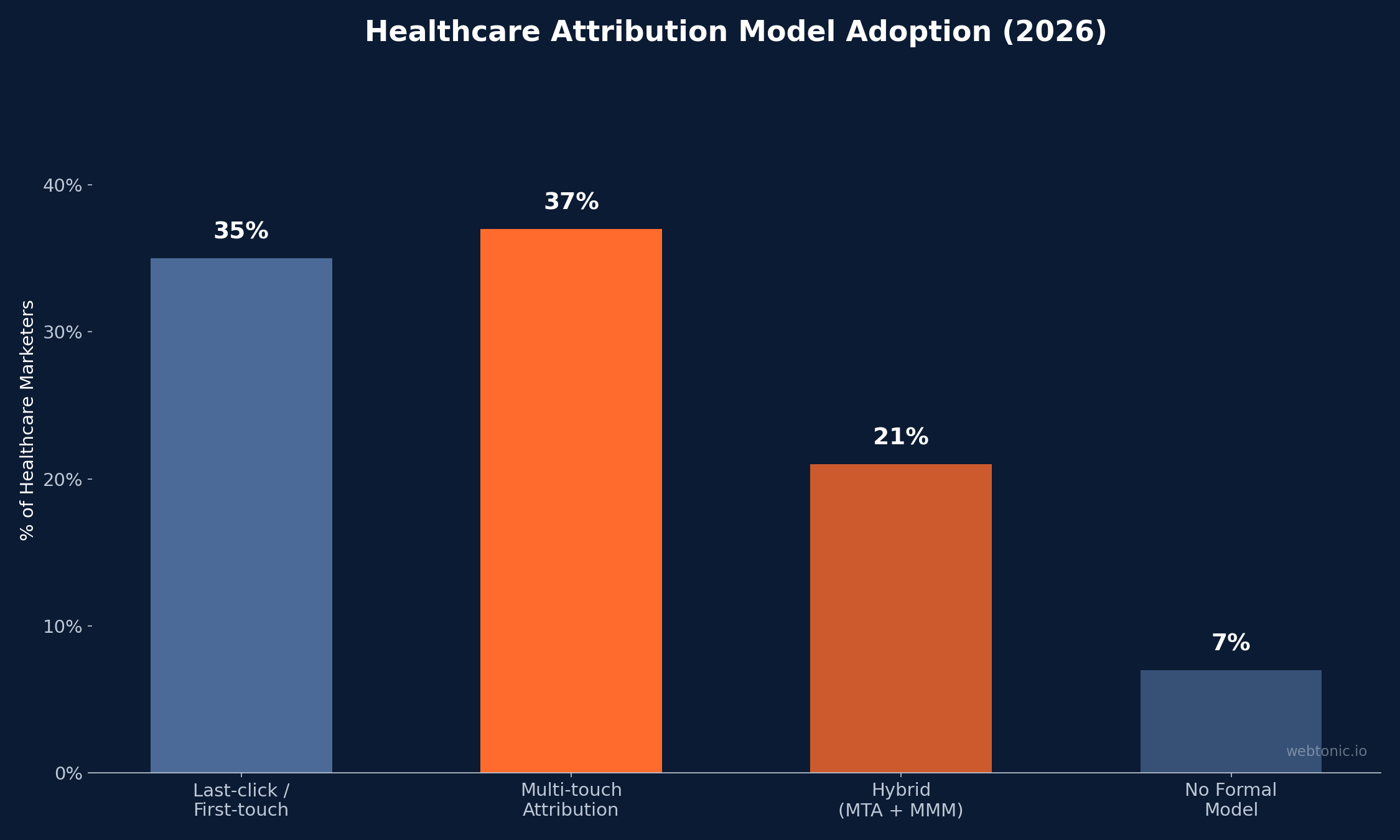
- 37% have moved to multi-touch attribution, while only 21% use hybrid models combining media mix modeling with digital attribution (Freshpaint 2026).
- Over 60% of fertility consultations start with a phone call, yet only 9% of healthcare organizations integrate call center data into measurement (Freshpaint, Web Tonic).
- HIPAA-compliant attribution with clean signals produces a 20–35% reduction in patient acquisition cost over a 90-day window (Matchnode).
- IVF patient research-to-booking cycles span 3–6 months, requiring 12–18 month attribution windows for accurate ROI measurement (Improvado, Authority Specialist).
- Multi-touch attribution requires >85% patient match rate (CRM to EMR) and >80% phone call tracking coverage to produce reliable results (Improvado).
Healthcare Attribution Model Adoption in 2026
The Freshpaint State of Healthcare Marketing 2026 report, based on survey data from 200 senior healthcare marketing leaders, reveals a fragmented attribution landscape where most organizations still fly partially blind.
| Attribution Model | Adoption Rate | Key Limitation |
|---|---|---|
| Last-click / First-touch | 35% | Undervalues awareness campaigns by 40–60% |
| Multi-touch Attribution | 37% | Requires clean cross-channel data integration |
| Hybrid (MTA + MMM) | 21% | Highest accuracy, highest implementation cost |
| No formal model | 7% | No spend-to-outcome visibility |
Source: Freshpaint 2026
Fertility Clinic Attribution Benchmarks
Fertility marketing has unique attribution challenges: high patient lifetime values ($15,000–$25,000+ per cycle), emotional multi-month research journeys, and a mix of online and offline conversion points that break standard digital-only tracking. These benchmarks reflect what leading clinics actually measure.
| Metric | Benchmark | Source |
|---|---|---|
| Avg. research-to-booking cycle | 3–6 months | Authority Specialist |
| Google Ads conversion rate | 6.8% | Benchmarketing 2026 |
| Google Ads CPA | $112 | Benchmarketing 2026 |
| Meta Ads ROAS | 2.8× | Benchmarketing 2026 |
| Phone call share of consultations | 60%+ | Web Tonic |
| Combined Google + SEO ROAS | 8.2× | Tandem Medical |
| Last-click awareness undervaluation | 40–60% | ICG Consulting |
| IVF cycle revenue | $15K–$25K | Medical Marketing Firm |
The Healthcare Measurement Visibility Gap
The disconnect between marketing spend and measurable outcomes is wider in healthcare than in most industries — and fertility clinics feel it acutely due to HIPAA constraints on pixel-based tracking.
- 59% of healthcare marketers can only connect 10–25% of their spend to real patient outcomes (Freshpaint 2026).
- Only 9% integrate call center data into their marketing measurement — a critical blind spot when 60%+ of fertility consultations start with a phone call (Freshpaint).
- 64% of healthcare marketers struggle to prove ROI to leadership (Freshpaint).
- Google does not offer Google Analytics with a BAA, meaning HIPAA-regulated entities must avoid sending PHI to Google via Analytics (Oyova).

Multi-Touch Attribution for Fertility Clinics
Single-touch attribution fails fertility marketing because the patient journey involves 8–15 touchpoints over months before a consultation booking. Here is what the data says about model accuracy and requirements.
- Multi-touch attribution requires >85% patient match rate (CRM to EMR) and >80% phone call tracking coverage to produce reliable results — lower coverage creates larger blind spots than single-touch models (Improvado).
- Omnichannel attribution with EMR integration needs 12–18 month attribution windows to capture lagged brand campaign effects on patient volume (Improvado).
- HIPAA-compliant attribution with clean conversion signals produces a 20–35% reduction in patient acquisition cost over a 90-day window (Matchnode).
- 60–75% of fertility patient journeys begin with informational search queries, making first-touch models miss the true awareness drivers (Authority Specialist).
IVF Channel Mix and Conversion Attribution
Understanding which channels drive actual consultations — not just clicks — is the core challenge. ICG Consulting's operational data from active IVF campaigns shows how conversion volume splits by channel, and why last-click models distort the picture.
| Channel | Conv. Share | ARPU Profile | Last-Click Bias |
|---|---|---|---|
| Meta Ads | 45% | Single cycles, lower SEC | Over-credited at bottom of funnel |
| Google Search Ads | 20% | 2–3 cycle packages, higher ARPU | Over-credited by last-click |
| Organic (SEO + Direct) | 35% | Mixed — brand + informational | Heavily under-credited |
Clinics investing in both growth marketing and organic content need data-driven or hybrid attribution to see the true contribution of each channel.
Call Tracking and Offline Attribution
Fertility clinics depend on phone conversations more than most healthcare verticals. Over 60% of consultations start with a call, yet most marketing measurement systems treat phone traffic as unattributable.
- LIV Fertility Center implemented GA4 with UTM tagging, call tracking with duration thresholds, form submission events, and WhatsApp click-to-chat tracking — growing from 35 to 120 qualified leads/month (Tandem Medical).
- A Delhi IVF chain reduced CPL from ₹1,400 to ₹780 (44% decrease) in 90 days by implementing qualified-lead-first attribution that distinguished tire-kickers from genuine consultation bookings (ICG).
- Irresist's fertility call tracking platform identifies missing source attribution where paid phone traffic appears as free, which distorts ROI calculations for fertility paid media (Irresist).
- A Chicago fertility clinic achieved 240% conversion growth after setting up accurate call and form tracking connected to their Google Ads campaigns (Lead Horse).
Best Practices for HIPAA-Compliant Fertility Attribution
- Implement server-side conversion tracking — clean attribution signals give Meta and Google's algorithms real conversion data, producing 20–35% lower patient acquisition costs over 90 days (Matchnode).
- Use call tracking with duration thresholds — a 60-second minimum call duration filters out non-consultations and gives bidding algorithms higher-quality signals.
- Integrate CRM with EMR data — achieve the >85% patient match rate threshold required for reliable multi-touch attribution (Improvado).
- Set 12–18 month attribution windows — fertility patients research for 3–6 months and may not start treatment for another 6+ months after first contact.
- Use incrementality tests — the 21% of organizations using hybrid MTA + MMM models can detect lagged effects of brand campaigns on patient volume 6–18 months later (Freshpaint, Improvado).
- Track WhatsApp and chat attribution — critical for international patients and performance creative campaigns driving messaging-based inquiries (Tandem Medical).
Attribution Investment vs. ROI by Healthcare Specialty
| Specialty | Typical Marketing ROI | Avg. CPA | LTV Window |
|---|---|---|---|
| Fertility / IVF | 2.8–8.2× ROAS | $74–$118 CPL | Multi-cycle, 1–3 years |
| Primary Care | 2.4–4.1× ROAS | $180–$420 CPA | 3-year repeat visits |
| Orthopedics | 3.1–5.0× ROAS | $200–$500 CPA | Single procedure + rehab |
| Dental | 3.0–5.5× ROAS | $150–$350 CPA | Ongoing 6-month visits |
Sources: Improvado, Tandem Medical, Benchmarketing
Building the Fertility Clinic Attribution Technology Stack
A complete attribution stack for fertility clinics requires integration across multiple data sources. The complexity increases because HIPAA compliance restricts standard pixel-based tracking that other verticals take for granted. Here is what leading clinics deploy.
- Server-side conversion APIs replace browser pixels — Meta's Conversions API and Google's Enhanced Conversions send first-party data from the server without exposing PHI in browser traffic. Clean server-side signals produce 20–35% lower patient acquisition costs within 90 days (Matchnode).
- Call tracking with dynamic number insertion assigns unique phone numbers per channel, campaign, and landing page. With 60%+ of fertility consultations starting via phone, this closes the largest attribution gap. Duration thresholds (typically 60+ seconds) filter non-consultations from qualified leads.
- CRM-to-EMR integration connects marketing touchpoints to clinical outcomes — actual treatment starts, not just consultation bookings. This achieves the >85% patient match rate threshold that Improvado identifies as the minimum for reliable multi-touch attribution.
- UTM tagging with consistent taxonomy across Google Ads, Meta, email, and organic ensures every touchpoint feeds into a unified attribution model. Tandem Medical's implementation for LIV Fertility Center included cross-domain tracking to follow patients from informational content to booking forms across subdomains.
- Consent management platforms are now mandatory — HIPAA-regulated fertility clinics must implement consent banners that manage data sharing preferences before any tracking fires. Organizations without proper consent frameworks risk $50,000+ per HIPAA violation in enforcement actions.
Common Attribution Mistakes in Fertility Marketing
Even well-resourced fertility clinics make systematic attribution errors that distort marketing ROI calculations and lead to budget misallocation.
- Using single-visit revenue instead of lifetime value — an IVF patient's LTV extends across multiple cycles ($30,000–$75,000+), egg freezing add-ons, and medication revenue. Measuring only the first cycle undervalues acquisition spend by 60–80% (Improvado).
- Ignoring WhatsApp and messaging attribution — for clinics serving international patients, WhatsApp inquiries can represent a significant share of qualified leads. LIV Fertility saw WhatsApp inquiries grow 5× after implementing click-to-chat tracking (Tandem).
- Treating all phone calls equally — without duration thresholds and call scoring, marketing attribution counts scheduling calls and spam alongside genuine consultation inquiries. This inflates conversion counts and deflates true CPA.
- Relying on in-platform reporting alone — Google Ads and Meta each claim credit for conversions based on their own attribution model. Without an independent measurement layer, fertility clinics often double-count 20–30% of conversions when summing platform reports.
- Attribution windows that are too short — a 7-day or 28-day window misses the 3–6 month research cycle typical of fertility patients. Extending windows to 12–18 months captures the full impact of awareness campaigns on downstream conversions.
Frequently Asked Questions
What attribution model works best for fertility clinics?
Hybrid models that combine multi-touch attribution with media mix modeling produce the most accurate results for fertility marketing. The 21% of healthcare organizations using hybrid models can detect lagged brand campaign effects on patient volume 6–18 months later, which is critical given the 3–6 month IVF research-to-booking cycle.
Why is last-click attribution problematic for IVF marketing?
Last-click attribution undervalues awareness campaigns by 40–60% in fertility marketing because patients interact with 8–15 touchpoints over months before booking. It over-credits Google Search Ads and under-credits Meta, organic content, and brand campaigns that drive the initial research phase.
How does HIPAA affect fertility clinic marketing attribution?
HIPAA restricts pixel-based tracking on patient-facing pages. Google does not offer Google Analytics with a Business Associate Agreement, so HIPAA-regulated fertility clinics must use server-side tracking, consent management, and HIPAA-compliant attribution platforms to avoid sending protected health information to ad platforms.
What percentage of fertility consultations start with a phone call?
Over 60% of fertility consultations begin with a phone call, yet only 9% of healthcare organizations integrate call center data into their marketing measurement. Implementing call tracking with duration thresholds is one of the highest-impact attribution improvements a fertility clinic can make.
How much does proper attribution reduce patient acquisition cost?
HIPAA-compliant attribution with clean conversion signals typically produces a 20–35% reduction in patient acquisition cost over a 90-day window. One Delhi IVF chain achieved a 44% CPL reduction by switching to qualified-lead-first attribution that filtered tire-kickers from genuine consultation bookings.
Sources
Freshpaint — State of Healthcare Marketing 2026
Improvado — Healthcare Marketing Attribution Guide 2026
Improvado — Hospital Marketing ROI Measurement 2026
Matchnode — HIPAA-Compliant Attribution for Digital Health
Tandem Medical — IVF Marketing 2026 Playbook
ICG — IVF Google Ads vs Meta Ads Data
ICG — Delhi IVF Chain CPL Reduction Case Study
Authority Specialist — IVF Clinic SEO Benchmarks 2026
Benchmarketing — Fertility Clinics Benchmarks 2026
Oyova — HIPAA-Safe Analytics 2026