Table of contents
Key Takeaways
- Organic search drives 45–60% of total website traffic for high-performing fertility clinics, with mobile searches representing 65–80% of all fertility-related queries (Authority Specialist, 2026).
- Only 24% of healthcare providers fully leverage predictive analytics for patient care, despite 89% naming analytics a top digital transformation priority (Gitnux, 2026).
- Conversion rates from organic search to initial IVF consultations range from 3–8% depending on content depth, with top-3 organic positions capturing 25–35% of all clicks (Authority Specialist).
- CPL-based reporting misleads fertility clinics — a $50 CPL lead that never books costs more than a $200 CPL lead that starts treatment, according to Irresist.io's IVF marketing analytics framework.
- CRM-driven patient retention interventions reduce IVF dropout rates by 15%, recovering an estimated 15 patients/year at $30,000 average cycle revenue for a 100-patient clinic (Novara Fertility).
- Real-time dashboard adoption reached 59% among large US health systems in 2024, up from 41% in 2022 (Gitnux).
- AI search snapshots now impact 15–25% of top-level informational fertility queries, with AI models naming specific providers in only 17% of healthcare responses (Authority Specialist AI Study).
Fertility Clinic Digital Analytics Benchmarks
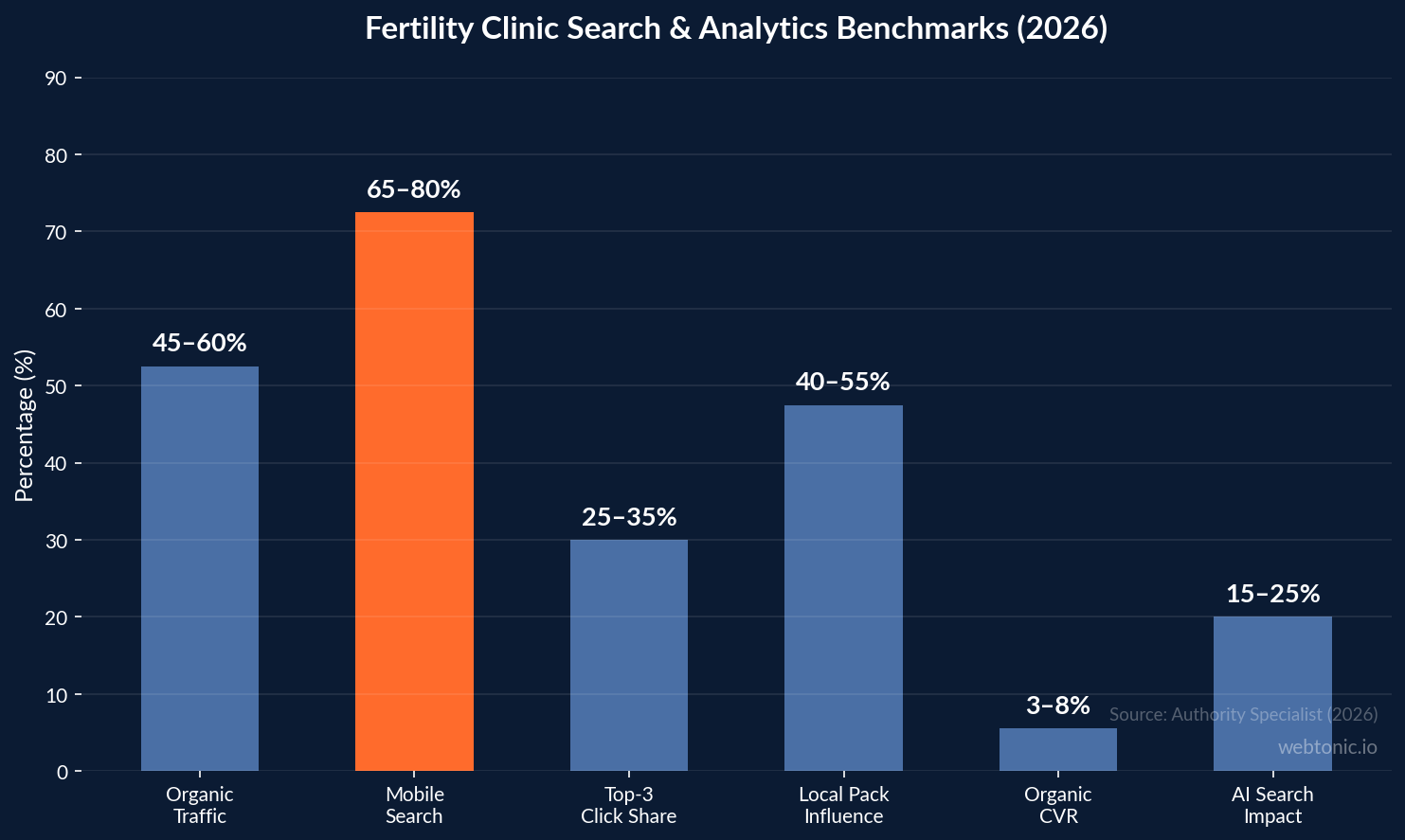
Fertility clinic analytics operate at the intersection of high-value patient journeys, HIPAA compliance constraints, and multi-touch attribution challenges. Based on audits of 34 fertility centers, Authority Specialist (2026) established the definitive search and conversion benchmarks for the IVF sector.
Fertility Clinic Search & Analytics Benchmarks (2026)
| Metric | Benchmark | Context |
|---|---|---|
| Organic Traffic Share | 45–60% | High-performing clinics |
| Mobile Search Volume | 65–80% | Local fertility service queries |
| Organic CVR to Consultation | 3–8% | Depends on content depth |
| Top-3 Organic Click Share | 25–35% | High-intent fertility keywords |
| Local Pack Influence | 40–55% | Local appointment inquiries |
| AI Search Impact | 15–25% | Informational fertility queries |
| AI Provider Recommendation | 17% | Across 120 AI responses |
Healthcare Analytics Industry Landscape
The broader healthcare analytics ecosystem provides critical context for fertility clinic measurement strategies. According to Gitnux (2026), the healthcare analytics industry reveals a sharp split between ambition and execution:
- 89% of healthcare leaders name analytics a top digital transformation priority
- Only 24% of providers fully leverage predictive analytics for patient care
- Big data analytics in healthcare projected to reach $79.23 billion by 2028
- Real-time dashboard adoption at 59% among large US health systems (2024), up from 41% in 2022
For fertility clinics specifically, this gap between analytics ambition and execution is amplified by HIPAA compliance requirements that restrict standard tracking approaches. Improvado (2026) recommends that healthcare systems transition from pixel-based tracking to aggregated spend-and-outcome data post-OCR bulletin, and establish monthly analytics close with the same rigor as financial close — lock data by day 5, publish dashboards by day 7, hold optimization meetings by day 10.
Why CPL Misleads IVF Clinics
Cost per lead is the most commonly tracked marketing metric in fertility clinics — and the most misleading. Irresist.io (2026) makes a compelling case that the most expensive IVF lead is the one that looks cheap in a report and never becomes a patient.
The fundamental analytics framework for fertility clinics should track two metrics instead of CPL:
- Lead-to-patient rate = (patients ÷ leads) × 100 — measures actual conversion through the full patient journey
- Patients per 100 leads = the same result expressed per 100 inquiries — makes comparison across channels intuitive
Irresist.io's IVF Marketing ROI Intelligence framework maps spend to movement layers — lead → booked consult → attended consult → service start — with proof at each stage. A $50 CPL lead that never books a consultation costs the clinic more than a $200 CPL lead that starts an IVF cycle at $15,000–$25,000. The analytics infrastructure must track this entire journey to produce meaningful ROI calculations.
Patient Journey Attribution for Fertility Clinics
IVF patient acquisition is among the most complex attribution challenges in healthcare marketing. Patients research for 3–12 months before scheduling a consultation, touching multiple channels across dozens of sessions. Healthcare systems must now prove marketing attribution in a privacy-first world where traditional multi-touch models conflict with HIPAA requirements and cookie deprecation.
The practical attribution framework for fertility clinics requires:
Fertility Clinic Attribution Model Components
| Component | Purpose | Implementation |
|---|---|---|
| First-Touch Tracking | Identify awareness channel | UTM parameters + GA4 user acquisition |
| Multi-Session Tracking | Map research journey | GA4 user-scoped properties (HIPAA-safe) |
| Lead Source Attribution | Connect lead to channel | CRM integration with source field |
| Consultation Tracking | Measure booked → attended | EMR/CRM sync, call tracking |
| Cycle Start Attribution | Connect marketing to revenue | Closed-loop CRM reporting |
| LTV Tracking | Measure multi-cycle value | Patient lifetime value modeling |
Irresist.io's GA4 guide for IVF clinics provides fertility-specific GA4 configuration, emphasizing that standard e-commerce tracking models do not capture the IVF patient journey. The 3–12 month research cycle means that last-click attribution dramatically undervalues awareness channels like Meta Ads and content marketing while overvaluing bottom-funnel search.
CRM Analytics and Patient Retention
Patient dropout is the largest revenue leak in fertility clinics, and CRM analytics are the primary tool for measuring and reducing it. Novara Fertility (2026) provides full attribution from lead source through initial consult to cycle start, and their retention data reveals the economic impact of analytics-driven interventions:
- 15 patients retained per year from reduced dropout
- Baseline IVF dropout rate: 54%
- 15% dropout reduction with engagement intervention
- $30,000 average cycle revenue per retained patient
- Estimated annual recovery: $450,000 for a 100-patient clinic
Q-Reviews (2026) argues that CRM and patient relationship management are becoming foundational in IVF, with measurable outcomes including higher consultation-to-cycle conversion, reduced patient dropout between cycles, and improved patient satisfaction scores. The analytics layer tracks open rates, engagement scores, and drop-off points in the patient communication sequence.

AI Search Visibility and Analytics
AI-generated search results are creating a new analytics dimension for fertility clinics. The Authority Specialist AI Study (2026-07), based on 40 standardized healthcare questions tested across 3 AI models (ChatGPT, Claude, Gemini), reveals concerning patterns for fertility providers:
- AI search snapshots impact 15–25% of top-level informational fertility queries
- AI models name specific healthcare providers in only 17% of responses (versus 44.2% industry average)
- AI Recommendation Index for IVF clinic SEO marketing: 18.3% — the rate at which AI tells buyers to hire a professional, compared with 44.2% industry average (−25.9 percentage points)
The model-by-model breakdown shows significant variation: ChatGPT recommends hiring a professional 28% of the time, Claude 13%, and Gemini 15%. For fertility clinics, this means analytics dashboards must now track AI visibility alongside traditional search metrics. Clinics with physician-attributed content and complete medical schema consistently outperform those without in both rankings and click-through rates.
Clinic Software and Data Management
Effective fertility clinic analytics depend on the underlying data infrastructure. ClinIKEHR (2026) identifies five critical analytics and reporting capabilities for modern fertility clinics:
- Cycle success rates by protocol — tracking IVF, IUI, FET, and donor outcomes separately
- Embryo quality trends — longitudinal tracking of blast rates, PGT-A normal rates
- Patient demographics and outcomes — age, diagnosis, and AMH-stratified reporting
- Laboratory performance metrics — fertilization rates, blast rates, cryopreservation success
- Financial performance — revenue per cycle, cost per outcome, marketing ROI
GritWiz (2026) takes this further with decision intelligence for IVF operations, including revenue leakage detection (identifying and recovering hidden revenue loss) and executive-ready decision briefings that connect clinical outcomes to business metrics. MOVO-X offers monthly outcome analytics with automated reporting across all fertility treatment protocols.
Best Practices for Fertility Clinic Analytics
- Replace CPL with lead-to-patient rate as your primary marketing metric — track the full journey from lead → booked consult → attended consult → cycle start. A $200 CPL that converts to treatment is worth more than a $50 CPL that never books.
- Implement closed-loop CRM reporting connecting marketing source to cycle start — this is the only way to calculate true marketing ROI in a $15K–$25K per cycle specialty.
- Track patient dropout at every stage — with a 54% baseline dropout rate, a 15% reduction via engagement interventions recovers an estimated $450,000/year for a 100-patient clinic.
- Establish a monthly analytics close process — lock data by day 5, publish dashboards by day 7, hold optimization meetings by day 10, mirroring financial close rigor.
- Monitor AI search visibility alongside traditional rankings — AI snapshots now impact 15–25% of informational fertility queries, and AI models only name specific providers 17% of the time.
- Use GA4 with HIPAA-compliant configuration — transition from pixel-based tracking to aggregated spend-and-outcome data. Standard e-commerce models do not capture the 3–12 month IVF research journey.
- Implement physician-attributed content with medical schema — clinics with this combination consistently outperform in both rankings and CTR.
- Track multi-location Map Pack impressions separately — multi-location fertility groups with optimized GBPs across all branches generate 2–3× more local impressions than single-profile setups.
Related reading
- Fertility & IVF Email Marketing Statistics: 2026 Benchmarks & Performance Data
- Fertility & IVF Dashboards & Reporting: 2026 Statistics & Benchmarks
- Fertility & IVF Marketing Attribution Statistics: 2026 Benchmarks
- Marketing Analytics services at Web Tonic
Frequently Asked Questions
What percentage of fertility clinic traffic comes from organic search?
High-performing fertility clinics derive 45–60% of total website traffic from organic search, according to Authority Specialist's analysis of 34 fertility centers. Mobile searches account for 65–80% of all fertility-related queries. The top 3 organic positions for high-intent keywords like "IVF clinic near me" capture 25–35% of all clicks.
How should IVF clinics measure marketing ROI?
IVF clinics should replace CPL-based reporting with lead-to-patient rate tracking across the full journey: lead → booked consultation → attended consultation → cycle start. This closed-loop approach connects marketing spend to actual revenue. At $15,000–$25,000 per IVF cycle, a lead that converts to treatment is worth dramatically more than what CPL alone suggests.
What is the patient dropout rate in IVF treatment?
The baseline IVF patient dropout rate is approximately 54%, according to Novara Fertility data. CRM-driven engagement interventions can reduce this by 15%, recovering an estimated 15 patients per year for a 100-patient clinic at $30,000 average cycle revenue — an annual recovery of approximately $450,000.
How do AI search results affect fertility clinic visibility?
AI search snapshots now impact 15–25% of top-level informational fertility queries. However, AI models name specific healthcare providers in only 17% of responses — significantly below the 44.2% all-industry average. Clinics with physician-attributed content and complete medical schema perform better in AI-generated results. The AI Recommendation Index for IVF marketing is just 18.3%.
What analytics tools do fertility clinics need?
Fertility clinics need GA4 with HIPAA-compliant configuration for website analytics, a CRM with lead source attribution tracking through cycle start, call tracking software for phone conversion attribution, and clinic management software (EMR) with outcome reporting by protocol. Real-time dashboards have reached 59% adoption among large US health systems, reflecting the industry shift toward data-driven decision making.
Sources
authorityspecialist.com — IVF Clinic SEO Benchmarks 2026
gitnux.org — Healthcare Analytics Industry Statistics
irresist.io — IVF Marketing Analytics: Why CPL Misleads Clinics
irresist.io — IVF Marketing ROI Proof
novarafertility.com — Fertility Clinic CRM & Retention
q-reviews.com — CRM in IVF
improvado.io — Healthcare Marketing Analytics 2026
clinikehr.com — Data Management in Fertility Clinics 2026
gritwiz.com — IVF Decision Intelligence
movo-x.com — Fertility Clinic Software