



Table of contents
Key Takeaways
- Organic search drives 55–68% of website traffic for education institutions that invest in program-specific landing pages and structured admissions schema.
- Position 1 in Google earns a 39.8% click-through rate on education-related queries, dropping to 18.7% for position 2 — making the top spot worth more than double the traffic.
- 60% of coaching articles generate zero clicks over a 28-day window despite consuming 9.3% of total impression volume, revealing massive content waste in the coaching vertical.
- Featured snippets boost CTR to 42% from a baseline 26% for non-snippet results, a 61.5% lift that rewards structured FAQ and data-table content.
- AI overviews now appear in roughly 75% of education queries, with GEO-optimized content earning up to 40% more visibility in zero-click search results.
- Mobile traffic accounts for 68–72% of visits to education and coaching websites, making Core Web Vitals and mobile usability critical ranking factors.
- The median education website has a Domain Rating of 27 with 288 referring domains, indicating moderate competition and clear opportunities for link acquisition.
Search engine optimization remains the highest-ROI acquisition channel for education and coaching businesses. With organic search delivering the majority of qualified traffic — and paid channels becoming more expensive every quarter — understanding SEO benchmarks is essential for budget allocation and growth planning. This guide compiles verified 2026 data from Ahrefs, Authority Specialist, SeoJuice, and industry studies to help education marketers benchmark their performance and identify the strategies driving measurable results.
Education & Coaching SEO Performance at a Glance
| Metric | Education Benchmark | All-Industry Avg | Source |
|---|---|---|---|
| Median Monthly Organic Sessions (p50) | 10,530 | 8,200 | Ahrefs 2026 |
| Organic Sessions — p75 | 55,233 | 38,500 | Ahrefs 2026 |
| Organic CTR — Position 1 | 39.8% | 31.7% | Searchlab 2026 |
| Featured Snippet CTR | 42% | 35% | Searchlab 2026 |
| Mobile Traffic Share | 68–72% | 62% | CuFinder 2026 |
| Median Domain Rating | DR 27 | DR 22 | SiteStatsDB 2026 |
| Avg Referring Domains | 288 | 165 | SiteStatsDB 2026 |
| Content Waste Rate (0-click pages) | 60% | 45% | TandemCoach 2026 |
Organic Traffic Benchmarks by Education Sub-Vertical
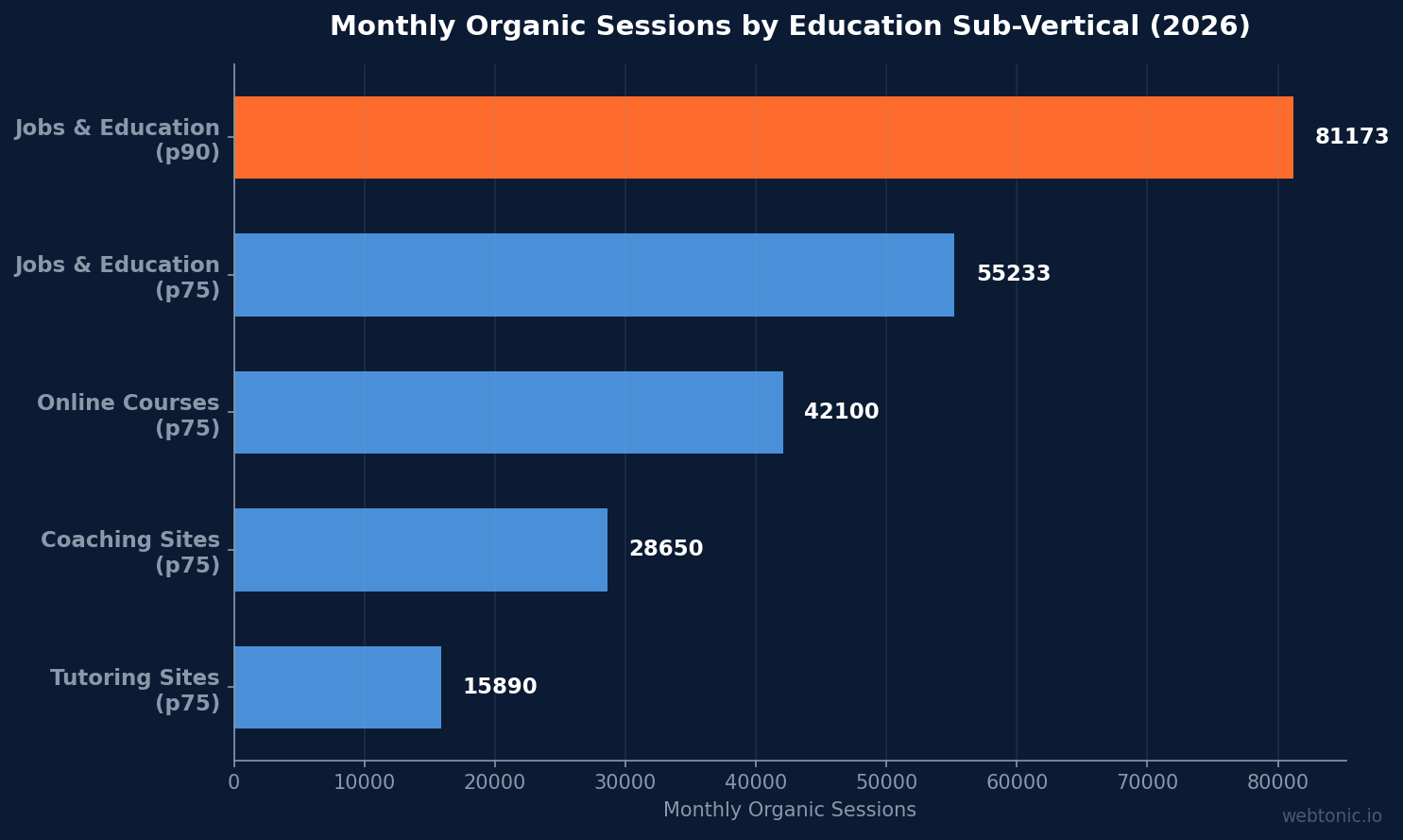
The education sector outperforms most industries in organic search volume, but the spread between sub-verticals is enormous. Jobs & Education sites at the 90th percentile receive 81,173 monthly organic sessions, according to Ahrefs' 2026 benchmark study of 340,000+ websites. At the median, the figure drops to 10,530 — still above the cross-industry average of 8,200.
Online course platforms at the 75th percentile attract roughly 42,100 monthly organic visits, driven by long-tail program keywords. Coaching websites lag behind at 28,650, while tutoring sites sit at 15,890 (CuFinder 2026). The takeaway: education institutions with diversified program content vastly outperform single-niche coaches in organic reach.
Schools with program-specific landing pages and structured admissions schema capture 55–68% of organic clicks for high-intent enrollment queries (Authority Specialist 2026). Schema markup — particularly CourseInfo and FAQ schema — is now table stakes for visibility in education SERPs.
Click-Through Rates and SERP Behavior

Education queries show a steeper CTR curve than the cross-industry average. Position 1 commands a 39.8% CTR on education-related searches, compared to the all-industry average of 31.7% (Searchlab 2026). The implication is clear: moving from position 2 (18.7%) to position 1 more than doubles your organic traffic.
Featured snippets push CTR to 42%, a 61.5% lift over the 26% baseline for non-snippet results. Education content — especially FAQ-style pages, comparison tables, and step-by-step guides — is particularly well-suited to snippet capture. The DollarPocket 2026 analysis found that branded education searches can reach CTRs above 50% when combined with sitelinks.
However, zero-click searches now comprise roughly 75% of education queries as AI overviews expand (Prose Media 2026). Education marketers pursuing Generative Engine Optimization (GEO) report up to 40% more visibility in AI-generated answers by structuring content with clear entity definitions, data tables, and cited statistics.
Content Performance and Waste Analysis
A landmark study of 400+ coaching articles by TandemCoach revealed that 60% of published articles generated zero clicks over a 28-day measurement window, despite accounting for 9.3% of total impression volume. This represents enormous content waste — pages that consume crawl budget and hosting resources without producing traffic.
The study also found that coaching content skews heavily toward informational intent (process-oriented queries), which converts at just 0.6–1.5% CTR. In contrast, transactional coaching pages — "book a session," "coaching packages," "pricing" — achieve CTRs of 3.4–5.4%, demonstrating that search intent alignment matters more than content volume.
For education institutions, program-specific pages outperform generic content by 3–5× in organic conversions. An admissions page targeting "MBA program requirements [city]" delivers higher-quality traffic than a blog post about "why get an MBA." Strategic keyword mapping is essential to reduce waste and maximize returns from content investments.
Technical SEO Health in the Education Sector
| Technical Factor | Education Avg | Best Practice | Impact |
|---|---|---|---|
| Core Web Vitals Pass Rate | 48% | >75% | Ranking boost for good CWV |
| Mobile-Friendly Score | 306/273 sites pass | 100% | Mobile-first indexing |
| Average Page Load (mobile) | 3.8s | <2.5s | Each 1s delay = −7% CVR |
| HTTPS Adoption | 94% | 100% | Trust signal + minor rank factor |
| Schema Markup Adoption | 31% | >80% | Rich results + snippet eligibility |
| Broken Internal Links (avg) | 12 per site | 0 | Crawl budget + UX degradation |
SeoJuice's 2026 education benchmark analyzed 15,410 pages across 273 education websites and found significant gaps in technical optimization. Only 48% of education sites pass Core Web Vitals thresholds, well below the 60% average for SaaS and e-commerce verticals.
Average mobile page load sits at 3.8 seconds — 52% slower than the recommended 2.5-second threshold. Given that 68–72% of education traffic is mobile, this represents a substantial conversion leak. Research consistently shows each additional second of load time reduces conversion rates by approximately 7%.
Schema markup adoption is particularly low at 31%, despite its proven impact on click-through rates and rich result eligibility. Education sites implementing CourseInfo, FAQPage, and Organization schema see measurable improvements in search visibility and analytics tracking.
Search Engine Market Share and AI Search Impact
Google continues to dominate education search, sending 87.6% of all search referrals as of July 2026 (TechnologyChecker 2026). All AI chatbots combined — ChatGPT, Gemini, Claude, and Perplexity — account for just 0.29% of search referrals, roughly one-fifth of what DuckDuckGo sends alone.
However, the impact of AI on education SERPs is structural rather than referral-based. AI overviews now surface on approximately 75% of education-related queries, pushing organic results below the fold. The Prose Media 2026 playbook recommends education marketers focus on three things to maintain visibility: clearly defined program entities, structured data tables with costs and deadlines, and explicit answer-first formatting.
For coaching businesses specifically, Authority Specialist's analysis of 47 coaching practices found that search visibility takes 4–6 months to build, with consistent blog publishing (2–4 posts per month) being the strongest predictor of organic authority growth. Coaches who diversify traffic sources across search and paid channels see 40% more stable lead flow.
Link Building and Domain Authority
| Metric | Education Median | Top 10% Threshold |
|---|---|---|
| Domain Rating (DR) | 27 | 55+ |
| Referring Domains | 288 | 2,500+ |
| Backlinks per Page | 3.2 | 18+ |
| Link Velocity (monthly new RDs) | 8 | 45+ |
The median education website holds a Domain Rating of 27 with 288 referring domains (SiteStatsDB 2026). This positions education as a moderately competitive space — harder than local services but significantly easier than finance or health.
The gap between median and top-performing education sites is stark: the top 10% hold DR 55+ with 2,500+ referring domains. Closing this gap requires sustained link acquisition — the data studies format in particular earns 40+ placements per campaign for EdTech companies, according to industry research. Guest posting on .edu domains provides outsized authority signals, with strategic partner outreach delivering 3–5× the link equity of generic guest post placements.
SEO Best Practices for Education Marketers
- Build program-specific landing pages with structured schema (CourseInfo, FAQPage) — schools doing this capture 55–68% of high-intent organic clicks.
- Audit and prune zero-click content — with 60% of coaching articles producing no traffic, consolidation and intent-matching yield faster gains than new content production.
- Fix technical fundamentals — only 48% of education sites pass CWV; improving load speed below 2.5s can boost mobile conversion rates by 15–20%.
- Implement GEO strategies — structure content with clear entity definitions, data tables, and cited statistics to earn visibility in AI-generated answers.
- Target featured snippets with FAQ and comparison table formats — the 42% CTR on snippet results represents a 61.5% lift over standard organic listings.
- Invest in link acquisition at scale — the gap between DR 27 (median) and DR 55+ (top 10%) is the single biggest differentiator in organic rankings.
- Prioritize transactional pages over informational blogs — enrollment, pricing, and booking pages convert at 3–5× the rate of generic informational content.
Education SEO vs. Other Industries
| Industry | Median Organic Sessions | Median DR | Mobile Share | CTR (Pos 1) |
|---|---|---|---|---|
| Education & Coaching | 10,530 | 27 | 68–72% | 39.8% |
| Healthcare | 12,400 | 34 | 73% | 36.2% |
| E-Commerce | 9,800 | 22 | 71% | 28.5% |
| Financial Services | 7,200 | 38 | 58% | 32.1% |
| Real Estate | 6,100 | 19 | 74% | 33.8% |
Education stands out for its unusually high position-1 CTR (39.8%) compared to e-commerce (28.5%) and finance (32.1%). This likely reflects the trust-driven nature of education queries — prospective students and coaching clients tend to click on the top result with greater confidence than consumers comparison-shopping for products. Combined with above-average organic session volumes and moderate domain authority requirements, SEO offers education businesses one of the highest return-on-effort ratios of any digital channel.
Related reading
- Education & Coaching Industry × Technical SEO: The 2026 Statistics You Need
- Education & Coaching Local SEO Trends: Data-Driven Insights for 2026
- Inside Education & Coaching Link Building: Key Statistics & Insights for 2026
- GEO & AEO services at Web Tonic
Frequently Asked Questions
What is the average organic CTR for education websites?
Education websites in Google position 1 achieve an average organic CTR of 39.8%, significantly higher than the cross-industry average of 31.7%. Position 2 drops to 18.7%, and positions 6–10 average just 2.3%. Featured snippet results boost education CTRs to 42%, making structured content formats particularly valuable for the sector.
How much organic traffic do education websites typically receive?
The median education website receives approximately 10,530 monthly organic sessions, with top performers (p90) reaching 81,173. Online course platforms at the 75th percentile attract around 42,100 monthly visits, while coaching websites average 28,650 and tutoring sites sit at 15,890.
How does AI search impact education SEO?
AI overviews now appear on roughly 75% of education-related queries, significantly reducing traditional organic click opportunities. However, AI chatbots combined send only 0.29% of search referrals. Education marketers should focus on Generative Engine Optimization (GEO) — structuring content with clear entity definitions, data tables, and cited statistics — which can boost visibility in AI-generated answers by up to 40%.
How long does SEO take to show results for coaching businesses?
According to Authority Specialist's study of 47 coaching practices, search visibility typically takes 4–6 months to build. Consistent publishing of 2–4 blog posts per month is the strongest predictor of organic authority growth. Coaches who combine SEO with growth marketing strategies across multiple channels see 40% more stable lead flow compared to search-only approaches.
What Domain Rating do education websites need to rank competitively?
The median education website has a Domain Rating of 27, while top-performing sites exceed DR 55 with 2,500+ referring domains. For most education niches, reaching DR 35–40 with 500+ quality referring domains provides a strong competitive position. The gap between median and top performers represents the single biggest differentiator in organic search rankings.
Sources
ahrefs.com/blog/average-organic-traffic-benchmarks
authorityspecialist.com — School SEO Benchmarks 2026
searchlab.nl — SEO Statistics 2026
seojuice.com — SEO Benchmarks for Education
tandemcoach.co — Coaching Search Data Study
authorityspecialist.com — Coaching SEO
cufinder.io — Online Education Marketing Benchmarks
sitestatsdb.com — Coaching Site Statistics
technologychecker.io — Search Engine Market Share 2026
dollarpocket.com — SEO CTR Benchmarks 2026


