



Table of contents
Facebook ads reach over 3 billion monthly active users, but Meta's Andromeda algorithm now reads your creative to decide who sees it. Your ad copy is your primary targeting lever — not the audience settings you choose in Ads Manager.
Key Takeaways
- Average Facebook CPC dropped to $0.70 for traffic campaigns in 2025–2026, down from $0.77 the year before (Visible Factors).
- Lead generation campaigns cost $1.92 per click on average — nearly 3× the traffic campaign CPC.
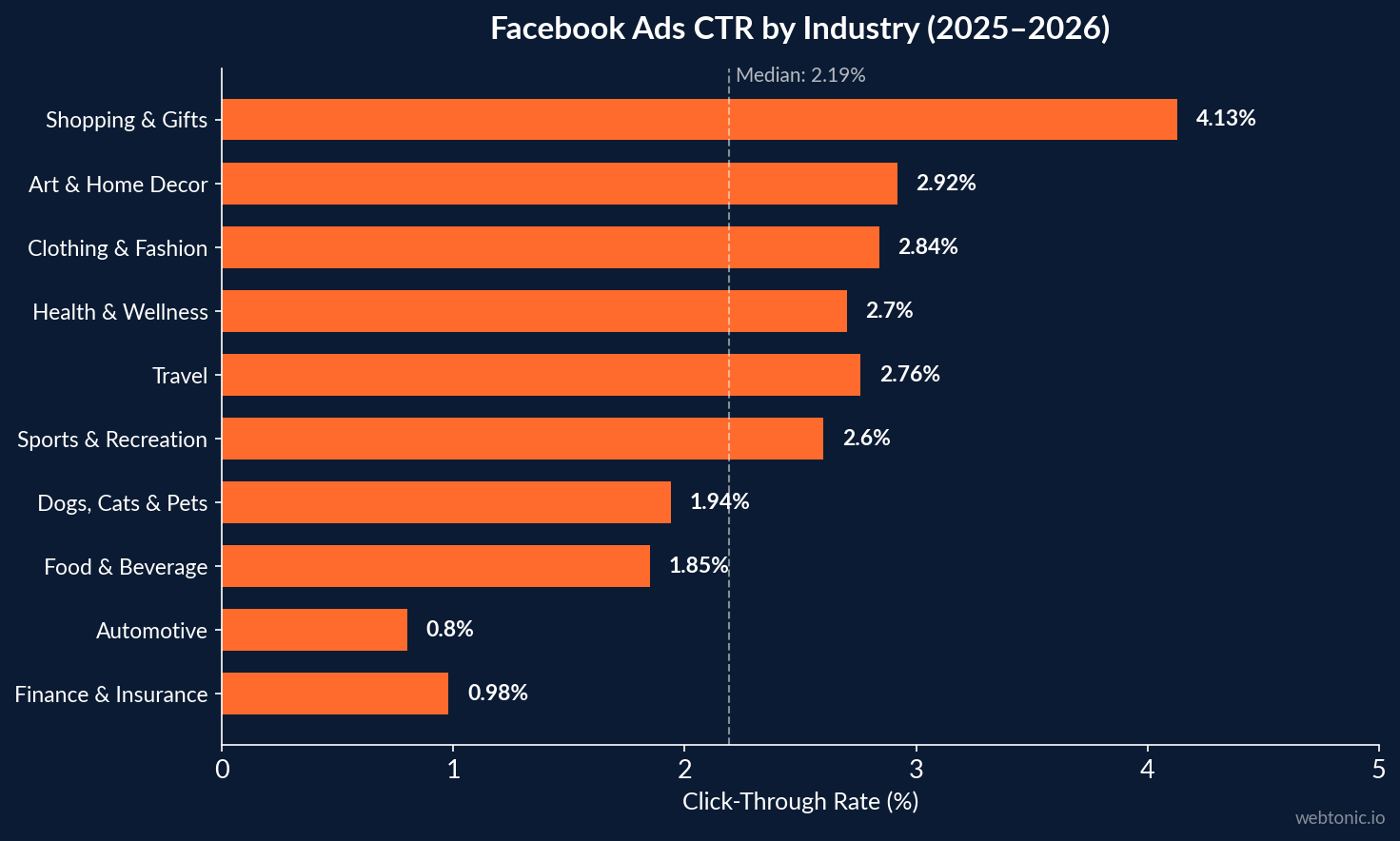
- Median CTR across all industries is 2.19%, with Shopping, Collectibles & Gifts leading at 4.13%.
- Median CPM is $13.48, reflecting a more competitive auction environment heading into 2026.
- Carousel ads cut CPC by 20–30% and CPA by 30–50% compared to single-image ads.
- Static images still drive 60–70% of Meta conversions — video is not always the answer.
- 12 of 15 industry verticals posted year-over-year ROAS improvements in 2025, even as CPMs rose.
- Median ROAS across industries sits at 1.93×, with top-performing verticals exceeding 3×.
- Advantage+ audience targeting lowers cost per conversion by double digits compared to manual targeting alone (Hootsuite, 2026).
- Campaigns need at least 50 conversion events to exit the learning phase — editing before that resets the clock.
- Lookalike audiences built from value-based custom audiences outperform interest-based targeting for finding high-value prospects.
- Retargeting should get 10–15% of total account budget, separated into its own campaign.
Facebook Ads Benchmarks You Need to Know
Before you change anything in your Facebook ads strategy, benchmark your current performance against what the rest of the market is doing. These numbers come from Visible Factors' 2026 benchmark analysis of thousands of ad accounts across 15 industries.
| Metric | All-Industry Average | Best-Performing Vertical |
|---|---|---|
| CTR | 2.19% | Shopping & Gifts: 4.13% |
| CPC (Traffic) | $0.70 | Shopping & Gifts: $0.34 |
| CPC (Lead Gen) | $1.92 | Sports & Recreation: $0.81 |
| CPM | $13.48 | Arts & Entertainment: $8.21 |
| ROAS | 1.93× | Clothing & Fashion: 3.2× |
| CVR | 8.25% | Health & Wellness: 12.4% |
If your Facebook ads CPC is well above $1.92 for lead gen or your CTR sits under 1.5%, you likely have a creative or targeting problem — not a budget problem. The data shows that higher spend does not automatically fix poor ad performance.
Audience Targeting: How to Choose the Right People
Facebook targeting has evolved into four layers, each suited to a different campaign objective. Understanding when to use each one is the difference between wasting budget and finding customers who actually buy.
Core Audiences (Demographics and Interests)
Core audiences let you filter by demographics, interests, and behaviors. Combining demographics and interests gives the algorithm sharper signals about who your ideal buyer is. This is detailed targeting — and it is still useful for niche products where interest signals are strong. However, relying solely on demographics and interests limits how quickly Meta's algorithm can optimize delivery. Layer interests carefully: combining "Yoga" with "Small Business Owner" creates a more qualified audience than targeting either one alone.
Custom Audiences (Your First-Party Data)
Facebook custom audiences built from your own customer data work best when the custom audience is based on recent purchase or engagement behavior. Feed your custom audiences fresh data at least monthly — stale lists degrade match rates and waste spend. — email lists, website visitors, app users, and CRM records — are now the most reliable targeting input. Privacy changes reduced third-party data signals, making first-party data your strongest competitive advantage. Upload your customer list, segment by purchase value, and let Meta match against its user graph.
Lookalike Audiences
Lookalike audiences find new people who resemble your best existing customers. The quality of the seed audience determines everything. Value-based lookalike audiences — which weight your highest-spending customers more heavily — consistently outperform basic lookalikes. Start with a 1% lookalike (closest match) and expand to 3–5% only after the smaller audience shows strong performance.
Advantage+ Audience (AI-Powered)
Advantage+ audience targeting uses Meta's machine learning to automatically find high-converting people based on your conversion history, Pixel signals, and past ad interactions. It works best for prospecting campaigns where you have sufficient conversion data for the algorithm to learn from. Use manual targeting for retargeting campaigns and niche audiences where you need precise control over who sees your ads.
| Audience Type | Best For | Key Requirement |
|---|---|---|
| Core (Interests) | Niche products, small budgets | Strong interest signals in your vertical |
| Custom Audiences | Retargeting, retention | First-party data (email lists, CRM, Pixel) |
| Lookalike | Prospecting at scale | High-quality seed audience (≥1,000 customers) |
| Advantage+ | Broad prospecting | ≥50 weekly conversions for algorithm to learn |
Campaign Structure That Actually Scales
The most effective Facebook ads accounts separate cold and warm traffic into distinct campaigns. Mixing audiences that need different messages in the same campaign forces Meta's algorithm to compromise on delivery — and compromises always underperform.
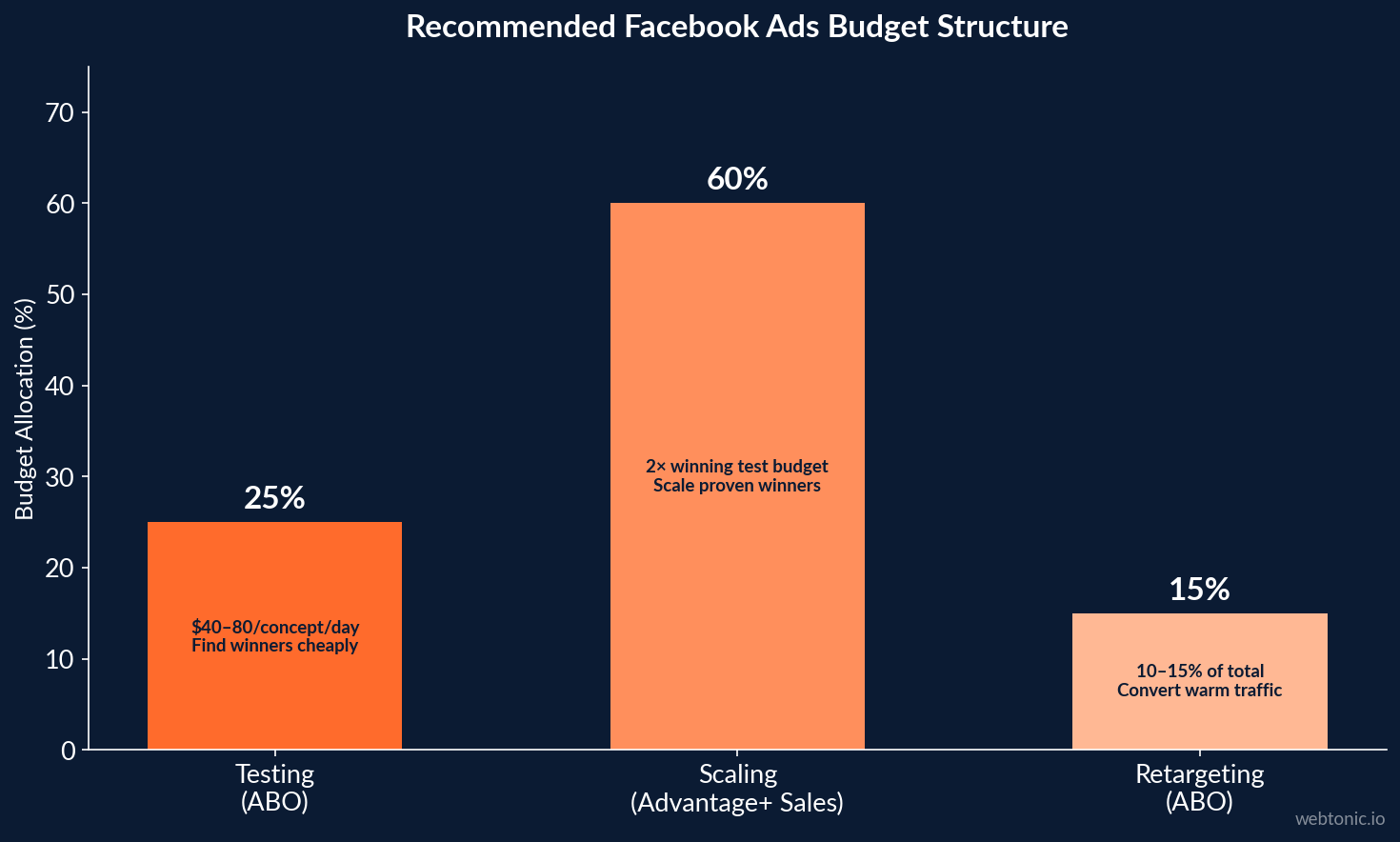
A proven three-campaign structure looks like this:
- Testing campaign (ABO): One ad set per creative concept, 3–5 ads each. Budget of $40–80 per concept per day. The only job is finding winning creative cheaply. Exclude recent site visitors and past purchasers.
- Scaling campaign (Advantage+ Sales/CBO): Graduated winners from testing. Start at 2× the winning test budget. Let Meta distribute spend across consolidated ad sets. Exclude past purchasers and other scaling campaigns.
- Retargeting campaign (ABO): 10–15% of total account budget. Maximum 2–3 ad sets. Segment by behavior — pricing page visitors, trial abandoners, and blog readers each need different Facebook copy and messaging.
Top-of-funnel campaigns focus on reach and creative testing. Mid-funnel campaigns focus on consideration and engagement. Bottom-of-funnel campaigns focus on conversion. This structure ensures budget flows in one direction: test cheaply, promote what wins, then recycle warm demand. HOC Digital Solutions' analysis confirms this three-layer approach works across both lead gen and e-commerce accounts.
Writing Facebook Ad Copy That Converts
Under Meta's Andromeda algorithm, your Facebook copy does double duty: it persuades the viewer and tells the algorithm who to target. Specific, problem-first creative outperforms generic brand messaging because it gives the algorithm a clearer signal about who should see the ad.
Effective Facebook ad copy follows a consistent pattern:
- Lead with the problem, not the product. "Tired of leads that never answer the phone?" beats "We offer lead generation services." The specific pain hooks the right audience.
- Include a clear CTA in the primary text. Don't rely solely on the button. State the action: "Download the free checklist," "Book your demo," or "Shop the collection." A strong CTA removes friction.
- Match copy to funnel stage. Cold audiences need education and trust-building. Warm audiences need urgency and social proof. Retargeted people need a reason to come back now.
- Use numbers and specifics. "2,400 businesses switched to our platform this quarter" is more convincing than "Thousands of businesses trust us." Concrete data builds credibility.
- Keep primary text under 125 characters for mobile — the rest gets truncated behind "See More." Front-load your value proposition.
Test at least 3–5 copy variations per ad set to give the algorithm enough creative diversity. The winning variation often surprises you — which is exactly why you test.
Creative Best Practices: Images, Video, and Carousels
Creative format directly affects your CPC, CTR, and conversion rate. Here is how each format performs based on 2025–2026 data:
- Static images still drive 60–70% of Meta conversions. They load instantly, communicate one idea clearly, and are cheapest to produce. Use high-contrast visuals with minimal text overlay.
- Short-form video needs a 3-second hook — if you don't capture attention in the first 3 seconds, the viewer scrolls past. Square (1:1) or vertical (4:5/9:16) formats outperform landscape. Keep videos under 30 seconds for top-of-funnel campaigns.
- Carousel ads cut CPC by 20–30% and CPA by 30–50% compared to single-image ads. Use them to tell a sequential story, showcase multiple products, or demonstrate a step-by-step process. Each card should have its own headline, image, and link.
Regardless of format, every ad needs creative that earns the click. The best-performing Facebook ads in 2026 share three traits: they look native to the feed, they make one clear promise, and they include social proof (reviews, user counts, or customer quotes).
Budget and Bidding Strategy
Budget decisions should be based on data, not gut feeling. Here is a framework that works across account sizes:
- Start with enough budget to exit the learning phase. Each ad set needs roughly 50 conversion events per week to optimize. If your average CPA is $20, that means $1,000/week minimum per ad set.
- Use Advantage Campaign Budget (CBO) for accounts spending over $5,000/month. CBO lets Meta redistribute budget to the best-performing ad sets automatically.
- Never touch campaigns during the learning phase. Editing the audience, budget (by more than 20%), or creative resets the learning phase and forces the algorithm to start over.
- Scale winning campaigns by 15–20% budget increments. Sudden budget jumps destabilize delivery. Gradual increases let the algorithm adjust without losing optimization signals.
When you open Ads Manager, choose your objective carefully — the objective you select determines which optimization levers Meta surfaces. Cross-reference Ads Manager ROAS against your CRM before making budget decisions. Platform-reported revenue and actual profitability are not the same number — platform ROAS is typically 2.1–3.5× higher than ground truth measured via incrementality tests.
Retargeting: Segment by Behavior, Not Just Visits
Most advertisers create one retargeting audience — "all website visitors, last 30 days" — and call it done. That approach leaves money on the table. Behavioral segmentation is what separates high-performing retargeting from wasted spend.
Segment your retargeting into at least three behavioral buckets. The goal is to target people with messaging that matches their intent level:
- High-intent visitors: Ads people viewed on pricing pages, checkout abandoners, and demo request starters. These people are close to converting and respond to urgency messaging ("Your cart expires in 24 hours").
- Engaged browsers: People who visited multiple pages, spent significant time on site, or viewed specific product categories. These audiences need social proof and benefit-focused messaging.
- Content consumers: Blog readers, video viewers, and social media engagers. These people interact with your brand on social media platforms but have not yet taken a high-intent action. These audiences are earlier in the funnel and respond to educational content and free resources.
Use the Conversions API (CAPI) alongside the Meta Pixel to capture retargeting signals that browser-side tracking misses. CAPI sends conversion data directly from your server, improving match rates by 15–30% compared to pixel-only tracking.
The Facebook Ads Checklist (Before You Launch)
Run through this checklist before hitting publish on any campaign. Skipping even one step can waste your entire testing budget.
| Checklist Item | Why It Matters | Common Mistake |
|---|---|---|
| Meta Pixel + CAPI installed | Tracks conversions; feeds the algorithm | Pixel-only tracking misses 15–30% of events |
| Conversion event selected | Tells Meta what to optimize for | Optimizing for clicks instead of purchases/leads |
| Exclusions configured | Prevents wasting spend on existing customers | No exclusions = paying to reach people who already bought |
| Creative tested | Algorithm needs options to optimize | Launching with just 1 ad per ad set |
| UTM parameters set | Enables cross-platform attribution | Relying solely on Meta-reported conversions |
| Landing page speed | Slow pages kill conversion rates | Sending traffic to a homepage instead of a dedicated page |
Common Facebook Ad Mistakes to Avoid
These mistakes show up in nearly every underperforming account. Eliminate them before optimizing anything else:
- Editing campaigns during the learning phase. This is the single most common mistake. Every significant edit resets the 50-event learning threshold, forcing Meta to re-learn who your best audience is.
- Using broad audiences with no creative differentiation. Broad targeting works when your creative is specific enough to pre-qualify the viewer. Generic creative plus broad targeting equals expensive reach with no conversions.
- Ignoring frequency. When average weekly frequency exceeds 2.0 for prospecting campaigns, creative fatigue sets in. The same people see the same ad too many times, and performance degrades rapidly.
- Mixing cold and warm audiences. Cold audiences need awareness-level creative — a social media marketing fundamental that too many advertisers skip. Warm audiences need conversion-focused messaging. Running them in the same campaign forces one audience to see messaging designed for the other.
- Trusting platform ROAS without cross-referencing. Meta over-reports ROAS by 2.1–3.5× on average. Always compare platform numbers to actual revenue in your CRM or analytics dashboard.
- Not testing enough creative. The algorithm needs variety to optimize. Launch with at least 3–5 ad variations per ad set and rotate fresh creative every 2–3 weeks.
Related reading
- Facebook Ad Sizes and Specs: Every Placement, Ratio and File Type
- Facebook Ad Examples: 24 That Work and Why
- Facebook Ad Copy Examples: 12 Formulas and 8 Rewrites
- Meta Ads Agency services at Web Tonic
Frequently Asked Questions
What are the most effective Facebook targeting options in 2026?
The most effective Facebook targeting options in 2026 are custom audiences built from first-party data (email lists, CRM, Pixel data) and lookalike audiences seeded from your highest-value customers. Advantage+ audience targeting also performs well for prospecting when you have 50+ weekly conversions for the algorithm to learn from. Interest-based targeting still works for niche verticals but is less reliable than data-driven approaches.
How much do Facebook ads cost in 2026?
The average Facebook ads CPC is $0.70 for traffic campaigns and $1.92 for lead generation campaigns across all industries. Median CPM is $13.48. Costs vary significantly by industry — Finance and Insurance averages $1.22 CPC, while Shopping and Gifts averages just $0.34. Your actual cost depends on audience quality, creative relevance, and competition in your vertical.
How do I write Facebook ad copy that drives conversions?
Lead with the specific problem your target customer faces, not your product features. Include concrete numbers and social proof. Keep primary text under 125 characters for mobile visibility. Always include a clear CTA in the copy itself — do not rely only on the button. Test 3–5 copy variations per ad set and let the algorithm identify the winner.
Should I use Advantage+ or manual targeting for Facebook ads?
Use Advantage+ audience for prospecting campaigns where you have sufficient conversion history for Meta's algorithm to optimize delivery. Use manual targeting for retargeting campaigns, niche audiences, or when you need precise control over who sees your ads. Many top-performing accounts use both: Advantage+ for broad prospecting and manual targeting for segmented retargeting.
What is the best Facebook ad format for conversions?
Static images drive 60–70% of conversions on Meta and remain the most reliable format. Carousel ads lower CPC by 20–30% and are ideal for showcasing multiple products or features. Short-form video works well for top-of-funnel awareness when you can capture attention in the first 3 seconds. The best format depends on your offer — test all three and let performance data decide.
Sources
visiblefactors.com/facebook-ads-benchmarks
adadvisor.ai/blog/facebook-ads-best-practices
blog.hootsuite.com/facebook-advertising
blog.hootsuite.com/facebook-ad-targeting
postnitro.ai/blog/post/facebook-carousel-ads
hocdigitalsolutions.co.uk – Meta Ad Account Structure
weboganic.com – Advanced Facebook Targeting Tips
digitalapplied.com/blog/facebook-ads-benchmarks-2026


