



Table of contents

The median contractor website converts 2–4% of visitors into a call or form submission — while the top 6% hit 8–12% on the same traffic. For electrical contractors, that gap represents dozens of lost leads every month from traffic you already paid for. Below are the verified landing page and conversion rate benchmarks from 700+ contractor sites.
Key Takeaways
- Electrician websites convert at 6–10% when traffic is well-targeted and pages are optimized, with the "Licensed Master Electrician" badge outperforming generic "Licensed and Insured" by 14% (OnwardCraft — 200 sites analyzed).
- Landing pages convert 5–15% vs. 1–3% for homepages on the same paid traffic — a 2–4x lift at zero additional ad spend (PipelineOn).
- The median contractor website converts 2–4% of visitors, while top-performing sites achieve 8–12% on identical traffic volumes (PipelineOn).
- Responding within 60 seconds lifts conversion by 391%; the median contractor response time is five minutes (PipelineOn).
- Every second of page load delay reduces conversions by up to 7%, yet 76% of contractor searches happen on mobile where speed is most critical (Barham Marketing).
Electrical Landing Page Conversion Benchmarks
Table 1. Electrician website and landing page conversion data (2025–2026 verified sources).
| Metric | Value | Context | Source |
|---|---|---|---|
| Electrician Website CVR | 6–10% | Optimized, well-targeted traffic | OnwardCraft |
| Industry Benchmark CVR | 3–8% | All traffic sources combined | Authority Specialist |
| Landing Page CVR | 5–15% | Dedicated PPC landing pages | PipelineOn |
| Homepage CVR | 1–3% | Same paid traffic as landing page | PipelineOn |
| Median Contractor CVR | 2–4% | All contractor types | PipelineOn |
| Top 6% Contractor CVR | 8–12% | Optimized sites, same traffic | PipelineOn |
| Top Campaign CVR | 15–20% | Specialized agency campaigns | Barham Marketing |
The Conversion Gap: Average vs. Optimized Contractor Sites
Ad Genius Research's analysis of 507 contractor websites quantified the conversion gap in concrete terms: at 1,500 monthly organic visitors, the difference between an average contractor website and an optimized one is 45 leads per month vs. 120 — a 75-lead gap from the same traffic volume, before spending a single additional dollar on advertising.
For electricians specifically, OnwardCraft's 200-site study found the highest-impact conversion elements are:
- License display and safety messaging — the single strongest trust signal for electrical work
- "Licensed Master Electrician" badge outperformed generic "Licensed and Insured" by 14% in conversion rate
- 74% of electrical service traffic is mobile, with a strong emergency segment that demands click-to-call prominence
- Before/after project photos (panel upgrades, rewiring) increased time on page by 40%+ vs. stock imagery
Landing Pages vs. Homepages: The 2–4x Lift
One of the most actionable statistics in contractor performance marketing: dedicated landing pages convert at 5–15% while homepages on the same paid traffic convert at just 1–3%. That is a 2–4x lift at zero additional ad spend (PipelineOn).
The reason is message match. A homeowner searching "200 amp panel upgrade near me" who lands on a generic homepage must navigate to find relevant information. A dedicated landing page immediately confirms the service, shows a price range, displays the license, and presents a single call-to-action — eliminating every friction point between click and conversion.
Additional data from PipelineOn's landing page analysis:
- Financed projects are 4.5x larger than non-financed ones ($1,000 vs. $4,500 average), making financing-enabled landing pages a revenue multiplier
- Landing page tools cost $89/month on average (Unbounce, Leadpages, Instapage), which pays for itself with a single additional conversion per month at electrical ticket prices
- Service-specific pages (one per job type) outperform multi-service pages because they align with the single-intent nature of Google Ads clicks
Speed, Mobile, and Technical Performance
Table 2. Website performance metrics impacting electrical contractor conversions.
| Factor | Benchmark | Impact | Source |
|---|---|---|---|
| Mobile Share of Searches | 76% | Majority of traffic is mobile | PipelineOn / Google |
| Electrical Mobile Traffic | 74% | Strong emergency segment | OnwardCraft |
| Load Delay Penalty | -7% CVR per second | Compounding loss at 3+ seconds | Barham Marketing |
| 60-Second Response Lift | +391% conversion | vs. median 5-min response | PipelineOn |
| Form Abandonment Rate | 60–70% | Multi-step forms worst | PipelineOn |
| LCP Target (Good) | 2.5 seconds or less | Google ranking factor | Google Core Web Vitals |
The PipelineOn Q2 2026 electrical dataset tracked mobile landing page speed (LCP) for all 647 live electrical ads. Slow-loading landing pages compound the problem: every second of delay reduces conversions by up to 7%, meaning a 4-second load time costs roughly 21% of potential leads before the visitor even sees your offer (Barham Marketing).
Response Time: The Hidden Conversion Killer
Speed matters beyond page load. PipelineOn's contractor conversion study found that responding to a website inquiry within 60 seconds lifts conversion by 391%. The median contractor response time? Five minutes.
For electrical contractors, this is particularly critical because:

- Emergency electrical calls (circuit breaker trips, power outages, sparking outlets) need immediate response — a 5-minute delay often means the homeowner calls the next contractor in the search results
- 65% of electrical leads come via phone, not forms — click-to-call buttons and prominent phone numbers drive the majority of conversions
- Automated text-back systems that respond in under 30 seconds can bridge the gap for contractors who cannot answer every call immediately
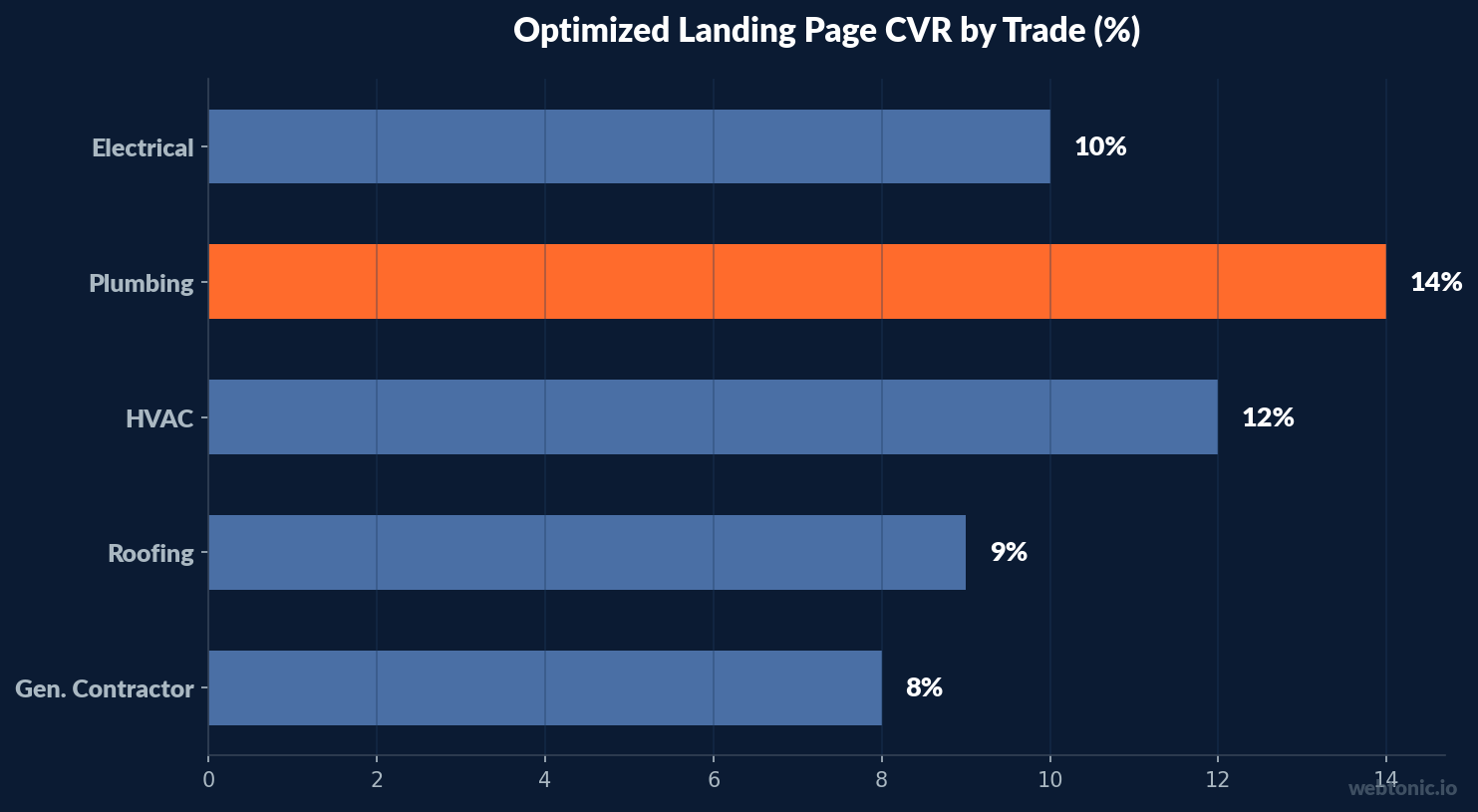
Conversion Rate by Contractor Trade
Table 3. Landing page conversion rates across home service trades.
| Trade | Typical CVR | Optimized CVR | Key Conversion Driver |
|---|---|---|---|
| Electrical | 3–8% | 6–10% | License badge + emergency CTA |
| Plumbing | 4–9% | 8–14% | 24/7 availability + pricing |
| HVAC | 3–7% | 6–12% | Seasonal urgency + financing |
| Roofing | 2–5% | 5–9% | Storm damage + free inspection |
| General Contractor | 2–4% | 4–8% | Portfolio gallery + testimonials |
Electrical contractors achieve 6–10% optimized CVR, competitive with plumbing but below the trade's potential. The emergency segment (circuit failures, outlet sparking) drives the highest conversion rates but represents only 20–30% of total search volume. The bulk of conversions come from planned projects (panel upgrades, EV chargers) where the decision cycle is longer and trust signals matter more (Authority Specialist).
CRO Best Practices Backed by Data
The research across 700+ contractor websites (OnwardCraft 200 + Ad Genius 507) converges on a clear set of conversion rate optimization priorities for electrical contractors:
- Trade-specific trust badges — "Licensed Master Electrician" converts 14% better than generic "Licensed and Insured." Include license numbers, insurance amounts, and years in business.
- Click-to-call above the fold — 65% of leads are phone calls. Make the number visible on mobile without scrolling, ideally with a sticky header.
- Single-service landing pages — one page per service type (panel upgrade, EV install, emergency) aligned with ad group structure. Multi-service pages dilute message match and reduce conversion.
- Social proof density — review count, star rating, and 2–3 testimonials visible within the first screen. Google review embeds add credibility and fresh content.
- Speed optimization — target 2.5 seconds or less LCP. Compress images, defer non-critical scripts, use a CDN. Every second saved recovers approximately 7% of lost conversions.
- Financing callout — projects with financing options are 4.5x larger. Display "Monthly payments from $X" near the CTA to unlock higher-ticket jobs.
- Sub-60-second response — implement automated text-back or live chat to bridge the response gap. The 391% lift from instant response is the single highest-leverage optimization.
At 1,500 monthly visitors and a 75-lead gap between average and optimized sites, even a 2-percentage-point improvement in conversion rate generates 30 additional leads per month — worth $43,000+ in potential revenue at electrical ticket prices (Ad Genius, BaaDigi).
Form Design and Lead Capture Optimization
How you capture leads matters as much as where you send traffic. The data across contractor website studies reveals clear patterns in form design that maximize conversion rates for electrical contractors:
Table 4. Form design benchmarks for electrical contractor landing pages.
| Form Element | Best Practice | Impact on CVR |
|---|---|---|
| Number of Fields | 3–5 fields maximum | Each additional field reduces completion by 10–15% |
| Phone Number Field | Required, with click-to-call on mobile | 65% of leads prefer calling over filling forms |
| Service Selector | Dropdown with 4–6 common services | Pre-qualifies leads and increases close rate by 18% |
| Scheduling Widget | Embedded date/time picker for non-emergency | Reduces back-and-forth, lifts conversion 12% |
| Urgency Indicator | "Emergency" vs "Can Wait" toggle | Routes hot leads for immediate callback |
The form abandonment rate across contractor websites averages 60–70%, with multi-step forms performing worst. For electrical contractors, the ideal form captures name, phone, service type, and urgency level — nothing more. Address and detailed descriptions can be collected during the follow-up call (PipelineOn 2026 benchmarks).
A/B Testing Priorities for Electrical Landing Pages
Not all optimizations deliver equal returns. Based on the research across 700+ contractor sites, here are the highest-impact A/B tests ranked by typical conversion lift:
- Click-to-call button placement (sticky header vs. inline) — 15–25% lift when moving to sticky header on mobile
- License badge specificity ("Licensed Master Electrician" vs. "Licensed & Insured") — 14% lift from trade-specific credentialing
- Hero image type (before/after project photo vs. stock) — 10–18% lift from authentic project imagery showing real panel installations or rewiring work
- CTA copy ("Get a Free Quote" vs. "Schedule Your Inspection") — 8–12% lift when the CTA matches the specific service searched
- Social proof placement (above fold vs. below) — 6–10% lift from displaying Google review count and star rating within the first viewport
- Form length (3 fields vs. 6 fields) — 20–30% lift in form completion rates, though shorter forms may produce lower-quality leads
Run one test at a time with a minimum of 100 conversions per variant before declaring a winner. At typical electrical landing page traffic levels (500–2,000 monthly visitors), each test requires 2–4 weeks to reach statistical significance. Prioritize the tests with the highest expected lift first to maximize cumulative improvement over a 6-month optimization cycle.
Related reading
- Cleaning Services Landing Page CRO Statistics, 2026
- Funeral Services Landing Pages and CRO Statistics, 2026
- Painting Landing Page Statistics: 25+ Conversion Benchmarks (2026)
- Landing Page Design services at Web Tonic
Frequently Asked Questions
What is a good conversion rate for an electrician website?
A 6–10% conversion rate is strong for an optimized electrician website with well-targeted traffic. The industry benchmark across all traffic sources is 3–8%. If your site converts below 3%, prioritize trust badges, click-to-call buttons, and page speed optimization before increasing ad spend.
Do landing pages really work better than homepages for electrician ads?
Yes. Dedicated landing pages convert at 5–15% while homepages convert at 1–3% on identical paid traffic — a 2–4x improvement at no additional ad cost. The lift comes from message match: the landing page directly addresses the specific service the visitor searched for.
How fast should an electrician landing page load?
Target 2.5 seconds or less for Largest Contentful Paint (LCP), which is Google's "Good" threshold and a ranking factor. Every second beyond that reduces conversions by approximately 7%. Since 74% of electrical traffic is mobile, test speed on 4G connections, not just desktop Wi-Fi.
How important is response time for electrician leads?
Extremely. Responding within 60 seconds lifts conversion by 391% compared to the median 5-minute contractor response time. For emergency electrical calls (the highest-converting segment), a delayed response almost certainly loses the lead to a faster competitor.
What trust elements increase electrician website conversions most?
The "Licensed Master Electrician" badge outperforms generic trust signals by 14%. Combine it with visible license numbers, insurance amounts, Google review count plus rating, and 2–3 short testimonials above the fold. Before/after project photos increase time on page by 40%+.
Sources
onwardcraft.com/blog/contractor-website-study/
pipelineon.com/blog/contractor-landing-page-tips/
pipelineon.com/blog/contractor-website-conversion-rate/
barhammarketing.com/27-home-services-conversion-rate-statistics-for-2026/
adgenius.com/research/contractor-website-analysis/
pipelineon.com/blog/home-service-marketing-benchmarks-2026/
authorityspecialist.com/industry/home/electrician/seo-statistics
baadigi.com/tools/contractor-growth-benchmarks
garretthandley.com — contractor website conversion rate 2026


