Table of contents
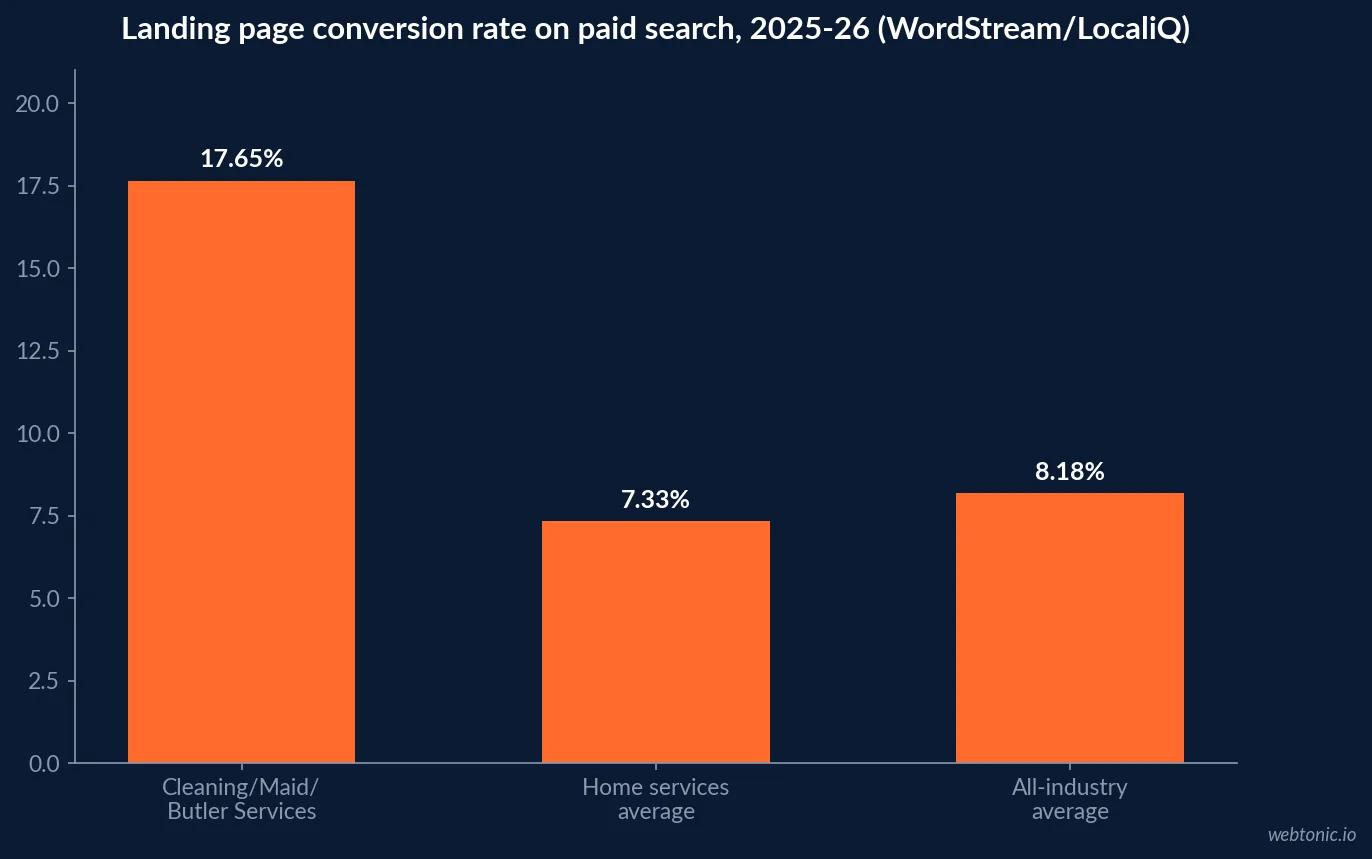
Cleaning/Maid/Butler Services already convert search ads at nearly 2.4 times the home services average. The landing page problem in this category is not weak traffic quality - it is a missing trust layer that leaves an already-strong conversion rate short of its ceiling.
Key Takeaways
- Cleaning/Maid/Butler Services convert at 17.65% on paid search.
- That is against a 7.33% home services category average.
- And an 8.18% average across all industries WordStream tracks.
- Cleaning also posts a 9.01% click-through rate, the second-best in home services.
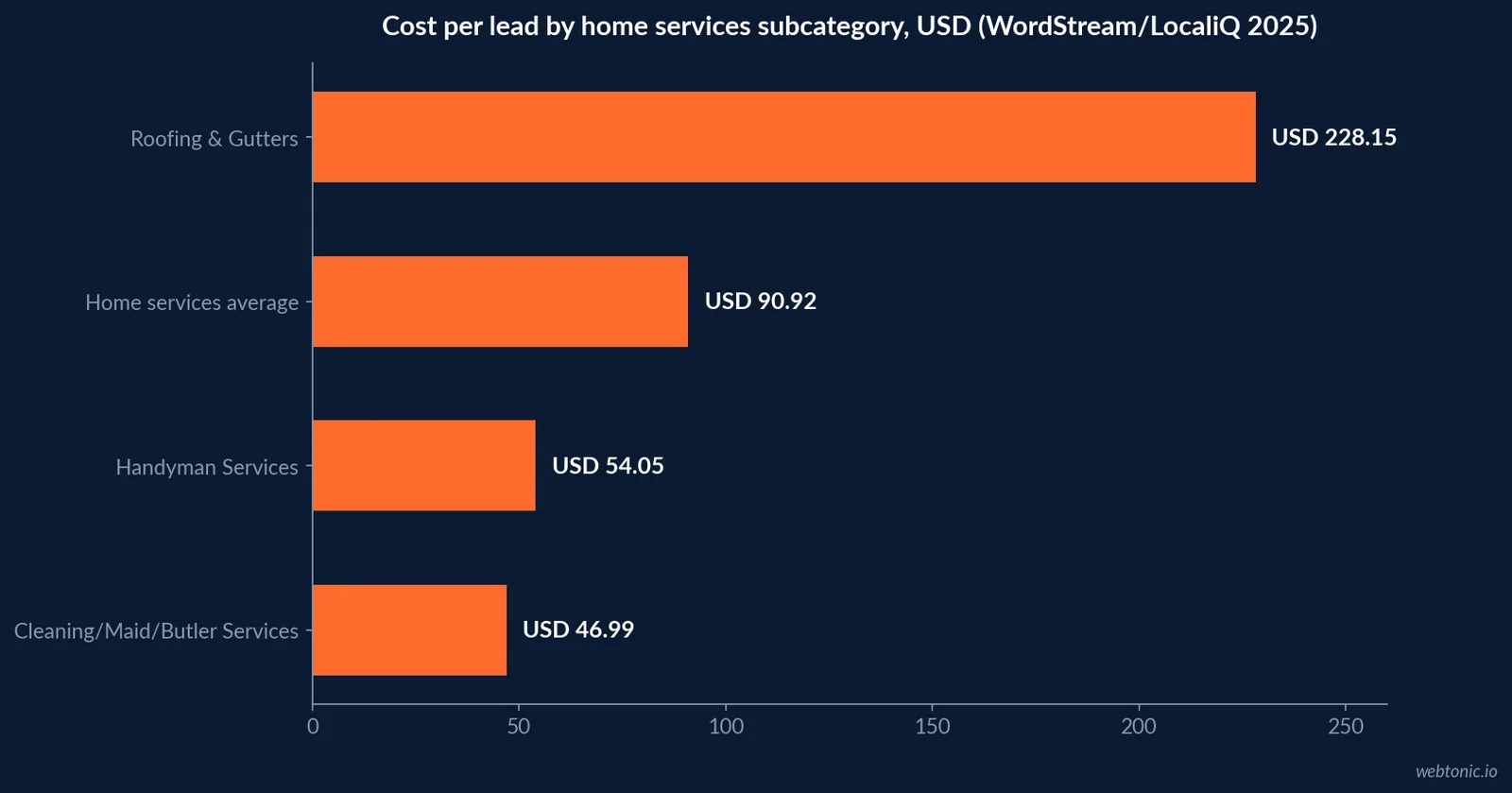
- Cost per lead runs $46.99, the second-lowest in the category.
- That beats the $90.92 home services average by nearly half.
- And the $66.69 all-industry average Google Ads cost per lead.
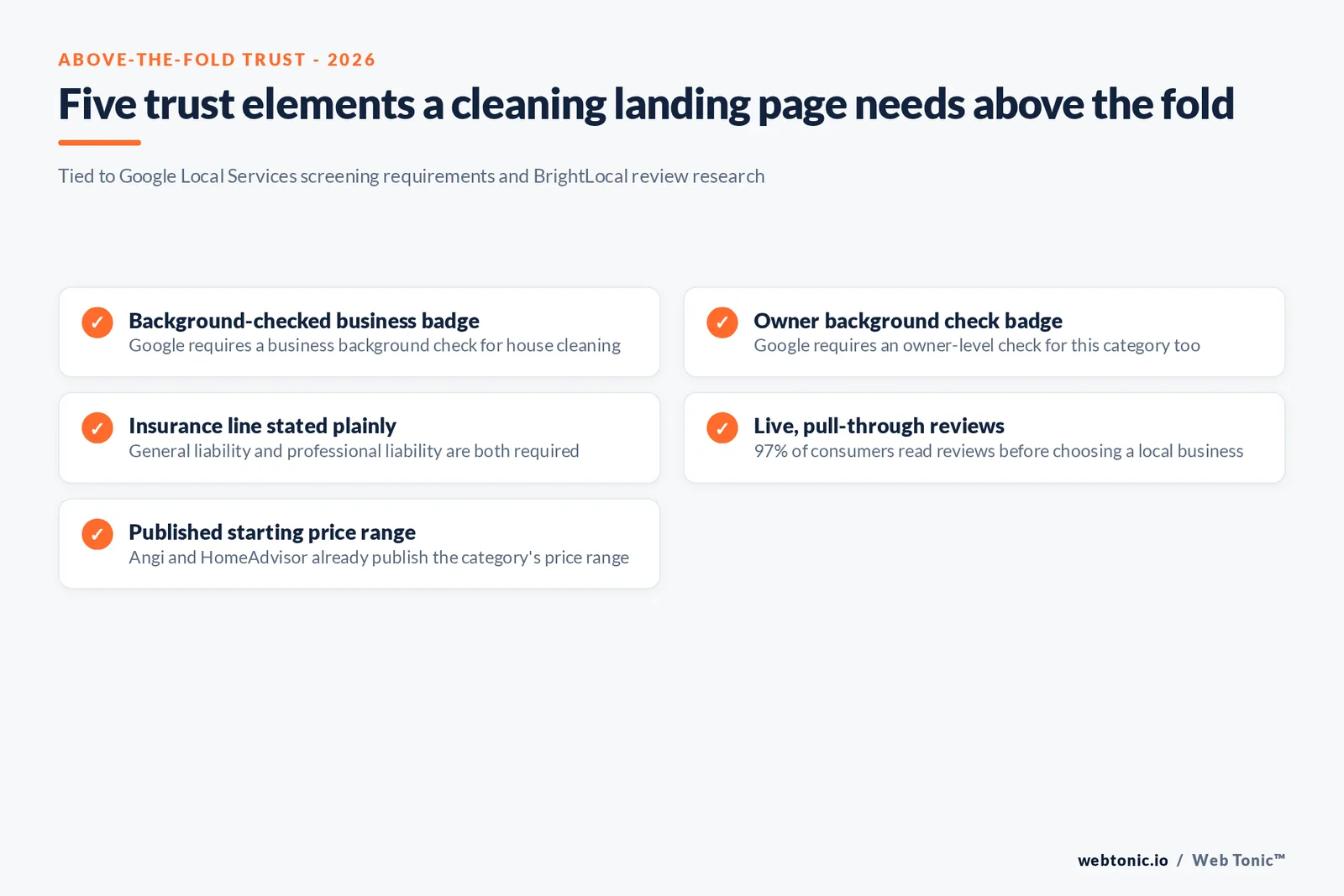
- House cleaning is a background-check-required category on Google Local Services Ads.
- Both the business and the owner must pass screening to run Local Services Ads.
- General liability and professional liability insurance are both required.
- 97% of consumers read reviews for local businesses (BrightLocal, 2026).
- The average consumer checks six review sites before choosing one.
- Standard house cleans commonly run $25 to $90 an hour (HomeAdvisor, 2026).
- The US janitorial market is roughly $112 billion (ISSA, 2026).
- About 1.23 million janitorial businesses compete for that revenue.
- Firm count is growing about 4.2% a year, faster than the 2.7% market growth.
- The FTC's fake-review ban took effect in August 2024 and carries civil penalties.
The benchmark most cleaning landing pages are actually being judged against
WordStream by LocaliQ's 2025 Home Services Search Advertising Benchmarks report breaks Google and Microsoft Ads performance into 16 home services subcategories. Cleaning/Maid/Butler Services posted a 9.01% click-through rate, a 17.65% conversion rate and a $46.99 cost per lead - the best or near-best figure on every metric that measures whether a click turns into a paying customer.
WordStream's separate 2026 Google Ads Benchmarks report, drawn from more than 13,000 US campaigns, puts the all-industry average conversion rate at 8.18% and average cost per lead at $66.69. Cleaning is not merely a good home services category - it beats the market outright.
| Metric (2025-26) | Cleaning/Maid/Butler | Home services average | All-industry average |
|---|---|---|---|
| Click-through rate | 9.01% | 6.37% | 6.64% |
| Conversion rate | 17.65% | 7.33% | 8.18% |
| Cost per lead | $46.99 | $90.92 | $66.69 |
| Source | WordStream/LocaliQ 2025 | WordStream/LocaliQ 2025 | WordStream/LocaliQ 2026 |
Why the conversion rate is high and the ceiling is still open
A 17.65% conversion rate means roughly five out of every six clicks still leave without booking. Home services shoppers researching a $150-$300 recurring clean move faster and take on less risk than someone hiring a roofer, which explains the gap against categories like Construction & Contractors (2.61% CVR) or Roofing & Gutters (3.70%). But speed cuts both ways: a visitor who is ready to decide in under a minute needs the trust signal visible immediately, not after a scroll.
The two objections a first-time cleaning customer actually has - who is entering my home and what happens if something breaks - are answerable in a sentence each, and most category landing pages still bury the answer in an About page instead of the hero.
| Home services subcategory | Conversion rate | Cost per lead | What the buyer is deciding |
|---|---|---|---|
| Cleaning/Maid/Butler Services | 17.65% | $46.99 | Who is entering my home, recurring cost |
| Window Cleaning | 13.58% | n/a | One-off job, ladder/height risk |
| Handyman Services | 13.45% | $54.05 | Scope of the job, one visit or several |
| Doors & Windows Sales | 4.41% | $200.34 | Multi-thousand-dollar purchase, financing |
| Roofing & Gutters | 3.70% | $228.15 | Insurance claim, multi-week project |
What Google already requires a cleaning landing page to be able to prove
Google's own Local Services screening rules single out house cleaning as a category requiring a business background check and an owner background check, plus general liability insurance, professional liability insurance, and business/owner licensing where the state requires it. Those are not marketing claims - they are pass/fail conditions Google's screening partners verify before a Local Services Ad can run at all.
A landing page that restates this credential set in plain language - "background-checked cleaners, insured and bonded" - is not writing copy. It is surfacing verification the business had to earn anyway, which is exactly the reassurance a fast-deciding visitor is scanning for.
| Google Local Services requirement | House cleaning status | What to put on the page |
|---|---|---|
| Business background check | Required | "Background-checked business" badge near the CTA |
| Owner background check | Required | Owner name/photo with the same badge |
| General liability insurance | Required | Coverage amount, insurer name if allowed |
| Professional liability insurance | Required | State plainly, most competitors omit it |
| State business/owner licence | Required where applicable | Licence number in the footer |
The review block is doing more work than the hero image
BrightLocal's 2026 Local Consumer Review Survey, run on a representative panel of 1,002 US adults, found that 97% of consumers read reviews for local businesses and that the average shopper checks six different review sites before choosing one. A cleaning landing page that shows three quote cards and stops has answered less than a sixth of that research behavior.
That has a compliance edge too: the FTC's final rule banning fake reviews and testimonials, effective since August 2024, makes purchased or fabricated review content a civil-penalty risk, not just a credibility problem. Embedding a live, pull-through review widget rather than static hand-picked quotes solves both issues at once.
| Review behavior (BrightLocal 2026, n=1,002 US adults) | Figure | Landing page implication |
|---|---|---|
| Consumers who read reviews before choosing | 97% | Reviews are not optional page furniture |
| Average review sites checked per decision | 6 | Link out to Google/Yelp, do not only embed |
| Consumers who value a recent review | 44% cite recency as top factor | Timestamp every quote |
| Consumers who value owner responses | 37% cite response as a trust factor | Show a reply, even a short one |
Pricing transparency as a conversion lever, not a race to the bottom
Third-party marketplaces already price the category publicly. HomeAdvisor's 2026 cost guide quotes $25 to $90 an hour for house cleaning, depending on home size and condition. A visitor comparing three cleaning sites has usually already seen a number in that range before they land on yours.
Hiding price behind a "request a quote" form when the range is public knowledge adds a step the competitor without that step does not have. A published starting range, paired with the "what changes the price" factors (square footage, frequency, deep-clean add-ons), converts the pricing question into a qualification tool instead of a drop-off point.
Why the fragmentation of the industry raises the stakes on the page
ISSA, the worldwide cleaning industry association, sizes the US janitorial market at roughly $112 billion in 2026, growing about 2.7% a year - but the number of competing firms is growing faster, around 4.2% a year, across an estimated 1.23 million janitorial businesses. Low barriers to entry mean a search results page for "house cleaning near me" is getting more crowded every year, not less.
In a market this fragmented, the landing page is frequently the only differentiator a small or mid-size cleaning company has against a national franchise with a bigger media budget. Trust signals close that gap cheaper than outbidding on cost per click ever will.
| Industry fact (ISSA, 2026) | Figure | Why it matters for the landing page |
|---|---|---|
| US janitorial/cleaning market size | ≈ $112 billion | A large, crowded, easy-to-enter market |
| Market growth rate | ≈ 2.7% a year | Demand is not the bottleneck |
| Growth in competing firms | ≈ 4.2% a year | Supply is growing faster than demand |
| Estimated janitorial businesses | ≈ 1.23 million | Most rivals look identical on paper |
What Google's own Quality Score rewards on this exact page
Google's Quality Score help documentation names three components: expected click-through rate, ad relevance, and landing page experience - defined as how relevant and useful the page is to the person who clicked, including navigation ease and page transparency. A cleaning landing page that buries the service area, price range or credentials behind extra clicks is being scored down on the same signal that determines cost per click, independent of the conversion rate itself.
That means the trust-signal fixes on this page are not only a conversion lever - they can lower the cost of the click that reaches the page in the first place.
Mobile load speed still decides a share of these decisions
Google's Milliseconds Make Millions study, which monitored mobile load times hour-by-hour for 30 days across retail, travel, luxury and lead-generation sites, found that a mere 0.1-second improvement in load time lifted conversion rates measurably across every sector tested, including a 10% conversion increase for travel sites and an 8% increase for retail. It is not a cleaning-specific study, but the underlying mechanism - a fast-deciding mobile visitor abandoning a slow page - applies directly to a category where the average conversion window is already short.
For a lead-generation page like a cleaning company's, the practical takeaway is to treat page speed as part of the trust stack alongside the background-check badge and the review widget, not as a separate technical task.
What homeowners say about price shocks and financing, in their own survey answers
Housecall Pro's 2026 State of Home Service Spending survey of more than 1,100 US homeowners - covering home services broadly, not cleaning alone - found that 68% of homeowners seek additional quotes when a price comes in higher than expected, and that 62% are more likely to move forward with a job when financing or a payment plan is offered. For a recurring cleaning contract quoted above the published $25-$90-an-hour range, both numbers argue for showing the price band up front and offering a flexible first-visit or bundled-frequency rate rather than losing the visitor to a round of comparison shopping.
| Homeowner survey behavior (Housecall Pro 2026, n=1,100+ US homeowners) | Figure | Landing page response |
|---|---|---|
| Seek additional quotes when price is higher than expected | 68% | Publish the range, do not surprise at checkout |
| More likely to proceed when financing/payment plans offered | 62% | Offer a first-clean discount or split payment |
| Willing to pay a premium for 24-hour resolution | 72% | Highlight same-day or next-day booking if offered |
| Would delay or scale back a project due to cost | 77% | Lead with value framing, not just price |
What to test first if the page underperforms its own category
Given a 17.65% category benchmark, a page converting below roughly 12-13% has room that is unlikely to be a targeting problem. Test, in order: the background-check/insurance badge placement above the fold, a live review widget instead of static quotes, a published starting price range, and a single clear CTA repeated at the top and bottom of the page rather than three competing calls to action.
If the landing page sits inside a broader paid search account, our breakdown of how to build a Google Ads strategy and our conversion rate benchmarks across formats are useful next reads before a redesign. Our growth marketing team can also review the funnel end to end.
Frequently Asked Questions
What is a good landing page conversion rate for a cleaning company?
WordStream by LocaliQ's 2025 Home Services Search Advertising Benchmarks puts the average conversion rate for the Cleaning/Maid/Butler Services subcategory at 17.65%, against a 7.33% average across all 16 home services subcategories and an 8.18% average across every industry it tracks in its 2026 Google Ads Benchmarks report. A cleaning landing page converting under 10% is underperforming its own category, not just the market.
Why do cleaning ads convert so much better than plumbing or roofing?
The purchase itself is smaller and more repeatable. WordStream's data shows the same pattern on cost: Cleaning/Maid/Butler Services posted the second-lowest cost per lead in home services at $46.99, against a $90.92 category average and a $228.15 high for Roofing & Gutters. A $150 recurring clean is a lower-commitment decision than a $12,000 roof, so the page has to do less persuading and more reassuring.
What actually needs to be on the page to convert a cleaning lead?
Google's own Local Services Ads screening rules are the checklist. House cleaning is one of the categories requiring both a business background check and an owner background check, general liability insurance, professional liability insurance, and state-level business and owner licensing where it applies. A landing page that states these credentials in plain language is answering the exact question a first-time booker is asking before they hand over a house key.
How much do reviews actually move a cleaning company's conversion rate?
BrightLocal's 2026 Local Consumer Review Survey, a representative panel of 1,002 US adults, found that 97% of consumers read reviews for local businesses and that the average consumer checks six different review sites before choosing one. For a service that enters someone's home, the review block is not decoration on the page - for a large share of visitors, it is the actual conversion moment.
Does the FTC's rule on fake reviews change what a cleaning company can put on its landing page?
Yes. The FTC's 16 CFR Part 465 rule, finalized in August 2024, bans buying or selling fake consumer reviews and testimonials and allows civil penalties against knowing violators. A cleaning landing page cannot display purchased or fabricated five-star quotes; it needs real, attributable reviews pulled from a platform, which is also the format 97% of readers already trust more.
Sources
WordStream by LocaliQ - 2025 Home Services Search Advertising Benchmarks
WordStream by LocaliQ - 2026 Google Ads Benchmarks by Industry
Google Local Services Help - Business screening and verification requirements
BrightLocal - Local Consumer Review Survey 2026
Federal Trade Commission - Final rule banning fake reviews and testimonials
HomeAdvisor - 2026 house cleaning prices
ISSA - The state of the cleaning and facility solutions industry, 2026
Google Ads Help - About Quality Score for Search campaigns
Think with Google - Milliseconds Make Millions mobile speed study
Housecall Pro - State of Home Service Spending 2026