Table of contents
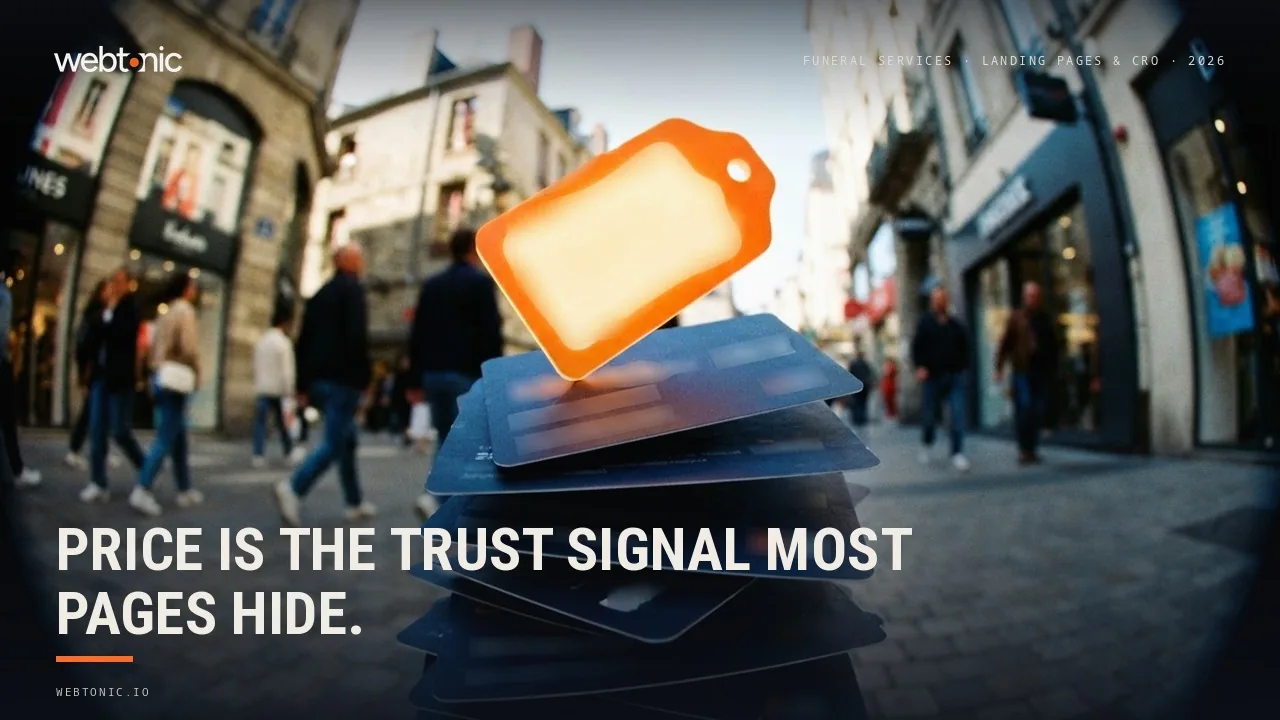
No public study has ever isolated a landing page conversion rate for funeral homes. The two figures that come closest are Unbounce's 6.6% all-industry median (41,000 pages, 57M conversions) and its 6.1% commercial/professional-services median, and neither is funeral-specific. What is specific to this industry is the FTC's Funeral Rule, which dictates what a compliant landing page is legally allowed to withhold about price - and that rule shapes CRO decisions here more than any conversion benchmark does.
Key Takeaways
- 6.6% is the median landing page conversion rate across all industries, from 41,000 pages and 57 million conversions (Unbounce, 2024 Conversion Benchmark Report). No funeral-specific figure exists.
- 6.1% is the median for commercial and professional services pages, the closest labeled Unbounce category to at-need funeral arrangements (Unbounce, 2024).
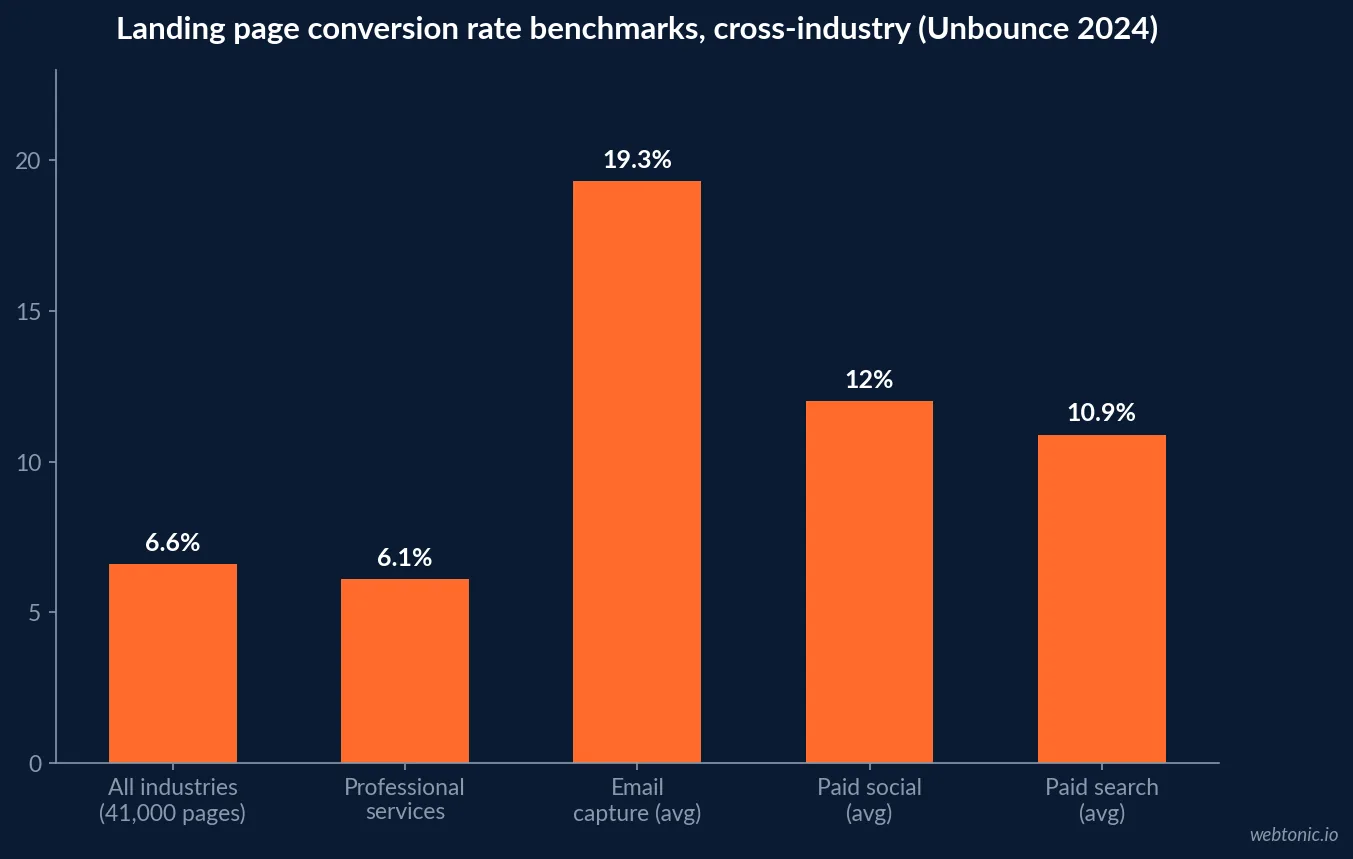
- Email capture converts at 19.3% on average, nearly double paid search landing pages at 10.9% and ahead of paid social at 12% (Unbounce, 2024).
- 9.74% is the average Google Ads conversion rate for Personal Services, the closest labeled WordStream category to funeral homes, against a 7.52% all-industry average (WordStream/LocaliQ, 2025 Google Ads Benchmarks, 16,000+ campaigns).
- Home & Home Improvement converts at 7.33%, also above the all-industry average, a second reasonable proxy category (WordStream/LocaliQ, 2025).
- $8,300 is the 2023 median cost of a funeral with viewing and burial, and $6,280 the median for cremation (NFDA, published 2025), the two figures a price-transparent landing page is deciding whether to show.
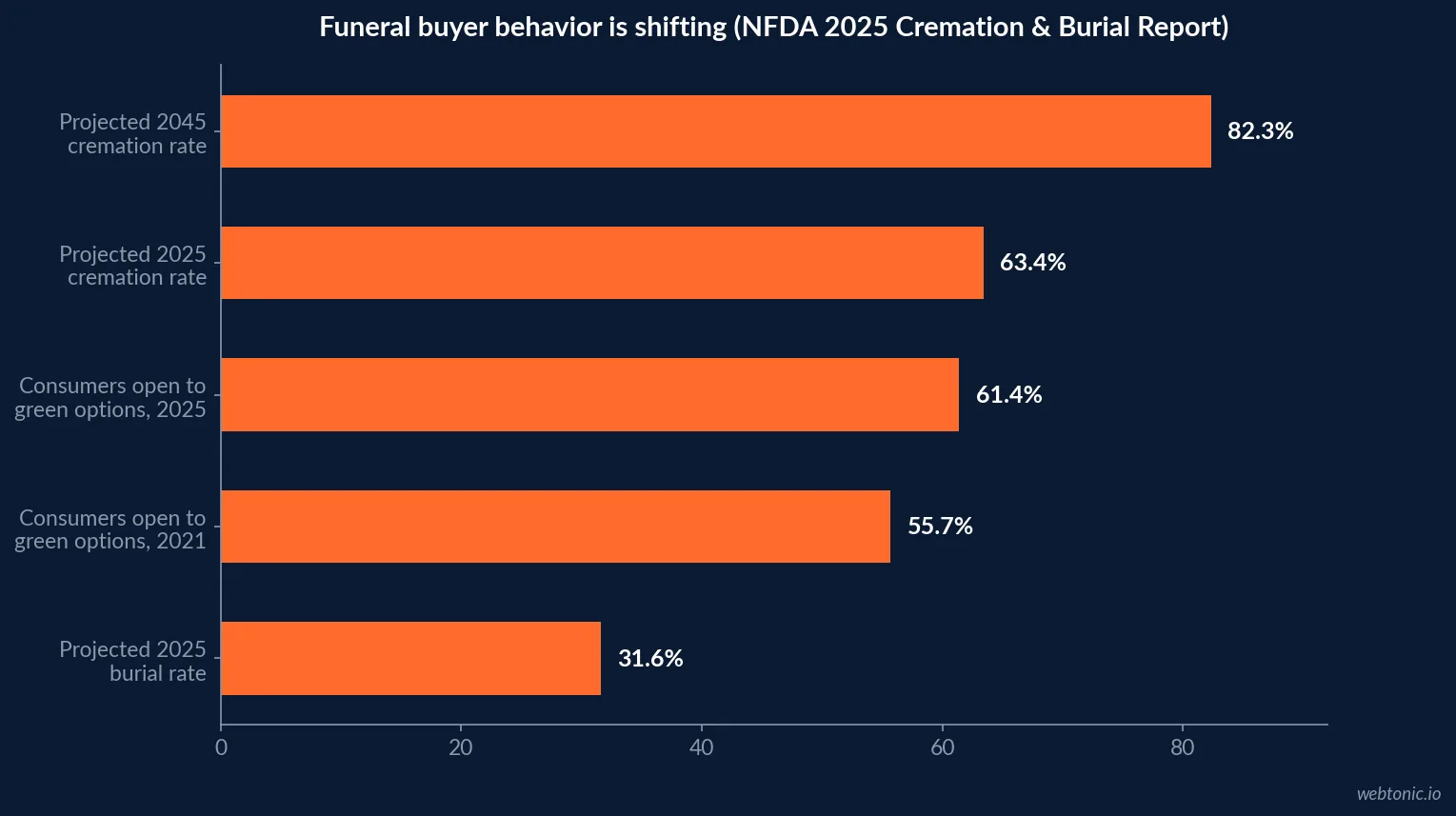
- 63.4% is the projected 2025 US cremation rate against 31.6% burial (NFDA, 2025 Cremation & Burial Report) - a page built only around a casket gallery is designing for the shrinking half of the market.
- The FTC's Funeral Rule (16 CFR 453) requires an itemized price list on request, in person or by phone, but commenters told the FTC's own 2022 rulemaking process that most providers still do not post that list online.
- 15,401 funeral homes operate in the US, and 75% are family- or privately-owned (NFDA, 2025), meaning most landing pages on this page's topic are built without an in-house CRO team.
- 61.4% of consumers are open to non-traditional (e.g. green) funeral options, up from 55.7% in 2021 (NFDA, 2025 Consumer Awareness and Preferences Report), evidence of a more research-driven, comparison-shopping buyer than the "call us, we'll explain" model most funeral landing pages still use.
Why funeral CRO has no dedicated benchmark, and what fills the gap
Unbounce's 2024 Conversion Benchmark Report, built from 41,000 landing pages, 464 million pageviews and 57 million conversions, covers nine labeled industries - SaaS, ecommerce, financial services, health and wellness, professional services among them - and funeral services is not one of the nine. That leaves two defensible substitutes: commercial and professional services (median 6.1%) as the closest category by buying behavior, and the 6.6% all-industry median as a floor. Every figure this page cites from Unbounce is labeled by which of those two buckets it falls into, never presented as a funeral-specific number.
| Landing page benchmark (cross-industry, Unbounce 2024) | Median conversion rate |
|---|---|
| All industries (41,000 pages) | 6.6% |
| Commercial & professional services | 6.1% |
| SaaS | 3.8% |
| Email opt-in / capture pages | 19.3% (average, not median) |
| Paid social landing pages | 12.0% (average) |
| Paid search landing pages | 10.9% (average) |
The FTC Funeral Rule sets the CRO ceiling before design does
The FTC's 16 CFR Part 453 Funeral Rule, in force since 1984, requires funeral providers to give an itemized General Price List to any consumer who asks in person or by phone. It does not yet require posting that list online. The FTC's own 2022 Advance Notice of Proposed Rulemaking states plainly that commenters "almost universally report that many funeral providers are not making their price lists available electronically or on their websites, even when requested by consumers," and the Commission held a public workshop in September 2023 examining whether to close that gap. As of this writing the amendment has not been finalized (tracked under RIN 3084-AB55), so a funeral landing page that omits pricing is compliant today, even though the regulator has signaled it may not stay that way.
That compliance floor matters for CRO because it removes the highest-friction design question - "do we have to show a price?" - and replaces it with a strategic one: does showing NFDA's published 2023 median figures ($8,300 viewing and burial, $6,280 cremation) build enough trust with a comparison-shopping visitor to outweigh the businesses that prefer a phone-first, price-on-request model most of the industry still runs today.
| FTC Funeral Rule (16 CFR 453) requirement | Status |
|---|---|
| Itemized price list given in person or by phone on request | Binding law since 1984 |
| Price list required to be posted online | Not finalized; under FTC review since 2022 ANPR |
| Public workshop on online disclosure amendment | Held September 7, 2023 |
| Commenter finding on current practice | “Many funeral providers are not making their price lists available electronically” (FTC ANPR) |
What the buyer looks like when they land on the page
The product a funeral landing page sells is split roughly along the line NFDA's 2025 Cremation and Burial Report tracks: a projected 63.4% of 2025 dispositions will be cremation against 31.6% burial, a gap NFDA expects to widen to 82.3% cremation by 2045. A page built around a casket selection gallery, still the default template for many funeral home sites, is optimizing for the minority, shrinking half of the buyer base. NFDA's companion 2025 Consumer Awareness and Preferences data adds that 61.4% of consumers are now open to non-traditional options like green burial, up from 55.7% in 2021, and 58.3% have already attended a funeral held at a non-traditional location - both signs of a more research-comparative visitor than the walk-in, decision-already-made buyer the industry's landing page templates were built for decades ago.
| NFDA 2025 buyer-behavior figure | Value |
|---|---|
| Projected 2025 US cremation rate | 63.4% |
| Projected 2025 US burial rate | 31.6% |
| Projected 2045 cremation rate | 82.3% |
| Consumers open to green/non-traditional options (2025) | 61.4%, up from 55.7% in 2021 |
| Consumers who attended a non-traditional-location funeral | 58.3% |
| Preference for cremated remains: buried/interred in a cemetery | 37.8% |
| Preference for cremated remains: kept in an urn at home | 37.1% |
Why most funeral businesses can't run a CRO program themselves
NFDA counts 15,401 funeral homes in the US, employing 105,300 people and generating $16.3 billion in revenue, with crematories and cemeteries adding a further $4.274 billion. Approximately 75% are family- or privately-owned, the same small-operator structure that shows up across home-service categories where dedicated CRO staff is rare. That structural fact is why this page treats Unbounce's professional-services and all-industry benchmarks as directional ceilings to test against, not targets a solo funeral director's marketing person is expected to hit without support: the businesses in Unbounce's 41,000-page dataset skew toward companies with a marketing function running continuous A/B tests, a resource most funeral homes do not have in-house.
| NFDA 2025 industry structure figure | Value |
|---|---|
| Funeral homes in the US | 15,401 |
| People employed | 105,300 |
| Share family- or privately-owned | ~75% |
| Funeral home revenue | USD 16.3 billion |
| Crematory and cemetery revenue | USD 4.274 billion |
Search traffic quality: which proxy category to benchmark against
WordStream/LocaliQ's 2025 Google Ads Benchmarks, drawn from over 16,000 US campaigns running April 2024 through March 2025, does not list funeral services as a standalone category either. The two closest labeled categories both convert above the 7.52% all-industry average: Personal Services at 9.74% and Home & Home Improvement at 7.33%. A funeral marketer running paid search should treat 9.74% as the more relevant target given the service-relationship nature of funeral arrangements, while noting the report's own caveat that these are cross-industry proxies, not a funeral-specific measurement.
| WordStream/LocaliQ 2025 Google Ads conversion rate benchmark | Rate |
|---|---|
| All-industry average | 7.52% |
| Personal Services (closest proxy) | 9.74% |
| Home & Home Improvement (secondary proxy) | 7.33% |
| Average CTR, all industries | 6.66% |
| Average CPC, all industries | USD 5.26 |
| Average CPL, all industries | USD 70.11 |
A CRO checklist built from what's actually verified
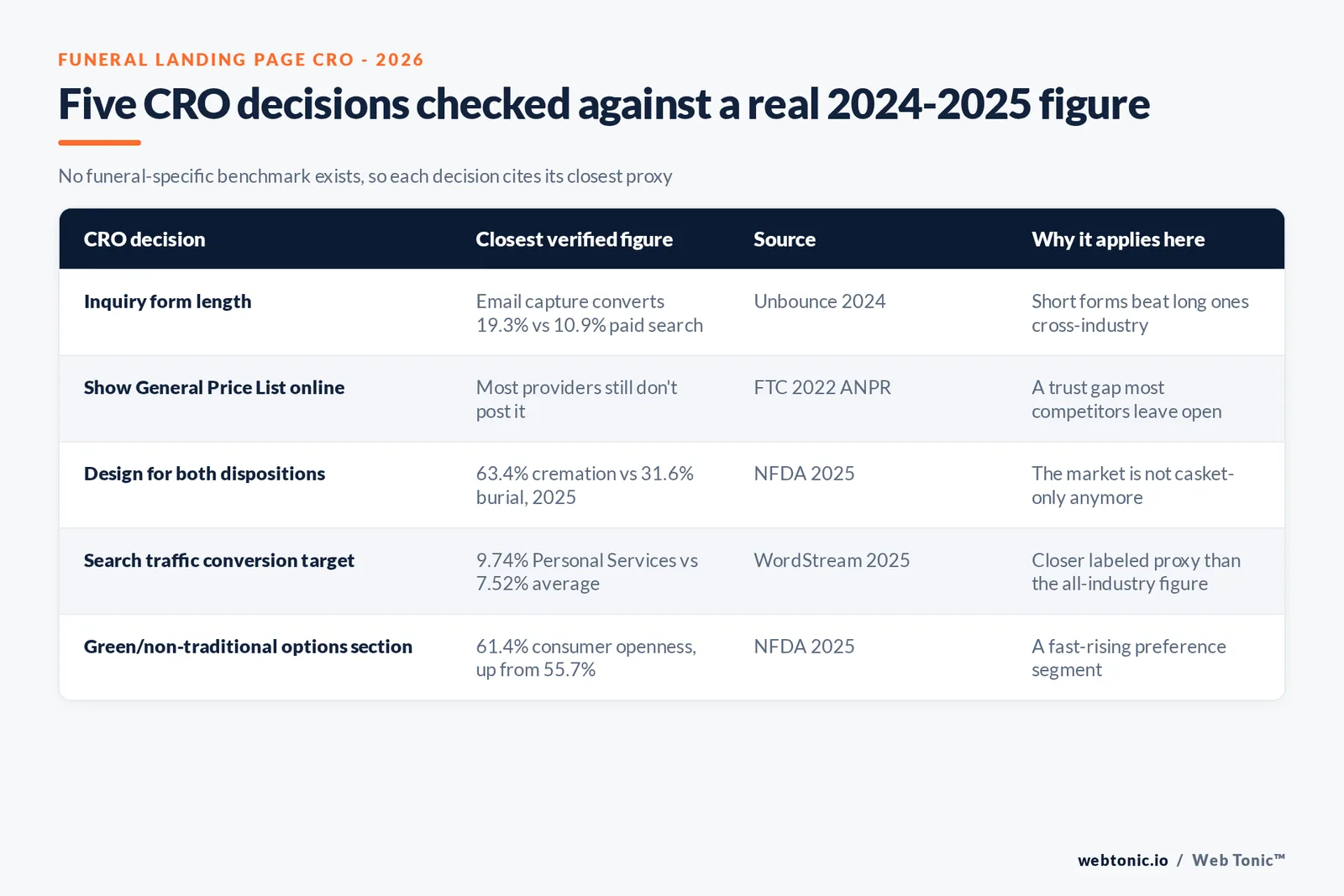
Given the absence of a funeral-specific benchmark, the defensible approach is to treat every cross-industry figure above as a hypothesis to test locally, not a target to hit blindly. Five checks follow directly from the sources above: keep the inquiry form to contact-only fields, since Unbounce's data shows short-form capture consistently outperforms longer transactional forms; decide deliberately whether to publish General Price List figures given the FTC's own finding that most competitors still don't; build the page around both disposition paths (burial and cremation) given NFDA's near-even 2025 split; and benchmark paid traffic against Personal Services' 9.74%, not the lower all-industry 7.52% average.
| CRO checklist item | Evidence it rests on |
|---|---|
| Keep the inquiry form to name, phone, and reason for contact | Email/short-form capture converts far above paid landing pages (Unbounce) |
| Decide explicitly on price transparency, don't default to hiding it | FTC found most competitors already hide it online (FTC 2022 ANPR) |
| Design equally for cremation and burial paths | 63.4% vs 31.6% 2025 split (NFDA) |
| Benchmark search conversion against 9.74%, not 7.52% | Personal Services is the closer WordStream proxy category |
| Add a green/non-traditional options section | 61.4% consumer openness, up from 55.7% in 2021 (NFDA) |
Where to go from here
Our growth marketing practice builds and tests landing pages against the closest verifiable proxy benchmark when no industry-specific figure exists, exactly the gap this page documents for funeral services. For the paid traffic that feeds these pages, our guide to what Google Ads actually costs in 2026 is a useful companion before setting a budget against the Personal Services benchmarks cited above, and our roundup of top email marketing partners is worth a look once the inquiry form above is converting, since email remains the highest-converting channel in Unbounce's own cross-industry data.
Frequently Asked Questions
What is a good landing page conversion rate for a funeral home?
No study publishes a funeral-specific landing page conversion rate. The closest cross-industry benchmark is Unbounce's 2024 Conversion Benchmark Report, built from 41,000 landing pages and 57 million conversions, which puts the median conversion rate at 6.6% across all industries and 6.1% specifically for commercial and professional services, the category closest to at-need funeral arrangements. Treat both as directional, not a funeral-industry figure.
Does the FTC Funeral Rule limit what a landing page can say?
Yes, directly. The FTC's Funeral Rule (16 CFR Part 453) requires funeral providers to give an itemized General Price List to anyone who asks, in person or by phone, and the FTC's own 2022 Advance Notice of Proposed Rulemaking states that commenters 'almost universally report that many funeral providers are not making their price lists available electronically or on their websites, even when requested by consumers.' The FTC has held public workshops on requiring online price disclosure but had not finalized that amendment as of this writing, so posting a price list online remains a voluntary trust signal, not yet a legal requirement, while the phone/in-person disclosure rule is binding today.
Should a funeral landing page show prices above the fold?
The evidence points toward yes as a trust signal, even though it is not yet mandatory online. NFDA's own 2025 Consumer Awareness and Preferences data shows 61.4% of consumers are open to non-traditional options like green burial, up from 55.7% in 2021, a sign that funeral consumers increasingly research and compare before contacting a provider, the exact behavior a hidden price list frustrates. The FTC's own commentary on underreported online price transparency supports the same conclusion from the regulatory side.
How long should a funeral home's inquiry form be?
No funeral-specific test exists, but the cross-industry logic from Unbounce's channel data still applies: email capture and short-form inquiries convert far above paid-traffic averages (19.3% average conversion for email versus 10.9% for paid search landing pages), so a funeral at-need or preneed inquiry form should ask for the minimum needed to start a phone conversation, not attempt to collect full arrangement details online.
What do search ad benchmarks suggest about funeral landing page traffic quality?
WordStream/LocaliQ's 2025 Google Ads Benchmarks report, based on over 16,000 US campaigns, found the broader Personal Services category converts at 9.74% and Home & Home Improvement at 7.33%, both above the 7.52% all-industry average. Funeral services is not broken out as its own category in that report, so a funeral marketer should benchmark against Personal Services as the closest labeled proxy, not assume the all-industry number applies unchanged.
Sources
Unbounce - 2024 Conversion Benchmark Report
FTC - Funeral Rule Advance Notice of Proposed Rulemaking (16 CFR 453)
Reginfo.gov - Funeral Rule rulemaking status, RIN 3084-AB55
NFDA - Statistics (2025 data)
WordStream/LocaliQ - 2025 Google Ads Benchmarks