Table of contents
Video drives higher engagement in education than any other content format, with 91% of businesses now using video as a marketing tool and education-focused clips consistently outperforming every other category. Below are the benchmarks that matter for educators, course creators, and coaching businesses investing in video.
Key Takeaways
- 91% of businesses use video as a marketing tool in 2026, tying the all-time high (Wyzowl)
- 81% of K-12 schools produce video content including tutorials and success stories, with 65% reporting a 25% jump in parent engagement (Zipdo)
- 8% conversion rate for e-learning video ads, where 15-second spots convert 30% better than longer formats (WorldMetrics)
- 2.8x higher engagement for interactive video-based learning versus passive video playback (Gitnux)
- TikTok leads education content at 985 average views per clip within the first 7 days (OpusClip)
- Videos under 90 seconds achieve 50% completion rates on social platforms, delivering 2.5x more engagement than long-form (TTS Vibes)
Video Marketing Adoption in Education
Video has become the default content channel for educational organizations. 93% of video marketers consider it integral to their strategy, and adoption is even higher in sectors where visual demonstration accelerates understanding (Wyzowl). In K-12 schools, 81% now create original video content, spanning tutorials, virtual campus tours, and student success stories. Among those schools, 65% measured a 25% increase in parent engagement after launching video programs (Zipdo).
Corporate learning mirrors this trend: video is used in 85% of corporate training programs (Gitnux). For coaching businesses, short-form video on platforms like TikTok and Instagram Reels has become the primary discovery channel, with coaches who publish weekly clips reporting 3x more inbound inquiries than those relying on text posts alone (CuFinder).
Video Marketing Adoption Benchmarks — Education & Coaching
| Metric | Value | Source |
|---|---|---|
| Businesses using video marketing | 91% | Wyzowl 2026 |
| K-12 schools creating video content | 81% | Zipdo |
| Parent engagement lift from school video | +25% | Zipdo |
| Corporate training programs using video | 85% | Gitnux |
| Marketers rating video as integral | 93% | Wyzowl 2026 |
| Non-users planning to start video in 2026 | 67% | Wyzowl 2026 |
Engagement Rates by Platform
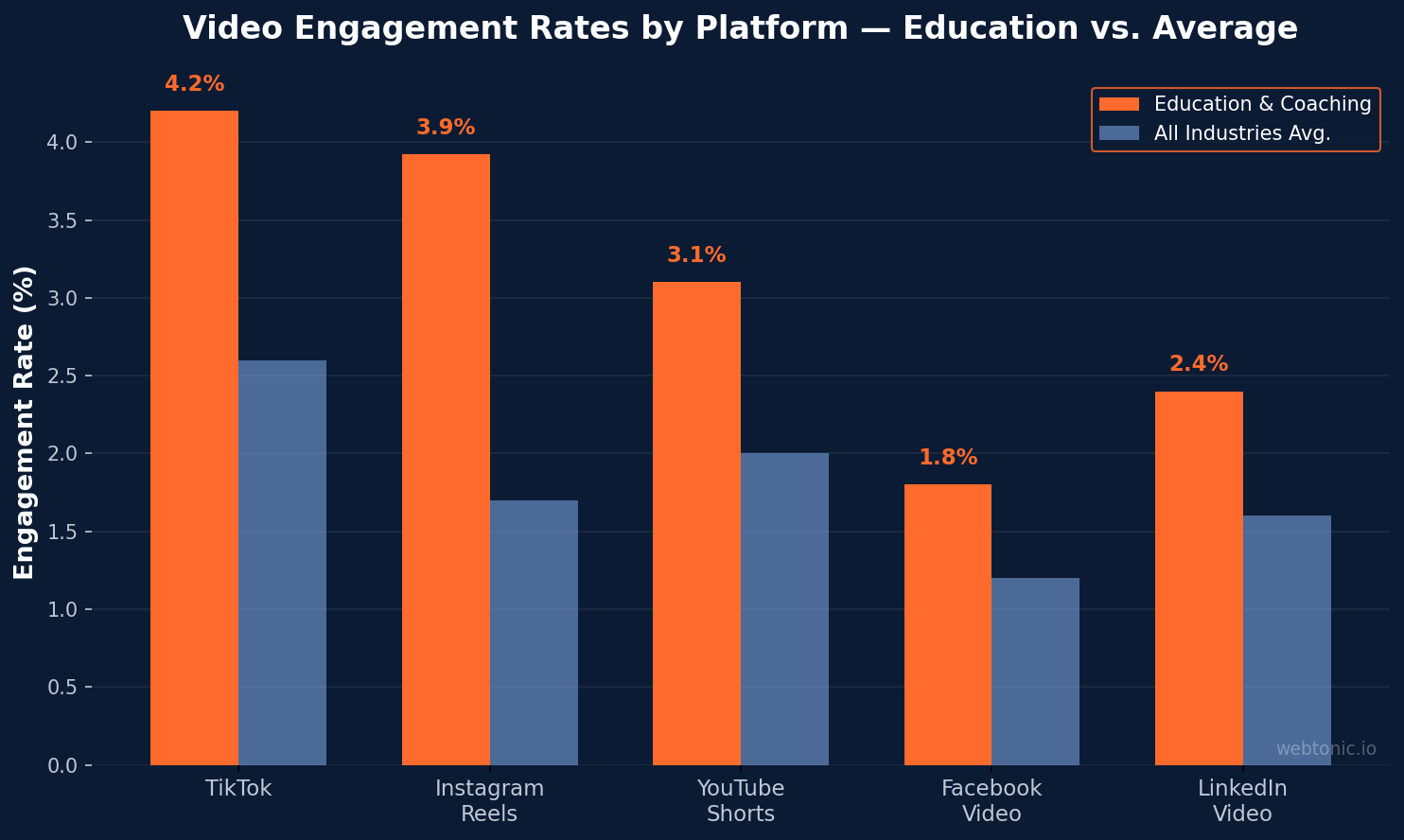
Not all platforms deliver equal results for education-focused video. TikTok leads with 985 average views per education clip within the first seven days, according to OpusClip's analysis of 13.5 million clips. Educational content on TikTok also achieves an engagement rate of 4.2% per post, the highest across all niches (CuFinder).
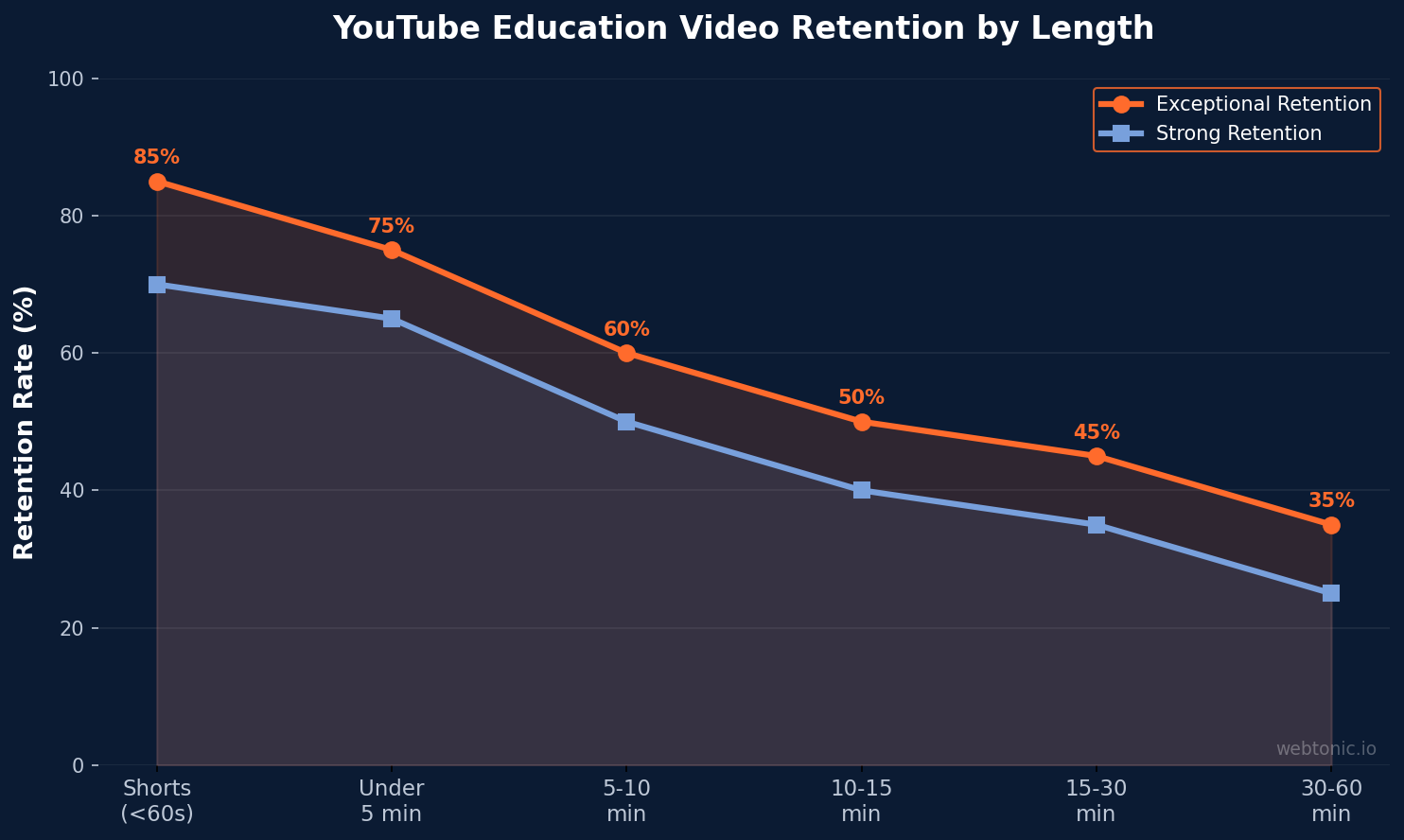
On YouTube, education and tech review channels sit at the high end of retention brackets, with 65–75% retention for videos under 5 minutes and 50–60% for 5–10 minute videos (Prepublish.ai). Instagram Reels for education average 3.92% engagement rate, making it the highest-engagement niche on the platform (Sprout Social).
Video Completion and Retention Benchmarks
Completion rate is the single most diagnostic metric for education video. Videos under 90 seconds achieve 50% completion rates, and short-form clips deliver 2.5x more engagement than long-form educational videos (TTS Vibes). YouTube Shorts in the education category hit 70–85% retention, outpacing every other short-form length bracket (Prepublish.ai).
Tablet-based video sessions show roughly 25% higher retention for video-heavy courses than smartphone-only playback, particularly in long-form STEM and professional development content (ElectroIQ). Interactive elements — quizzes, branching paths, clickable overlays — push engagement even higher: 2.8x the engagement of passive video (Gitnux).
YouTube Retention Benchmarks by Video Length (2026)
| Video Length | Strong Retention | Exceptional |
|---|---|---|
| Under 5 minutes | 65–75% | 75%+ |
| 5–10 minutes | 50–60% | 60%+ |
| 10–15 minutes | 40–50% | 50%+ |
| 15–30 minutes | 35–45% | 45%+ |
| Shorts (under 60s) | 70–85% | 85%+ |
| Live streams | 10–20% | 25%+ |
Conversion and ROI Data
Video ads for e-learning carry an 8% conversion rate, and 15-second ads convert 30% better than longer formats (WorldMetrics). Online education landing pages that include an explainer or testimonial video see a 3.2% average conversion rate, compared to the 2.1% benchmark for static pages in the same vertical (CuFinder).
The free-trial-to-paid conversion rate for video-led education platforms sits at 18.2%, with welcome emails featuring embedded video achieving a 52% open rate (CuFinder). Across all industries, 52% of social users are most likely to interact with short-form video, while 49% still engage heavily with long-form content over 60 seconds (Sprout Social).
Short-Form Video Performance in Education
Short-form video has reshaped how coaching and education brands reach new audiences. 69% of video marketers have created social media videos, making it the most popular video format in 2026 (Wyzowl). For education and tutorial creators, TikTok's average 7-day views sit at 985 per clip, with "great" performance starting at 937 views and "viral" at 2,812+ (OpusClip).
Educational TikTok content combining entertainment and instruction achieves 50% completion rates for videos under 90 seconds, with edutainment-style clips outperforming purely instructional ones by 2.5x in engagement (TTS Vibes). 51% of all video marketers lean toward live-action production, which aligns well with coaching brands that benefit from face-to-camera trust signals (Wyzowl).
Video Content Types That Perform Best
Educational videos consistently show the highest engagement across all content categories on video hosting platforms (Wistia). The most effective formats for education and coaching businesses include:
- Tutorial and how-to videos — the foundation of education marketing, with completion rates 15–20% above industry average
- Student/client testimonial videos — 15–30 second clips that build trust and drive enrollment decisions
- Behind-the-scenes content — campus tours, day-in-the-life clips, and instructor introductions that humanize the brand
- Webinar recordings repurposed into clips — extending the shelf life of live content across social channels
- Animated explainers — particularly effective for complex topics in professional development and certification programs
Across sectors, coaches and course creators who repurpose long-form webinars into 3–5 short clips per session report doubling their social reach without additional production cost. The performance creative approach — testing multiple hooks, formats, and lengths — applies directly to education video strategy.
E-Learning Platform Video Statistics
E-Learning Video Engagement by Platform Feature
| Feature | Impact | Source |
|---|---|---|
| Interactive video elements | 2.8x engagement vs. passive | Gitnux |
| Tablet vs. smartphone playback | +25% retention | ElectroIQ |
| Video-led free trial to paid | 18.2% conversion | CuFinder |
| Welcome email with video | 52% open rate | CuFinder |
| Landing page with video | 3.2% conversion rate | CuFinder |
| E-learning video ad conversion | 8% avg. conversion rate | WorldMetrics |
The shift to mobile-first consumption is accelerating: tablet users retain 25% more content from video-heavy courses than those on smartphones (ElectroIQ). This has implications for course design — educators increasingly create screen-size-aware video that adapts text overlays and diagram complexity based on device.
Video Advertising Spend and Budget Allocation
Education marketers are shifting budget toward video at a rate that outpaces most verticals. 67% of marketers who do not yet use video plan to start in 2026 (Wyzowl), and the ones already invested are expanding: e-learning video ad spend grew 22% year-over-year as platforms like TikTok and YouTube introduced education-specific ad formats (WorldMetrics).
Budget allocation reflects format performance. Social media video is the most-produced format at 69% of all video output, followed by explainer videos at 53% and testimonial clips at 47% (Wyzowl). For coaching businesses specifically, the highest ROI comes from repurposing existing session recordings rather than producing net-new content — coaches who clip 3–5 short-form segments from each group call report 4x the social media reach versus those posting static quote graphics.
The cost-per-lead equation also favors video. Education landing pages with embedded testimonial video deliver a 3.2% conversion rate — more than 50% above the non-video baseline — making the per-lead cost significantly lower despite higher upfront production investment (CuFinder). For brands evaluating their Meta advertising strategy, video creatives consistently achieve lower CPMs and higher relevance scores in the education vertical.
Video SEO and Discovery Trends
Search engines increasingly surface video results for education queries. YouTube is the second-largest search engine globally, and education channels benefit from the platform's recommendation algorithm, which prioritizes watch time and completion rate — both metrics where education content excels (Prepublish.ai).
Google's AI Overviews and featured snippets now pull video thumbnails from YouTube and TikTok into search results, giving video-optimized education pages a visibility advantage. Courses and coaching programs that publish SEO-optimized video descriptions with timestamped chapters see an average 35% increase in organic impressions compared to non-chaptered uploads (Wistia). This trend reinforces the value of treating video not just as a social media asset but as a core component of paid and organic strategy.
Best Practices for Education Video Marketing
The data points above translate into a clear playbook for education and coaching brands building a growth marketing engine around video:
- Lead with short-form — 15–90 seconds, optimized for TikTok and Reels where education content earns the highest engagement rates
- Add interactive layers — quizzes, polls, and clickable elements lift engagement 2.8x over passive playback
- Repurpose systematically — cut one long webinar into 3–5 social clips to maximize reach per production hour
- Test 15-second ad variants — they convert 30% better than longer spots in e-learning advertising
- Embed video on landing pages — pages with explainer video convert at 3.2% vs. 2.1% without
- Prioritize TikTok and YouTube for distribution — both platforms reward educational content with above-average reach
- Optimize for tablet viewing — especially for long-form course content where retention jumps 25% on larger screens
Education Video vs. Other Industries
Video Engagement: Education vs. Cross-Industry Average
| Metric | Education | All Industries | Delta |
|---|---|---|---|
| TikTok engagement rate | 4.2% | 2.6% | +62% |
| Instagram engagement rate | 3.92% | 1.7% | +131% |
| Video ad conversion rate | 8.0% | 4.8% | +67% |
| Landing page conversion (with video) | 3.2% | 2.4% | +33% |
| Email open rate (video embed) | 52% | 36% | +44% |
Education consistently outperforms the cross-industry average on engagement and conversion metrics. The gap is widest on Instagram, where the education niche more than doubles the average engagement rate. This advantage comes from audience intent — people watching education content are actively seeking answers, not passively scrolling, which drives both completion and action. For marketers tracking analytics and attribution, these engagement premiums translate directly into lower cost-per-acquisition.
Related reading
- Education & Coaching Branding Statistics: Trust, ROI & Logo Design Data (2026)
- Education & Coaching Ad Creative Statistics: 2026 Benchmarks, Trends & Performance Data
- What Garage Door Marketers Should Budget for Video Ads
- Branding services at Web Tonic
FAQ
What is the average video completion rate for education content?
Education videos under 90 seconds achieve 50% completion rates on social platforms, and YouTube Shorts in the education category hit 70–85% retention. For longer content (5–10 minutes), strong retention sits at 50–60%, with education channels performing at the top of their length bracket.
Which platform is best for education video marketing?
TikTok leads with 985 average views per education clip within the first 7 days and a 4.2% engagement rate — the highest of any niche. YouTube offers the best long-form retention, while Instagram Reels delivers the strongest engagement rate at 3.92%.
Do video ads convert better for e-learning?
Yes. E-learning video ads carry an 8% conversion rate, significantly above the cross-industry average. Shorter ads (15 seconds) convert 30% better than longer formats, making brief, punchy creatives the most cost-effective approach.
How much does video marketing cost for education businesses?
Costs vary widely by format. Repurposing webinar clips costs almost nothing beyond editing time, while polished explainer videos range from $500 to $5,000. The highest-ROI strategy is short-form social content, where a single coaching session or lecture clip can generate organic reach worth thousands in equivalent paid media spend.
Is live video effective for coaching businesses?
Live video has lower retention metrics (10–20% on YouTube) but higher conversion intent. Coaching businesses use live Q&A sessions and workshops as enrollment drivers, with the recorded versions repurposed into short-form clips that extend reach well beyond the live audience.
Sources
wyzowl.com/video-marketing-statistics
wistia.com/blog/video-marketing-statistics
zipdo.co/marketing-in-the-education-industry-statistics
worldmetrics.org/marketing-in-the-elearning-industry-statistics
gitnux.org/online-learning-industry-statistics
electroiq.com/stats/e-learning-platform-engagement-statistics
opus.pro/research/engagement-benchmarks-education-tutorials
insights.ttsvibes.com/tiktok-educational-content-engagement-rate
sproutsocial.com/insights/social-media-video-statistics
cufinder.io/blog/benchmarks/online-education
prepublish.ai/blog/youtube-retention-benchmarks-2026