Table of contents
No published study prices a garage door video ad budget as a line item, so this page builds the number rather than quoting a fabricated one. The inputs are Wyzowl's 2026 video marketing survey and Zonda's 2025 job economics for the category - both named, both dated, and both stated in full below.
Key Takeaways
- No study prices garage door video ad budgets directly - this is a model, not a quote.
- 91% of businesses use video as a marketing tool in 2026, cross-industry.
- 41% of marketers spent money on video ads this year, up from 36% last year.
- 46% of marketers cap video at a third or less of total marketing budget.
- 17% of marketers do not track their video spend at all.
- YouTube rates most effective at 69%, ahead of Instagram (56%) and Facebook (55%).
- LinkedIn rates 50% effective; TikTok rates only 29% effective.
- 85% of marketers say video helped generate leads.
- 83% say video directly increased sales.
- 82% call their video marketing ROI good.
- Garage door replacement is a USD 4,672 average job (Zonda 2025).
- That job returns USD 12,507 in resale value, a 267.7% ROI.
- Home and Home Improvement carries the 3rd-highest Google Ads CPC, USD 8.33.
- U.S. home improvement and repair spending is projected at USD 518 billion in 2026.
- The combined garage door market is sized at USD 19.6 billion in 2026.
- One consolidator, Guild Garage Group, exceeds USD 300 million in annual revenue.
Why there is no published number for this
Video ad budgets are typically surveyed as a share of total marketing spend, or by platform, not by home services vertical. Wyzowl's 2026 Video Marketing Statistics report - now in its 12th consecutive year, built from 266 respondents surveyed in late 2025 - is the closest thing to an authoritative cross-industry baseline, but it does not break results out by trade. Garage door and window companies have to adapt cross-industry adoption and effectiveness data to their own job economics, which is exactly what the model below does.
Treat every figure in this article as an input to your own number, not as a quote you can copy onto a media plan.
| Wyzowl 2026 finding | Figure | What it means for a video budget |
|---|---|---|
| Businesses using video | 91% | Video is now a baseline expectation, not a differentiator |
| Spent money on video ads this year | 41% | A minority but a growing one, up from 36% last year |
| Cap video at a third or less of budget | 46% | Most marketers treat video as a budget line, not the whole plan |
| Do not track video spend at all | 17% | A real risk of budget drift if this line item goes unmeasured |
| Plan to spend the same or more in 2026 | 92% | Budgets are not shrinking even where ROI is debated |
Which platform earns the first dollar
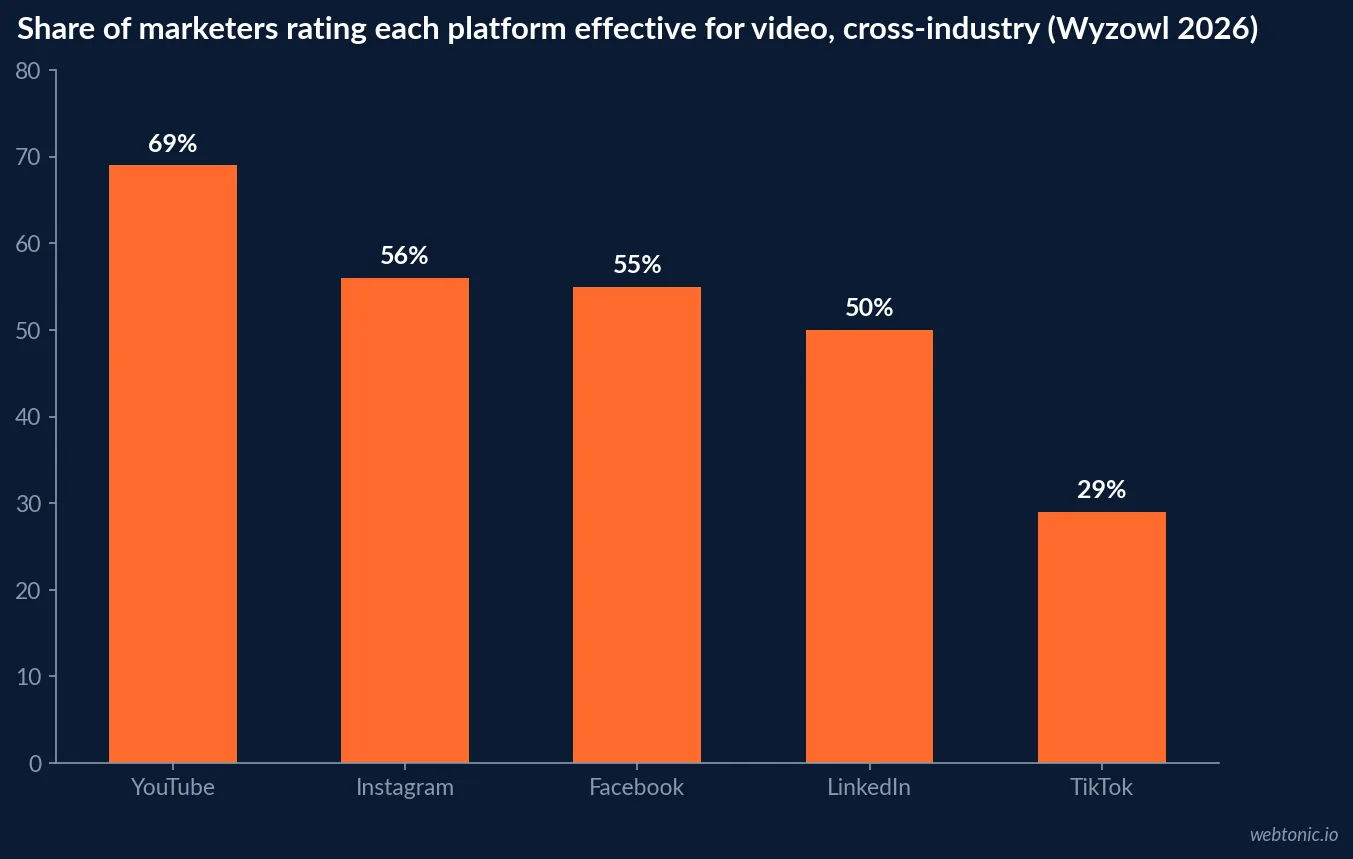
Wyzowl's respondents rate YouTube the single most effective video platform at 69%, ahead of Instagram (56%), Facebook (55%) and LinkedIn (50%). YouTube is also the most widely used platform for video distribution at 82% adoption. TikTok sits at the other end: 40% adoption but only 29% rated it effective, tied for the lowest tier alongside interactive video, X, VR and Snapchat.
None of these figures are garage-door-specific - they are marketer self-reports across all industries. But they argue for sequencing budget toward YouTube and Meta placements first and treating TikTok as a smaller, separate test rather than a co-equal channel from day one. This page focuses on the video-production budget question, not the media-buying question for any single platform.
| Platform (Wyzowl 2026, cross-industry) | Used for video marketing | Rated "effective" |
|---|---|---|
| YouTube | 82% | 69% |
| 69% | 56% | |
| 66% | 55% | |
| 70% | 50% | |
| Webinars | 56% | 42% |
| TikTok | 40% | 29% |
The job economics the budget is chasing
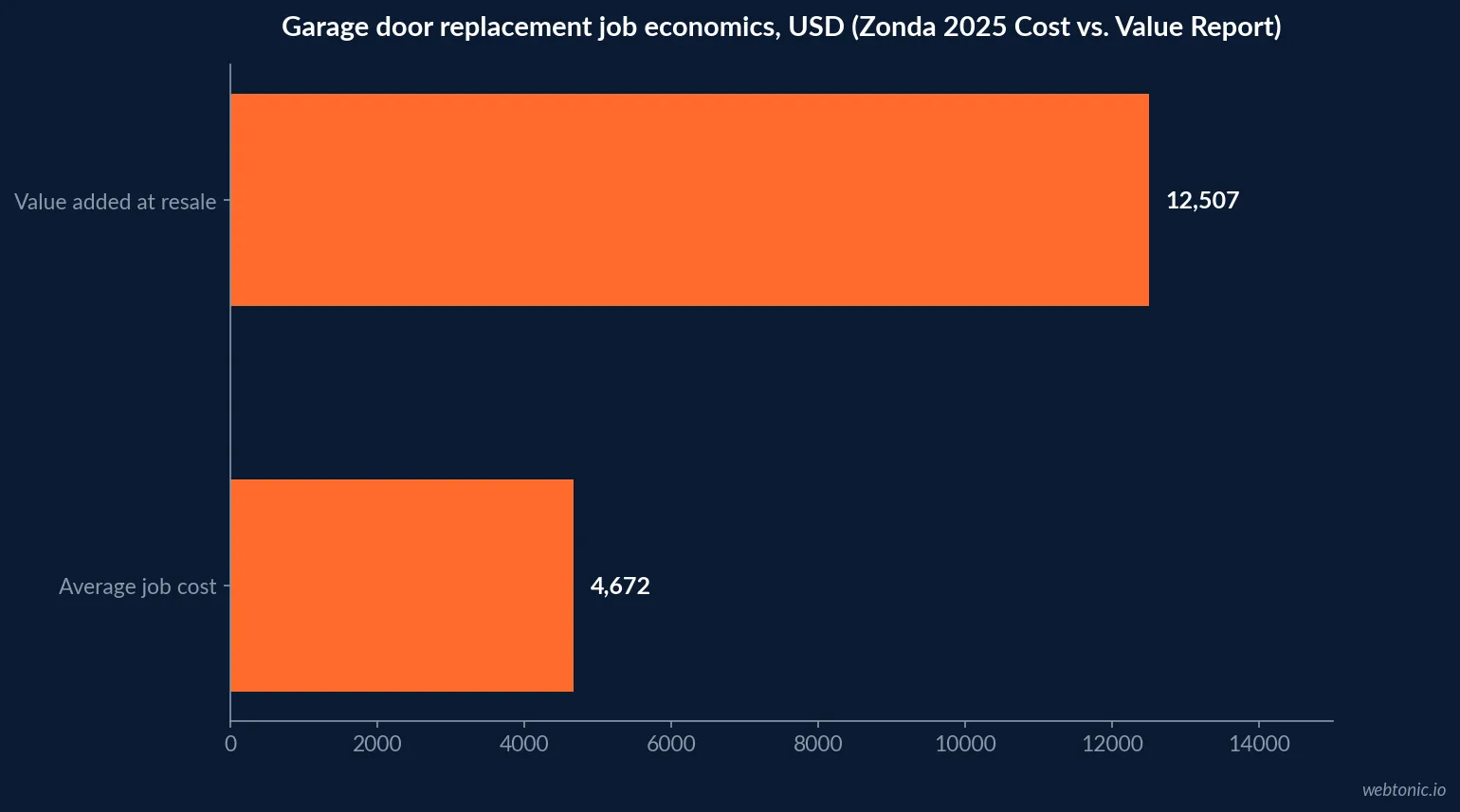
Zonda's 2025 Cost vs. Value Report puts the average garage door replacement job at USD 4,672, returning USD 12,507 in resale value - a 267.7% ROI, ranked the #1 exterior project measured for the second year running. That is a real number a video script can lead with instead of a generic "quality you can trust" line, and it is the anchor for the budget model below: if one additional closed job is worth roughly USD 4,672 in revenue, a monthly video budget that is a small fraction of one job's value is easy to defend even before measuring ROI directly.
| Model input | Figure | Source | Role in the budget model |
|---|---|---|---|
| Average job cost | USD 4,672 | Zonda 2025 Cost vs. Value Report | The revenue one video-influenced job is worth |
| Value added at resale | USD 12,507 | Zonda 2025 | The homeowner-facing ROI message |
| Home & Home Improvement Google Ads CPC | USD 8.33 | WordStream 2026 Google Ads Benchmarks | What the search channel already costs per click |
| All-industry average Google Ads CVR | 8.18% | WordStream 2026 | A cross-industry conversion baseline to sanity-check video-driven traffic against |
| 2026 U.S. remodeling and repair spend | USD 518 billion | Harvard JCHS LIRA, Jan 2026 (revised Apr 2026) | The macro budget pool this category competes for |
A defensible way to size the number
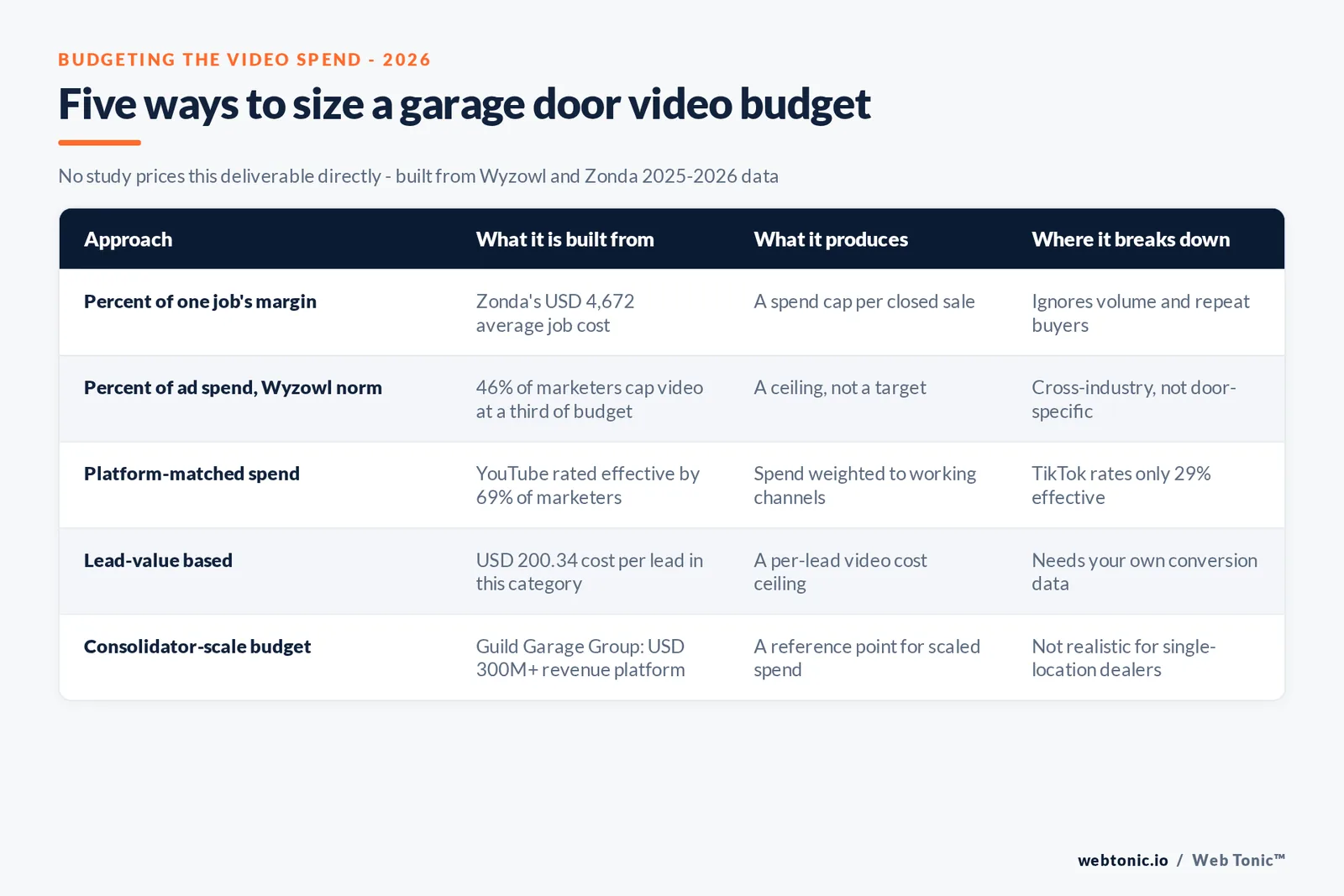
Start from Wyzowl's 46% finding that most marketers cap video at a third or less of total marketing spend, and apply it to whatever the business already spends on paid channels. Then check the result against the value of one job: if the proposed monthly video budget is a small single-digit percentage of one average job's USD 4,672 value, it is a defensible test spend even before any leads are attributed to it. If it exceeds several jobs' worth of revenue with no lead attribution in place, that is the 17% of marketers who do not track video spend at all - and the single most avoidable mistake in this exercise.
Review the result after 60 to 90 days against actual lead volume, not against the Wyzowl cross-industry ROI figures, which describe marketer sentiment rather than this category's attribution reality.
The market backdrop that sets the ceiling
Harvard's Joint Center for Housing Studies projects 2026 U.S. home improvement and repair spending at USD 518 billion, with year-over-year growth easing from 2.1% mid-year to 1.6% by year end - a slowing but still-growing pool of demand. Inside that pool, FMI Consulting's March 2026 brief sizes the garage door segment specifically at USD 19.6 billion, with consolidators like Guild Garage Group - more than 25 acquisitions, reportedly over USD 300 million in annual revenue - already competing for the same homeowner's attention.
A company setting its first real video budget is not just competing against other independents; it is increasingly competing against platforms with institutional marketing budgets. That argues for treating video as a genuine, ongoing budget line rather than a one-time campaign.
What the content itself should say
93% of Wyzowl's respondents say video increases brand awareness and helps audiences understand a product or service, and 63% of consumers say they would rather watch a short video than read an article to learn about a product. For a garage door or window company, that argues for video that shows the install and the ROI math side by side - the 267.7% return figure spoken on camera does more work than the same number printed in a caption. Our growth marketing team builds that kind of proof-led creative brief before a single dollar of media spend is committed, and our breakdown of what Meta ad budgets actually look like is a useful next read once the video assets exist and need a media plan.
Where to send the first test dollars
If the numbers above make a defensible case internally, the next step is a proof-of-concept video and a bounded media budget on the single most effective platform for this category, rather than spreading a first test thin across five channels. Our team scopes that kind of first test against the exact job economics covered here rather than a generic template.
The digital video ad market this budget competes inside
IAB's 2026 Digital Video Ad Spend & Strategy Report puts U.S. digital video ad spend - CTV, social video and online video combined - at more than USD 80 billion in 2026, growing 11% year over year, nearly 20% faster than the broader ad market. That is the pool of inventory and buyer competition a garage door company's video budget is entering, alongside far larger national advertisers. It argues for a narrow, well-targeted local buy rather than trying to outspend that market on reach.
Growth at that scale also means video inventory and targeting tools keep improving faster than most other formats, which is a reason to keep testing rather than writing video off after one underperforming campaign.
| Digital video ad market fact (2026) | Figure | Source |
|---|---|---|
| U.S. digital video ad spend | USD 80 billion+ | IAB |
| Year-over-year growth | 11% | IAB |
| Growth vs. total ad market | Nearly 20% faster | IAB |
| Businesses using video as a marketing tool | 91% | Wyzowl 2026 |
Setting a review cadence, not a set-and-forget number
Whatever number the model above produces, treat it as a starting bid, not a annual commitment. Wyzowl's finding that 17% of marketers do not track video spend at all is the single biggest risk in this exercise - a budget with no attribution attached cannot be defended at renewal time regardless of how it was sized. Set a 60- to 90-day review against actual lead volume before increasing spend, and be willing to shift budget between YouTube, Meta and any other tested platform based on the effectiveness data in this article rather than habit.
Frequently Asked Questions
How much should a garage door company spend on video ads?
No published study prices this specific line item, so the honest answer is a model, not a quote. Wyzowl's 2026 survey finds 46% of video marketers cap video at a third or less of their overall marketing budget, and 41% of marketers spent money on video ads this year. Applied against Zonda's USD 4,672 average garage door job cost, a defensible starting range is the cost of producing and running enough video to influence a handful of jobs a month, reviewed against actual lead volume after 60 to 90 days rather than set once and left alone.
Which platform should the budget go to first?
Wyzowl's 2026 data rates YouTube the most effective video platform, with 69% of marketers calling it effective, ahead of Instagram (56%), Facebook (55%) and LinkedIn (50%). TikTok trails at 29%, tied for least effective alongside interactive video and X. That is a cross-industry rating, not a garage-door-specific one, but it argues for testing YouTube and Meta placements before allocating meaningful budget to TikTok.
Does video ad spend actually change close rates for a considered purchase like this?
Wyzowl's 2026 respondents report video helped generate leads for 85% of them and directly increased sales for 83%, with 82% calling their video ROI good. Those figures are cross-industry marketer self-reports, not audited garage door data, but they support treating video as a mid-funnel trust builder for a four-figure purchase rather than a pure top-of-funnel awareness spend.
What is the return the budget is chasing?
Zonda's 2025 Cost vs. Value Report found garage door replacement returned 267.7% of its cost at resale - a USD 4,672 job returning USD 12,507 in value, the #1 ranked exterior project. That ROI story is the actual message video content should be carrying, since it is a real, sourced number most competitors are not using in their creative.
Is the market big enough to justify ongoing video production, not just one campaign?
FMI Consulting's March 2026 sector brief sizes the combined U.S. garage door market at USD 19.6 billion, spread across 114 million installed doors, with more than 10 private-equity-backed platforms formed since 2022. Guild Garage Group alone has completed more than 25 acquisitions and is reported at over USD 300 million in annual revenue. Consolidators at that scale are very likely already running always-on video programs, which raises the bar for what an independent's one-off campaign has to compete against.
Sources
Wyzowl - Video Marketing Statistics 2026
Zonda Media - 2025 Cost vs. Value Report
Harvard Joint Center for Housing Studies - Leading Indicator of Remodeling Activity, Jan/Apr 2026
WordStream - 2026 Google Ads Benchmarks
FMI Consulting - Private Equity Sector Brief: Overhead & Garage Door Services, March 2026
International Door Association - Membership types
IAB - 2026 Digital Video Ad Spend & Strategy Report