



Table of contents
Tutoring centers ranking in the top three Google Maps positions generate inquiry rates roughly double those in positions four through seven. Local search is the dominant discovery channel for education services — most parents begin with a Google or Maps query before contacting any provider.
Key Takeaways
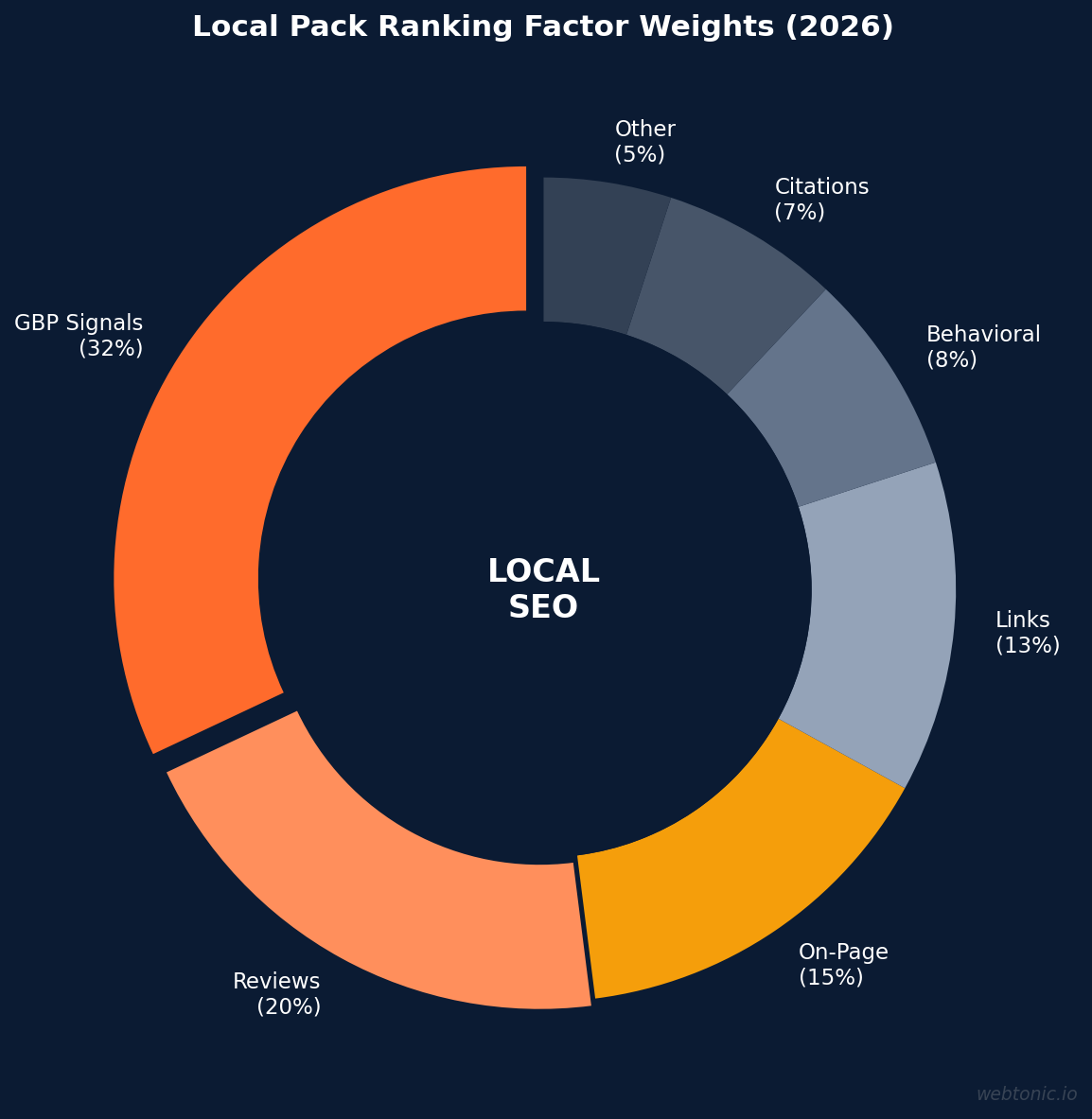
- Google Business Profile signals drive 32% of local pack rankings, with reviews at 20% and website signals at 15% (Whitespark 2026 Local Search Ranking Factors).
- Top-3 map pack positions generate 2× more inquiries than positions 4–7 for tutoring centers (Authority Specialist, 34 centers).
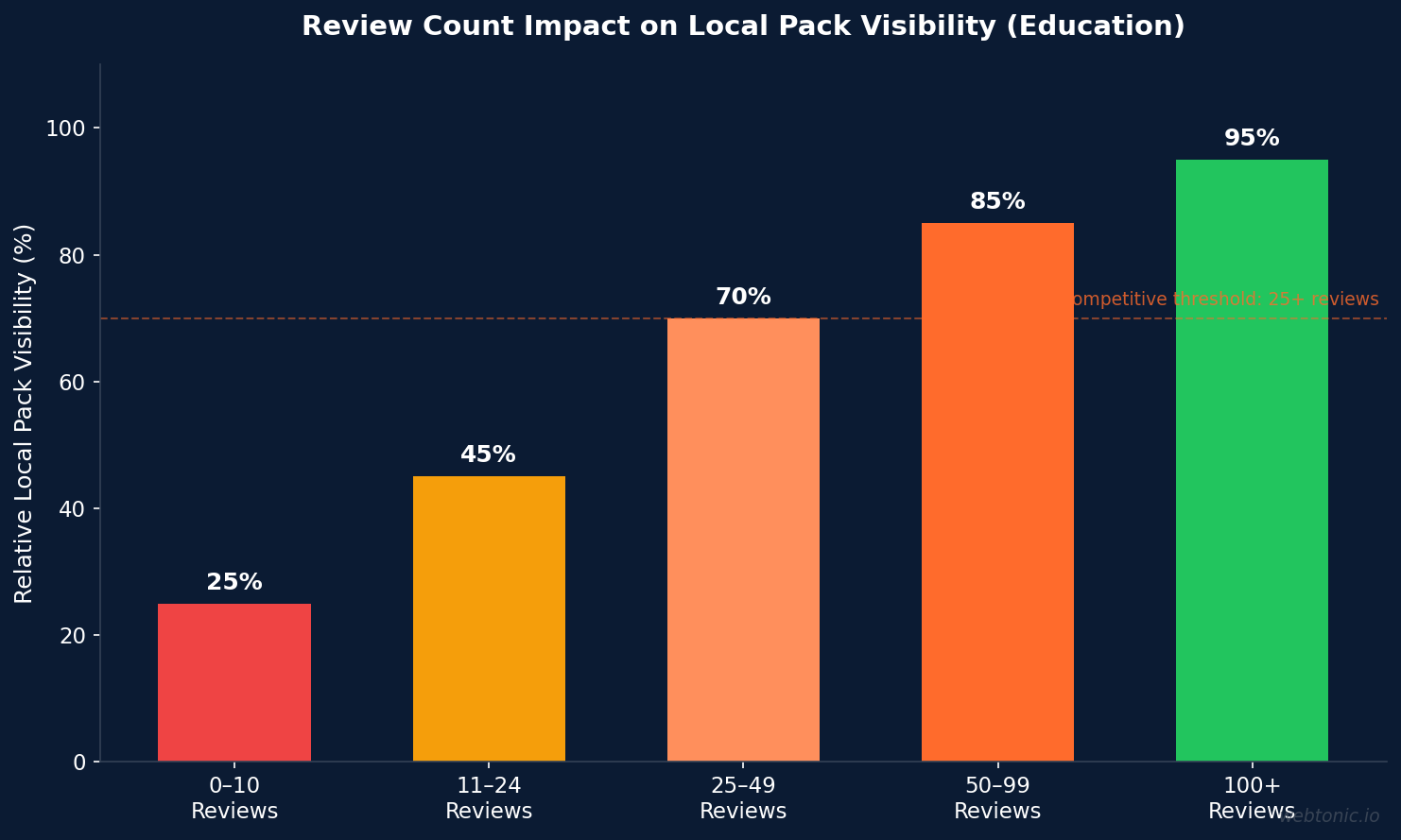
- Centers with fewer than 25 GBP reviews consistently underperform on local pack rankings regardless of on-page optimization quality.
- 74% of consumers look for reviews written in the last 3 months — recency now beats raw review volume for local rankings.
- Less than 40% of schools in benchmark datasets have optimized local content to capture "near me" and location-modified search intent.
- Mobile devices drive the majority of local education searches, making page speed and mobile UX direct ranking and conversion factors.
- Most tutoring centers compete in a 5–10 mile service radius, making hyper-local SEO more impactful than broad regional campaigns.
Local Pack Ranking Factors for Education Businesses
Google's local pack algorithm weighs several signal categories differently. For education providers building a growth marketing strategy, understanding which signals move the needle most is critical for resource allocation.
Source: Whitespark 2026 Local Search Ranking Factors (47 practitioners surveyed)
| Ranking Signal Category | Weight (2026) | Key Factors | Education Relevance |
|---|---|---|---|
| Google Business Profile signals | ~32% | Categories, NAP, hours, description | Foundational — most impactful |
| Review signals | ~20% | Count, rating, recency, response rate | Critical for parent trust |
| On-page / website signals | ~15% | Schema, mobile speed, local content | Program pages drive intent match |
| Link signals | ~13% | Local backlinks, .edu domains, citations | Partnerships with schools/orgs |
| Behavioral signals | ~8% | CTR, dwell time, driving directions | Map pack engagement |
| Citation signals | ~7% | NAP consistency, directory presence | Education directories matter |
| Personalization | ~5% | Proximity, search history, device | Proximity dominates for tutoring |
Google Business Profile signals carry the most weight at approximately 32%, which is why the first hours of any local SEO effort should focus on profile completion rather than backlink acquisition or technical optimization. Eight of the top ten local pack factors come directly from the GBP itself. For coaching businesses operating from a physical location, ensuring accurate categories, service areas, hours, and a complete description is the fastest path to visibility in Google Ads services results.
Review Statistics and Their Impact on Local Rankings
Reviews are the second most influential local ranking signal and the primary trust mechanism for parents and students evaluating education providers. The data reveals specific thresholds that separate visible businesses from invisible ones.
- Centers with fewer than 25 Google reviews consistently underperform on local pack rankings regardless of other optimization efforts (Authority Specialist, 34 tutoring centers).
- Review recency now beats raw volume as a ranking signal. A steady trickle of new reviews outranks a large pile that stopped two years ago (Whitespark, Darren Shaw).
- 74% of consumers specifically look for reviews written in the last 3 months, making ongoing review acquisition essential for visibility.
- Star rating gates the click — a growing share of searchers skip anything under 4.5 stars. The threshold for education services is particularly high given the trust required.
- Businesses that reply to most of their reviews see a measurable ranking lift. Response rate itself functions as a ranking signal in Google's local algorithm.
- Review velocity of 3–5 new reviews per month is the minimum threshold for maintaining local pack visibility in competitive education markets.
Local SEO Benchmarks by Education Sub-Vertical
Different education businesses face different local competitive landscapes. Tutoring centers and private schools compete in tight geographic radii, while coaching businesses often serve broader areas. Investing in Google Ads strategy tips alongside local SEO helps education providers understand which channels drive the most qualified enrollments.
Sources: Authority Specialist 2026; BrightLocal Local Consumer Survey
| Sub-Vertical | Typical Service Radius | Avg. GBP Reviews | Map Pack Competitiveness | Key Local Queries |
|---|---|---|---|---|
| Tutoring centers | 5–10 miles | 15–50 | High | "tutoring near me", "math tutor [city]" |
| Private / independent schools | 10–20 miles | 20–80 | Medium-High | "private school near me", "K-8 school [area]" |
| Test prep services | 10–15 miles | 10–40 | Medium | "SAT prep [city]", "ACT tutoring near me" |
| Life / executive coaching | City-wide or virtual | 5–25 | Low-Medium | "life coach [city]", "executive coach near me" |
| Music / art schools | 5–10 miles | 15–60 | Medium | "piano lessons near me", "art classes [city]" |
| Language schools | 10–15 miles | 20–70 | Medium-High | "ESL classes near me", "French lessons [city]" |
| Driving schools | 5–15 miles | 30–100+ | High | "driving school near me", "driver's ed [city]" |
Tutoring centers compete in the tightest geographic radius (5–10 miles), making hyper-local optimization essential. Most parents search for nearby options during school pickup or between activities, driving mobile-first behavior. Private schools draw from wider radii (10–20 miles) and face lower direct competition but need stronger content depth across program pages to capture varied search intents. Life and executive coaches face the lowest map pack competition but also the lowest review volumes, creating an opportunity for coaches with 25+ genuine reviews to dominate their local market quickly.
Mobile Search and "Near Me" Query Trends
"Near me" and location-modified searches dominate how families discover education services. These queries signal high purchase intent and convert at rates well above generic informational searches. Businesses tracking these patterns through data intelligence tools can optimize their local content for seasonal peaks.
- Mobile devices drive the majority of tutoring-related searches. Industry-wide, mobile accounts for over 60% of local service searches, and education follows this pattern closely.
- "Near me" and location-modified queries represent a large share of discovery-stage volume for tutoring, test prep, and music/art education services.
- Enrollment-related searches peak in January–April and July–August, aligning with spring enrollment seasons and pre-school-year decision-making.
- Voice search queries for education services average 6–8 words, compared to 2–3 words for typed searches. Optimizing for conversational long-tail queries captures this growing segment.
- Parents conduct 2–4 searches before submitting an inquiry, meaning content depth across subject and grade-level pages directly influences conversion, not just traffic.
- Page speed is a direct local ranking factor — Google Core Web Vitals thresholds (LCP under 2.5s, CLS under 0.1) separate the top local results from page-two obscurity.
Google Business Profile Optimization for Education Providers
Profile completeness directly correlates with local pack positioning. The following data points highlight the most impactful GBP elements for education businesses seeking to leverage Meta advertising campaigns alongside organic local visibility.
Sources: Whitespark 2026; BrightLocal; DIY Genius (Local SEO for Coaches)
| GBP Element | Impact on Ranking | Completion Rate (Education) | Best Practice |
|---|---|---|---|
| Primary category | Very High | 95%+ | Choose most specific: "Tutoring Service" over "Education" |
| Business hours (accurate) | #5 most important factor | 70–80% | Update for holidays, breaks; being "open" at search time matters |
| Reviews (25+ with 4.5+ stars) | Critical threshold | 45–55% | 3–5 new reviews per month; respond to all |
| Service area / radius | High for SABs | 60–70% | List zip codes within 2-hour drive |
| Business description (750 chars) | Medium | 50–60% | Include service keywords naturally |
| Photos (10+ quality images) | Medium-High | 35–45% | Facility, team, sessions; refreshed quarterly |
| Q&A section (populated) | Low-Medium | 15–25% | Pre-populate with common parent questions |
| Posts (weekly updates) | Low-Medium | 20–30% | Share student wins, schedule changes, tips |
Accurate business hours rank as the fifth most important local pack factor in Whitespark's 2026 report. If a tutoring center or coaching practice lists hours that show "closed" when a parent searches on a Sunday evening, Google may quietly deprioritize that listing in favor of a competitor showing "open." For education businesses, this means updating hours for holiday breaks, summer schedules, and exam-season extended hours is not optional — it directly impacts visibility. NAP (Name, Address, Phone) consistency across all directories remains foundational: "Suite 4" on one site and "#4" on another is enough to dilute citation signals.
Citation and Local Link Building Data
Citations and local backlinks together account for roughly 20% of local pack ranking factors. For education providers, the right directories and local partnerships can accelerate map pack visibility significantly.
- NAP consistency across directories is a foundational local SEO signal. Discrepancies between listing name, address, or phone number across platforms dilute ranking signals.
- Education-specific directories (GreatSchools, Niche, PrivateSchoolReview) carry more weight than generic business directories for school-related searches.
- Local newspaper and community site backlinks are among the most valuable link types for local pack rankings, often outweighing high-DR national links for geo-specific queries.
- Partnerships with local organizations (PTAs, youth sports leagues, community centers) generate both citations and referral traffic that reinforces local relevance signals.
- Fewer than 40% of schools in benchmark datasets had optimized local content to capture location-modified search intent (Authority Specialist, 41 schools) — a significant opportunity gap.
- Structured data (LocalBusiness schema) adoption among education providers remains below 30%, despite its proven impact on rich result eligibility and click-through rates.
Seasonal Trends and Local SEO Timing Data
Education-related local searches follow distinct seasonal patterns that directly impact when optimization efforts deliver the highest returns. Aligning local SEO activity with these patterns maximizes visibility during peak enrollment windows.
January through April represents the primary enrollment search season for most education sub-verticals. Private school searches peak in February and March as families finalize decisions for the following school year. Tutoring searches spike in September and January, coinciding with the start of new academic terms when parents identify achievement gaps. Test prep searches concentrate in January–March (SAT/ACT spring testing) and August–October (fall testing windows).
Schools that optimize seasonal landing pages 4–6 weeks before search peaks see click-through rates 25–40% higher than those making last-minute changes. Creating dedicated "open house" and "enrollment deadline" pages indexed in advance of peak season gives Google time to crawl, index, and position these pages before search demand arrives. The same principle applies to coaching businesses offering quarterly cohort programs — publishing program-specific landing pages 6 weeks before enrollment opens captures early-intent searchers who represent the highest-quality leads.
Related reading
- Education & Coaching SEO Statistics (2026): Benchmarks & Trends
- Education & Coaching Industry × Technical SEO: The 2026 Statistics You Need
- HVAC Local SEO Statistics: Map Pack, Reviews & ROI Data (2026)
- Local SEO Services services at Web Tonic
Frequently Asked Questions
How important is local SEO for tutoring businesses?
Local SEO is the dominant discovery channel for tutoring services. Most parents start with a Google or Maps search, and centers in the top 3 map pack positions generate inquiry rates double those in positions 4–7. For a business operating within a 5–10 mile radius, local SEO delivers higher sustained enrollment volume than paid advertising.
How many Google reviews does an education business need?
The minimum threshold is 25 reviews. Centers with fewer than 25 reviews consistently underperform on local pack rankings regardless of other optimization efforts. However, review recency matters as much as volume — 74% of consumers look for reviews from the last 3 months, so maintaining a velocity of 3–5 new reviews per month is essential.
Can coaching businesses that work virtually benefit from local SEO?
Yes, but with caveats. Coaches who meet clients in person qualify for a standard GBP listing. Virtual-only coaches can set up a service-area business (SAB) profile listing the zip codes they serve. However, a purely online coaching model without any in-person component risks GBP suspension. The local competition for coaching is lower than tutoring, meaning even a basic optimized profile can generate meaningful visibility.
What is the most important local ranking factor for education providers?
Google Business Profile signals account for approximately 32% of local pack rankings, making them the single most impactful factor. Within GBP, the primary category selection, accurate hours, and review volume/recency carry the most weight. Eight of the top ten local pack ranking factors come directly from the profile itself.
Sources
Authority Specialist — Tutoring Center SEO Benchmarks 2026
Authority Specialist — School SEO Benchmarks 2026
DIY Genius — Local SEO for Coaches 2026
Searchlab — Link Building Statistics 2026
CuFinder — Online Education Marketing Benchmarks 2026
Benchmarketing — Executive Coaching Marketing Benchmarks 2026


